


- White Label Simplifies Launch: A white label VPN business lets you launch a fully branded VPN service without building or managing infrastructure, reducing time, cost, and complexity.
- Provider Selection: Choosing the right provider is critical; evaluate global server coverage, protocol support, app rebranding options, API/SDK access, and security practices.
- Launch Steps: Launching involves setting up branded apps, configuring servers, integrating backend management tools, testing for performance, and planning your go-to-market strategy.
- Operational Responsibilities: Operational responsibilities like customer support, billing, user education, and monitoring performance remain with your organization and impact retention and revenue.
- Pricing Flexibility: Tiered subscription pricing, add-ons such as Dedicated IPs, and scalable plans allow for flexible monetization and recurring revenue growth.
Launching a VPN in-house sounds straightforward on paper, but the reality is complex: global server deployments, encryption protocol maintenance, cross-platform client apps, and 24/7 network monitoring. For you, that complexity can stall product expansion and block new revenue streams.
A white label VPN business removes those barriers. It lets you deliver a fully branded VPN service without building or managing infrastructure, while keeping technical control and operational oversight.
This guide walks through how the model works, the build versus buy decision, and the practical steps for launching a scalable VPN offering efficiently.
Understanding White Label VPN Business
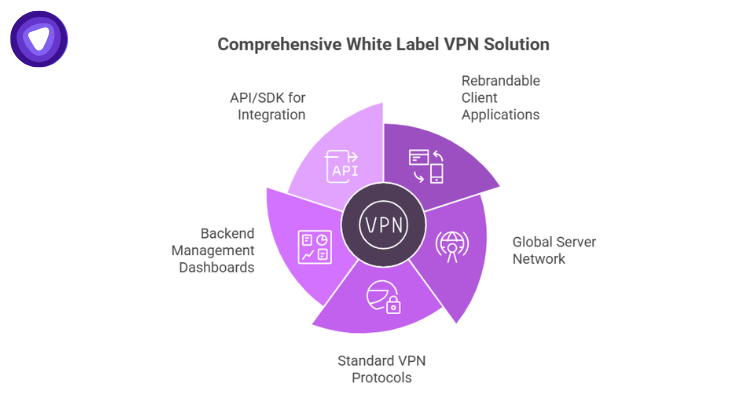
A white label VPN business lets an organization sell a VPN service under its own brand while the underlying infrastructure, applications, and protocols are maintained by a specialized provider.
Compared with building your own VPN network from scratch, white labeling reduces capital outlay, shortens time to market, and allows you to focus on branding, customer acquisition, pricing, and support.
White label implementations generally include:
- Rebrandable client applications (mobile, desktop)
- Access to a global server network
- Standard VPN protocols (e.g. WireGuard, OpenVPN, IKEv2)
- Backend management dashboards
- API and SDK for integration
This structure is ideal for businesses that want their own VPN product without assuming heavy technical development or server operations.
Read more on what a White Label VPN Business really is.
VPN Market Reality: Verified Growth Trends
Before exploring how to start, understanding the market context is important.
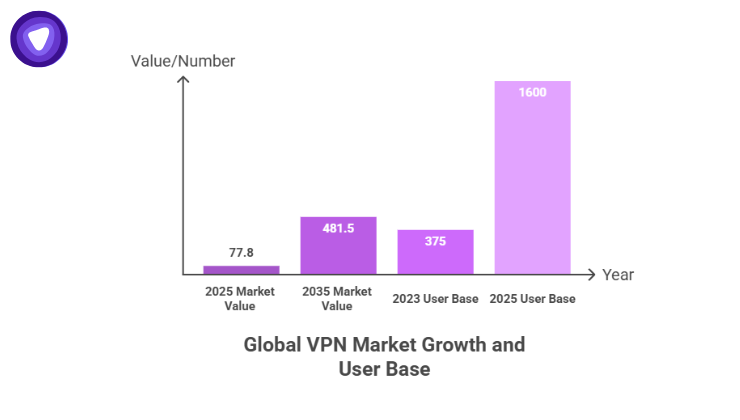
According to recent industry data, the global VPN market is expected to reach significant scale by 2025, with several estimates pointing to multi-billion dollar value. One source forecasts the market at $77.8 billion in 2025 with continued acceleration toward $481.5 billion by 2035.
VPN usage has also expanded dramatically in recent years. A recent market report shows 375 million VPN users in 2023, up 68 percent from 2019.
Another research report cites over 1.6 billion people using VPNs globally as of 2025.
These figures indicate that VPNs have become mainstream tools for online privacy, secure access, and content usage.
Build vs Buy: Strategic Decision Framework
Before launching a white label VPN business, you must decide whether to build infrastructure internally or buy through a white label provider.
This is a capital, time, and risk decision.
| Factor | White Label VPN | Build Your Own VPN |
| Time to Launch | 1–2 weeks | 4–6 months minimum |
| Dev Skills Needed | Minimal / None | Advanced engineering required |
| Infrastructure | Included | You manage global servers, bandwidth, and redundancy |
| Server Costs | Bundled in fees | $5–$15 per server per month (multiple servers required) |
| App Stores | Pre-approved and rebrandable | Manual testing, submissions, rejection risk |
| Patches & Upgrades | Handled by provider | Your responsibility, ongoing |
| Compliance Help | Typically provided | On your own |
| Cost to Start | $500–$2,000 per month | $10,000+ upfront minimum |
| Operational Risk | Shared with provider | Fully internal, high risk |
Core Technical Components of a White Label VPN Business
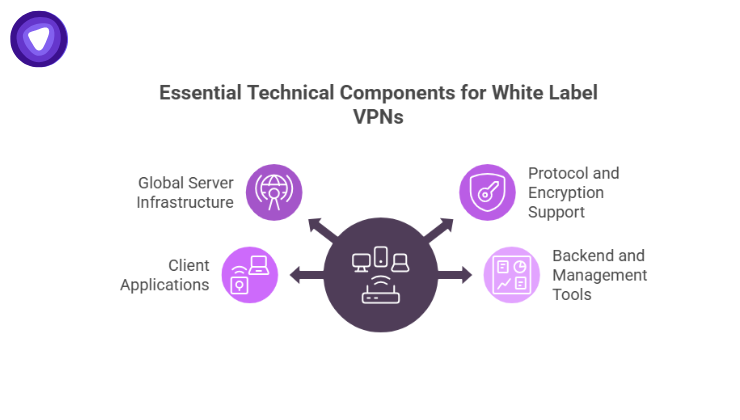
A successful white label VPN business still depends on strong technology. As the partner, these technical components must be part of your provider’s offering.
- Global Server Infrastructure
VPN performance and reliability directly relate to how well the underlying server network is architected.
Key technical expectations include:
- Many geographically distributed servers
- Load balancing for performance
- Redundancy and failover capability
- Optimized routing and peering
Without a resilient server network, customers will experience inconsistent speeds and downtime.
- Protocol and Encryption Support
Your VPN provider must support modern protocols:
- WireGuard for high performance
- OpenVPN for compatibility
- IKEv2 for mobile stability
These protocols ensure encrypted tunnels that protect data in transit. AES-256 encryption is the current industry standard for confidentiality and integrity.
A white label VPN business should include these protocols to meet customer performance and security expectations.
- Client Applications and Cross-Platform Coverage
Today’s users expect friendly apps on multiple platforms:
- Windows
- macOS
- Android
- iOS
Applications should integrate your branding while maintaining technical consistency and security updates. The breadth of platform support is a differentiator in a crowded market. Read more on how to set up your branded apps here.
- Backend and Management Tools
Beyond client apps, your business needs internal tools for:
- Subscription and user management
- Server selection controls
- Dedicated IP assignment
- API access for third-party integration
These backend tools determine how easily you can operate and scale.
Strategic Foundations Before Launch
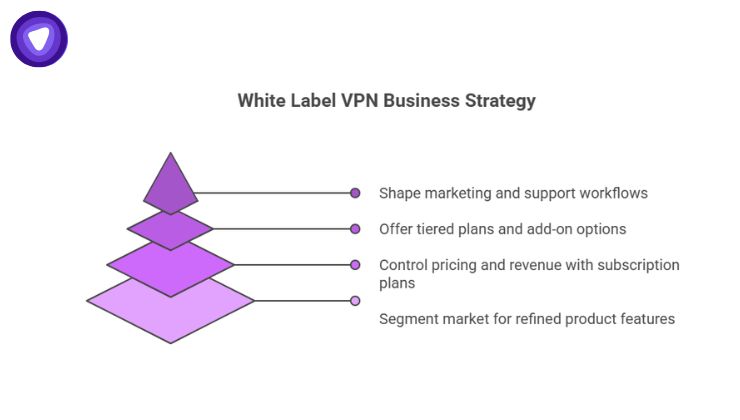
Starting a white label VPN business is not just technical setup. You need a strategic foundation.
Define Your Target Audience
Segmenting your market early refines product features and pricing. Typical segments include:
- Consumers looking for privacy and content access
- Small to Medium Businesses (SMBs) wanting secure remote access
- Enterprise teams requiring centralized control
- Telecom or ISP customers bundling VPN with connectivity
Each segment values different features and pricing schemes.
For consumers, simplicity and strong privacy are priorities. For business customers, management tools, secure access for remote workers, and static or dedicated IPs are often essential.
Positioning your product precisely shapes marketing, pricing, and support workflows.
Consider Revenue and Pricing Models
White label VPN services let you control pricing and revenue, unlike basic reselling with fixed commissions. Subscription‑based pricing is the dominant model in the VPN market and supports recurring revenue growth.
Most white label providers structure offerings into tiered pricing plans. According to published figures:
| Plan Type | Typical Cost (per month) | Notes |
| Starter | $500–$1,000 | Base tier for smaller user volumes |
| Scaling | $1,500–$2,500 | Expands capacity and features |
| Enterprise | Custom pricing | High‑volume user base |
In addition to tiered plans, pricing strategies commonly used in the industry include:
- Monthly and annual subscription tiers
- Feature bundles based on user or team size
- Add‑on pricing for options such as Dedicated IPs
- Reseller or partner pricing for B2B channels
Pricing must balance market competitiveness with long‑term sustainability. Techniques such as A/B testing and introductory offers can help refine pricing before a full market rollout.
How to Start a White Label VPN Business
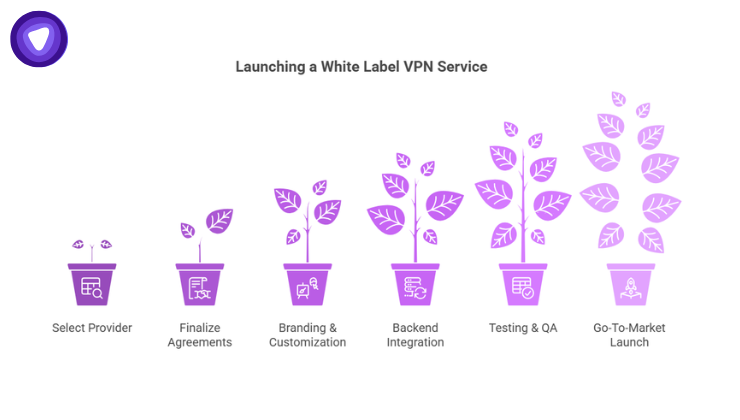
Now let’s outline the launch steps in a technical and tactical sequence.
Step 1: Select a White Label Provider
Choosing a provider is the most critical decision you will make. Evaluate potential partners against these criteria:
- Server footprint: global coverage with redundancy
- Protocol support: modern encryption and flexibility
- App rebranding options: intuitive customization
- APIs & SDKs: integration ease into your systems
- Security practices: third-party audits and patching
- Dedicated IP options: advanced feature support
A strong provider handles infrastructure while giving you control over branding and user experience. Read more on what features you should look for in a white label VPN provider.
Step 2: Finalize Legal and Commercial Agreements
White label relationships typically take one of these forms:
- Licensing agreement
- Revenue share model
- White label subscription fee
Clarify payment terms, support responsibilities, uptime guarantees, and data privacy obligations before signing. Legal clarity prevents operational disputes later.
Step 3: Branding and Customization
Once a partner is selected, begin rebranding and customization. Tasks to complete before launch:
- Launch fully branded VPN apps for Windows, iOS, Android, macOS, and Linux
- Update logo and color schemes in the applications
- Configure server lists for your users
This phase ensures your VPN service appears as your own branded product, while the provider handles infrastructure, apps, and security.
Step 4: Backend Integration
Set up the core operational systems to manage your service:
- Use the admin console to manage user accounts and server settings
- Utilize the API & SDK tools to integrate supported features with your internal workflows
- Automate subscription and billing processes where supported
These tools help reduce manual operational work and prepare your VPN service for launch without requiring you to build or maintain the underlying infrastructure.
Step 5: Testing and Quality Assurance
Thorough technical testing ensures stability at launch.
Checklist includes:
- Connectivity tests on all platforms
- Load and performance testing on servers
- Encryption integrity validation
- Compatibility across devices and networks
A soft launch with a controlled user group helps uncover issues before mass marketing starts.
Step 6: Go-To-Market Launch
With technical readiness complete, focus on launch planning. Channels may include:
- Email lists and newsletters
- Paid search or social campaigns
- Partner and channel marketing
- Integration announcements
Operational Responsibilities You Can Expect
Even though the infrastructure is handled by the provider, key operational responsibilities remain with your organization. You will manage customer support workflows, billing and payments, user education, and documentation, as well as monitor performance through dashboards and maintain feedback loops for feature improvements.
These areas have a direct impact on user retention and lifetime value. Maintaining operational excellence gives your business a competitive edge in a market where user expectations for reliability, security, and usability continue to rise.
Measuring Success and Scaling
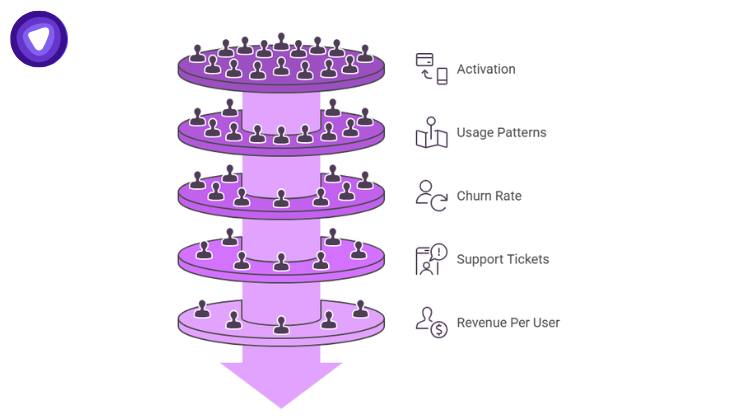
After launch, key performance indicators include:
- Activation rate: percentage of trials converting to paid users
- Usage patterns: locations and protocols frequently used
- Churn rate: retention over time
- Support ticket patterns: identify pain points
- Revenue per user: average subscription value
Consistent measurement guides iterative improvement.
As adoption grows, consider expanding server regions and premium features such as dedicated IPs or advanced protocol options. These are high-value add-ons that many customers are willing to pay extra for.
Product Solution: White Label VPN Simplified
For companies looking for a structured and technically sound way to start a white label VPN business, PureVPN White Label VPN Solution offers a mature infrastructure with rebrandable cross-platform clients, protocol support, backend tools, and dedicated IP capabilities.
Rather than building or managing global networks yourself, this solution gives you access to a proven system with support for modern VPN protocols and commercial features. It removes most infrastructure complexity while preserving your control over pricing, branding, and customer engagement.
If your goal is to enter the VPN market responsibly, with performance, privacy, and scalability, this product integrates these core needs.
Final Thoughts
A white label VPN business is not a hypothetical opportunity anymore. Verified data shows billions of users and tens of billions in market value, and demand continues to rise as privacy and secure access gain priority. With the right technical partner and a clear strategy, you can create a branded VPN offering that competes with established players while retaining control and recurring revenue.