

Launching secure connectivity inside an app can feel like building a rocket from scratch. Long development cycles, complex infrastructure, and security risks often intimidate engineering teams. But modern white label VPN platforms have changed that game. Now, embedding VPN functionality into your product is a matter of integrating a VPN SDK and connecting it to a managed VPN API, without building tunneling servers or encryption layers from scratch.
If you’re a SaaS founder, CTO, or product engineer, this matters. Secure connectivity is no longer a backend headache; it’s a product feature. Businesses offering business VPN solutions, privacy-focused mobile apps, or secure collaboration platforms need fast deployment, scalability, and full control over branding. A slow rollout can cost revenue and inflate engineering budgets.white
This guide walks you through how a white label VPN works, explains its architecture, shares practical use cases, discusses tradeoffs, and outlines a proven 4-week integration timeline with sandbox-ready code. By the end, you’ll understand how to launch a working deployment without guessing or over-engineering.
- SDK-based VPN integration can be production-ready in four weeks.
- API and client components handle authentication, routing, and session management.
- Infrastructure, encryption, and server management are provider-managed.
- VPN performance depends on protocol, routing, and server locations.
- Security relies on token authentication, proper session handling, and monitoring.
- Cost scales with active users, reducing upfront investment.
White Label VPN SDK and How They Benefit Businesses
A white label VPN is a fully managed VPN platform that businesses can rebrand and embed into their apps. Instead of building infrastructure for tunnels, encryption, and global servers, developers integrate white label VPN software via SDK and API layers.
| What It Is | What It Is Not | Where It Appears |
|---|---|---|
|
✓
A complete white label VPN software stack ready for integration
|
×
Not just a proxy server or UI reskin
|
•
SaaS VPN solution platforms for secure user sessions
|
|
✓
Branded VPN client inside your app or product
|
×
Not limited to consumer privacy apps
|
•
Commercial VPN solutions for distributed teams
|
|
✓
Provider-managed global servers and encryption
|
×
Not a replacement for an enterprise-grade cybersecurity strategy
|
•
Privacy-focused mobile apps or browsers
|
|
✓
API-driven session management and analytics
|
|
•
Integrated white label cybersecurity services for businesses
|
How Does A VPN SDK Integration Work?
At a high level, a VPN SDK integration connects your application to a managed VPN network via the SDK and VPN API. Most modern SDKs handle reconnection, and error handling. In most software architectures:
- SDK (Software Development Kit) → Typically handles client-side integration, including initialization, configuration, and making structured requests to a backend.
- API (Application Programming Interface) → Typically handles server-side logic, such as authentication, session management, data processing, and provisioning.
However, this is not universally true. Some SDKs:
- Handle parts of authentication (e.g., token generation or OAuth flows).
- Manage local session storage on the client.
- Abstract API calls so developers never interact directly with the API.
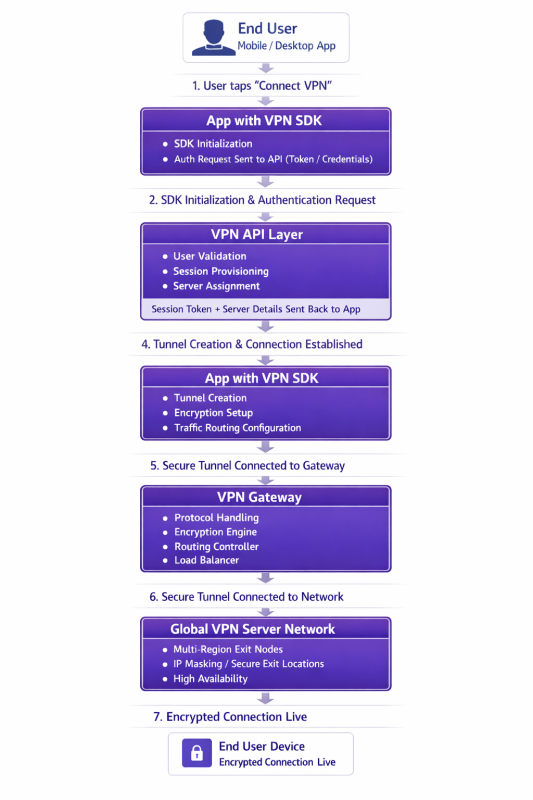
Sandbox Testing Flow (Developer View)
Use this when validating your 4-week integration:
- Generate test user → Request VPN session token
- Initialize SDK → Authenticate token
- Connect tunnel → Verify IP change
- Send traffic → Confirm encryption
- Simulate reconnect → Validate stability
What This Diagram Proves
- No infrastructure build required
- SDK manages tunnel + routing automatically
- API controls authentication and provisioning
- Global servers handled by the provider
- Full VPN working inside your app
- Achievable within 4 weeks
How to Read This Diagram
A clean explanation of how an embedded VPN flow works inside your app, from user action to secure traffic handling.
Step 1
User Action
The user activates VPN inside your app. No external client is required. The SDK handles the experience internally.
Step 2
Authentication & Session
The app requests a secure session using your backend and VPN API. A token is issued, and server assignment occurs.
Step 3
Tunnel Creation
The SDK establishes an encrypted tunnel between the device and VPN gateway using secure protocols.
Step 4
Traffic Encryption & Routing
All user traffic flows through the encrypted tunnel. The VPN gateway applies encryption, routing, and load balancing.
Practical Use Cases for White Label VPN SDK
1. Secure SaaS Platform Connectivity
- Scenario: SaaS app requires encrypted sessions for all users.
- Why it fits: The SDK handles encryption and traffic routing automatically.
- Watch out: Monitor latency and ensure token expiry aligns with session policies.
2. Enterprise Remote Access
- Scenario: Distributed teams need secure access to internal company resources.
- Why it fits: Deploy a company VPN without building infrastructure.
- Watch out: Integrate identity management and single sign-on.
3. Privacy-Focused Mobile App
- Scenario: App offers private browsing or secure messaging.
- Why it fits: SDK integrates directly into mobile clients, providing persistent protection.
4. Public WiFi Protection
- Scenario: Users connect to unsafe networks like airports or cafes.
- Why it fits: VPN automatically encrypts traffic and hides IPs.
- Watch out: Choose protocols that balance speed and security.
5. Embedded Security Feature
- Scenario: Product adds privacy as a premium service.
- Why it fits: Supports white label cybersecurity services expansion.
- Watch out: Ensure subscription logic and billing integrate with your app.
Tradeoffs and Constraints of White Label VPN SDK
| Factor | Considerations |
|---|---|
| Complexity | SDK reduces infrastructure complexity, but API lifecycle and client updates are required |
| Performance | Encryption adds CPU load; server distance affects latency |
| Team Skills | Backend engineers handle API; mobile/desktop developers integrate SDK |
| Cost | Pricing scales with active users; predictable but ongoing |
Implementation Guide for White Label VPN SDK
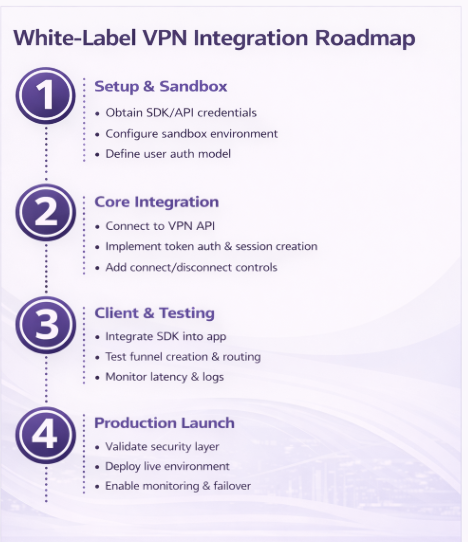
Integrating a white label VPN reseller solution doesn’t have to be overwhelming. Here’s a proven 4-week approach that lets teams deploy a functional VPN with minimal friction.
Week 1: Setup and Access
- Obtain SDK and VPN API credentials from your provider.
- Configure a sandbox environment for testing.
- Define user authentication and session model.
- Verify server locations that match your target user base.
Week 2: Core Integration
- Connect backend systems to the VPN API.
- Implement token-based session creation and management.
- Add programmatic connect and disconnect functions for clients.
- Test API endpoints with simulated users.
Week 3: Client Integration and Testing
- Integrate the SDK into your mobile, desktop, or web client.
- Validate tunnel creation, traffic routing, and encryption.
- Monitor latency, CPU usage, and connection reliability.
- Adjust routing and server selection for optimal performance.
Week 4: Production Readiness
- Add retry logic and automated reconnect features.
- Validate token management and session expiration.
- Deploy to production and monitor early adoption.
Good implementation looks like:
- Stable connection under load
- Secure, token-based authentication
- Observability via logs and metrics
- Automatic reconnection
- Consistent latency and minimal packet loss
Checklist for Decision Makers
A compact evaluation view to help product, engineering, and business teams decide whether an embedded VPN model fits their speed, security, and operational needs.
Adopt If
Good conditions for moving forward with an embedded VPN approach.
Avoid If
Signals that a fully managed embedded model may not be the right fit yet.
Minimum Production Requirements
- Token-based authentication and secure storage
- Session monitoring and logging
- Failover and retry mechanisms
- Protocol optimization for latency and throughput
- Server selection and performance tracking
Patterns and References for White Label VPN SDK
Common engineering patterns ensure stable VPN SDK integration:
- Retry and backoff for API calls
- Centralized error logging and monitoring
- Session lifecycle management
- Secure token storage with expiry and rotation
Pros and Cons of VPN SDK Integration
| Aspect | Pros | Cons |
|---|---|---|
| Deployment Speed | Launch in 4 weeks | Dependent on provider uptime |
| Infrastructure | No server setup needed | Less control over custom protocols |
| Security | Managed encryption & token auth | Must trust the provider for patching |
| Cost | Predictable, scales with users | Ongoing subscription cost |
| Maintenance | Minimal infrastructure maintenance | SDK updates may require a client release |
| Performance | Optimized routing & global servers | Latency varies by location & protocol |
Summary
A white label VPN SDK empowers teams to embed secure connectivity without building complex infrastructure. Integration relies on VPN API, SDK tunnel management, and token-based session handling. Using a structured four-week plan, teams can achieve a working deployment that scales predictably, reduces upfront costs, and meets enterprise-grade security requirements.
Practical takeaways:
- Start in a sandbox environment to validate API and SDK integration
- Monitor performance, latency, and session health
- Use token-based authentication and automated reconnect logic
- Consider server locations and protocol choice for the best user experience
Ready to launch your own branded VPN in just weeks? Explore technical guides, sandbox resources, and request a personalized walkthrough from PureVPN White Label today. Our expertise in white label VPN software and cybersecurity services makes fast, secure deployment achievable.