

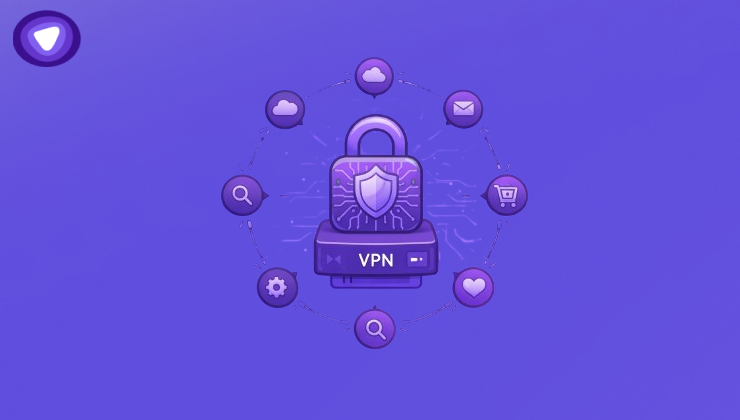
Every app that handles sensitive data is a potential target. Users abandon apps if they feel their personal information is at risk, and security gaps in app traffic can lead to costly breaches. A white label VPN for apps addresses this problem head-on. By embedding a fully branded VPN directly inside mobile or desktop applications, businesses secure every connection, protect user privacy, and maintain trust, without forcing users to switch apps or rely on external services.
This blog examines how white label VPN for apps works, why companies integrate it, the technical foundation behind it, and the measurable benefits for both users and businesses.
Key Takeaways
- Seamless Security Integration: White Label VPN for apps embeds full VPN functionality directly into an app, maintaining branding and user experience.
- Enhanced User Privacy: It encrypts all traffic, masks IPs, and prevents network-level attacks, protecting sensitive user data.
- Developer Control and Customization: Developers can manage branding, subscriptions, UI, and authentication without relying on third-party VPN apps.
- Improved User Experience: Integrated VPN reduces friction, activates transparently, and has minimal performance impact while keeping users informed.
- Business Benefits: Embedded VPN drives user trust, loyalty, competitive differentiation, potential revenue streams, and provides actionable usage insights.
What Is White Label VPN for Apps?
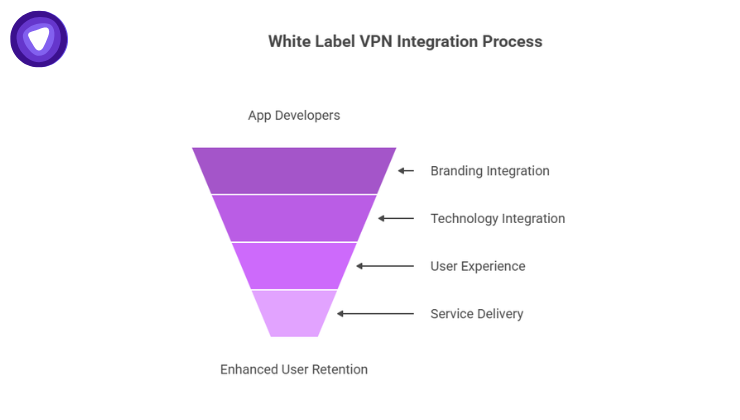
A White Label VPN for apps is a full VPN service that developers integrate into their own software, with all branding, UI, and design under the app’s identity. The end user sees a seamless experience that feels like part of the app.
The underlying technology is a professional VPN service with security components such as encrypted tunnels, secure protocols, and global servers. Instead of redirecting users to a third-party VPN, the VPN runs inside the app itself.
A branded VPN solution is different from traditional VPN apps in three key ways:
- Brand Control: The VPN interface and experience carry the app’s branding rather than an external VPN provider.
- Integrated Experience: Users stay inside the app to enable VPN protection instead of switching apps.
- Unified Service Delivery: The app controls subscription, authentication, and support for the VPN feature.
A recent report found that 65 percent of users will abandon an app that they believe exposes their data. This highlights why direct integration of secure connectivity matters for retention.
Why Developers Choose White Label VPN Integration
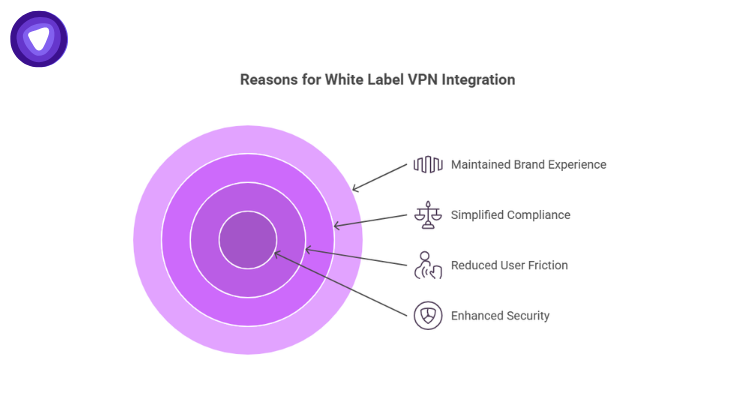
Embedding a White Label VPN for apps installs privacy and security as foundational features. Developers adopt this approach for several reasons:
Protect User Privacy
Apps that handle sensitive information, such as communication platforms, financial services, and health trackers, carry high responsibility. Encrypted traffic prevents network-level eavesdropping and blocks unauthorized access.
Reduce User Friction
Compared to asking users to download a separate VPN app, integrated VPN connectivity reduces steps. Users enable security without leaving the core app. This consistency leads to higher adoption of the feature and less user confusion.
Simplify Compliance and Security Standards
Certain industries demand strict security measures for customer data. While this blog avoids direct mention of compliance frameworks, the trend toward stricter privacy expectations means integrated VPN security is a competitive differentiator.
Maintain Brand Experience
When users see a single brand across all parts of their interaction, trust increases. A third-party VPN interrupts that consistency. A White Label VPN for apps maintains visual and functional uniformity.
These reasons align with a 2025 survey indicating that 78 percent of enterprise product leaders prioritize integrated security services inside core applications rather than add-ons.
Core Technical Components of White Label VPN
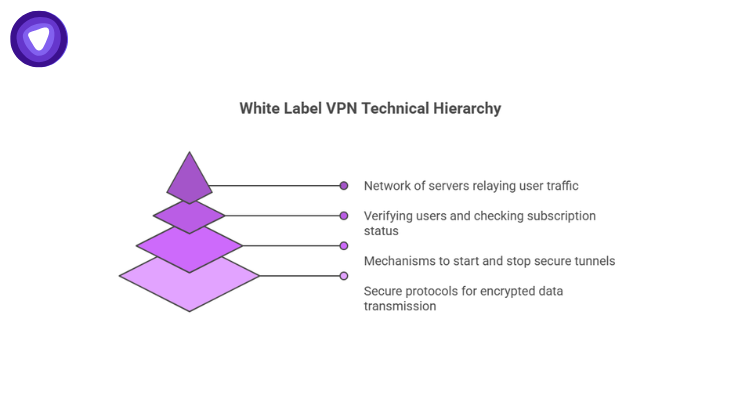
Understanding how a White Label VPN for apps operates involves examining the key technologies that make secure connectivity possible inside an app.
VPN Protocols
Secure protocols such as WireGuard, IKEv2, and OpenVPN ensure encrypted transmission. Each protocol establishes a secure tunnel between the user’s device and the remote VPN server. The protocols differ in speed, CPU usage, and packet handling, but all serve the same primary function: protect data in transit.
Also Read : VPN Protocols Used in White Label VPN Platforms
Tunnel Management
A built-in VPN requires mechanisms to start and stop the secure tunnel from within the app. This process involves:
- Network monitoring to detect connection changes
- Handling reconnections when network switches (e.g., Wi‑Fi to cellular) occur
- Cleanly shutting down the tunnel to avoid leaks
Tunnel management ensures the VPN does not interfere with normal app operation.
Authentication and Subscription Control
The app must authenticate users and check subscription status for VPN access. This is often done via secure API calls to the backend service. A White Label VPN for apps integrates authentication with the app’s existing user management system.
Server Infrastructure
Behind every VPN is a network of servers. These servers relay user traffic while masking the original IP and encrypting data. A strong provider offers:
- Multiple geographic locations
- Load balancing
- High uptime guarantees
These attributes matter because poor infrastructure leads to slow connections and dropped sessions.
Enhancing App Security With Integrated VPN
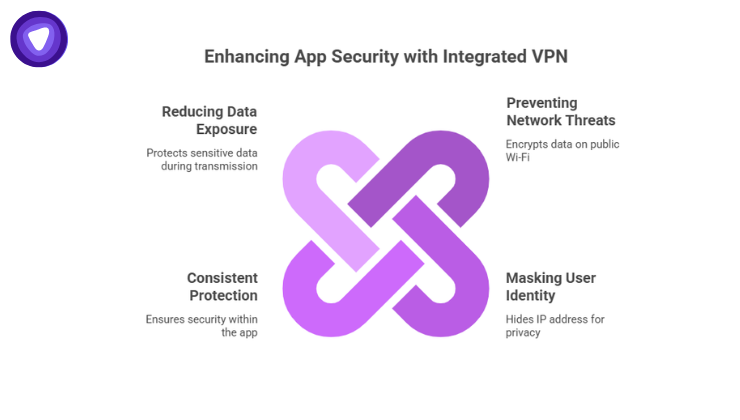
A White Label VPN for apps does more than encrypt traffic. It provides real security benefits when paired with well-designed features.
Preventing Network Threats
On public Wi‑Fi or untrusted networks, attackers can intercept traffic. A built-in VPN ensures that all outgoing and incoming data is encrypted, rendering typical network attacks ineffective.
Masking User Identity
The VPN assigns a secure server location as the user’s network endpoint. This masks the actual IP address and reduces tracking across networks, giving users stronger privacy.
Consistent Protection
Unlike optional external VPNs that users may turn on or off independently, integrated VPN protection stays within the app context. Developers can tailor when and how it operates, ensuring sensitive operations always use secure transmission.
Reducing Data Exposure
Apps that deal with sensitive operations, such as password updates, personal profile edits, and file uploads, benefit from encrypted channels at every point. This significantly lowers the risk of credential or personal data theft during transmission.
How White Label VPN Affects User Experience
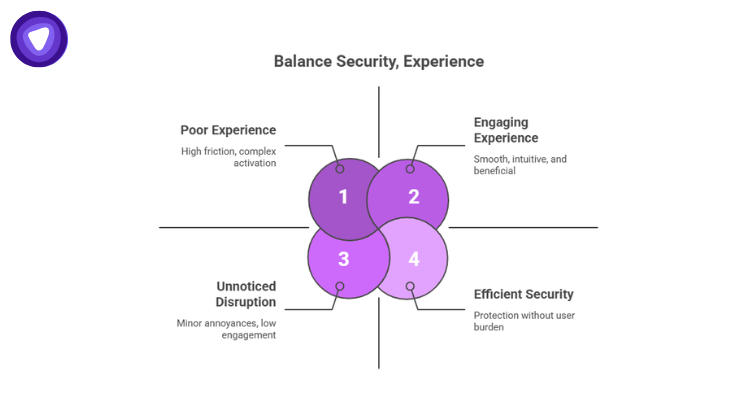
Security features are only valuable if they do not disrupt user interaction. A White Label VPN for apps must balance protection with a smooth experience.
Transparent Activation
Well-implemented VPN features activate without complex settings screens or configuration steps. Users expect a simple toggle or automatic protection when an action requires it.
Minimal Performance Impact
VPN encryption uses processing resources. Modern lightweight protocols such as WireGuard reduce overhead so users do not experience lag or slowdowns.
Clear Communication
Users must understand what the VPN feature does without confusing technical jargon. Effective messaging explains privacy benefits and when the VPN is active.
Error Handling
If a secure connection fails, the app should notify the user clearly and provide options to reconnect or continue without VPN, depending on the context.
User experience research indicates that clear feedback and minimal friction increase user engagement and long-term retention.
Business Benefits of White Label VPN for Apps
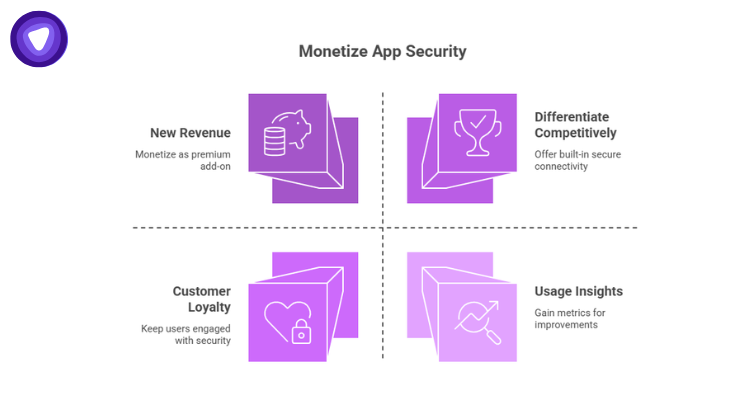
Embedding a White Label VPN for apps does not only strengthen security. It enhances business value in measurable ways.
New Revenue Streams
Developers can monetize the VPN feature as a premium add-on. This strategy increases average revenue per user while offering tangible value.
Competitive Differentiation
Users care about privacy. Offering built-in secure connectivity positions an app above competitors that do not provide this level of protection.
Stronger Customer Loyalty
An app that offers complete digital experiences, including security, keeps users engaged. Removed barriers and integrated safety grow trust.
Analytics and Usage Insights
When developers control the VPN integration, they gain insights into how often users engage with security features. These metrics help shape future product improvements.
Implementation Patterns for White Label VPN
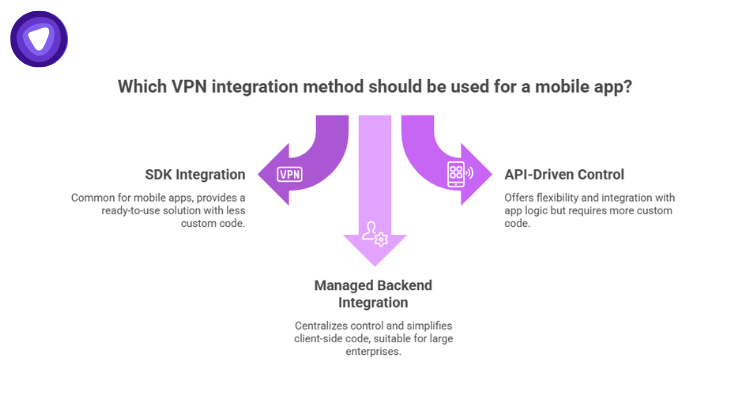
There are multiple ways to incorporate a White Label VPN for apps depending on the platform and architecture.
Embedded SDKs
A VPN Software Development Kit (SDK) allows the developer to add VPN features into the app codebase directly. SDKs offer:
- UI components
- Network hooks
- Automatic protocol selection
- Built-in error handling
Using an SDK is common for mobile apps on Android and iOS.
API-Driven VPN Control
Some VPN solutions expose APIs that the app calls to control VPN functions. This pattern requires more custom code from developers but offers flexibility and integration with app logic.
Managed Backend Integration
For large enterprises, the VPN service may work with a backend that manages user authentication, subscription checks, and selective activation. This approach centralizes control and simplifies client-side code.
Comparison of Integration Approaches
This table shows trade-offs between ease of implementation and depth of control.
| Integration Method | Control Level | Development Effort | Use Case |
| SDK Integration | High | Low to Medium | Mobile apps |
| API Control | Medium | Medium | Custom UI or logic |
| Backend Management | High | High | Enterprise systems |
Common Misconceptions
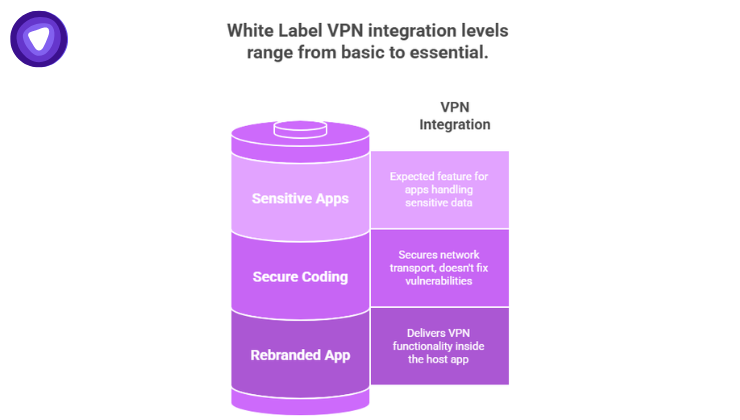
Understanding what a White Label VPN for apps is not is as important as knowing what it is.
- It is not just a rebranded third-party VPN app. The integration must deliver the VPN functionality inside the host app with synchronous control.
- It is not a replacement for secure coding practices. VPN integration secures network transport but does not fix vulnerabilities such as improper authentication or unencrypted storage.
- It is not optional for sensitive apps. Many categories of apps benefit from integrated secure connectivity as an expected feature.
Real-World Use Cases
Messaging and Communication Apps
Users expect private conversations. Embedding a White Label VPN for apps ensures that all messages and attachments transmit securely, especially on untrusted networks.
Financial Services
Banking and payment apps handle transactions that require extra layers of safety. Integrated VPN protects financial data during transmission.
Enterprise Productivity Tools
Businesses that deploy internal apps want consistent security for remote and office workers alike. A built-in VPN reduces risk when employees access internal services from public networks.
Measuring Success
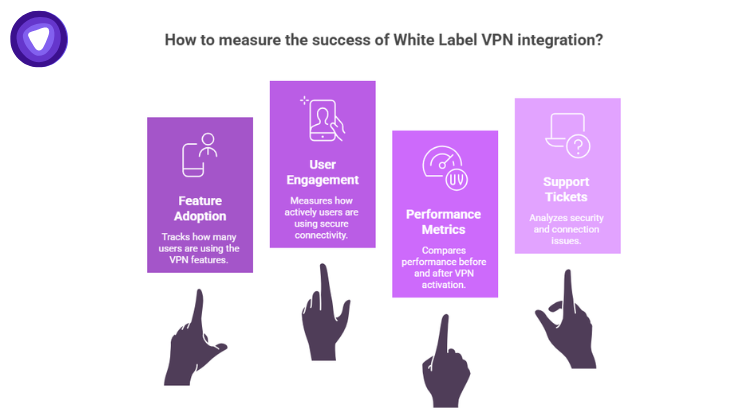
To understand the impact of a White Label VPN for apps, teams should track:
- Feature adoption rates
- User engagement with secure connectivity
- Performance metrics before and after VPN activation
- Support tickets related to security or connection issues
These metrics show how well the integration meets both user needs and business goals.
How PureVPN White Label VPN Solution Fits
A White Label VPN for apps becomes far more practical and effective when backed by a mature platform like the PureVPN White Label VPN Solution. PureVPN’s White Label offering gives developers access to a global server footprint with thousands of locations, ready‑to‑brand client applications across major platforms, and flexible SDKs and APIs that plug directly into existing app ecosystems.
This means secure traffic routing, modern tunneling protocols, and centralized user management are already built and maintained for you, so you can embed high-performance VPN connectivity inside your app without building or managing infrastructure yourself.
Partners retain full control over branding, subscription plans, pricing, and customer relationships while benefiting from a pre‑configured admin console, robust encryption stacks like OpenVPN and WireGuard, and 24/7 infrastructure support.
Final Thoughts
Adopting a White Label VPN for apps positions an app to deliver on core expectations of security and privacy. Embedding secure connectivity improves trust, retains users, and can create new value streams without disrupting the app experience.
The technical components, if implemented with care, create protection with minimal performance cost. For any app handling sensitive data or serving privacy-conscious users, integrating a branded VPN solution is a strategic step that aligns product quality with user expectations.