

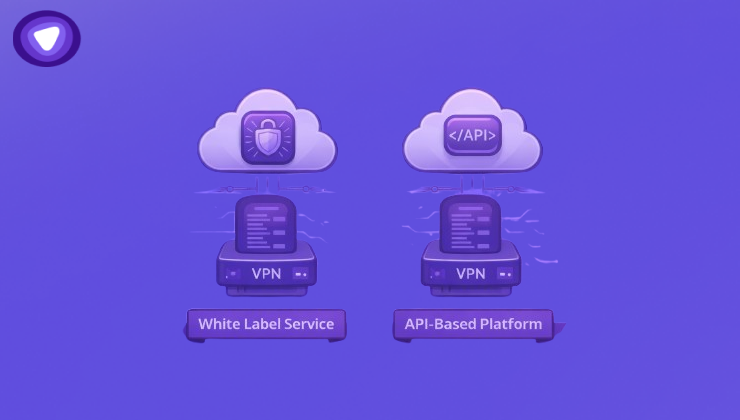
Launching a VPN product sounds technical until the real decision appears: build around APIs or deploy a ready-made platform. Most companies enter the VPN market assuming an API will give them flexibility, only to discover it requires building apps, infrastructure layers, and management systems before a single user can connect.
A white label VPN service removes that complexity by delivering a complete, branded VPN product supported by an existing global network.
Understanding how this model compares to API-based VPN platforms helps businesses choose the right path for speed, control, and long-term scalability.
- White Label VPN: Provides a ready-to-launch, fully branded product reducing development time and operational burden.
- API-Based VPN: Offers deeper customization but requires significant engineering, infrastructure management, and security oversight.
- Time to Market: White label VPNs can launch in 2–8 weeks versus 6–18 months for API-based solutions.
- Cost Efficiency: White label VPNs are more cost-effective for startups, with low setup fees and predictable monthly costs.
- Hybrid Control: Modern white label solutions include APIs and SDKs, combining rapid deployment with developer-level integration capabilities.
What Is a White Label VPN Solution?
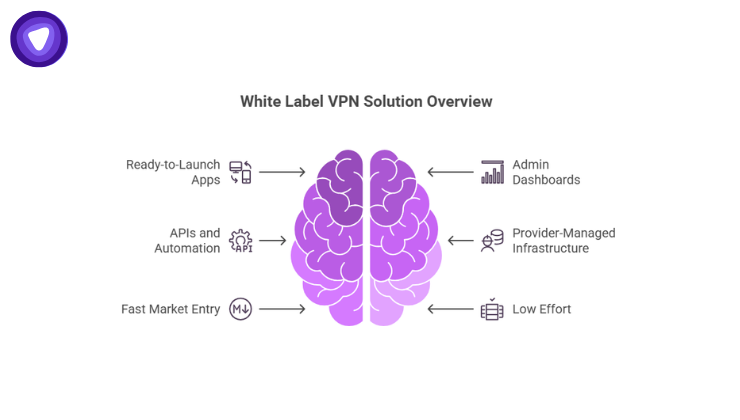
A white label VPN service is a fully developed VPN product that a company can brand and sell as its own. The infrastructure, server network, encryption protocols, and applications are already built and maintained by the provider. Businesses focus on branding, pricing, and customer acquisition without managing the underlying technology.
Key benefits include:
- Ready-to-launch VPN apps across Windows, macOS, Android, and iOS
- Admin dashboards for user and subscription management
- APIs and automation tools for integration
- Provider-managed servers, updates, and security
In short, it’s a fast, low-effort way to enter the VPN market.
What Is an API-Based VPN Provider?
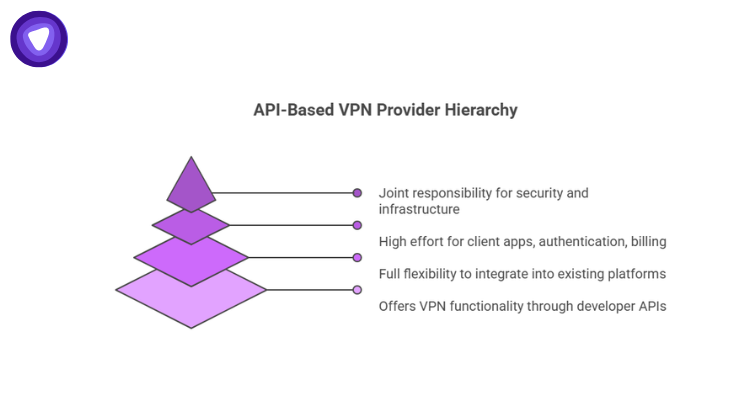
An API-based VPN provider offers access to VPN functionality through developer APIs instead of a ready-made product. Companies must build their own applications, dashboards, and subscription systems on top of the API.
Key aspects include:
- Programmatic control over VPN connections, servers, and user accounts
- Full flexibility to integrate into existing platforms or SaaS products
- High engineering effort for client apps, authentication, billing, and monitoring
- Shared responsibility for security and infrastructure management
This model is ideal for companies that need full customization and have the technical resources to build and maintain a VPN product.
Technical Architecture Differences
The architectural gap between the two models is significant.
| Layer | White Label VPN Service | API-Based VPN Platform |
| Applications | Ready-made VPN apps | Must be built |
| Infrastructure | Managed by provider | Often abstracted but still integrated |
| User interface | Prebuilt dashboards | Custom development required |
| Authentication system | Included | Must integrate through API |
| Billing | Often integrated | Must be implemented |
| Product design | Minimal development | Full product engineering |
A white label VPN service separates the infrastructure layer from branding.
A VPN API platform exposes the infrastructure and expects companies to build the rest.
White Label VPN Service vs API-Based VPN Platforms: Deep Dive Comparison
The following sections break down the key differences between white label VPN services and API-based VPN platforms across seven critical areas.
- Time to Market
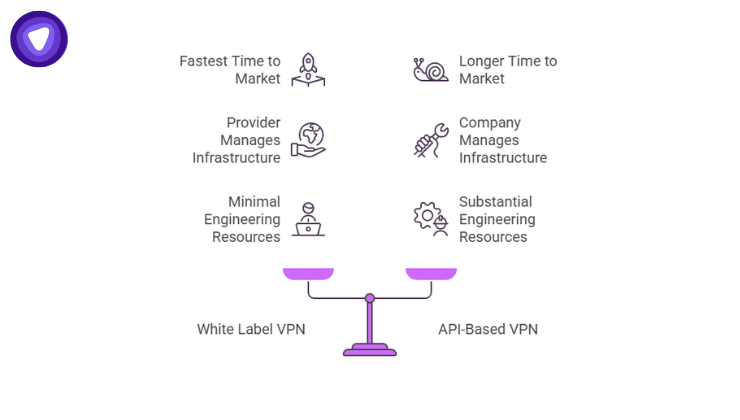
Time to market is often the deciding factor. Launching a VPN product requires:
- Server Infrastructure
- Encryption Protocols
- Cross-Platform Applications
- Authentication Systems
- Monitoring and Uptime Tools
Building these internally can take 6 to 18 months depending on engineering resources. A white label VPN service compresses this process dramatically because the entire technical stack already exists.
Typical deployment steps include:
- Configure Branding
- Set Pricing and Subscriptions
- Integrate Billing
- Deploy Applications
Many companies launch within weeks instead of months.
- Infrastructure Ownership and Operational Burden
Running a VPN network is operationally complex. Infrastructure teams must manage:
- Global Server Distribution
- Traffic Routing
- IP Address Management
- Security Patching
- Latency Optimization
- Failover Systems
With API platforms, companies still participate in infrastructure orchestration and monitoring.
With a white label VPN service, the provider manages:
- Server Provisioning
- Protocol Updates
- Uptime Monitoring
- Performance Optimization
The partner company focuses on customers rather than infrastructure operations.
- Engineering Resource Requirements
The development effort required by each model differs substantially.
White Label VPN Service
Engineering tasks are minimal:
- Branding Configuration
- Billing Integration
- Optional API Automation
Most companies do not need dedicated networking engineers.
API-Based VPN Platform
Development teams must build:
- VPN Applications
- Authentication Flows
- Connection Management Logic
- Session Monitoring Dashboards
- User Onboarding Systems
This approach requires backend developers, mobile engineers, and DevOps resources.
- Customization and Product Flexibility
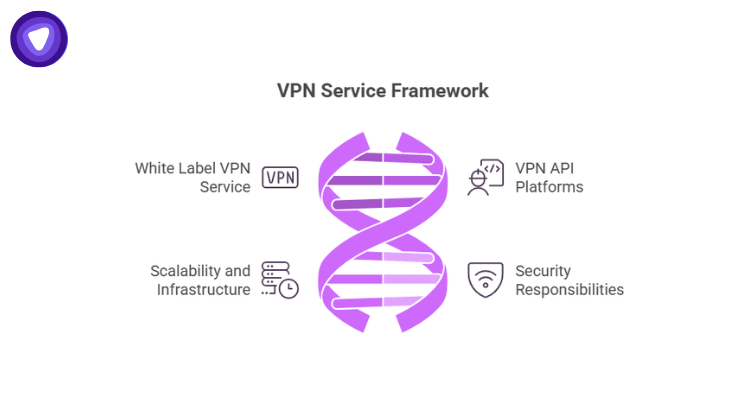
Customization is where API platforms outperform white label solutions.
White Label VPN Service
Customization typically includes:
- Branding
- Pricing Structures
- Subscription Tiers
- Marketing Features
However, core functionality remains consistent across partners.
VPN API Platforms
API platforms enable deeper customization:
- Embedding VPN Inside SaaS Applications
- Custom User Interfaces
- Proprietary Security Workflows
- Specialized Routing Policies
Companies designing complex network services often prefer this flexibility.
- Scalability and Infrastructure Expansion
Scalability depends heavily on the architecture.
With API platforms, growth may require:
- Expanding Server Resources
- Optimizing Traffic Routing
- Scaling Backend Infrastructure
Engineering teams must coordinate these changes.
With a white label VPN service, scalability comes from the provider’s existing network. Infrastructure providers typically maintain:
- Global Server Clusters
- Load Balancing
- Redundancy Systems
- Performance Monitoring
This allows partners to grow their user base without scaling internal infrastructure.
- Security Responsibilities
Security is a critical factor in VPN services.
White Label VPN Service
The provider maintains:
- Encryption Protocol Updates
- Vulnerability Patches
- Network Security Monitoring
Partners inherit these protections automatically.
API-Based VPN Platforms
Security responsibilities are shared. Businesses must ensure:
- Secure Integration
- Authentication Systems
- Application Security
- User Session Handling
Improper implementation can introduce vulnerabilities even if the underlying VPN infrastructure is secure.
- Cost Structure Comparison
Financial structure differs substantially between the two models when real development, infrastructure, and operational costs are considered.
| Cost Category | White Label VPN Service | API-Based VPN Platform |
| Initial development cost | Low, 2K–$10K setup fees for branding and onboarding with white label providers. | Very High, building custom servers, apps, and management systems often exceeds $250K–$500K+ in initial investment. |
| Infrastructure cost | Included in provider license (~$500–$5,000+/mo depending on scale). | High, server and bandwidth costs alone can be $300–$1,000+/mo per region, plus redundancy and load balancing. |
| Engineering salaries | Minimal | Significant |
| Maintenance | Managed by provider | Internal responsibility |
| Time investment | Low | High |
For startups and SaaS platforms, infrastructure outsourcing often reduces operational complexity.
Decision Framework: Which Model Should You Choose
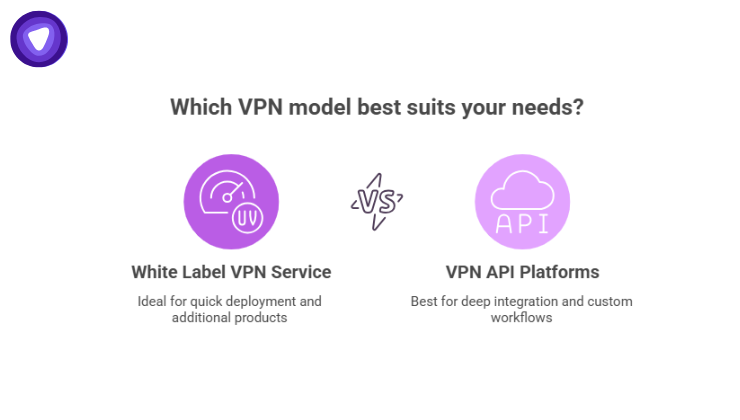
Use this simple framework to evaluate both options.
Choose white label VPN service if:
- Speed to market matters
- VPN is an additional product, not the core platform
- Engineering resources are limited
- Infrastructure management is not desired
Choose VPN API platforms if:
- VPN is deeply integrated into your software
- Custom workflows are required
- Your company already operates complex backend systems
- Engineering resources are available
Hybrid White Label VPN: Ready-to-Launch + API Control
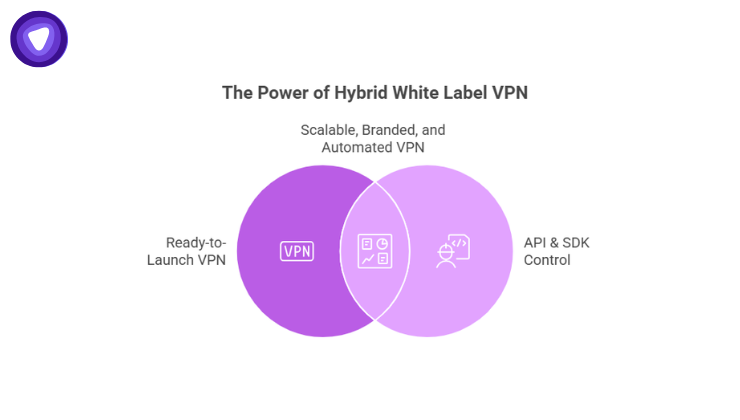
Modern white label VPN platforms offer the best of both worlds. Businesses get a fully branded, ready-to-launch VPN product while also accessing APIs and SDKs for automation and deeper customization.
With these APIs, companies can:
- Manage VPN accounts and subscriptions
- Access server locations and optimize connections
- Provision credentials and integrate with authentication systems
SDKs and admin dashboards simplify embedding VPN functionality into apps, SaaS platforms, or portals, removing the need to build the product layer from scratch.
This hybrid approach combines speed, scalability, and developer-level control, making white label VPNs with API support the practical choice for most businesses.
How PureVPN’s White Label VPN Solution Fits the Market
PureVPN’s white label VPN solution provides the core infrastructure businesses need to launch a branded VPN product without building the technology themselves. The platform includes a global server network, branded VPN applications across major operating systems, and an admin dashboard for managing users and subscriptions.
It also provides APIs for automation and account provisioning while PureVPN handles infrastructure operations, network performance, and system maintenance. This allows companies to focus on branding, distribution, and customer growth instead of managing VPN infrastructure.
Final Thoughts
Launching a VPN product requires much more than encryption technology. It involves infrastructure operations, application development, security management, and ongoing maintenance.
An API-based VPN platform offers flexibility and deep integration for engineering-driven organizations building custom network services.
A white label VPN service, however, provides a complete VPN product supported by existing infrastructure, allowing businesses to focus on branding, distribution, and customer growth.
For most SaaS companies, hosting providers, and security platforms seeking fast deployment and lower operational complexity, a white label VPN service remains the most practical path to entering the VPN market.