

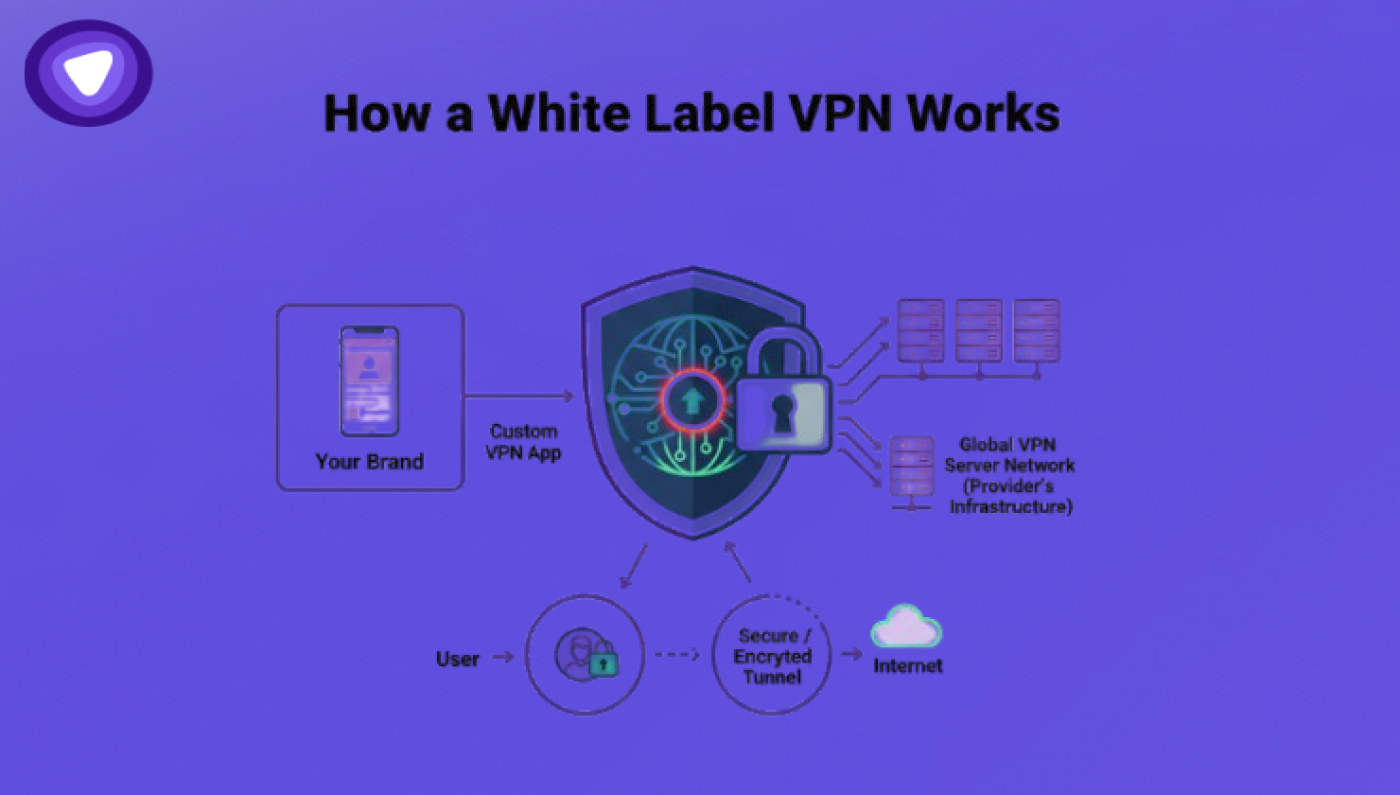
Launching a VPN from scratch means building a global server network, implementing secure tunneling protocols, managing encryption standards, securing IP pools, and maintaining 24 hour infrastructure monitoring.
That is not only a multi year engineering commitment. It is a capital intensive operation that requires data center contracts, security engineers, DevOps teams, and continuous maintenance spending.
A white label VPN removes that barrier. The infrastructure, protocols, and backend systems are already operational and maintained. You apply your brand, define pricing, integrate billing, and go to market under your own name while the underlying network and security stack remain managed by a specialized provider.
What is a White Label VPN?
A white label VPN is a ready built VPN service that one company develops and another company rebrands and sells as its own.
Instead of building global servers, encryption systems, and secure applications from scratch, the partner uses an existing VPN infrastructure and focuses on branding, pricing, and customer acquisition.
You control the apps, subscription plans, user management, and distribution strategy. The provider continues to operate the server network, encryption protocols such as OpenVPN or WireGuard, backend authentication systems, and uptime monitoring.
From the customer’s perspective, it appears as a standalone VPN under your brand. Technically, it runs on infrastructure maintained by the VPN provider.
Core Components of a White Label VPN
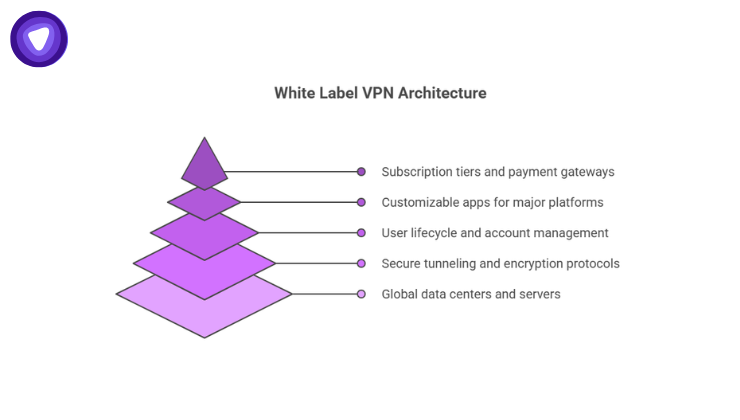
To understand how a white label VPN works, break it into functional layers. Each layer handles a specific responsibility, from traffic routing to monetization.
1. Server Infrastructure Layer
This is the foundation of the service. It includes global data centers, physical and virtual servers, IP address pools, routing systems, and bandwidth management controls.
The infrastructure provider is responsible for:
- Deploying and maintaining servers
- Load balancing traffic
- Optimizing latency across regions
- Monitoring uptime and network health
The white label partner does not operate these servers directly unless the agreement includes dedicated servers. Operational control of the network remains with the provider, ensuring scalability without internal DevOps overhead.
2. VPN Protocol and Encryption Layer
This layer secures user traffic.
It relies on established tunneling protocols such as OpenVPN, IKEv2, and WireGuard. These protocols handle encrypted data transmission using standards like AES or ChaCha20, secure key exchange mechanisms, and protected traffic tunnels between the user and the VPN server.
The provider maintains:
- Protocol updates
- Security patches
- Performance tuning
The partner benefits from a maintained encryption stack without hiring in house cryptography or network security engineers.
3. Authentication and User Management
A white label VPN includes backend systems that manage the user lifecycle. This covers account creation, subscription validation, device limits, and credential verification.
Partners typically receive:
- An admin control panel
- User provisioning tools
- API access for automation
- Usage analytics
- Billing integration options
This separation allows the partner to manage customers and revenue while the infrastructure layer remains independently maintained.
4. Branded Applications
The provider supplies production ready applications for major platforms including Windows, macOS, Android, and iOS.
Brand customization usually covers:
- App name and logo
- Interface color scheme
- Store listing assets
- Domain configuration
The application logic, connection handling, and protocol implementation remain technically consistent. The visible interface reflects the partner’s brand identity.
5. Billing and Monetization Layer
Commercial control sits entirely with the partner.
You define subscription tiers, pricing structures, payment gateways, promotional offers, and bundled packages. Many white label systems also support API based provisioning, which allows integration into:
- ISP customer portals
- SaaS dashboards
- Hosting control panels
- Telecom subscription systems
This integration capability is often the primary driver for adopting a white label VPN. It allows the VPN service to function as an embedded product within an existing digital ecosystem rather than as a standalone app.
Read more on the features of white label VPNs here.
How a White Label VPN Operates
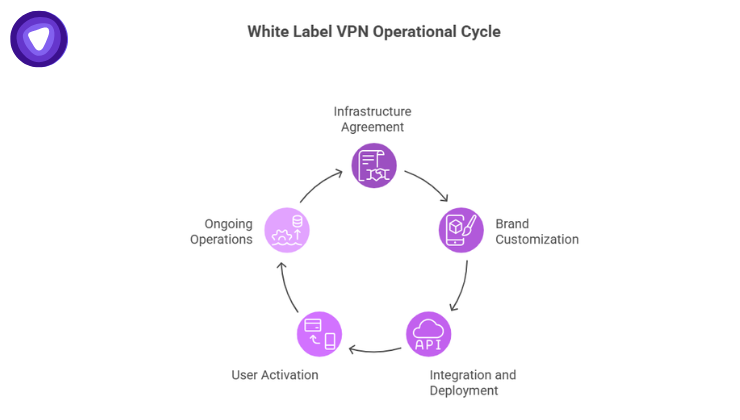
Launching a white label VPN involves a structured workflow between the partner and the infrastructure provider. Each step ensures the service is secure, branded, and ready for customers.
Step 1: Infrastructure Agreement
The process starts with signing an agreement that defines the operational and commercial framework. It covers:
- Server locations and global coverage
- Dedicated or shared IP options
- Branding scope and customization
- Support model and revenue structure
This sets clear expectations for both technical operations and business outcomes.
Step 2: Brand Customization
Once the agreement is in place, the VPN is tailored to the partner’s brand. The provider delivers:
- Branded applications across major platforms
- Admin dashboard access for managing users
- Custom domain endpoints and app store assets
At this stage, the VPN is visually distinct and ready to represent the partner as its own product.
Step 3: Integration and Deployment
The partner integrates the VPN into their business systems and prepares it for launch. This includes connecting billing systems, configuring APIs if needed, setting subscription plans, and defining user access policies. Once these steps are complete, the apps are published on app stores or distributed directly.
Step 4: User Activation
When a customer subscribes, the system handles validation, authentication, and connection automatically:
- Payment is verified through the partner’s billing system
- Credentials are created via the VPN backend
- The app authenticates the user and establishes an encrypted tunnel
- Traffic is routed securely through the provider’s infrastructure
From the user’s perspective, it functions as a fully branded VPN under the partner’s control.
Step 5: Ongoing Operations
The infrastructure provider manages server uptime, security updates, network monitoring, and scaling. Meanwhile, the partner focuses on growth through customer acquisition, retention, support, and pricing optimization.
This division allows the partner to concentrate on market expansion while relying on the provider to maintain a secure and high performing VPN network.
Technical Considerations Before Launch
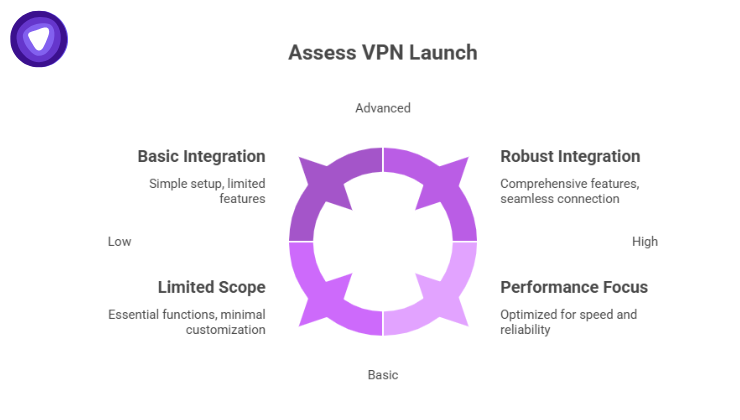
Even with a white label VPN, careful evaluation is crucial to ensure performance, privacy, and smooth integration with your systems. Key areas to assess include server distribution, logging policies, performance benchmarks, and API capabilities.
| Consideration | Key Points | Why It Matters |
| Server Distribution | Target markets, high traffic regions, redundant data centers | Low latency and efficient routing ensure a smooth user experience. |
| Logging Policies | Metadata collected, storage methods, data center jurisdiction, retention policies | Clear privacy practices protect your brand and build user trust. |
| Performance Benchmarks | Average connection time, drop rate, speed under load, protocol performance | Reliable infrastructure reduces churn and keeps users satisfied. |
| API and Automation Capabilities | Automated provisioning, real time credential retrieval, centralized management, scalable account handling | Enables smooth integration into SaaS or ISP platforms and simplifies operations. |
Where PureVPN White Label Fits
A mature white label VPN infrastructure significantly reduces engineering overhead while letting businesses retain full commercial control. PureVPN White Label VPN Solution offers global server coverage, branded applications across major platforms, Dedicated IP and server options, API support for automation, and centralized admin control.
This setup allows companies to launch a VPN product without building encryption systems, managing global hosting contracts, or maintaining 24 hour network operations. Partners can instead focus on distribution, partnerships, and user growth while the underlying infrastructure remains fully managed.
Final Thoughts
A white label VPN separates infrastructure from brand ownership. The provider manages servers, encryption, and uptime, while the partner controls branding, pricing, and customer relationships.
This model speeds time to market, lowers costs, and shifts operational complexity to the provider. Success depends on server quality, integration, privacy, and performance, but the mechanics are simple: the network runs, traffic is secure, and the brand in front is yours.