

- Identity Threat Landscape: Identity has become a primary attack target, with cybercriminals increasingly using stolen credentials, account takeovers, session hijacking, and identity fraud to gain unauthorized access.
- Real-Time Detection: Identity Threat Protection APIs analyze identity, device, behavioral, and network signals in real time to detect suspicious activity and calculate user risk levels.
- Faster Product Launch: APIs allow businesses to launch branded identity security products much faster than building threat intelligence, detection engines, and analytics infrastructure from scratch.
- Multi-Layer Security: Effective identity protection combines multiple layers of intelligence, including identity verification, device analysis, network risk assessment, and behavioral analytics.
- PureVPN Advantage: The PureVPN White Label VPN Solution helps businesses create branded security offerings by combining secure connectivity with identity and network intelligence capabilities.
Identity Threat Protection APIs enable real-time risk scoring and anomaly detection through direct integration, without building core detection systems in-house.
A login succeeds from a trusted device, followed shortly by the same identity authenticating from a different country using a residential proxy and a new email domain. Credentials are valid and access is granted. Identity threat protection systems detect this through correlation of IP reputation, device mismatch, geo-velocity, and proxy signals. Identity is now a primary attack surface, with attackers using stolen or synthetic identities to bypass perimeter defenses.
For SaaS providers, MSPs, telecom operators, and security vendors, building identity detection requires significant infrastructure and continuous threat intelligence.
Why Identity Threats Have Become a Primary Security Challenge
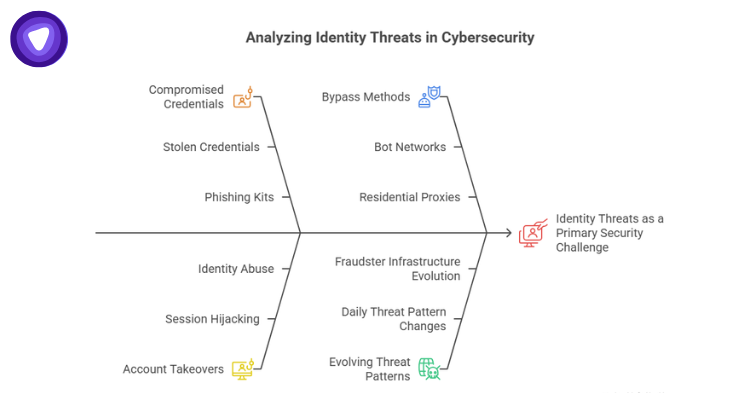
Most cyberattacks no longer begin with malware. They begin with compromised credentials, account takeovers, session hijacking, and identity abuse.
Attackers use stolen credentials, phishing kits, bot networks, residential proxies, and synthetic identities to bypass traditional security controls. Once authenticated, they often appear indistinguishable from legitimate users.
The financial impact is substantial. IBM’s Cost of a Data Breach Report found that the average global breach cost reached $4.88 million, the highest level recorded to date.
Identity-related attacks contribute significantly to these costs because they often remain undetected for extended periods while attackers move laterally through systems, access sensitive information, and establish persistence.
The challenge for businesses is straightforward:
- Passwords are frequently stolen or reused
- MFA can be bypassed through phishing and session theft
- Users connect from multiple devices and locations
- Fraudsters continuously change infrastructure
- Threat patterns evolve daily
Static authentication controls are no longer enough.
What Are Identity Threat Protection APIs?
Identity Threat Protection APIs provide security intelligence and risk analysis that help applications identify suspicious users, compromised accounts, and fraudulent activity in real time. Instead of simply verifying credentials, these APIs analyze contextual signals associated with an identity.
Common capabilities include:
- Identity risk scoring
- Account takeover detection
- Behavioral anomaly detection
- Device reputation analysis
- VPN and proxy detection
- Residential IP intelligence
- Geolocation verification
- Credential exposure monitoring
- Session risk analysis
- Bot and automation detection
Applications can consume this intelligence through API calls and automatically adjust security policies based on the calculated risk.
For example:
| User Activity | API Assessment | Security Action |
| Login from trusted device and location | Low risk | Allow access |
| Login from anonymous proxy network | Medium risk | Trigger MFA |
| Credential appears in breach database | High risk | Force password reset |
| Impossible travel detected | High risk | Block session |
| Bot-driven authentication attempts | Critical risk | Deny access |
This approach allows organizations to apply security dynamically rather than treating every login equally.
Why APIs Are the Fastest Path to Market
Building identity protection infrastructure internally is a major undertaking.
Organizations must develop:
- Threat intelligence collection systems
- Risk-scoring engines
- Identity analytics models
- Detection algorithms
- Global data processing infrastructure
- API delivery layers
- Monitoring and alerting systems
Each component requires ongoing maintenance and constant updates as attacker techniques evolve.
APIs eliminate much of this complexity.
Development teams can integrate identity intelligence into existing applications without creating the underlying infrastructure themselves.
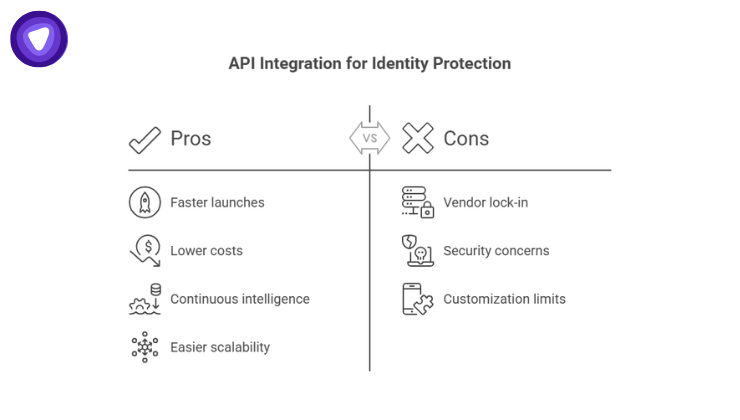
The benefits include:
Faster Product Launches
Instead of spending years building detection engines, businesses can integrate identity security capabilities in weeks or months.
This dramatically reduces development timelines and accelerates revenue generation.
Lower Development Costs
Building identity intelligence systems requires specialized security engineers, data scientists, infrastructure architects, and threat researchers.
API-based integration significantly reduces these costs.
Continuous Threat Intelligence
Threat actors constantly rotate infrastructure, IP addresses, proxy networks, and attack techniques.
API providers continuously update threat intelligence databases, ensuring customers benefit from current detection capabilities.
Easier Scalability
Identity protection services must process large volumes of authentication events in real time.
API architectures allow organizations to scale globally without managing complex backend infrastructure.
Core Components of a Modern Identity Protection Product
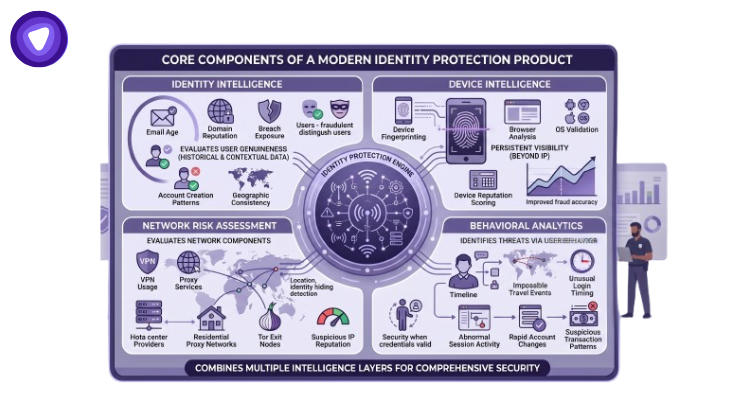
A successful identity security platform typically combines multiple intelligence layers.
Identity Intelligence
Identity intelligence evaluates whether a user appears genuine based on historical and contextual data.
Signals may include:
- Email age
- Domain reputation
- Breach exposure history
- Account creation patterns
- Geographic consistency
These indicators help distinguish legitimate users from fraudulent identities.
Device Intelligence
Attackers frequently change IP addresses while continuing to use the same devices.
Device intelligence creates persistent visibility beyond network-level identifiers.
Capabilities often include:
- Device fingerprinting
- Browser analysis
- Operating system validation
- Device reputation scoring
This improves fraud detection accuracy.
Network Risk Assessment
Network intelligence remains an important component of identity protection.
Detection systems commonly evaluate:
- VPN usage
- Proxy services
- Hosting providers
- Residential proxy networks
- Tor exit nodes
- Suspicious IP reputation
These signals help determine whether users are attempting to hide their true location or identity.
Behavioral Analytics
User behavior often reveals threats before credentials do.
Behavioral analysis may identify:
- Impossible travel events
- Unusual login timing
- Abnormal session activity
- Rapid account changes
- Suspicious transaction patterns
This provides an additional security layer even when credentials are valid.
Use Cases for Branded Identity Security Products
Identity protection APIs support multiple commercial offerings.
Managed Security Services
MSPs can add identity monitoring and threat detection to their existing service portfolios.
This creates recurring revenue while improving customer security.
SaaS Platforms
Software providers can offer advanced account protection features as premium services.
These capabilities increase product value and customer retention.
Telecom Providers
Telecommunications companies increasingly bundle security products alongside connectivity services.
Identity protection provides a natural extension of these offerings.
Financial Services
Banks, fintech providers, and payment platforms use identity intelligence to reduce fraud and account takeover risks.
Enterprise Security Vendors
Security providers can expand existing portfolios with identity-focused capabilities without building entirely new platforms.
Key Features Customers Expect
Organizations evaluating identity protection solutions increasingly look for capabilities that go beyond traditional authentication.
Essential features include:
- Real-time risk scoring
- API-based deployment
- Threat intelligence feeds
- Identity monitoring
- Fraud detection
- Session analysis
- VPN and proxy identification
- Alerting and reporting
- Multi-tenant support
- White-label branding options
The goal is simple: detect suspicious activity before it becomes a successful attack.
What to Look for in an Identity Threat Protection API Platform
Not all APIs provide the same level of visibility or detection accuracy.
When evaluating providers, businesses should assess:
Detection Coverage
The platform should analyze multiple identity signals rather than relying on a single indicator.
Global Infrastructure
Identity security systems require low-latency responses worldwide.
Scalability
The API should support large transaction volumes without performance degradation.
Integration Simplicity
Comprehensive documentation and developer-friendly APIs reduce deployment time.
Threat Intelligence Quality
Detection accuracy depends heavily on the quality and freshness of intelligence data.
White-Label Capabilities
Businesses launching branded security products need customization options that align with their own services and customer experience.
Accelerating Product Launches with PureVPN White Label VPN Solution
For organizations seeking to build branded security offerings, identity protection often works best alongside secure connectivity and network intelligence. Combining both capabilities provides broader visibility into user behavior, access patterns, and threat indicators.
The PureVPN White Label VPN Solution enables businesses to launch fully branded VPN and security services without building their own infrastructure. Through API-driven integration and customizable deployment options, organizations can deliver secure access services under their own brand while maintaining operational control over the customer experience.
Identity intelligence becomes even more valuable when combined with network-level insights. By integrating security intelligence, VPN visibility, and user access controls into a unified service offering, businesses can create differentiated security products that address both identity-based threats and secure connectivity requirements.
Closing Thoughts
Identity has become the primary target for modern attackers because it offers the fastest path to valuable systems and data. Security products built solely around passwords and authentication workflows struggle to keep pace with credential theft, account takeovers, and fraud operations that evolve continuously.
Identity Threat Protection APIs provide a practical path forward. They allow businesses to launch branded security services quickly, reduce development complexity, and deliver real-time protection powered by continuously updated threat intelligence. As identity-based attacks continue to grow, organizations that combine identity intelligence with secure access capabilities will be better positioned to meet customer demand and bring security products to market faster.