

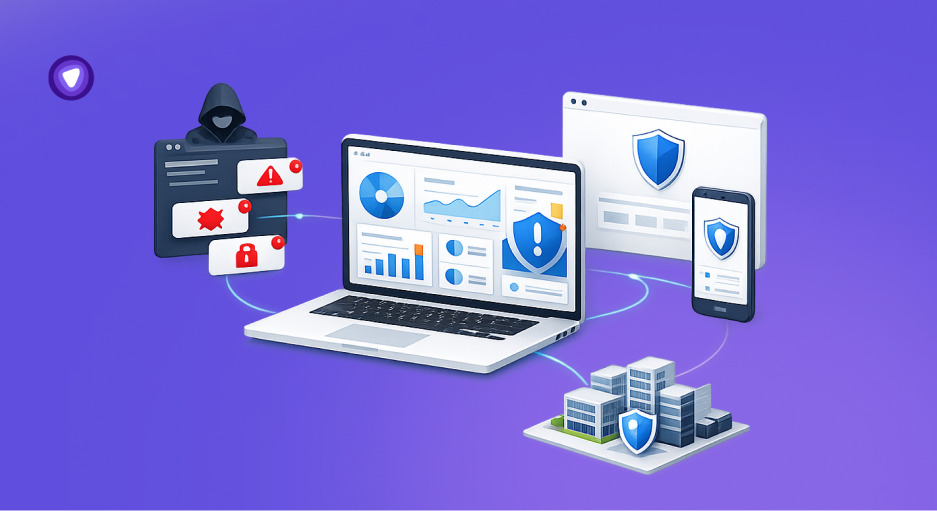
- Dark web monitoring identifies leaked credentials, exposed data, and compromised assets before attackers can use them for account takeover or fraud
- Most breaches begin with valid credentials, making identity exposure one of the fastest growing security risks for businesses
- Monitoring systems work by aggregating threat intelligence feeds, breach databases, and underground leak sources, then matching them to business domains
- Effective solutions do not scan the entire dark web but rely on curated intelligence sources and structured data analysis for actionable alerts
- White-label dark web monitoring enables providers to deliver branded security services through APIs, dashboards, and real-time alerting systems
A corporate email found in a leaked database may still allow normal logins and sessions, while the actual risk remains outside the security perimeter and undetected by traditional tools.
This is where dark web monitoring becomes a product category, not a support feature. It gives businesses visibility into exposed credentials, leaked customer data, and compromised access keys circulating in underground marketplaces before attackers turn them into active intrusions.
For service providers, MSSPs, and cybersecurity platforms, this capability is no longer optional. It is becoming a baseline expectation from clients who want early warning on identity exposure.
Why Dark Web Exposure is Now a Business Issue
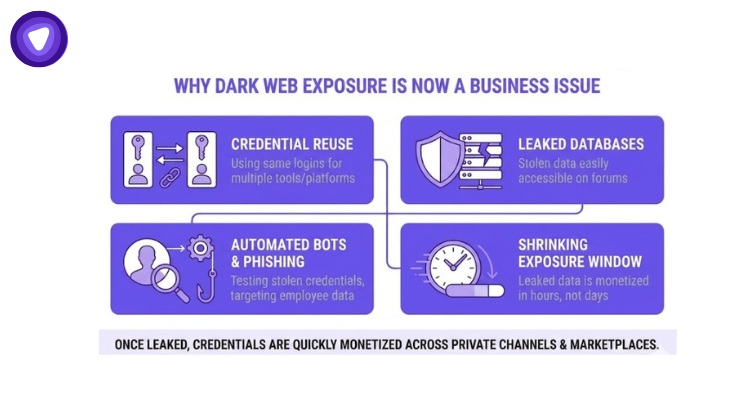
Most breaches do not begin with system failure. They begin with valid credentials.
Attackers increasingly rely on credential reuse, session hijacking, and purchased access rather than exploiting infrastructure flaws. Once credentials are leaked, they are quickly monetized across private channels and marketplaces.
Key pressure points driving demand:
- Credential reuse across enterprise tools and SaaS platforms
- Increased availability of leaked databases on dark web forums
- Expansion of phishing kits tied to real employee data
- Automated bots testing stolen credentials at scale
The exposure window between leak and exploitation is shrinking. In many cases, it is measured in hours rather than days.
What Dark Web Monitoring Actually Tracks
Dark web monitoring is not about scanning the entire dark web. It focuses on structured intelligence extraction from known leak sources, underground marketplaces, and breach repositories.
Core data types include:
- Email and password combinations from breached databases
- Session cookies and authentication tokens
- API keys and cloud access credentials
- Personally identifiable information such as phone numbers and addresses
- Corporate domain mentions linked to exposed datasets
Monitoring systems typically use a combination of:
- Crawlers for indexed leak sites
- Closed-source intelligence feeds
- Pattern matching across credential dumps
- Correlation engines linking identity to breach events
The objective is not raw data collection. It is early detection of exposure tied to actionable identity assets.
Where Dark Web Monitoring Fits in a Security Stack
Dark web monitoring does not replace endpoint security, firewalls, or identity providers. It operates as an external intelligence layer that feeds risk signals into identity and access management systems.
Typical use cases:
- Detecting leaked employee credentials before login abuse
- Identifying exposed customer data in breach dumps
- Flagging compromised contractor accounts
- Triggering forced password resets and session revocation
- Enriching SIEM alerts with external threat context
68% of breaches involve a human element, including phishing and credential misuse. This makes identity exposure monitoring directly relevant to incident prevention strategies.
Core Components of a White-label Dark Web Monitoring Service
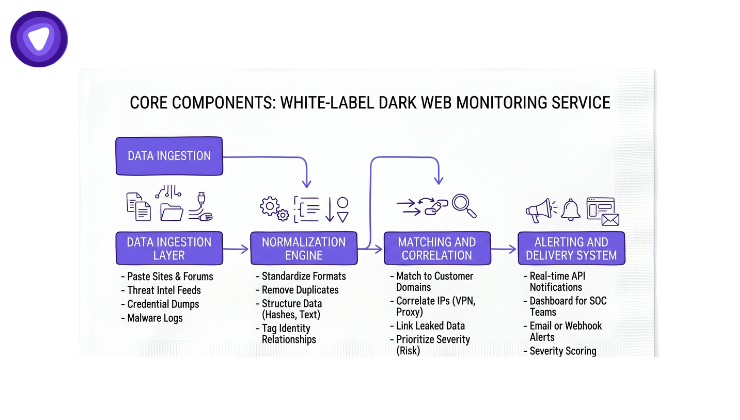
To offer dark web monitoring under your own brand, the architecture needs to support continuous ingestion, normalization, and alert distribution.
1. Data ingestion layer
This layer collects breach data from:
- Paste sites and leak forums
- Threat intelligence feeds
- Credential dump repositories
- Malware exfiltration logs (when available)
2. Normalization engine
Raw breach data is inconsistent. Normalization processes:
- Standardize email and domain formats
- Remove duplicates across datasets
- Structure password hashes and plaintext entries
- Tag identity relationships
3. Matching and correlation
This is where business value is generated:
- Match exposed credentials to customer domains
- Correlate IP history with known VPN or proxy usage
- Link leaked data to user identity profiles
- Prioritize severity based on reuse risk
4. Alerting and delivery system
Alerts must be structured for immediate action:
- Real-time API notifications
- Dashboard visibility for SOC teams
- Email or webhook alerts for IT administrators
- Severity scoring based on exposure type
White-label Architecture Using VPN Intelligence Layers
White-label VPN infrastructure provides an additional telemetry advantage for dark web monitoring platforms.
VPN connection metadata can contribute to identity risk scoring:
- Suspicious geo-location shifts
- IP reputation signals
- Concurrent session anomalies
- Proxy or anonymization detection patterns
When combined with breach data, this creates a stronger identity risk model.
For example:
- A leaked credential appears on a forum
- The same identity attempts login from a new geography
- VPN or proxy indicators suggest masking behavior
- Risk engine escalates the event before authentication succeeds
This correlation layer is what separates basic breach alerting from operational threat detection.
Capability Mapping for White-Label Providers
The following capability mapping outlines how white-label providers structure dark web monitoring into functional layers, business value, and underlying implementation components.
| Capability | Function | Business Value | Implementation Layer |
| Credential leak detection | Identifies exposed usernames and passwords | Early breach awareness | Threat intelligence ingestion |
| Domain monitoring | Tracks company email exposure | Brand and employee protection | Domain correlation engine |
| Session token detection | Detects active session leaks | Prevents account takeover | Deep parsing engine |
| IP reputation analysis | Evaluates source of exposure | Risk scoring accuracy | VPN telemetry layer |
| API alerting | Sends real-time notifications | Faster incident response | Integration layer |
| Dashboard reporting | Visualizes exposure trends | Operational visibility | UI/UX layer |
Turning Monitoring into a Branded Security Product
White-label dark web monitoring is not only a technical integration. It is a packaging decision.
Successful implementations focus on:
- Simplified alerting instead of raw threat feeds
- Risk scores instead of technical dumps
- Domain-based onboarding instead of manual configuration
- API-first design for integration into existing tools
Global cybercrime costs are projected to reach $10.5 trillion annually by 2025, driven largely by identity theft, ransomware, and credential abuse. This scale makes automated exposure monitoring necessary for most organizations handling distributed teams or cloud infrastructure.
The product value increases when monitoring is embedded into access workflows rather than delivered as a standalone dashboard.
Operational Requirements for Providers
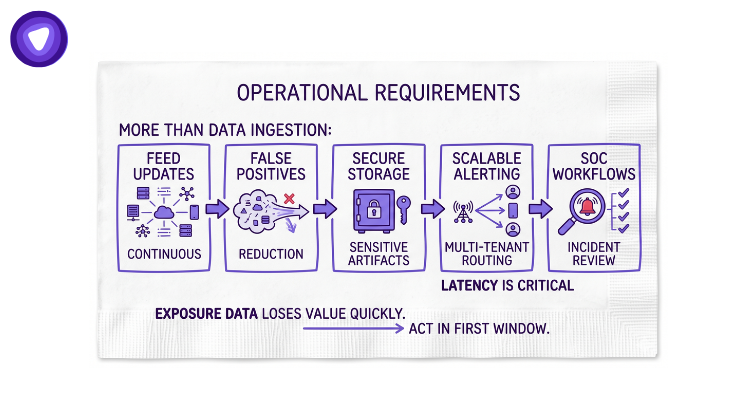
Running a white-label dark web monitoring service requires more than data ingestion.
Key operational layers include:
- Continuous feed updates from multiple intelligence sources
- False positive reduction systems for noisy leak data
- Secure storage for sensitive breach artifacts
- Scalable alert routing for multi-tenant environments
- SOC-level review workflows for high-severity incidents
Latency is critical. Exposure data loses value quickly if it is not acted on within the first detection window.
Go-to-Market Structure for White-Label Offerings
Providers typically package dark web monitoring into three tiers:
- Basic exposure alerts for SMB customers
- Enhanced monitoring with API integration and domain tracking
- Enterprise tier with identity correlation and VPN telemetry enrichment
Distribution is usually handled through:
- MSSPs integrating into managed security offerings
- SaaS platforms embedding APIs into dashboards
- IT service providers bundling it with access control solutions
The key commercial advantage is retention. Once exposure monitoring is tied to identity infrastructure, switching costs increase significantly.
Brand Integration Using PureVPN White-Label Infrastructure
A white-label VPN foundation allows providers to extend beyond connectivity into identity-aware security services. By combining encrypted access, IP intelligence, and session metadata, dark web monitoring becomes more than a breach alerting tool. It becomes part of a broader identity risk system.
Within this model, PureVPN’s white-label VPN solution supports the underlying secure connectivity layer that feeds telemetry into monitoring engines. It enables providers to deliver exposure detection, identity correlation, and secure access control under their own brand without building infrastructure from scratch.
For teams managing distributed users, contractors, or client environments, this combination allows consistent enforcement of access visibility and breach awareness in a single platform. PureVPN For Teams fits into this structure by providing scalable VPN infrastructure that can be extended with monitoring and alerting capabilities while remaining fully branded to the provider.
Closing Perspective
Dark web monitoring has shifted from passive breach notification to an active identity intelligence layer. Its value lies in speed, correlation, and integration with authentication systems that control access in real time.
Providers that package it under their own brand gain more than a feature. They gain a continuous visibility channel into one of the most exploited attack surfaces in modern security environments.