

- What It Is: A white label dark web monitoring service lets VPN brands and resellers detect leaked credentials and customer data under their own name, without building scraping or threat intelligence infrastructure from scratch.
- Why Demand Is Rising: Breach costs remain high and stolen credential volume keeps growing, pushing more businesses to expect proactive monitoring as a baseline service.
- Core Components: A credible program needs four core pieces: continuous data collection, accurate matching logic, a fully branded dashboard, and clear remediation guidance for every alert.
- Build vs Partner: Partnering with an established technology provider is far faster than building in-house, and pricing should scale with monitored assets rather than a flat per-seat fee.
- What Drives Success: Success depends on compliance discipline (authorized scope, clear retention policies) and strong positioning, since clients buy this service to solve a real risk, not because the concept interests them.
VPN customers used to judge a provider by speed and server count. Increasingly, they ask a harder question: does this brand know if my data has already leaked? Encryption alone does not answer that question. A white label dark web monitoring service does.
That gap is why a growing number of VPN brands, MSPs, and security resellers are building this capability instead of leaving customers to find out on their own. It turns a privacy product into a full protection story, sold under one brand instead of stitched together from someone else’s tools.
This is no longer a niche add-on. It has become a baseline expectation from clients who already assume their data is floating around somewhere. Building a white label dark web monitoring service the right way means understanding the data pipeline behind it, the packaging that makes it sellable, and the legal boundaries that keep it credible. This guide walks through each piece in order.
What a White Label Dark Web Monitoring Service Actually Delivers
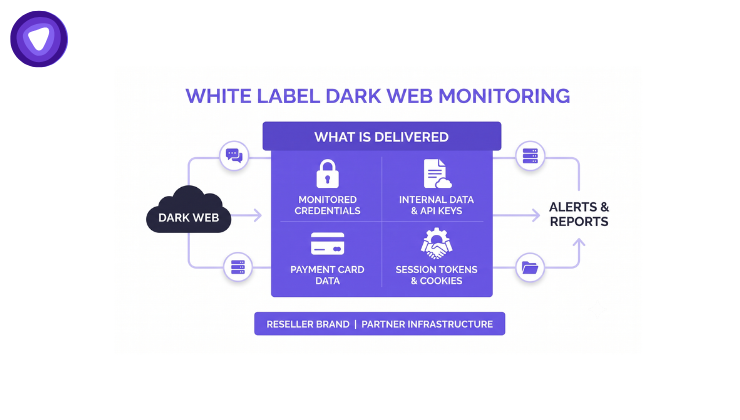
At its core, this type of service scans criminal marketplaces, breach dumps, paste sites, and closed forums for data tied to a specific business or individual. When a match appears, the platform generates an alert. The reseller’s brand sits on top of the dashboard, the emails, and the reports, while the underlying detection engine runs on a partner’s infrastructure.
The output typically includes:
- Exposed email addresses and passwords
- Compromised employee or customer credentials
- Leaked API keys and internal documents
- Payment card data tied to a monitored domain
- Session cookies and authentication tokens circulating in stealer logs
None of this requires the reseller to build scraping infrastructure, maintain forum access, or hire threat intelligence analysts. That division of labor is the entire premise of the model.
Why Demand for This Service Is Accelerating
Breach costs and identity exposure are both climbing at a pace most internal security teams cannot keep up with on their own, which is pushing budget toward outsourced monitoring.
The global average cost of a data breach dropped to 4.44 million dollars in 2025, a nine percent decline from the year before. That drop came almost entirely from faster detection and containment, not from fewer attacks. Organizations that catch exposure early spend far less cleaning up after it.
Meanwhile, the raw volume of exposed data keeps growing. Threat researchers recaptured 5.3 billion stolen credential pairs circulating in criminal underground sources in 2025 alone. Password reuse across personal and corporate accounts means one leaked login often opens several doors at once.
On the channel side, cybersecurity has become the fastest-growing category inside managed service offerings, expanding at roughly 18 percent annually while white label partnerships are increasingly the preferred route for providers who want to add coverage without hiring specialist staff.
Put those three trends together. Breaches are still expensive, exposed data keeps multiplying, and the providers selling protection increasingly rely on white label infrastructure to deliver it. A white label dark web monitoring service sits directly at that intersection.
Core Components Every Program Needs
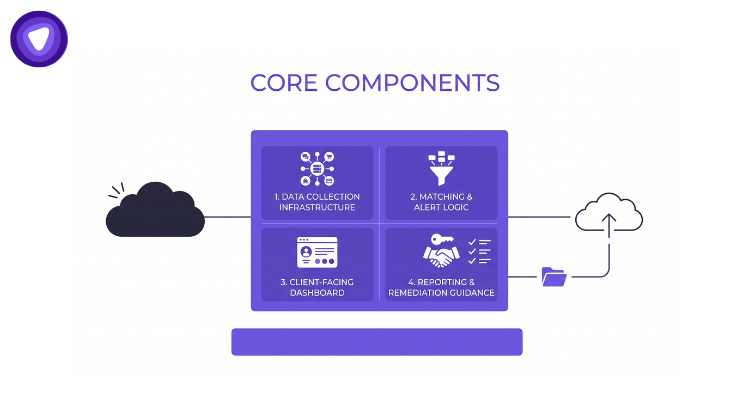
A credible white label dark web monitoring service is built from a handful of technical and operational pieces. Skipping any one of them shows up quickly in client complaints or false alerts.
Data Collection Infrastructure
The engine behind the service needs continuous access to forums, marketplaces, Telegram channels, and breach repositories. This is the part almost no reseller should attempt to build in-house. It requires ongoing access maintenance, language coverage, and legal safeguards around how the data is collected.
Matching and Alert Logic
Raw data is close to useless without accurate matching. The platform needs to tie a leaked record to the right domain, employee, or customer without flooding the client with noise. Overly broad matching creates alert fatigue. Overly narrow matching misses real exposure.
Client-Facing Dashboard
This is the layer that carries the brand. Logos, color schemes, domain names, and email templates all need to reflect the reseller, not the underlying technology vendor. A weak dashboard undermines trust even when the detection behind it is strong.
Reporting and Remediation Guidance
An alert with no next step frustrates clients. Strong programs pair every finding with a clear action: force a password reset, rotate an API key, notify affected customers, or escalate to legal. This turns a data feed into an actual service.
Building In-House vs Partnering With a Technology Provider
Few resellers have the resources to stand up their own dark web scraping operation. It requires infrastructure for anonymized access, ongoing legal review, and analysts who can tell the difference between noise and a genuine threat. That combination takes years to mature.
Partnering with an established provider compresses that timeline to weeks. The reseller focuses on packaging, pricing, and client relationships, while the technology partner handles collection, parsing, and threat validation behind the scenes. Most successful white label dark web monitoring launches follow this partnership model rather than building from scratch.
When evaluating a partner, a few questions matter more than the sales pitch:
- How many sources does the platform actually monitor, and how often are they refreshed?
- What is the average time between a leak appearing and an alert firing?
- Does the API support full white labeling, including custom domains and branded notifications?
- What data retention and deletion policies apply to client information?
- Is the vendor willing to support co-branded onboarding materials?
Pricing and Packaging Models
Pricing structure often determines whether a white label dark web monitoring service becomes a profit center or a break-even add-on. Most successful programs use tiered packaging tied to monitored asset count rather than a flat per-seat fee.
| Tier | Typical Client | Monitored Assets | Common Add-Ons |
| Starter | Solo professionals, micro businesses | 1 to 5 domains or emails | Monthly summary report |
| Business | SMBs, growing teams | Up to 50 employee identities | Real-time alerts, Slack or email integration |
| Enterprise | Mid-market and larger firms | Unlimited domains, custom scopes | Dedicated analyst review, API access, SLA-backed response |
| MSP/Reseller Bundle | Managed service providers | Multi-tenant, per-client scoping | Full white label branding, bulk licensing |
Bundling this service with an existing VPN, password manager, or endpoint protection offering tends to raise attach rates significantly, since clients already trust the brand for one layer of security and are receptive to adding another.
Compliance and Legal Considerations
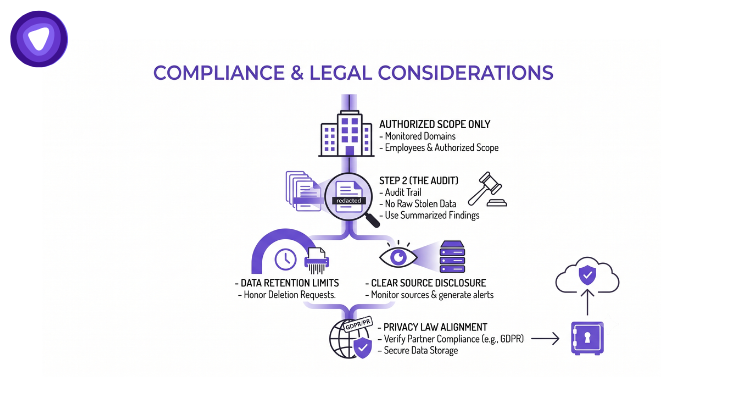
Selling any product built on dark web data collection means operating close to a legal gray zone even though the underlying activity, accessing Tor and forums for research, is legal in most jurisdictions.
A few practices keep a program on solid ground:
- Only collect and store data tied to a client’s own domains, employees, or explicitly authorized scope.
- Maintain clear data retention limits and honor deletion requests.
- Disclose to clients exactly what sources are monitored and how alerts are generated.
- Avoid presenting raw stolen data to end users; summarized findings with redaction are safer and more useful.
- Confirm the technology partner’s data handling practices align with regional privacy law, including GDPR where applicable.
Skipping this layer creates real exposure for the reseller, not just the end client.
Common Mistakes When Launching
A handful of missteps show up repeatedly across new white label dark web monitoring launches.
Overpromising detection speed is one of the most damaging. No platform catches every leak the moment it appears, and setting that expectation early leads to churn the first time a delayed alert surfaces.
Under-pricing is another frequent error. Providers sometimes treat this as a low-cost bolt-on rather than a distinct revenue line, which leaves little room to fund support or onboarding once the client base grows.
A third mistake is ignoring onboarding entirely. Clients rarely understand what a dark web alert means or what to do with it. Programs that pair every alert with a short remediation note see far better retention than those that just forward raw data.
Finally, some resellers underestimate how much the dashboard experience matters. A confusing or poorly branded interface undercuts an otherwise strong detection engine and makes the whole white label dark web monitoring offering feel unfinished.
Bringing the Service to Market
Positioning matters as much as the technology stack. Clients rarely buy dark web monitoring because they find the concept interesting. They buy it because a competitor got breached, a regulator tightened requirements, or an employee’s credentials turned up somewhere public.
Sales messaging works best when it ties the service to a concrete outcome: fewer account takeovers, faster breach containment, or a defensible answer when a customer asks how their data is protected. Case studies and simple before-and-after language tend to outperform technical feature lists.
Channel partners, IT consultants, and existing security vendors are natural distribution points. A well-packaged white label dark web monitoring service gives them a new recurring revenue line without asking them to become threat intelligence experts themselves.
Where a White Label Partner Speeds Things Up
PureVPN’s white label VPN solution gives brands a practical path into this space without building detection infrastructure from the ground up. Partners get a fully branded dashboard, ongoing monitoring, and support that plugs directly into an existing VPN or security product line, which shortens the path from decision to launch considerably.
For a brand already offering privacy or security tools to its customers, adding monitoring through an established white label partner is often the fastest way to round out that offering credibly. It skips the years of infrastructure work a homegrown platform would demand.
Conclusion
Launching this kind of service is no longer about chasing a trend. It is about closing a gap that clients already feel and that competitors are moving to fill. The providers that treat a white label dark web monitoring service as a serious, well-packaged offering, rather than an afterthought, are the ones building lasting recurring revenue from it.