

- Trust Already Exists: MSPs already have the client trust and billing relationship to sell data broker removal, but most lack a clear packaging and pricing model, so the pitch stalls before it starts.
- The Real Gap: Existing security stacks (endpoint, backup, email) never touch personal data sitting on people-search and broker sites, leaving executives and staff exposed to phishing and doxxing.
- Growing Demand: Demand is accelerating from three directions at once: a fast-growing personal data removal market, new regulations like California’s DROP platform, and employers adopting privacy protection as a benefit category.
- Easy to Scale: The service scales without a new department, since automated scanning, opt-out submission, and re-scanning handle the bulk of the work, leaving only onboarding and escalation for human staff.
- Pricing and Rollout: Pricing works best bundled into an existing security tier, sold per seat, or offered as an executive-only package, with a small pilot group as the safest way to prove the model before a full rollout.
Every MSP contract renewal hits the same wall. The client wants more protection, but the budget for another line item is fixed. Data broker removal changes that conversation. It gives MSPs a service clients did not know they needed. It slots directly into managed data privacy services without requiring a new sales pitch from scratch.
Most MSPs already own the client relationship, the billing infrastructure, and the trust needed to sell this. What they lack is a clear model for packaging, pricing, and explaining it. Without that model, the pitch sounds like reselling someone else’s tool.
The underlying problem is not going away on its own. Data brokers collect and resell personal information at scale, and the number of active brokers keeps rising every year. Clients feel this exposure long before they can name it. That is exactly where a well positioned service closes the gap.
The Gap Between Cybersecurity Stacks and Personal Data Exposure
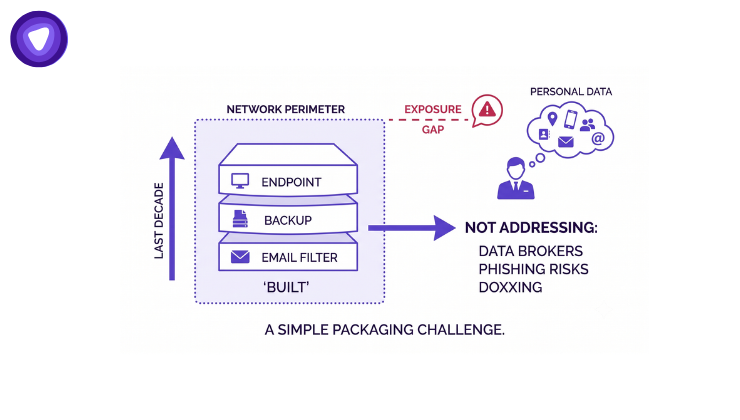
MSPs have spent the last decade building strong security stacks. Endpoint protection, backup, email filtering, and compliance reporting are standard line items now. But none of these tools touch a different exposure point. This is the personal data of executives, employees, and customers sitting on people-search and data broker sites.
Why Client Expectations Are Shifting
This gap matters more as client expectations shift. The global MSP market is valued at over $300 billion in 2025. Growth is expected to push past $800 billion by 2032. That growth is not coming from break-fix support. It is coming from clients who want a single provider handling every layer of risk. This includes layers outside the network perimeter.
A related data point reinforces this. Roughly 60 percent of businesses say cybersecurity concerns were the main reason they hired an MSP in the first place. Executive data exposure, phishing built from scraped personal details, and doxxing risk fall under that same concern. Most MSPs do not currently address any of them.
The Assumption Most Clients Get Wrong
Many clients already assume this protection exists. When an MSP runs endpoint detection and manages firewalls, clients often assume more is covered. They assume their personal footprint is protected too. It rarely is.
People-search sites operate outside the corporate network entirely. They scrape public records, data breaches, and social profiles. From there, they build searchable profiles on employees and executives.
A Quiet but Real Liability
A client can pass every security audit an MSP runs. Yet a home address, phone number, and family details can still sit in plain view on a dozen broker sites. Closing that gap is not a technical challenge. It is a packaging and awareness challenge, and precisely the kind of problem MSPs are built to solve.
Where Data Broker Removal Fits Inside Managed Data Privacy Services
Data broker removal is not a standalone gadget. It works best as one module inside a broader managed data privacy services offering. It sits next to VPN provisioning, password management, and dark web monitoring.
Framed this way, the pitch changes. Instead of selling a tool that deletes data from broker sites, MSPs sell a privacy layer. That layer protects the people behind the network, not just the network itself. This distinction matters for renewal conversations and upsells to existing security clients.
- Executives and public-facing staff are common targets for social engineering built from scraped personal records.
- Remote and hybrid teams expose home addresses and personal details through data broker aggregation.
- Clients in finance, healthcare, and legal services face reputational risk if leadership data surfaces on people-search sites.
Why Client Demand for This Service Is Growing
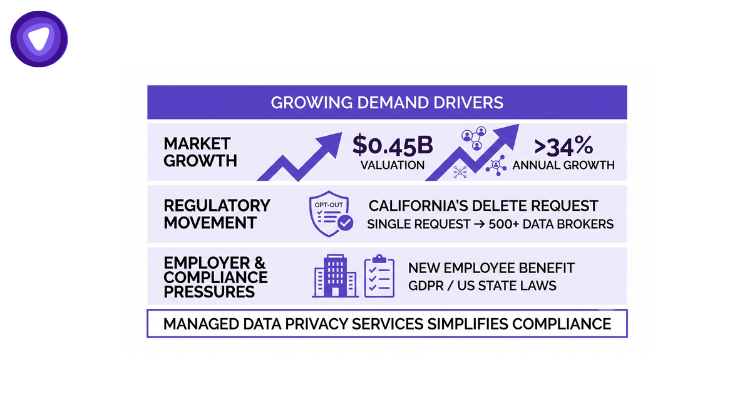
Demand is not theoretical. The personal data removal services market crossed $0.45 billion in valuation during 2025. It is projected to grow at more than 34 percent annually through the next decade. That growth rate outpaces almost every other segment inside managed data privacy services today.
Regulatory movement is accelerating this further. California’s Delete Request and Opt-out Platform lets a resident submit one request. That single request now reaches more than 500 registered data brokers. Clients who operate across state lines, or serve California customers, are starting to ask MSPs about this directly.
Employers are also becoming buyers in their own right. Privacy protection for executives, remote staff, and public-facing employees is turning into a benefit category. Cyber insurance followed a similar path, becoming standard within a few years of wide adoption.
Compliance pressure adds another layer to this. GDPR gives European residents the right to request deletion of personal data. Similar state level laws in the US are expanding that right to more residents each year. Clients operating across borders, or across multiple US states, need a partner who can track these overlapping rules. Handling opt-out requests one state at a time is no longer realistic on their own.
None of this requires an MSP to become a legal or compliance firm. It requires a managed data privacy services offering that already accounts for these regulations inside its removal workflow. The client never has to think about jurisdiction differences at all.
Building the Service Without Building a New Department
MSPs do not need a dedicated privacy team to launch this. The service works because most of the operational load sits with automated scanning and removal requests, not manual labor.
What to Automate
Broker scanning, opt-out submission, and re-scan scheduling should run without staff involvement. A white label platform handles this layer. The MSP is not writing scrapers or tracking broker opt-out policies by hand.
Report generation should also run on autopilot. Clients expect a monthly or quarterly summary showing which brokers were scanned, which listings were removed, and which ones resurfaced. Automating this keeps the service profitable at scale. Margin erodes fast the moment a technician has to build reports by hand for every client.
What Needs Human Oversight
Client onboarding, reporting, and escalation still need a human touch. When a broker refuses removal or republishes data, someone on the MSP side should explain that to the client directly. This is where managed data privacy services differ from a raw software subscription. The MSP is the accountable party, not just a reseller.
Packaging and Pricing Models
Most MSPs price this one of three ways. It can be bundled into an existing security tier. It can be sold as a standalone add-on per seat. Or it can be offered as an executive-only protection package.
Each model carries a different sales motion. Bundling works best for flat monthly retainer clients. It avoids a new invoice line they have to approve separately. Per-seat pricing suits clients who already pay per-user for other tools. Finance teams recognize that billing pattern right away. Executive-only packages close faster. The buyer is often one decision maker, not a full procurement process.
| Packaging Model | Best Fit | Typical Structure |
| Bundled into security tier | Existing MSSP clients on flat monthly contracts | Included at no extra line item, positioned as a tier upgrade |
| Per-seat add-on | Mid-market clients with defined headcounts | Flat monthly fee per employee or per protected identity |
| Executive protection package | Leadership teams, public-facing staff, high-risk roles | Premium tier with faster removal SLAs and manual escalation |
The right model depends on how the MSP already bills. Clients on flat MSSP retainers respond well to bundling, since it avoids a new invoice line. Clients who already pay per seat for other tools tend to accept a similar per-seat structure without pushback.
Positioning It to Clients
The sales conversation should stay factual. Avoid framing this as fear-based selling. Instead, walk clients through what a data broker actually holds. Home addresses, phone numbers, family details, and employment history are all sold to marketers, and occasionally to bad actors.
Position the service as an extension of what the client already pays for. Managed data privacy services are not a separate purchase decision. They are the next logical layer after endpoint security, backup, and email protection are already in place.
Case studies work better than statistics in this pitch. A single example lands harder than a percentage figure on a slide. Think of an executive whose home address surfaced during a harassment incident. Or a company where scraped employee data fed a phishing campaign.
Timing matters too. The strongest moment to introduce this offer is during a quarterly business review, right after discussing existing security wins. Clients are already thinking about risk in that meeting. Adding one slide on personal data exposure turns a routine review into an upsell moment. Back it with a clear pricing model. It rarely feels forced.
Common Objections and How to Handle Them
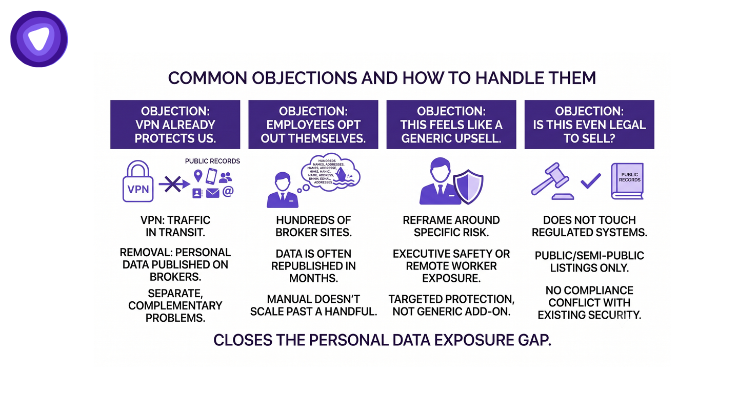
Some clients will push back before agreeing to add this line item. Handling these objections well often decides whether the sale closes.
- “We already have a VPN.” A VPN protects traffic in transit. It does not remove personal data already published on broker sites. These are separate problems that happen to complement each other well.
- “Our employees can opt out themselves.” Technically true, but broker sites number in the hundreds. Most republish removed data within months. Manual opt-out does not scale past a handful of people.
- “This feels like an upsell for the sake of an upsell.” Reframe it around one specific risk category. Executive safety or remote worker exposure both work well. Avoid presenting it as a generic add-on.
- “How do I know this is even legal to sell?” Data broker removal does not touch a client’s regulated systems. It works on public and semi-public listings only. There is no compliance conflict with existing security contracts.
Each of these objections points back to the same idea. Clients are not rejecting the value of privacy protection. They are rejecting a vague pitch. A specific, well scoped managed data privacy services package answers the objection before it is raised.
Measuring Results and Proving Value
Clients will ask how to know the service is working. The answer needs to be concrete, not just a promise of ongoing protection.
Three metrics work well for this. First, the number of broker listings found and removed per client per quarter. Second, the average time between a listing appearing and being taken down. Third, the recurrence rate, which tracks how often removed listings resurface on the same broker site.
Sharing these numbers in a simple dashboard or quarterly report gives clients something tangible to point to during budget reviews. It also gives the MSP a defensible reason to raise prices later. A documented track record of removals makes that case on its own.
Where PureVPN’s White Label Platform Fits
PureVPN’s white label solution gives MSPs a way to launch this service under their own brand. There is no need to build removal infrastructure from scratch. The platform combines VPN provisioning with data broker removal. MSPs can offer one privacy suite instead of stitching together separate vendors.
For an MSP adding managed data privacy services to an existing lineup, this removes two barriers at once. Those barriers are engineering time and ongoing broker relationship management. The MSP keeps the client relationship and the billing. PureVPN handles the removal mechanics behind the scenes, including the scanning, opt-out submission, and resubmission workflow described earlier.
Getting Started Without Overcommitting
An MSP does not need to roll this out to every client at once. A smaller pilot group works better. Start with a handful of existing security clients. Pick ones with public-facing leadership or remote staff already flagged as higher risk.
Run the pilot for one full quarter before expanding it. This gives enough time to see a full removal cycle play out. It should include at least one resubmission after a broker relists data. Use that quarter to build the reporting habit and confirm the pricing model holds up against actual delivery cost.
Once the pilot proves out, expanding to the full client base becomes a packaging decision rather than an operational risk. The MSP already has proof points, a working pricing model, and a reporting template ready to reuse.
Closing Thoughts
Data broker removal is not a passing trend inside the MSP world. It is becoming a baseline expectation, the same way backup and endpoint protection did a decade ago. MSPs that add it now, under their own brand, position themselves ahead of a demand curve that keeps getting steeper.