

- Utah’s SB 73 takes effect September 3, 2026, tying age-verification liability to physical location instead of IP address.
- The law regulates covered websites, not VPN vendors, so ordinary VPN use stays fully legal everywhere.
- Sites cannot publish instructions on using a VPN to bypass an age check, a narrow but real content restriction.
- Roughly half of US states already have some form of internet age verification law, per the Electronic Frontier Foundation.
- White label partners should review their own marketing and support content, not their VPN infrastructure, for exposure.
Utah’s Senate Bill 73 takes effect on September 3, 2026. It changes how VPN age verification laws treat location and liability. The law is the first in the United States to bring VPN use directly into an age verification statute. For white label VPN partners, the real question is not whether VPNs remain legal. The question is what VPN age verification laws mean for a partner brand’s content and compliance posture.
Quick answer: Utah’s SB 73 does not ban VPN use or regulate VPN vendors. It holds covered adult websites liable for verifying a Utah user’s age, even when that user connects through a VPN. It also bars those sites from publishing bypass instructions. For white label VPN partners, the exposure sits in marketing copy and support content, not in the VPN product itself.
What Utah’s SB 73 Actually Does
Governor Spencer Cox signed SB 73, formally called the Online Age Verification Amendments, on March 19, 2026. SB 73 is one of the first to tie VPN liability to physical location instead of IP address. The bill text confirms two core changes for covered adult websites.
First, physical location now determines whether a visitor counts as a Utah user. A person in Salt Lake City stays a Utah user under the law, even through a VPN server elsewhere. The website stays responsible for verifying that person’s age regardless of the IP address shown.
Second, covered platforms cannot publish instructions that help a visitor use a VPN to get around the age check. The Electronic Frontier Foundation has raised First Amendment concerns about this provision. The group argues it restricts what a website can say about a lawful privacy tool.
Reported penalties start at $2,500 per violation. Repeat violations rise to $5,000, based on public coverage of the enrolled bill. Enforcement sits with Utah’s Division of Consumer Protection.
Why This Does Not Change VPN Legality
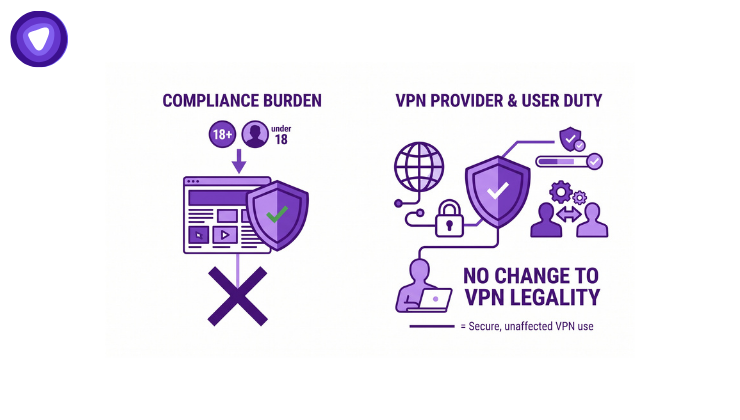
None of this makes VPN use illegal. VPN age verification laws like SB 73 place the compliance burden on the website hosting age-restricted content. The burden does not fall on the person using a VPN, and it does not fall on the VPN provider. Ordinary VPN use for security, remote work, or travel streaming remains unaffected across the country.
This distinction matters for anyone building or reselling a white label VPN product. The law creates a liability question for covered websites. It does not create a new licensing or detection duty for VPN infrastructure providers.
Why VPN Detection Is Not the Partner’s Problem
Reliably identifying VPN traffic at scale remains an unsolved problem across the security industry. Commercial VPN services route through large, rotating server pools. That traffic looks ordinary to most detection systems. Building a detection layer accurate enough for per-violation liability is a task for the covered website’s own compliance stack. It is not a gap in the VPN infrastructure a partner resells. A white label VPN partner should be ready to explain this in client talks about VPN age verification laws.
The Real Compliance Question for White Label Partners
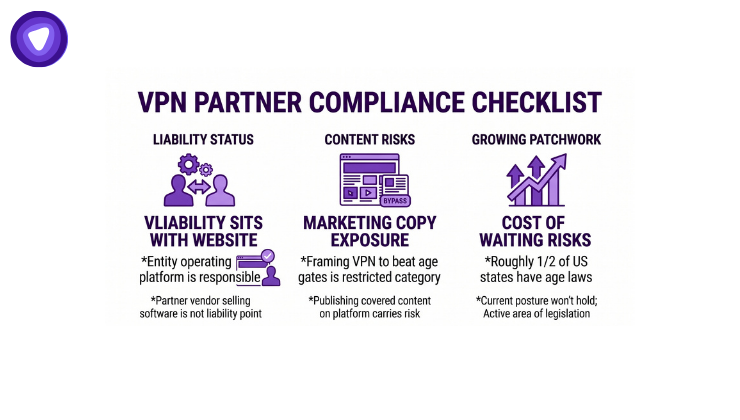
The location rule and the VPN-instruction ban do not touch a VPN vendor’s core product directly. They do touch three areas VPN age verification laws affect. A partner brand should check all three against its own compliance checklist now.
Liability Sits With the Covered Website, Not the VPN Vendor
SB 73 assigns responsibility to the entity operating the age-restricted platform. A white label VPN partner selling privacy and security software is not that entity. The narrower provision worth watching covers content that instructs users on bypassing an age gate. That provision could apply if a partner’s own platform ever hosts covered material.
Content and Marketing Copy Now Carries Legal Exposure
Blog posts, app descriptions, and support articles sometimes frame a VPN mainly as a tool for beating age checks. That framing sits closer to the restricted category than general privacy messaging does. A brand publishing that content on a covered platform faces the same exposure as any other operator under this clause.
A Growing Patchwork Raises the Cost of Waiting
Utah is not acting alone here. Roughly half the states in the country already have some form of internet age verification law. A partner operating across state lines cannot assume today’s compliance posture will hold for long. VPN age verification laws remain an active area of state legislation, not a settled category.
What This Means in Practice
The table below separates who actually carries risk under VPN age verification laws like SB 73 today.
| Party | Verifies Age | Faces Per-Violation Penalty | Restricted From Publishing Bypass Instructions |
| Covered adult website | Yes | Yes, $2,500 to $5,000 | Yes |
| VPN infrastructure vendor | No | No | Not directly regulated |
| White label partner brand, unrelated content | No | No | No |
| White label partner brand hosting covered content | Yes | Yes | Yes |
Most white label VPN partners sit in the third row above. The fourth row is the edge case worth checking now, before a state closes that gap. A partner reviewing its own data protection compliance posture already has a natural place to add this check.
How PureVPN White Label VPN Solution Supports Compliance-Ready Partners
A partner’s compliance posture depends on the vendor behind the product, not only on its own content review. PureVPN White Label VPN Solution runs on a KPMG-audited no-log policy across 6,500-plus servers in 88-plus countries. So partners are not left explaining a vendor’s own data practices during an unrelated state review.
Speed matters just as much when a compliance requirement shifts mid-year. Partners typically move from first contact to a live branded app within two weeks. Setup itself finishes the same day or the next, once signed. This is PureVPN’s own reported onboarding timeline, not independently audited. That timeline leaves room to adjust a compliance review before the next deadline, not after it. The same infrastructure also supports a broader privacy suite, so partners can bundle in identity protection later.
Final Thoughts
Utah’s SB 73 signals that more VPN age verification laws are coming at the state level, not fewer. The law does not ban VPN use, and it does not regulate VPN vendors directly. It does raise the stakes on what a partner brand publishes about circumventing age checks. That alone is one reason to pick a VPN partner with an audited compliance record before the next bill lands.