

- A white label privacy suite combines VPN, identity protection, and data broker removal into one unified security system.
- VPN forms the foundation by encrypting traffic, masking IP addresses, and securing access to internal systems.
- Identity protection strengthens security by detecting credential misuse and identifying abnormal login behavior in real time.
- Data broker removal reduces external exposure by eliminating personal information from broker databases and continuously monitoring reappearance.
- Integrating all three layers creates a continuous privacy model that reduces attack surfaces and supports scalable, branded security offerings.
A significant share of security incidents today begins outside traditional network boundaries. Credentials are reused across platforms, personal data is widely available through brokers, and identity signals are increasingly used to bypass standard authentication systems. Security teams are no longer dealing with isolated threats. They are dealing with connected exposure points across identity, traffic, and public data.
A white label privacy suite brings these layers together into a single architecture. VPN, identity protection, and data broker removal work as connected components rather than separate tools. This alignment reduces gaps that attackers typically exploit between systems.
The Shift From Isolated Tools To Privacy Ecosystems
Security architectures were originally built as separate functions. VPNs secured traffic. Identity tools handled authentication. Data exposure management was rarely part of enterprise security workflows.
This separation is no longer effective.
Modern threats operate across multiple layers at once:
- Stolen credentials are reused across services
- Publicly available personal data is used for targeting
- Authentication systems are bypassed using valid login data
- Attackers correlate identity data from multiple sources
The scale of this issue is expanding. Global cybercrime costs will reach $10.5 trillion annually by 2025, driven largely by identity misuse and data-driven attacks.
Security systems now need to function as connected ecosystems instead of isolated controls.
VPN As The Network Security Layer
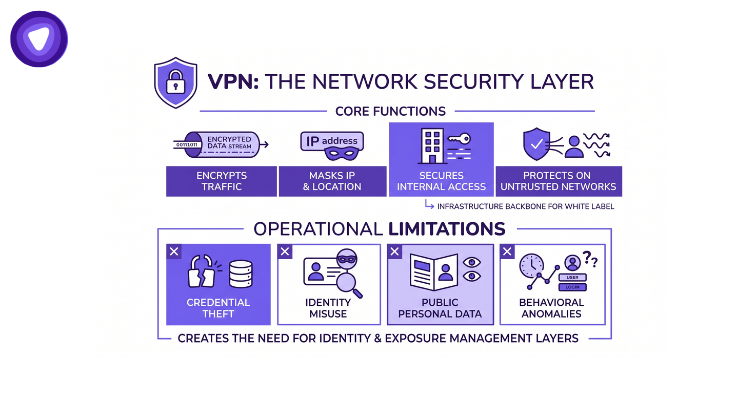
A VPN forms the foundational layer of a privacy suite by securing data in transit. It ensures that network communication remains encrypted and shielded from interception.
Core Functions Of VPN Infrastructure
- Encrypts internet traffic through secure tunnels
- Masks IP addresses and device location
- Secures access to internal systems and applications
- Protects users on untrusted networks
In a white label setup, this layer serves as the infrastructure backbone for higher-level privacy and identity functions.
Operational Limitations Of VPN-Only Security
A VPN does not address exposure outside the network layer:
- It does not prevent credential theft from external breaches
- It does not monitor identity misuse
- It does not remove publicly available personal data
- It does not detect behavioral anomalies in authentication
This creates the need for identity and exposure management layers.
Identity Protection As A Behavioral Security Layer
Identity protection focuses on how credentials are used rather than just whether they are valid. It evaluates patterns of behavior to identify misuse or abnormal access.
What Identity Protection Systems Monitor
- Login activity across devices and locations
- Use of compromised credentials from external leaks
- Deviations in authentication behavior
- Risk scoring for session legitimacy
According to IBM’s Cost of a Data Breach Report, the global average breach cost reached $4.88 million, with compromised credentials remaining one of the most common entry points.
Identity has effectively become the primary security boundary in modern environments.
Role In A Unified Privacy Architecture
Identity protection adds intelligence to VPN infrastructure by validating whether access attempts align with expected user behavior. It shifts security from static authentication to continuous evaluation.
Data Broker Removal As Exposure Reduction
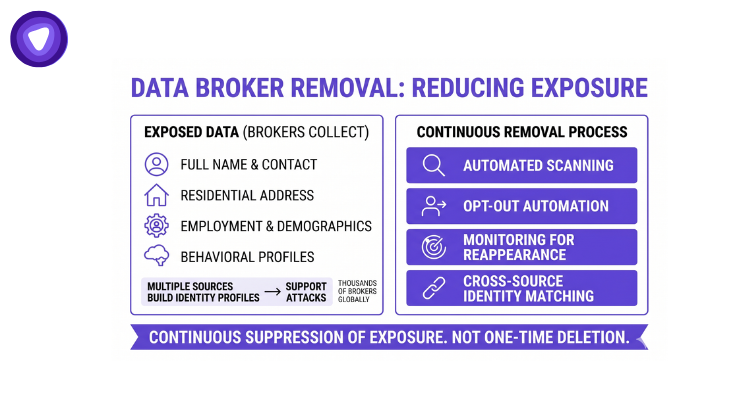
Data brokers collect and distribute personal information across multiple sources. This data is often used to build detailed identity profiles that can support phishing, impersonation, and targeted attacks.
Types Of Data Commonly Exposed
- Full names and contact details
- Residential addresses
- Employment and demographic data
- Behavioral and preference profiles
Research from privacy regulators indicates that large-scale data aggregation ecosystems involve thousands of brokers operating across regions, continuously repopulating personal data even after removal attempts.
Continuous Removal Process
A structured removal system typically includes:
- Automated scanning of broker databases
- Opt-out request automation
- Monitoring for data reappearance
- Cross-source identity matching
The goal is not one-time deletion but continuous suppression of exposure.
Why Integration Across Layers Is Essential
When VPN, identity protection, and data removal operate separately, gaps form between them. Those gaps are where attacks succeed.
An integrated model connects all three:
- VPN protects live traffic
- Identity systems validate access behavior
- Data removal reduces external exposure
Together, they form a continuous privacy control loop.
Key Benefits Of Integration
- Lower identity exposure across public and private systems
- Faster detection of credential misuse
- Reduced effectiveness of social engineering attacks
- Centralized security enforcement across environments
Architecture Of A White Label Privacy Suite
A white label privacy suite is designed as a modular system that can be rebranded and deployed across different environments.
Core Components
- VPN infrastructure layer
- Identity intelligence engine
- Data broker monitoring system
- Central management dashboard
- API integration layer
System Structure Overview
This structure enables each layer to operate independently while contributing to a unified security posture.
| Layer | Function | Input | Output |
| VPN Layer | Encrypts and routes traffic | User connection requests | Secure network traffic |
| Identity Layer | Detects anomalies in authentication | Login events | Risk scoring and alerts |
| Data Exposure Layer | Reduces public data availability | Personal identifiers | Removal actions and monitoring logs |
| Control Layer | Central management system | All system signals | Unified security visibility |
| API Layer | External integration | Third-party requests | Security responses and controls |
Business Use Cases For White Label Privacy Platform
White label privacy platforms support organizations across different operating models by unifying secure access, identity protection, and exposure reduction into a single scalable framework tailored to varying security needs.
SMB And Remote Teams
- Secure access for distributed employees
- Protection against credential reuse attacks
- Reduced exposure of employee data online
Managed Service Providers
- Branded privacy offerings for clients
- Centralized infrastructure management
- Scalable deployment across multiple organizations
Enterprise Security Teams
- Identity-aware access control
- Monitoring of high-risk user behavior
- Exposure management for executives and key personnel
Contractor And Partner Networks
- Controlled access for external users
- Temporary identity validation
- Reduced reliance on unmanaged environments
Deployment Considerations For Scalable Privacy Systems
White label privacy systems require flexibility across infrastructure and policy layers.
Key Technical Requirements
- API-first architecture for integration
- Multi-tenant environment support
- Distributed VPN server infrastructure
- Continuous identity event processing
- Automated data broker scanning systems
Operational Focus Areas
- Consistent VPN performance under load
- Real-time identity risk evaluation
- Non-disruptive background monitoring
- Modular activation of features per client
Scalability depends on how efficiently these systems interact under high usage conditions.
PureVPN White Label VPN As A Unified Privacy Infrastructure
Building a privacy suite from separate systems increases complexity and slows deployment. A unified white label infrastructure reduces that fragmentation.
PureVPN White Label VPN Solution provides the foundational VPN layer that can be extended into broader privacy architectures. It supports integration with identity protection workflows and exposure reduction systems, allowing organizations to build a complete privacy offering under their own brand.
Instead of managing separate vendors for network security, identity monitoring, and data exposure control, businesses operate through a single infrastructure layer designed for scale and customization.
Closing Perspective
Modern privacy challenges are distributed across multiple layers of the digital ecosystem. Network traffic, identity behavior, and public data exposure all contribute to the overall risk surface. Addressing these layers independently leaves structural gaps that attackers consistently exploit.
A white label privacy suite aligns these functions into a single system. It connects encrypted access, identity validation, and exposure reduction into a continuous control model that reflects how data is actually used and targeted today.