

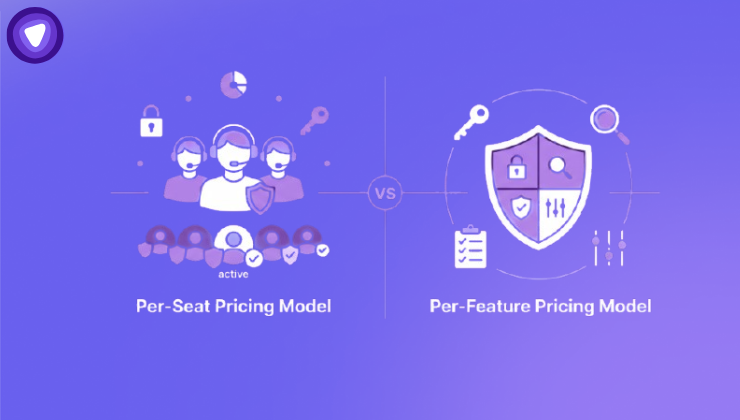
Quick Answer: For most platforms, the best digital privacy protection SaaS pricing model is a hybrid. Put exposure checks and dark web monitoring inside the seat price. Then sell data broker opt-out as an add-on, priced per protected person, since its cost keeps coming back.
Choosing a digital privacy protection SaaS pricing model is a margin decision first and a packaging decision second. The unit on your invoice decides how much of each dollar you keep. Pick the wrong unit, and every new customer widens a cost gap that stays hidden until renewal.
That gap starts with how removal work behaves. A 2025 peer-reviewed study from the Privacy Enhancing Technologies Symposium tested four paid removal services. On average, those services removed only 48.2 percent of the records they found. Users also confirmed that just 41.1 percent of flagged records were truly theirs. So any price tied to records found or removals filed bills customers for noise.
Meanwhile, the wider software market is moving away from single-unit pricing. The Growth Unhinged 2025 monetization survey found seat-based pricing fell from 21 to 15 percent of companies. Hybrid pricing rose from 27 to 41 percent over the same twelve months.
This guide is for product teams adding digital privacy protection to an existing SaaS plan. First, it breaks down what each function costs to run. Next, it shows where per-seat and per-feature pricing leak margin. Finally, it lays out the hybrid structure that holds up. Annual contracts lock in whatever unit you choose, so settle it before your next pricing page change.
What Each Digital Privacy Protection Function Costs to Run
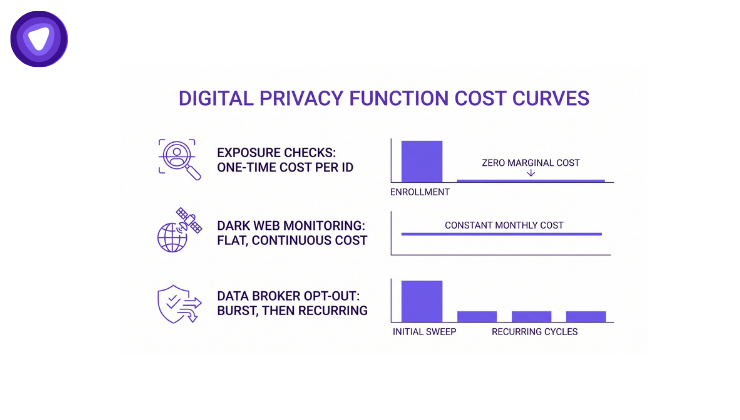
Pricing only works when the unit follows the cost. Digital privacy protection is not one cost line, though. It runs as three functions, and each one spends money on a different curve.
Exposure Checks: A One-Time Cost per Identity
The first scan checks an email, phone number, or username against breach data and broker listings. It runs once per identity at enrollment. After that, its marginal cost drops close to zero. As a result, the exposure check suits the base plan. It costs little and gives users an immediate reason to trust the feature.
Dark Web Monitoring: A Flat, Continuous Cost
Monitoring keeps each enrolled identifier under watch around the clock. Its cost stays flat per identity each month, whether alerts fire or not. Because the curve is flat, monitoring fits cleanly inside a per-seat price. In other words, a quiet month and a busy month cost about the same.
Data Broker Opt-Out: A Burst, Then a Recurring Cost
Opt-out behaves differently. The first sweep clears years of built-up listings, so month one costs the most. After that, brokers re-list records from fresh public filings and resold lists. Each re-listing restarts the status lifecycle from submitted through completed. That recurring work explains why opt-out rarely belongs inside a flat seat price.
Per-Seat Pricing: Where It Works and Where It Leaks
Per-seat pricing is still the default for B2B buyers. It is also the most common starting point for a digital privacy protection SaaS pricing model. Finance teams like it because the bill tracks headcount. In fact, most B2B SaaS products already meter privacy features as a per-seat add-on. Still, two hidden mechanics make per-seat pricing leak margin in this category.
The Activation Gap
A seat price charges every user with a license. Your own cost, however, follows the people who sign up. Those two numbers rarely match. Many users never open a privacy dashboard. A smaller group adds several emails and phone numbers each.
- If your partner bills per enrolled identity, low activation widens your margin.
- If your partner bills per provisioned seat, low activation means you pay for unused protection.
- If activation climbs after a breach headline, a flat seat price absorbs the entire cost spike.
For that reason, confirm the wholesale unit before you set the retail one.
Seat Reassignment Restarts the Opt-Out Burst
SaaS seats move between people. A departing employee hands a license to a new hire. For most features, that swap costs nothing. For opt-out, it restarts the expensive first sweep under a brand new identity. So a customer with high staff turnover can trigger dozens of first sweeps a year on one flat price. To contain this, cap reassignments per seat or charge a small re-enrollment fee.
Per-Feature Pricing: Matching Price to Cost
Per-feature pricing splits the three functions into separate line items. It tracks cost more closely than seats do. However, it only works when you define the billing unit with care. Two decisions matter most here.
Choose the Unit: Identity, Identifier, or Request
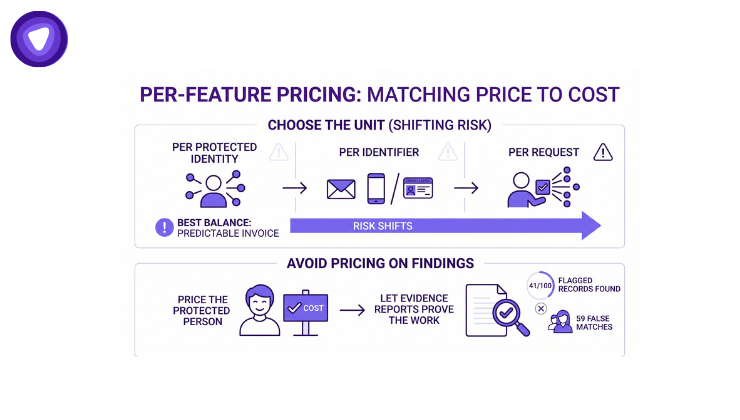
A per-feature price still needs a unit. Three options exist, and each one shifts risk differently.
- Per protected identity: One person counts once, no matter how many emails or phone numbers they add. Customers find this unit the easiest to plan for.
- Per identifier: Each email, phone number, or ID number counts separately. This tracks monitoring cost well but confuses buyers at checkout.
- Per request: Each opt-out submission counts. This tracks removal cost, yet it hands customers an unpredictable bill.
For most SaaS products, per protected identity strikes the best balance. It keeps the invoice predictable while still reflecting real cost.
Avoid Pricing on Findings
Some teams price opt-out per record found or per removal filed. The symposium data shows why that approach fails. In that study, only about 41 of every 100 flagged records belonged to the participant. A per-finding price would have billed for roughly 59 false matches out of every 100. Customers spot that gap the first time they read a removal report. Instead, price the protected person and let evidence reports prove the work.
Per-Seat vs. Per-Feature vs. Hybrid: Side by Side
The table below compares all three structures across the factors that decide margin and procurement speed. Use it as a quick filter before you model your own numbers.
| Factor | Per-Seat | Per-Feature | Hybrid (Seat Plus Opt-Out Add-On) |
| Billing unit | Licensed user | Function plus protected identity | Seat for checks and monitoring, identity for opt-out |
| Revenue predictability | High | Medium | High on base, medium on add-on |
| Cost alignment | Weak for opt-out | Strong | Strong |
| Activation gap exposure | High | Low | Low |
| Seat reassignment risk | High | Low | Capped by add-on terms |
| Procurement friction | Low | Medium | Low to medium |
| Best fit | Sales-led enterprise plans | Security-first products and a la carte buyers | Most B2B SaaS platforms |
Why a Hybrid Digital Privacy Protection SaaS Pricing Model Wins
A hybrid puts each function where its cost curve fits. Exposure checks and monitoring ride inside the seat. Opt-out sells as an add-on priced per protected identity. As a result, every user gets baseline protection, and only users who want removal pay for its recurring work.
This split also mirrors how buyers already purchase software. Procurement platform Vertice tracks SaaS contract data across its customer base. Price-per-user contracts fell from 42 to 37 percent between December 2024 and December 2025. Over the same period, hybrid contracts grew from 27 to 30 percent. Buyers now expect a base fee plus a variable layer.
Resellers who price modules separately follow the same logic. They do not fold every function into one flat fee. A hybrid digital privacy protection SaaS pricing model keeps the base bill easy for buyers to plan. Meanwhile, the add-on carries the cost that moves.
Illustrative Margin Math for a 10,000-Seat Platform
The figures below are round, illustrative numbers, not partner pricing. They show how a digital privacy protection SaaS pricing model moves margin as more users switch the feature on.
Start with shared assumptions. The platform has 10,000 paid seats. Wholesale cost is $1 per enrolled identity per month for monitoring. Opt-out costs $4 per enrolled identity per month.
Per-seat model ($3 add-on per seat, opt-out included):
- At 30 percent activation, revenue is $30,000. Costs reach $15,000, so margin sits at 50 percent.
- At 60 percent activation, revenue stays at $30,000. Costs climb to $30,000, so margin drops to zero.
Hybrid model ($1.50 per seat, plus an $8 opt-out add-on bought by one in three activated users):
- At 30 percent activation, revenue is $23,000. Costs reach $7,000, so margin sits near 70 percent.
- At 60 percent activation, revenue grows to $31,000. Costs reach $14,000, so margin holds near 55 percent.
The per-seat model looks healthy until users actually engage. By contrast, the hybrid model earns more as engagement grows. That difference is the core argument for choosing the unit before launch, not after the first renewal.
Billing Mechanics Your Engineering Team Inherits
Every pricing choice turns into code. Each model creates events your billing and access systems must handle from day one.
- Entitlement sync: An account management API with subscribed feature scopes lets billing switch monitoring or opt-out on and off per user. Without it, every plan change becomes a support ticket.
- Mid-cycle downgrades: Decide what happens to an opt-out sitting in pending verification when a customer drops the add-on. Finishing it protects trust, while cancelling it protects margin. Write the rule into your terms.
- Seat removal: When a seat disappears, stop monitoring and close open requests on a fixed schedule. Also document deletion of exposure records, not just suspension.
- Minimum terms: Opt-out cost lands heaviest in month one. An annual prepay or a three-month minimum stops customers from clearing their backlog and leaving.
Matching the Model to Your Go-To-Market Motion
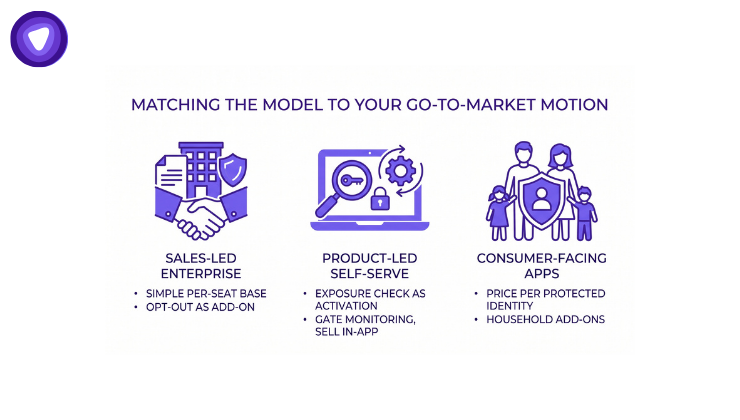
The right structure also depends on how your product reaches buyers. Each sales motion favors a different starting point.
- Sales-led enterprise: Keep a per-seat base so procurement stays simple. Then list opt-out as a named add-on on the order form.
- Product-led self-serve: Use the exposure check as an activation hook in the trial. Gate monitoring behind the paid seat, and sell opt-out inside the app.
- Consumer-facing apps: Price per protected identity with household add-ons. Identifiers multiply fast once partners and kids join one account.
What Happens When Protection Sits Inside the Base Plan
A productivity platform with millions of users offers a useful example. Over 30 percent of users who left the app named weak security as one reason. Large business buyers had also raised the gap during sales reviews. So the team built a branded VPN into the app for all users, at no extra charge. After that, average session time grew 12 percent, according to the productivity app case.
These are the client’s own reported results for a VPN feature, not for dark web monitoring or opt-out. Still, the pricing lesson carries over directly. Protection placed in the base plan reaches the users most likely to leave. That is why the hybrid model keeps monitoring inside the seat rather than behind a paywall.
How PureVPN White Label Digital Privacy Protection Fits Each Model
PureVPN White Label Digital Privacy Protection runs dark web monitoring and data broker opt-out on one engine. Its deployment paths map directly to the pricing models above. A full white label platform suits per-seat bundles. Modular API access lets SaaS teams take monitoring or opt-out a la carte for per-feature pricing. A hybrid deployment splits surfaces between your stack and the hosted dashboard.
Coverage spans 400+ people-search and broker sites, and opt-outs get re-checked each month. Every request comes with proof, such as listing details and screenshots. That proof helps at renewal time. The platform holds SOC 2 Type II and ISO 27001 certification. It also serves 150+ partners worldwide, a figure PureVPN reports internally rather than through an outside audit.
Choosing Your Digital Privacy Protection SaaS Pricing Model
The right digital privacy protection SaaS pricing model follows cost, not convention. Exposure checks and monitoring behave like flat seat costs, so bundle them. Opt-out behaves like recurring work, so price it per protected identity. Avoid any unit tied to findings, and settle reassignment and downgrade rules before launch. Teams that get this right protect margin as engagement grows, rather than watching it shrink.
Request a 20-minute pricing and packaging review for your plan tiers.
Frequently Asked Questions
What is the best digital privacy protection SaaS pricing model?
A hybrid model works best: monitoring inside the seat price, data broker opt-out sold per protected identity.
Is per-seat pricing good for dark web monitoring?
Yes. Dark web monitoring carries a flat monthly cost per identity, which matches a per-seat price cleanly.
Why should data broker opt-out be priced separately?
Brokers re-list removed records, so opt-out work recurs and costs most during the first sweep.
Should SaaS platforms charge per record found or per removal?
No. One 2025 study found only 41.1 percent of flagged records actually belonged to the user.
How does seat reassignment affect privacy feature costs?
Each new seat holder triggers a fresh first sweep, so capped reassignments or re-enrollment fees protect margin.