

- Five modules, not one product: VPN, password management, tracker blocking, identity monitoring, and broker opt-out each solve a different problem.
- Compliance now spans several states: California, Vermont, Texas, and Oregon require broker registration. Connecticut and New Jersey are joining soon.
- Staffing follows your setup choice: a partner API model needs billing and support staff. It does not need compliance officers or engineers.
- Price modules separately: VPN access and opt-out monitoring carry different costs. They should never share one flat price.
- Assign ownership early: someone must track the opt-out lifecycle, or churn shows up around month four.
MSPs lose margin fast when they sell privacy as a service as one flat bundle. VPN seats, identity monitoring, and broker-removal work all renew on different timelines. Blending them into one price hides where the margin actually leaks.
Here is an illustrative model. An MSP runs 500 client seats on a privacy bundle with a $9 monthly margin per seat. A 12 percent renewal drop on just the opt-out portion erases close to $6,500 in annual margin. VPN seats keep renewing fine the whole time. Most MSPs track one blended number instead of three separate ones. That gap goes unnoticed until the next contract review.
This guide is written for MSPs building a privacy as a service line inside an existing managed security stack. It covers the real cost of bundling and the compliance rules now spreading past California. It also covers pricing and ownership, so renewal margin survives past year one.
The Real Cost of Selling Privacy as a Service as One Bundle
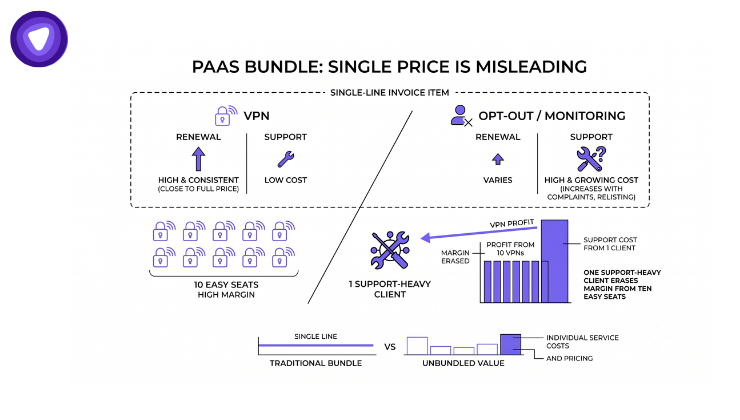
Most MSPs price this the same way they price antivirus reselling. They quote one number, invoice one line item, and assume renewal behaves the same way across every module.
It does not. VPN seats renew close to full price every cycle, with low support cost. Opt-out and monitoring work carries support cost that grows with client complaints, especially when a broker relists data mid-cycle. Blend both into one number, and one support-heavy opt-out client can quietly erase the margin from ten easy VPN seats.
Why a Branded VPN Should Be the Core Offer
Privacy as a service works best as one core product plus optional layers. It does not work well as five modules priced as equals. For an MSP, that core product is branded VPN access. Clients understand it fastest, and it carries the lowest support cost per seat.
Everything else, password management, tracker blocking, and identity monitoring, works better as a retention add-on. Introduce these after the first renewal, once the client already trusts the core service and pays on time.
Sequencing is what made this work for one partner, not the bundle itself. VPN access launched alone first, renewed at low support cost, and only then did the partner layer in the rest. Operational costs fell 32% once the core offer stabilized. Enterprise clientele grew 20% over the following two months, and revenue followed at 25%. None of that came from selling five modules at once on day one.
The Add-On Modules You Layer In After Launch
Once the VPN base renews well, four modules extend the offer. Each solves one narrow problem for the same client base.
| Module | Problem It Solves | Typical Source |
| Password management | Cuts down on reused passwords and reset tickets | Bundled password manager module |
| Tracker and ad blocking | Stops third party data collection in the browser | Threat protection layer with SDK access |
| Identity exposure monitoring | Flags where a person’s data shows up in breaches | Identity intelligence API |
| Data broker opt-out | Removes listings from people search and broker sites | Opt-out workflow API with status polling |
Deciding What to Build In House
Staffing matters more than tech choice here. An MSP running these add-ons through partner APIs needs three things. It needs a billing system. It needs a support desk. It needs one person who understands the opt-out steps well enough to explain delays to a client.
It does not need a compliance officer. It does not need a threat research team. It does not need engineers building encryption from scratch. Building any of these modules in house adds headcount for work a partner already runs at scale.
The Compliance Surface Is Expanding Past California
Most planning for privacy as a service still treats California as the whole picture. That view is already out of date.
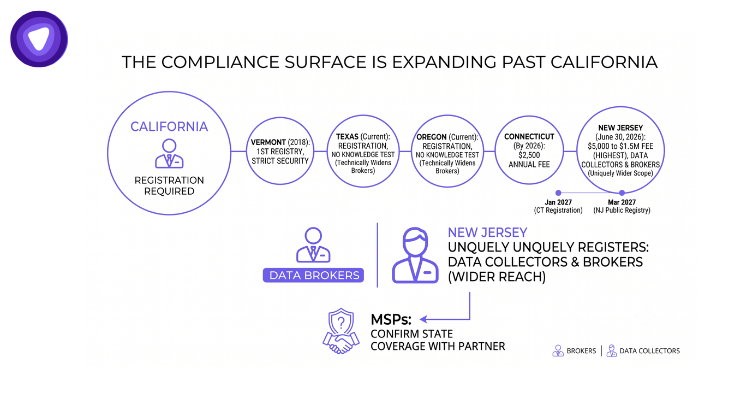
Four states require data broker registration today: California, Vermont, Texas, and Oregon. Connecticut joined the list in 2026. Registration there is due by January 2027, with a $2,500 annual fee.
New Jersey went further. It enacted its own law on June 30, 2026, and most provisions took effect immediately. Registration fees there range from $5,000 to $1.5 million a year, the highest in the country. A public registry follows in March 2027.
An MSP selling privacy as a service under its own brand should confirm state coverage with its partner. That question gets more urgent with each new state that signs a law.
- Vermont built the first registry, back in 2018, and it pairs registration with stricter security rules.
- Texas and Oregon require registration with no knowledge test, so more brokers technically qualify there than in California.
- New Jersey uniquely requires data collectors, not just brokers, to register, which widens who the law touches.
None of this tracking falls on the MSP directly. It falls on whichever partner runs the opt-out and monitoring layer. Ask if that partner holds current credentials before you sign anything. Look for SOC 2 Type II status and a verified no-log policy.
Pricing So Renewal Margin Does Not Erode
Flat per-seat pricing works for the first sale. It fails at renewal, once clients start comparing your bundle to unbundled options. Three tier models hold up better once a client base grows past year one.
- Per-seat VPN bundle: a fixed monthly fee for the core branded VPN product, sold per employee at the client site.
- Per-identity monitoring: price scales with how many employees get exposure monitoring. Useful once enterprise clients ask for it by name.
- Module add-ons: price password management and tracker blocking as upsells on the VPN base. Do not fold them into the original quote.
Whichever model you pick, price opt-out and monitoring apart from VPN access. The two carry different costs. They also renew on different timelines. One flat number makes margin hard to track past the first quarter.
Who Owns This After the Sale
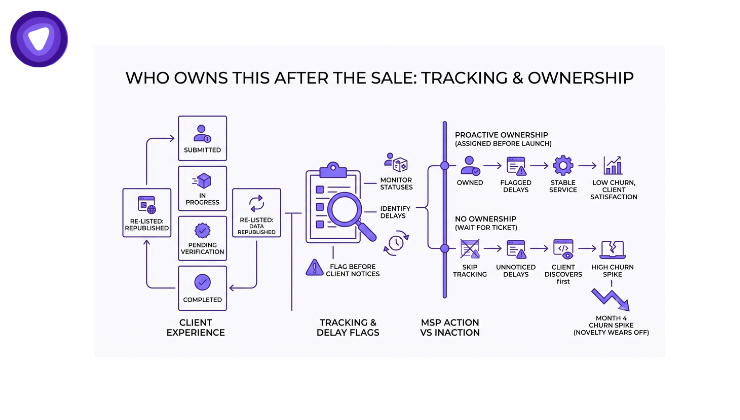
Privacy as a service does not end at setup. Broker opt-out requests move through several steps. First submitted, then in progress, then pending verification, then completed. Sometimes a listing gets re-listed when a broker republishes the same data.
Someone on the MSP’s team needs to own that tracking. That person should flag delays before the client notices first. Assign this before launch. Do not wait for the first support ticket. MSPs that skip this step tend to see churn spike around month four, right after launch novelty wears off.
Where PureVPN White Label VPN Solution Fits
MSPs building a privacy as a service line from scratch face a choice. They can spend a year building separate integrations for VPN, monitoring, and opt-out. Or they can start from one partner console that already runs all three. PureVPN White Label VPN Solution is built around branded VPN as the launch product. Password management, tracker blocking, and identity monitoring ship as add-on modules once the core offer renews well.
This sequencing matters most for MSPs trying to launch fast, without new backend hires. The VPN module ships with credentials and support already built in. What the MSP still controls is the packaging, the pricing tiers, and the client relationship. That is where the real margin in privacy as a service sits.
Final Thoughts
The operators that protect renewal margin separate module costs, assign lifecycle ownership, and verify their partner’s compliance evidence before launch. Do those three things and a privacy bundle survives past the first renewal. Skip them, and a support ticket exposes what was bundled inside it.