


- Credential Exposure Monitoring Basics: Credential exposure monitoring helps SaaS platforms detect when user credentials appear in breach databases or dark web sources before attackers can use them.
- Attack Risk: Exposed credentials are quickly weaponized in automated attacks, making early detection critical for preventing account takeovers and unauthorized access.
- How It Works: The process works by ingesting breach intelligence, normalizing data, and matching leaked credentials against user accounts in the SaaS environment.
- Automated Response: Once exposure is detected, systems can trigger automated responses such as password resets, session revocation, and MFA enforcement to reduce risk.
- Security Impact: Integrating credential exposure monitoring strengthens SaaS security posture by reducing attack windows, improving incident response speed, and limiting credential-based breaches.
Credential exposure monitoring helps SaaS platforms detect compromised user credentials from external breaches and trigger protective actions before account takeover attempts occur.
A stolen password rarely stays inactive for long. Exposed credentials are quickly tested against cloud applications, admin portals, customer accounts, and internal systems. For SaaS providers, the resulting risk extends beyond the original breach source and directly impacts user security.
By continuously monitoring breach intelligence sources and identifying affected accounts, SaaS platforms can reduce credential-based attacks, improve incident response, and strengthen account protection. As credential theft remains a leading cause of unauthorized access, credential exposure monitoring has become an essential component of modern SaaS security.
Why Credential Exposure Monitoring Matters
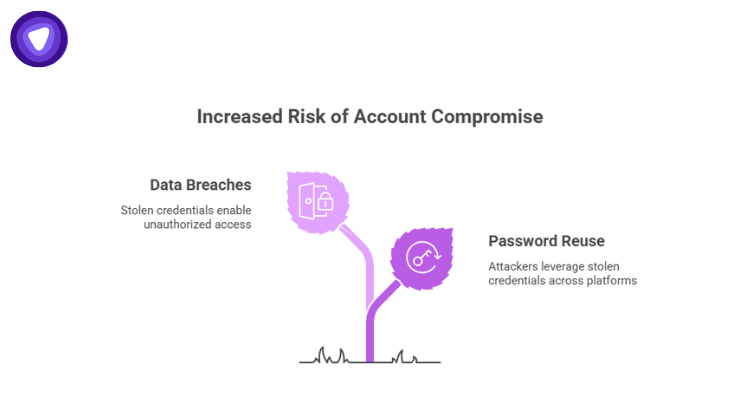
Most SaaS applications depend on usernames and passwords as part of their authentication flow. Even when multi-factor authentication is available, many users continue to reuse passwords across multiple services.
When another platform suffers a data breach, attackers often obtain:
- Email addresses
- Usernames
- Password hashes
- Plain-text passwords
- Authentication tokens
These credentials quickly appear on dark web marketplaces, private forums, and breach databases.
Attackers then launch credential stuffing campaigns against other services where users may have reused the same passwords.
Stolen credentials remained one of the most common initial access methods in confirmed breaches. Credential abuse continues to be a primary driver of account compromise across industries.
For SaaS providers, this creates a difficult challenge. The exposed credential may not originate from their environment, yet their platform becomes the next target.
Credential exposure monitoring provides visibility into this risk.
What Is Credential Exposure Monitoring?
Credential exposure monitoring is the process of continuously identifying whether user credentials associated with your application have appeared in known breach datasets or underground sources.
The objective is simple: detect compromised credentials before attackers successfully use them.
A monitoring system typically performs several functions:
| Function | Purpose |
| Breach Data Monitoring | Tracks newly disclosed credential leaks |
| Credential Matching | Identifies affected users within the SaaS platform |
| Risk Scoring | Prioritizes incidents based on severity |
| User Notification | Alerts impacted users |
| Automated Response | Forces password resets or additional verification |
| Security Analytics | Tracks exposure trends and attack patterns |
Unlike traditional login monitoring, credential exposure monitoring focuses on external compromise events rather than suspicious activity inside the application.
How Credential Exposure Monitoring Works
A modern implementation follows a structured workflow.
1. Collect Exposure Intelligence
The first layer involves gathering breach intelligence from multiple sources.
These may include:
- Public breach repositories
- Dark web monitoring feeds
- Underground marketplace intelligence
- Security research databases
- Commercial threat intelligence providers
The monitoring system continuously ingests newly discovered credentials.
2. Normalize and Process Data
Breach data arrives in different formats and quality levels.
Processing typically includes:
- Email normalization
- Username standardization
- Duplicate removal
- Hash identification
- Metadata enrichment
This step improves matching accuracy while reducing false positives.
3. Match Against User Accounts
The system compares breach records against account identifiers stored within the SaaS platform.
Most organizations avoid direct password comparisons.
Instead, they use:
- Cryptographic hashing
- Secure lookup methods
- Privacy-preserving matching techniques
The goal is to identify affected users without exposing sensitive account data.
4. Assess Risk
Not every exposure carries the same level of threat.
Factors commonly evaluated include:
- Password age
- Password reuse likelihood
- User privilege level
- Administrative access
- Exposure source credibility
- Number of leaked records
High-risk accounts typically require immediate action.
5. Trigger Security Controls
Once exposure is confirmed, automated responses can reduce the attack window.
Examples include:
- Forced password reset
- Temporary account lock
- MFA enrollment requirement
- Step-up authentication
- Session revocation
- Security alerts
These actions limit the value of stolen credentials.
Security Benefits for SaaS Platforms
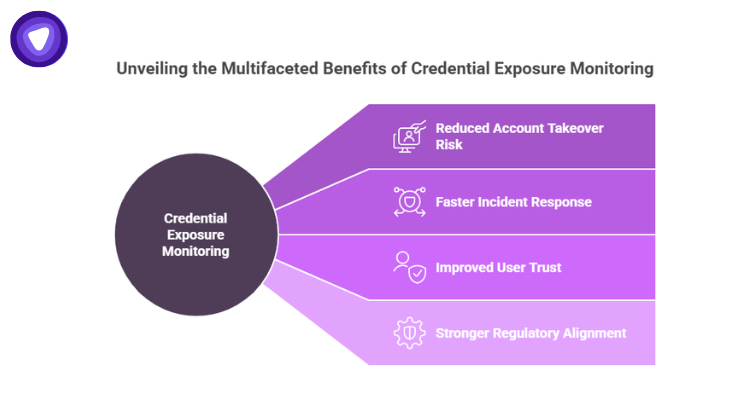
Credential exposure monitoring delivers measurable security improvements across multiple areas.
Reduced Account Takeover Risk
Account takeover remains one of the most costly threats facing SaaS companies.
Compromised credentials continued to rank among the most expensive breach vectors due to the extensive remediation and investigation required.
Early exposure detection interrupts many takeover attempts before they succeed.
Faster Incident Response
Traditional detection methods often rely on suspicious login behavior.
Credential exposure monitoring identifies risk before malicious activity reaches production systems.
This shortens response times significantly.
Improved User Trust
Customers expect SaaS providers to actively protect their accounts.
Prompt notifications about exposed credentials demonstrate proactive security practices and help maintain confidence in the platform.
Stronger Regulatory Alignment
Many security frameworks emphasize credential protection and risk management.
Exposure monitoring supports:
- SOC 2 security controls
- ISO 27001 requirements
- NIST recommendations
- Industry-specific security standards
The capability also creates a stronger security posture during audits and assessments.
Architectural Considerations
Implementing credential exposure monitoring requires careful design decisions.
Privacy First Design
Security teams must avoid storing or transmitting sensitive credentials unnecessarily.
Recommended practices include:
- Hash-based comparisons
- Encryption in transit
- Encryption at rest
- Data minimization
- Strict retention policies
User privacy should remain a core design requirement.
Real-Time Processing
Attackers move quickly after credentials become available.
Monitoring pipelines should support:
- Continuous ingestion
- Near real-time matching
- Automated alerting
- Immediate response workflows
Delays increase exposure risk.
Scalability
Large SaaS environments may process millions of user accounts.
The architecture should support:
- High-volume matching
- Distributed processing
- Efficient indexing
- Automated scaling
Performance bottlenecks can reduce monitoring effectiveness.
API Integration
Many SaaS applications already use external security services.
Credential monitoring systems should integrate with:
- Identity providers
- SIEM platforms
- Security orchestration tools
- Threat intelligence feeds
- Authentication services
This creates a unified security workflow.
Best Practices for Deployment
Organizations achieve better results when credential monitoring becomes part of a broader identity security strategy.
Prioritize High-Risk Users
Administrative accounts should receive enhanced monitoring.
Focus first on:
- Administrators
- Super users
- Financial users
- Support teams
- Privileged accounts
Compromise of these accounts often leads to wider damage.
Combine Monitoring With MFA
Credential monitoring identifies exposure.
MFA reduces attacker success rates.
MFA blocks the vast majority of automated account compromise attempts when properly implemented.
The combination provides significantly stronger protection than either control alone.
Automate Response Actions
Manual investigations create delays.
Automated workflows should handle:
- User notifications
- Password resets
- Session invalidation
- Risk-based authentication
Automation reduces response time and operational overhead.
Educate Users
Many credential exposures stem from password reuse.
User awareness programs should encourage:
- Unique passwords
- Password managers
- MFA adoption
- Recognition of phishing attempts
Technology alone cannot eliminate credential risk.
Common Challenges
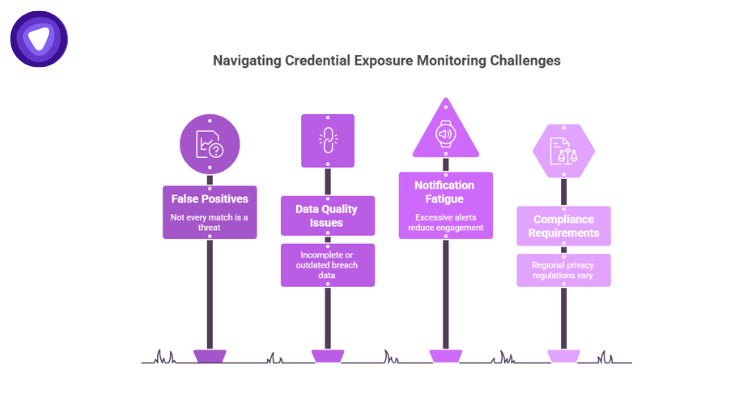
Credential exposure monitoring introduces several operational challenges.
False Positives
Not every matched credential represents an active threat.
Security teams need reliable validation processes to prevent unnecessary disruption.
Data Quality Issues
Breach datasets often contain incomplete or outdated information.
Validation and enrichment processes improve accuracy.
Notification Fatigue
Excessive alerts can reduce user engagement.
Notifications should be actionable, relevant, and prioritized according to risk.
Compliance Requirements
Different regions impose different requirements for handling personal information.
Monitoring systems must align with applicable privacy regulations and organizational policies.
Bringing Credential Exposure Monitoring to Your White Label Security Offering
For companies building SaaS products with integrated security services, credential exposure monitoring can become a valuable differentiator.
Users increasingly expect security features to extend beyond basic authentication. They want visibility into credential risks, proactive alerts, and automated protection when exposures occur. Integrating these capabilities directly into the user experience strengthens platform security while reducing support and incident response burdens.
Organizations using PureVPN White Label VPN Solution can extend their security offerings with complementary identity protection capabilities such as credential exposure monitoring. Combined with secure remote access, encrypted connectivity, and account protection measures, this creates a more complete security experience for end users without requiring multiple standalone security products.
Closing Thoughts
Credential theft remains one of the most reliable attack paths because passwords continue to sit at the center of digital identity. The challenge for SaaS providers is no longer detecting attacks after they occur. It is identifying exposed credentials before attackers can use them.
Credential exposure monitoring provides that visibility. By continuously tracking breach intelligence, matching affected accounts, and automating protective actions, SaaS platforms can reduce account takeover risk, strengthen customer trust, and improve overall security resilience. As identity threats continue to evolve, proactive credential monitoring is becoming a standard component of modern SaaS security architecture.