

- Enterprise Security Shift: Enterprise security virtual appliances replace hardware-based security with software that runs across cloud, hybrid, and virtual environments for flexible protection.
- Faster Scaling: They enable faster deployment and scaling compared to traditional security appliances, reducing delays linked to procurement and physical installation.
- Core Capabilities: They provide secure remote access, encrypted site-to-site connectivity, network segmentation, and identity-based access control.
- Centralized Control: Centralized policy management improves visibility, consistency, and control across distributed infrastructure and remote teams.
- Cost Efficiency: These solutions reduce infrastructure costs while supporting cloud-first and hybrid enterprise architectures without limiting growth.
The network perimeter is no longer fixed. Applications now run across cloud platforms, while employees access systems from homes, offices, and public networks across multiple regions.
This distribution makes security harder to manage without adding physical infrastructure or operational complexity.
Enterprise security virtual appliances address this shift by replacing hardware-based controls with software that scales across cloud, hybrid, and remote environments.
The result is consistent protection, centralized control, and the flexibility needed for modern enterprise networks.
What Is an Enterprise Security Virtual Appliance?
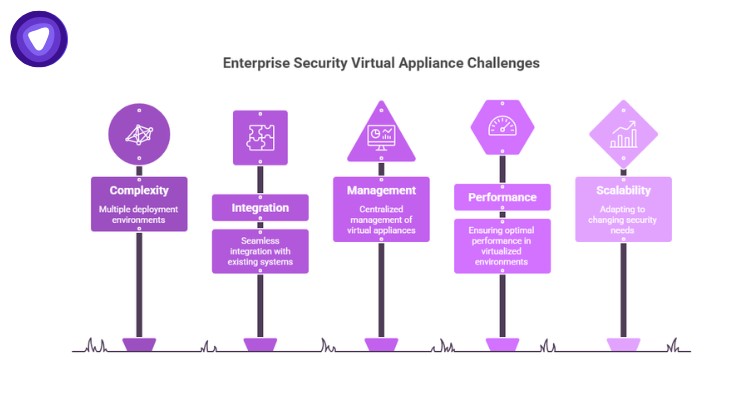
An enterprise security virtual appliance is a software-based security solution that delivers network protection functions within virtualized environments.
Unlike traditional security appliances that require dedicated hardware, virtual appliances operate inside:
- Public cloud environments
- Private clouds
- Virtual machines
- Hybrid infrastructures
- Data centers
- Multi-cloud deployments
The appliance performs security functions such as:
- Secure remote access
- Traffic encryption
- Access control
- Network segmentation
- Identity verification
- Traffic inspection
- Secure connectivity between locations
Because deployment is software-driven, organizations can provision protection quickly without purchasing and installing physical devices.
Why Traditional Security Infrastructure Struggles to Scale
For years, organizations relied on hardware appliances to secure network traffic.
That approach worked when applications, employees, and data remained inside centralized environments.
Business infrastructure has changed significantly.
According to Gartner, more than 90% of organizations will adopt a hybrid cloud approach by 2027, making distributed infrastructure the standard operating model rather than the exception.
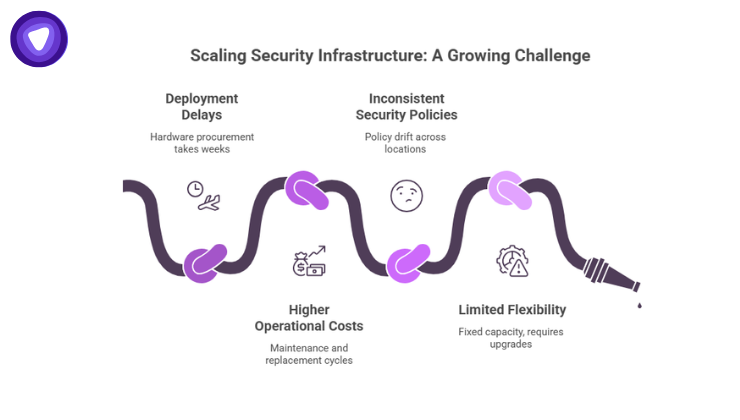
As environments expand, physical security appliances create several challenges:
Deployment Delays
Hardware procurement cycles can take weeks or months.
New offices, cloud environments, and business units often require immediate connectivity and protection.
Higher Operational Costs
Each appliance introduces:
- Hardware expenses
- Maintenance contracts
- Replacement cycles
- Physical installation requirements
Costs increase as infrastructure grows.
Inconsistent Security Policies
Managing multiple appliances across locations often leads to policy drift.
Different configurations create visibility gaps and increase administrative burden.
Limited Flexibility
Hardware capacity is fixed.
Unexpected traffic growth often requires additional appliances or upgrades.
Virtual appliances eliminate many of these limitations by providing security functions through software that scales as needed.
Core Security Functions of Virtual Appliances
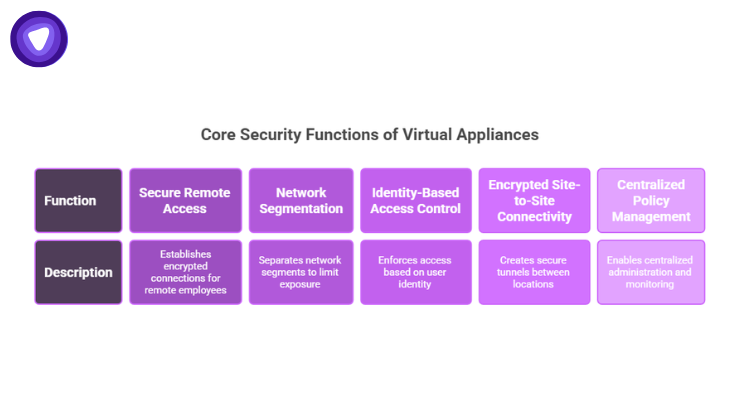
Enterprise security virtual appliances perform several critical functions that support secure business operations.
Secure Remote Access
Remote work remains a permanent business reality.
According to the U.S. Bureau of Labor Statistics, millions of employees continue working remotely or in hybrid arrangements across industries.
Virtual appliances establish encrypted connections between users and company resources regardless of location.
This ensures that sensitive data remains protected when employees access:
- Internal applications
- Development environments
- File repositories
- Customer systems
- Cloud workloads
Network Segmentation
Flat networks increase risk.
Once attackers gain access, lateral movement becomes easier.
Virtual appliances support network segmentation by separating:
- Departments
- Development environments
- Production systems
- Third-party vendors
- Partner access
This limits exposure and reduces potential attack impact.
Identity-Based Access Control
Modern security strategies focus on user identity rather than network location.
Virtual appliances can integrate with identity providers to enforce:
- User authentication
- Multi-factor authentication
- Role-based permissions
- Access restrictions
Only authorized users gain access to designated resources.
Encrypted Site-to-Site Connectivity
Organizations frequently operate across multiple offices, cloud regions, and data centers.
Virtual appliances create secure tunnels between locations, ensuring traffic remains encrypted while moving across public networks.
Centralized Policy Management
Security teams require visibility.
Virtual appliances enable centralized administration, making it easier to:
- Apply policies
- Monitor activity
- Review logs
- Manage users
- Update configurations
This reduces management overhead while improving consistency.
Benefits of Virtual Appliances for Enterprise Security
Modern enterprise networks require scalable, software-driven security instead of fixed hardware deployments.
Faster Deployment
Virtual appliances can often be deployed within minutes.
There is no need to:
- Ship hardware
- Schedule installations
- Configure physical infrastructure
Organizations can extend protection rapidly as business requirements change.
Simplified Scaling
Growth should not require a complete redesign of security architecture.
Virtual appliances scale alongside:
- User growth
- Cloud expansion
- New applications
- Geographic expansion
Resources can be adjusted according to demand.
Reduced Infrastructure Costs
Organizations avoid many expenses associated with physical appliances.
The savings extend beyond hardware purchases to include:
- Maintenance
- Shipping
- Power consumption
- Rack space
- Replacement cycles
Greater Business Agility
Security teams can support new initiatives faster.
Whether launching a new cloud environment or expanding internationally, virtual appliances can be deployed wherever protection is required.
Improved Visibility
Centralized monitoring helps security teams identify:
- Unauthorized access attempts
- Suspicious behavior
- Policy violations
- Connectivity issues
This improves operational awareness and response times.
Enterprise Security Virtual Appliance vs Traditional Hardware
For organizations adopting cloud-first strategies, virtual appliances align more closely with modern infrastructure requirements.
| Feature | Virtual Appliance | Hardware Appliance |
| Deployment Speed | Minutes | Days or weeks |
| Scalability | Elastic | Hardware-dependent |
| Infrastructure Cost | Lower | Higher |
| Geographic Expansion | Rapid | Requires new hardware |
| Cloud Compatibility | Native | Often limited |
| Maintenance | Software-based | Physical servicing |
| Resource Allocation | Flexible | Fixed capacity |
| Remote Management | Centralized | Often fragmented |
Security Challenges Virtual Appliances Help Address
Security environments are becoming more complex as organizations adopt cloud services, remote work models, and third-party integrations, increasing exposure points across the network.
Expanding Attack Surfaces
Every new application, user, and cloud workload increases exposure.
According to IBM’s Cost of a Data Breach Report 2024, the average global data breach cost reached $4.88 million, the highest level recorded to date.
Reducing unnecessary exposure has become a priority for security teams.
Virtual appliances help enforce access controls and secure communication channels across distributed environments.
Cloud Security Complexity
Many organizations operate workloads across multiple cloud providers.
Maintaining consistent security policies across environments becomes difficult without centralized controls.
Virtual appliances provide a unified security layer regardless of where workloads reside.
Third-Party Access Risks
Contractors, vendors, and partners often require access to internal resources.
Granting broad network access increases risk.
Virtual appliances support controlled access policies that restrict users to only the resources necessary for their role.
Remote Workforce Security
Remote access remains one of the most targeted attack vectors. Credential abuse continues to play a major role in security incidents.
Encrypted access and identity-based controls reduce opportunities for unauthorized access.
Key Considerations When Selecting a Virtual Appliance
Not all solutions provide the same capabilities.
Organizations should evaluate several factors before deployment.
Scalability
The appliance should support growth without requiring significant redesign.
Consider:
- User capacity
- Traffic volume
- Geographic expansion
- Cloud adoption plans
Multi-Cloud Support
Many organizations operate across multiple cloud providers. Support for diverse environments ensures flexibility as infrastructure evolves.
Centralized Administration
Management complexity increases quickly without centralized controls. Look for solutions that provide unified dashboards and policy management.
Security Controls
Evaluate available security features, including:
- Encryption standards
- Authentication methods
- Access controls
- Logging capabilities
- User management
Deployment Flexibility
The solution should support:
- Public clouds
- Private clouds
- Hybrid environments
- Virtualized infrastructure
This ensures long-term adaptability.
How PureVPN White Label VPN Supports Enterprise Virtual Security Deployments
Organizations building secure connectivity services often require more than standard VPN functionality. They need a platform capable of supporting enterprise-scale deployments, centralized management, and flexible infrastructure requirements.
PureVPN White Label VPN Solution enables businesses to deliver secure remote access and encrypted connectivity under their own brand while supporting distributed environments. The solution provides access to a global VPN infrastructure, centralized administration capabilities, and deployment flexibility that aligns with modern virtualized environments.
For service providers, MSPs, telecommunications companies, and enterprises developing customer-facing security offerings, PureVPN White Label VPN reduces the operational burden associated with building and maintaining VPN infrastructure from scratch. Instead of investing heavily in backend development, organizations can focus on delivering secure connectivity services while maintaining brand ownership and control over the customer experience.
Final Thoughts
Network security increasingly depends on adaptability. Organizations must secure users, applications, and infrastructure regardless of location while maintaining visibility and control. Enterprise security virtual appliances support this shift by replacing hardware limitations with software-driven protection that scales alongside business growth.
As cloud adoption, remote work, and distributed infrastructure continue expanding, virtual appliances provide a practical foundation for consistent network security. They simplify deployment, improve operational efficiency, and help organizations maintain protection without adding unnecessary complexity. For enterprises planning long-term growth, scalable security architecture is no longer optional. It is a fundamental requirement.