

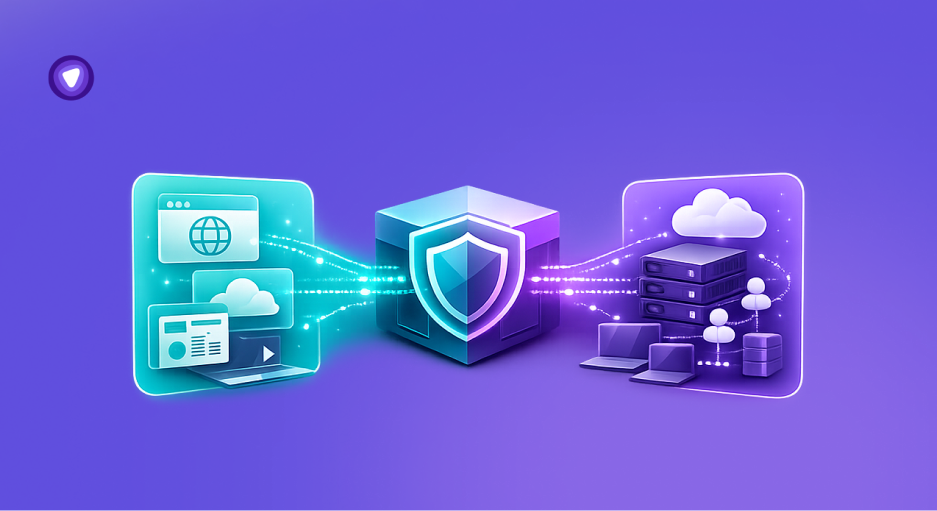
- Secure Application Layer Gateways (ALG) operate at the application layer to inspect and control traffic inside encrypted VPN sessions.
- Traditional firewalls and VPNs are not sufficient for modern networks due to encrypted traffic, APIs, and distributed cloud environments.
- ALG enhances VPN security by enabling protocol-aware inspection, session validation, and application-level policy enforcement.
- In white label VPN setups, ALG helps MSPs and SaaS providers manage secure, scalable, and application-aware access for multiple clients.
- PureVPN White Label VPN integrates ALG to reduce visibility gaps in encrypted traffic while maintaining consistent global access control.
A single misrouted packet is enough to expose what a perimeter was supposed to protect.
Modern business networks no longer fail at the edge. They fail inside application flows where identity, session control, and encrypted traffic intersect without clear inspection or policy enforcement. That gap is where Secure Application Layer Gateways (ALG) become critical.
They sit between users and applications, not just filtering traffic but interpreting it. In environments built on remote access, distributed teams, and hybrid infrastructure, that interpretation layer decides whether access stays controlled or turns opaque.
What a Secure Application Layer Gateway Does in Business Networks
An Application Layer Gateway operates at Layer 7 of the OSI model. Instead of only passing packets based on IP and ports, it inspects application-specific data and adjusts traffic behavior in real time.
In enterprise environments, this matters because modern applications rarely follow static patterns. They use:
- Encrypted API calls
- Dynamic ports
- Microservice communication
- Multi-region authentication flows
A Secure ALG understands these behaviors and applies policy at the application level rather than the network level.
Core functions include:
- Deep inspection of application protocols
- Session validation across endpoints
- Controlled NAT traversal for complex protocols
- Traffic normalization for security enforcement
- Real-time application-aware routing
This shifts security from perimeter-based filtering to session-aware control.
Why Traditional Network Security No Longer Holds Up
Most legacy firewalls were built for predictable traffic. Fixed ports, known protocols, and centralized applications.
That model collapses under current conditions:
- Remote teams connect from unmanaged networks
- Applications depend on cloud APIs
- Services communicate across distributed environments
- Encryption hides payload-level visibility
According to IBM’s Cost of a Data Breach Report, the global average breach cost reached $4.88 million, the highest recorded level to date. A large share of these incidents involved gaps in visibility across identity and application layers.
Another key shift comes from attack behavior itself. Around 68% of breaches involve a human element, including credential misuse and social engineering that bypasses perimeter defenses.
Security is no longer about blocking entry points. It is about validating every application interaction continuously.
Secure ALG in a VPN-Centric Business Architecture
VPN infrastructure already solves encrypted connectivity. However, encryption alone does not solve application-level control.
A Secure ALG complements VPN architecture by adding inspection and policy enforcement after the tunnel is established.
In a business VPN environment, this enables:
- Application-aware access control for remote users
- Protocol validation inside encrypted tunnels
- Session-level authentication checks
- Controlled access to internal APIs and services
- Prevention of protocol abuse inside VPN traffic
This becomes especially important for organizations using white label VPN deployments, where the VPN infrastructure is embedded into their own product or service offering.
Without ALG, a VPN becomes a blind tunnel. With ALG, it becomes a controlled application pathway.
Key Protocols Managed by Application Layer Gateways
Secure ALGs are not generic filters. They are protocol-specific engines designed to interpret application behavior.
Common protocols include:
- SIP for voice communication
- FTP for file transfers
- HTTP/S API traffic
- DNS queries
- VoIP signaling streams
Each of these behaves differently when encrypted, NAT-translated, or routed through distributed systems.
For example:
- SIP requires session tracking to maintain call integrity
- FTP requires dynamic port negotiation
- API traffic requires header-level validation rather than port-based rules
Without ALG, these protocols either break or bypass security controls entirely.
Where Secure ALG Fits in White Label VPN Solutions
White label VPN platforms are often deployed by MSPs, SaaS providers, and enterprises building secure access products under their own brand.
In these environments, Secure ALG acts as the application intelligence layer inside the VPN infrastructure.
It enables:
- Controlled exposure of internal services to end users
- Application-specific routing rules per tenant
- Secure API access management across clients
- Protocol-aware inspection without breaking encryption
- Policy enforcement aligned with organizational roles
This is critical when multiple clients share the same VPN backbone but require isolated, controlled application access.
Technical Architecture of a Secure ALG System
A production-grade Secure ALG is typically structured across three layers:
1. Traffic Interception Layer
Captures application traffic after VPN tunnel decryption or ingress routing.
- Session identification
- Protocol detection
- Initial packet classification
2. Application Parsing Layer
Interprets application-specific logic.
- Header and payload analysis
- Protocol state tracking
- Behavioral validation
3. Policy Enforcement Layer
Applies security rules dynamically.
- Allow, deny, or modify sessions
- Rate limiting per application
- Identity-based access control
- Logging and anomaly detection
This separation ensures that inspection does not degrade network performance while maintaining visibility at the application level.
Secure ALG vs Traditional Firewall vs VPN Gateway
This comparison highlights a key shift. VPNs secure transport. Firewalls filter access. Secure ALGs validate application behavior inside that access.
| Feature | Traditional Firewall | VPN Gateway | Secure Application Layer Gateway |
| Inspection level | IP / Port | Encrypted tunnel only | Application Layer (L7) |
| Protocol awareness | Limited | None | Full protocol parsing |
| API visibility | No | No | Yes |
| Session control | Basic | Medium | Advanced, application-aware |
| Remote access security | Partial | Encrypted only | Encrypted + validated sessions |
| NAT traversal handling | Basic | Supported | Optimized per protocol |
| Threat detection scope | Network-level | Transport-level | Application + session-level |
Security Challenges ALG Solves in Modern Networks
Several persistent issues in enterprise environments require application-layer intervention:
Encrypted traffic blind spots
Encryption protects data but also hides malicious behavior. ALG restores visibility at the session level without breaking encryption policies.
API abuse and token misuse
APIs often bypass traditional security layers. ALG validates structure, rate, and session integrity.
Remote access inconsistency
Users connecting from different regions or devices introduce unpredictable session behavior. ALG normalizes and enforces policy consistency.
Protocol tunneling risks
Attackers can embed unauthorized traffic inside allowed protocols. ALG detects abnormal protocol behavior patterns.
Performance Considerations in ALG Deployment
Application layer inspection introduces processing overhead. Efficient implementation focuses on:
- Hardware-accelerated packet parsing
- Session caching for repeated flows
- Selective inspection based on risk scoring
- Distributed gateway architecture
- Policy prioritization per application type
Modern implementations reduce latency impact while maintaining full session visibility.
Role of ALG in Hybrid and Cloud-First Environments
Hybrid infrastructure introduces fragmented application paths. Some services run on-premises, others in cloud-native environments.
Secure ALG helps unify access logic across:
- SaaS applications
- Internal microservices
- Cloud APIs
- On-prem systems
- Third-party integrations
Instead of managing separate security rules per environment, ALG applies consistent application-aware policies across all traffic flows.
PureVPN White Label VPN with Secure ALG Integration
PureVPN’s white label VPN solution integrates Secure Application Layer Gateway (ALG) capabilities to deliver both encrypted connectivity and application-level control within a unified architecture. In this setup, ALG operates as the inspection and policy engine embedded into the VPN stack, enabling application-aware governance across encrypted sessions.
It supports businesses in delivering branded secure access platforms, controlling API and service usage, enforcing protocol-aware policies, maintaining session integrity across global endpoints, and scaling secure access without rebuilding core infrastructure.
For MSPs and SaaS providers, this creates a controlled environment where VPN access extends beyond encryption into behavior-based application management. The operational impact is twofold: it reduces blind spots inside encrypted traffic by restoring application-level visibility, and it enables secure access services to be delivered to clients without exposing underlying backend complexity.
Closing Perspective
Application traffic is no longer static, predictable, or contained. It moves across clouds, devices, and identities without fixed boundaries. Security systems that stop at encryption or IP filtering no longer match that behavior.
Secure Application Layer Gateways shift control to the point where applications actually behave, not where packets merely pass. In VPN-driven architectures and white label deployments, this becomes the layer that keeps access structured, observable, and policy-driven across every session.