

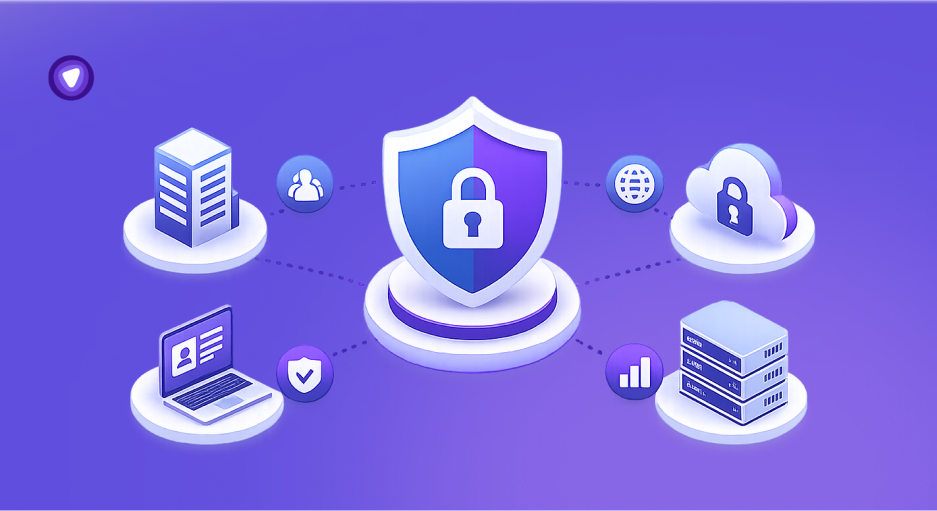
- Virtual Security Infrastructure: Virtual security infrastructure replaces traditional perimeter-based security with centralized control across distributed cloud, remote, and hybrid environments
- MSPs and Enterprise Needs: MSPs and enterprises need unified access management to handle multi-tenant environments, role-based access, and consistent policy enforcement at scale
- Modern Security Architecture: Modern security architecture relies on identity, encrypted connectivity, policy control, and real-time visibility to secure distributed systems
- API-Driven Automation: API-driven automation and dynamic VPN-based connectivity reduce manual work and improve scalability across rapidly changing infrastructure
- PureWL Value: PureWL enables white-labeled, multi-tenant VPN infrastructure with centralized control, secure access, and seamless integration into existing enterprise and MSP systems
Security teams no longer defend fixed perimeters. Workloads move across cloud platforms, SaaS tools, private servers, and remote endpoints every hour. Access is no longer a location-based decision. It is a continuous verification problem across distributed systems that were never designed to operate as one unit.
This shift has changed what infrastructure security means. It is no longer about protecting a single network layer. It is about building a controlled access system that follows users, services, and data across environments without slowing operations or fragmenting policy enforcement.
Virtual security infrastructure has become the operational layer that connects these moving parts.
Distributed Infrastructure Has Become the Default Operating Model
Enterprise networks are no longer centralized. Workloads are distributed across multiple environments, often simultaneously.
More than 90% of organizations are expected to adopt a hybrid cloud approach by 2027, making distributed infrastructure the standard model for enterprise operations. This structure increases flexibility but expands the number of access points that must be secured.
Security complexity increases in three areas:
- Identity is no longer tied to a fixed network perimeter
- Applications run across multiple cloud providers
- Third-party vendors require controlled but flexible access
At the same time, threat exposure continues to grow. Cybercrime is projected to reach $10.5 trillion annually by 2025. The scale is driven by automated attacks targeting distributed systems, not isolated networks.
The result is a structural gap between how infrastructure operates and how security is traditionally enforced.
Why MSPs and Enterprises Need Virtual Security Infrastructure
Managed Service Providers and enterprise IT teams face similar operational constraints, even if their environments differ.
MSPs manage multiple client networks simultaneously. Enterprises manage internal complexity across departments, regions, and hybrid environments. Both require a unified control layer that does not break under scale.
Key requirements include:
- Centralized access control across distributed systems
- Consistent policy enforcement across clients or departments
- Secure onboarding and offboarding of users at scale
- Separation of environments without duplicated infrastructure
- Real-time visibility into access behavior
Traditional VPN setups and static perimeter models do not meet these requirements. They create fragmented access layers that increase administrative overhead and reduce visibility.
A virtual security infrastructure solves this by abstracting control from physical network boundaries.
Security Architecture in a Virtual Infrastructure Model
Virtual security infrastructure is not a single tool. It is a layered system that connects identity, access, encryption, and policy control into one operational framework.
Identity and Access Layer
This layer defines who can connect and what they can access. It integrates authentication systems such as SSO, directory services, and multi-factor authentication.
Access is assigned based on roles rather than network location. This reduces lateral movement risks and simplifies onboarding for distributed teams.
Encrypted Connectivity Layer
All traffic between users and resources is routed through encrypted tunnels. This ensures that data remains protected even when moving across public networks or untrusted environments.
Modern systems also include protocol-aware routing, which allows selective traffic control without exposing entire network segments.
Policy Enforcement Layer
This layer defines operational rules for traffic behavior:
- Which applications can be accessed
- Which IP ranges are permitted
- Which regions or devices are allowed
- How sessions are logged and monitored
Policies are applied centrally and enforced consistently across all endpoints.
Visibility and Monitoring Layer
Real-time telemetry is essential for detecting anomalies in distributed environments. This includes:
- Session tracking
- Access logs
- Device fingerprinting
- Geo-location patterns
Security teams use this layer to identify abnormal behavior before escalation occurs.
The Role of VPN-Based Security in Modern Infrastructure
VPN systems have evolved beyond remote access tools. In distributed infrastructure, they function as secure routing layers between users and internal systems.
However, legacy VPN implementations often struggle with:
- Limited scalability across multiple tenants
- Static configurations that do not adapt to cloud workloads
- Lack of granular policy control
- Difficulty in managing distributed user groups
Modern virtual infrastructure replaces static tunnels with dynamic, policy-driven connections.
This is particularly relevant for MSPs managing multiple clients. Each client requires isolated environments without separate infrastructure stacks.
Key Capabilities of a Virtual Security Platform
A modern virtual security infrastructure is defined by its ability to scale without increasing operational complexity.
| Capability | Function | Operational Impact |
| Multi-tenant architecture | Separate environments per client or business unit | Reduces infrastructure duplication |
| Centralized policy engine | Unified control for all access rules | Eliminates configuration drift |
| Role-based access control | Access defined by identity, not location | Reduces unauthorized access risk |
| Encrypted traffic routing | Secure tunnels for all connections | Protects data in transit |
| API-driven management | Automation of onboarding and policies | Reduces manual configuration workload |
| Real-time monitoring | Live visibility of sessions and activity | Improves incident response time |
This structure allows MSPs and enterprises to scale access control without rebuilding infrastructure for each environment.
Scaling Security Across MSP and Enterprise Environments
MSPs operate in high-density, multi-client environments. Enterprises operate in high-complexity, internal ecosystems. Both require scalability, but the pressure points differ.
For MSPs:
- Rapid client onboarding is critical
- Environment isolation must be absolute
- Policy duplication must be eliminated
- Billing and access segmentation must remain clear
For enterprises:
- Internal departments require segmented access
- Global teams need consistent security rules
- Cloud workloads require adaptive routing
- Legacy systems must integrate with modern access layers
A virtual security infrastructure provides a single operational layer across both models, reducing fragmentation while maintaining separation where required.
API-Driven Security and Automation
Modern infrastructure is API-driven. Over 80% of internet traffic is now API-based in modern applications, driven by microservices and cloud-native architectures. Security systems must operate at the same level of automation.
Virtual security infrastructure uses APIs to:
- Provision and de-provision users instantly
- Assign access policies dynamically
- Integrate with DevOps pipelines
- Trigger alerts based on behavioral rules
- Sync identity systems across environments
This reduces dependency on manual configuration, which is often a source of misalignment in distributed networks.
Automation also ensures that security policies remain consistent even when infrastructure scales rapidly.
Deployment Models in Virtual Security Infrastructure
Different environments require different deployment approaches. The structure remains consistent, but configuration varies based on operational scale.
| Deployment Model | Use Case | Key Advantage |
| Cloud-native deployment | SaaS-heavy organizations | Fast scaling across regions |
| Hybrid deployment | Enterprises with legacy systems | Integration with on-prem resources |
| Multi-tenant MSP deployment | Managed service providers | Isolated client environments |
| Dedicated virtual instances | High-security environments | Full control over infrastructure |
Each model relies on the same underlying principle: centralized control with distributed execution.
Security Challenges Addressed by Virtual Infrastructure
Virtual security infrastructure directly addresses recurring challenges in distributed environments:
- Expanding attack surface across cloud and remote endpoints
- Inconsistent access policies across teams
- Limited visibility into user behaVirtual Security Infrastructure Built for MSPs and Enterprise Networks
- vior
- Manual configuration errors during scaling
- Difficulty isolating client environments in MSP operations
According to IBM’s 2024 Cost of a Data Breach Report, the average global breach cost reached $4.88 million, the highest recorded to date. Distributed systems contribute significantly to this cost due to delayed detection and fragmented security controls.
Reducing these risks requires infrastructure-level control rather than tool-based patchwork security.
Where PureWL Fits in Virtual Security Infrastructure
PureWL white label VPN solution is built for MSPs and enterprise environments that need controlled, scalable access infrastructure without rebuilding their existing security stack. It provides a foundation for virtual security infrastructure through white-labeled secure access, multi-tenant architecture, centralized policy enforcement, encrypted connectivity for distributed teams, and API-driven automation for provisioning and scaling.
For MSPs, it enables structured client onboarding with fully isolated environments under a single management layer. For enterprises, it delivers a unified control system across departments, regions, and hybrid cloud setups. PureWL integrates into existing infrastructure rather than replacing it, making it suitable for organizations that need scalable security without operational disruption.
Closing Perspective
Virtual security infrastructure is now a requirement for operating distributed systems at scale. Networks are no longer defined by physical boundaries. They are defined by identity, access, and continuous control across environments.
MSPs and enterprises that rely on fragmented tools face growing operational friction as infrastructure expands. A unified security layer reduces this complexity by aligning access control, encryption, and policy enforcement under one system.
As infrastructure continues to distribute across cloud and hybrid environments, security models must evolve at the same pace.