


- The signed contract protects a partner, not the sales call. A vendor’s verbal promises on uptime or support mean nothing once a written liability cap limits what a partner can actually recover.
- Liability caps and indemnification carve outs decide real exposure. A cap set at one month of fees covers a fraction of an average data breach, so the carve outs for severe claims matter more than the headline number.
- IP and app store ownership need a written assignment, not an assumption. A vendor that keeps the branding, trademark, or developer account under a license instead of an assignment holds leverage a partner will not see coming.
- A change of control clause protects against acquisition risk. Without one, a partner’s contract can transfer automatically to a competitor that buys the vendor, with no consent or termination right in place.
- Subprocessor disclosure, breach notification, and data return terms belong in writing. These sit in the DPA and exit clauses, not the uptime SLA, and should never be left to a “reasonable efforts” standard.
A vetting call tells a partner what a vendor claims it can do. A compliance review tells a partner what a vendor’s infrastructure meets. Neither document is enforceable. The signed contract is what actually protects a partner once a vendor’s incentives change. This white label VPN vendor evaluation checklist covers the clauses that decide the outcome. Liability caps. IP assignment for the branded app. What happens if the vendor gets acquired. Who must disclose a subprocessor before it touches partner data. Most partners never read these terms until a dispute forces the question.
Why the Signed Contract Protects Differently Than a Sales Call or a Compliance Review
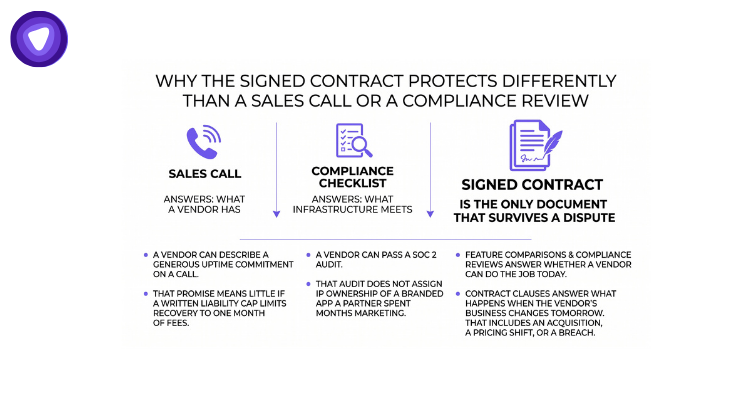
A sales call answers what a vendor has. A compliance checklist answers what a vendor’s infrastructure meets. Neither one is what a court or an auditor reads during a dispute.
The contract is the only document that survives a relationship going wrong. A vendor can describe a generous uptime commitment on a call. That promise means little if a written liability cap limits recovery to one month of fees. A vendor can pass a SOC 2 audit. That audit does not assign IP ownership of a branded app a partner spent months marketing.
A white label VPN contract checklist built around the actual document catches a different risk than a feature comparison. Feature comparisons and compliance reviews answer whether a vendor can do the job today. Contract clauses answer what happens when the vendor’s business changes tomorrow. That includes an acquisition, a pricing shift, or a breach.
This vendor due diligence checklist for VPN contracts walks through the clauses worth reading twice. They are ordered the way they tend to surface once something goes wrong.
Liability Caps and Indemnification Scope
Limitation of liability is the single most negotiated term in commercial contracts. It ranks ahead of price and indemnification, according to the World Commerce and Contracting Most Negotiated Terms 2024 report. That ranking exists for a reason. The cap decides what a partner can actually recover if a vendor’s failure causes real damage.
Vendor-favorable caps are getting harder to justify. Common Paper’s 2026 SaaS Contract Benchmark Report tracked this shift directly. A cap limiting recovery to half of fees paid dropped sharply. It fell from 7% of agreements in 2024 to 2.5% in 2026. Carve-outs for unlimited liability on the most severe claims rose too. Gross negligence and willful misconduct exceptions climbed from 1.1% to 10.2% over the same period. Market norms have shifted toward more customer bargaining power than they held two years ago.
The math still favors the vendor by default. A standard cap set at one to three months of fees leaves a real gap. The global average cost of a data breach reached $4.44 million in 2025. That figure comes from IBM’s Cost of a Data Breach Report. A cap set at one month of VPN fees covers a fraction of that exposure.
This is a clear example of a white label VPN liability clause worth negotiating before signing. Confirm three things in writing. First, the exact cap amount. Second, whether it is a multiple of fees paid or a fixed dollar figure. Third, which claims fall outside the cap entirely. A vendor that cannot answer the third question quickly has not thought through its own indemnity language. Partners evaluating a white label data broker removal solution face a similar gap. A vendor that delays a deletion request creates the same exposure. This check applies across every white label product line, not VPN alone.
Cyber Insurance Requirements
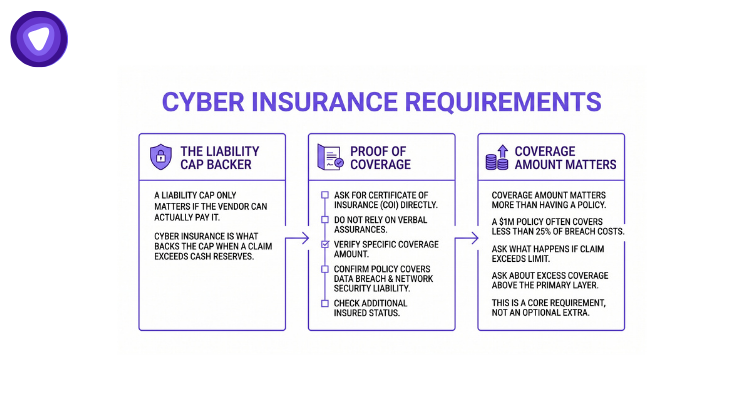
A liability cap only matters if the vendor can actually pay it. Cyber insurance is what backs the cap when a claim exceeds the vendor’s own cash reserves.
Ask for the certificate of insurance directly. A verbal assurance that coverage exists is not proof. The certificate should name a specific coverage amount. It should confirm the policy covers data breach and network security liability. It should also state whether a partner can be added as an additional insured. A vendor that treats this request as unusual is signaling something. Either the policy does not exist, or it does not cover the scenario a partner actually cares about.
Coverage amount matters more than the fact of having a policy at all. A $1 million cyber policy sounds substantial on paper. Measured against the average breach cost above, it covers less than a quarter of a single incident. Ask what happens if a claim exceeds the policy limit. Ask whether the vendor carries excess coverage above the primary layer. This is a core line item on any vendor evaluation checklist, not an optional extra.
IP and Trademark Assignment for the Branded App
A white label partnership only works if the branding stays with the partner. That outcome depends on how the contract assigns intellectual property. It does not depend on how confident the branding conversation felt during onboarding.
IP assignment belongs at the top of any VPN reseller agreement checklist. The agreement should state plainly who owns the app name, the logo, and the trademark filing. It should also state who owns the app store developer account once the branded build goes live. A vendor that retains ownership of these assets can create a real advantage for itself later. That advantage tends to surface during a renewal negotiation or a dispute, not before. A partner spends a year building brand recognition under one name. The agreement should not treat that branding as a license instead of an assignment.
App store account ownership deserves its own line item on any VPN partner agreement checklist. If the vendor’s developer account hosts the branded app, switching providers later gets harder. A partner can lose the app’s review history, ratings, and install base in the process. Confirm whether the partner’s own developer account handles submission. If not, confirm what migration path exists if the relationship ends.
Change of Control: What Happens If the Vendor Is Acquired
A vendor’s acquisition risk belongs in the contract. It does not belong in a hope that the acquirer keeps things running the same way. Change of control clauses appear in 72% of enterprise SaaS agreements. They show up in 85% of strategic vendor contracts, according to a 2026 legal analysis of contract negotiation patterns. The clause exists because an acquisition changes a vendor’s incentives, even when the day-to-day service looks identical.
A weak change of control clause says nothing at all. In that case, a partner’s contract transfers automatically to whichever company buys the vendor, competitor or not. A stronger clause gives the partner a real option. It grants a consent right or a termination right if the acquirer is a direct competitor. It can also trigger review if the acquisition changes data handling in a material way.
Ask what happens to the agreement if a competitor acquires the vendor outright. Ask whether the partner gets advance notice of a pending acquisition. Some vendors only disclose the deal after it closes. A vendor that has not thought through this scenario has likely never been through an acquisition itself. That gap is its own signal about company maturity. A white label VPN vendor evaluation checklist is incomplete without this clause.
Subprocessor Disclosure and the Data Processing Agreement
A white label VPN vendor rarely handles every infrastructure layer alone. Server hosting, billing processing, and support ticketing often run through separate subprocessors. Each one is a new party with access to partner or end-user data.
The data processing agreement should list every subprocessor by name. Describing them generically as “trusted third parties” is not disclosure. More than 20 U.S. states now require processor agreements under comprehensive state privacy laws as of 2026. GDPR imposes a similar obligation for any EU resident data in the pipeline. A vendor operating without a current subprocessor list meets neither standard.
Any thorough white label VPN SLA terms review should extend into the DPA itself, not stop at uptime. Confirm how the vendor notifies partners before adding a new subprocessor. Confirm whether the partner has the right to object. A DPA that lets the vendor add subprocessors silently removes a partner’s control over its own data supply chain. Any serious vendor evaluation checklist treats subprocessor visibility as mandatory, not optional.
Breach Notification Terms Written Into the Contract
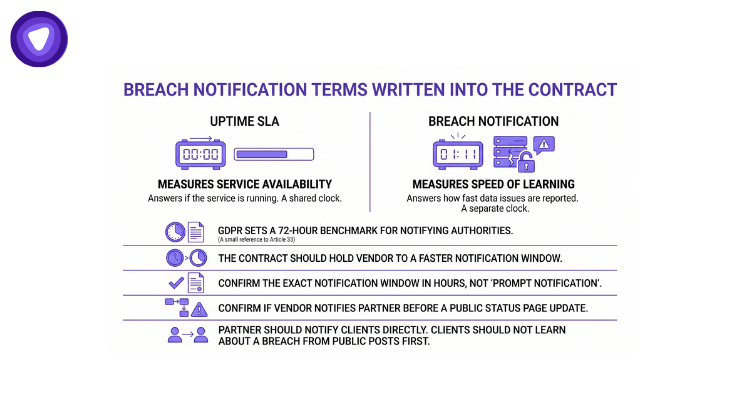
An uptime SLA and a breach notification clause solve different problems. Uptime measures whether the service is running. Breach notification measures how fast a partner learns something went wrong with the data behind it. These are two separate clocks, not one shared commitment.
GDPR sets a 72-hour benchmark for notifying a supervisory authority once a controller becomes aware of a breach. That standard sits in Article 33 of the regulation. A white label VPN contract should hold the vendor to a comparable or faster internal notification window. The partner usually carries its own downstream notification duty to its clients.
Confirm the exact notification window in hours, not a vague “prompt notification” clause. Confirm whether the vendor notifies the partner before or after any public status page update. A partner’s clients should not learn about a breach from a public post first. Their own reseller should tell them directly.
Auto-Renewal, Price Change Notice, and Termination Rights
Auto-renewal paired with uncapped price increases is one of the most common traps in vendor contracts. Legal reviews of SaaS agreement structures flag this pattern repeatedly. A partner that misses a 30 or 60 day non-renewal window pays for it. The contract can auto-renew at a new, higher price with no further consent required. Auto-renewal terms belong on every white label vpn vendor evaluation checklist, right beside the liability cap.
Three terms deserve confirmation before signing. First, the exact non-renewal notice window, stated in calendar days. Second, whether a price increase requires advance written notice, and how much. Third, whether termination for cause is actually usable. A usable clause defines specific, measurable failures. Missed SLA thresholds across a stated number of consecutive months is one example. An undefined “cause” standard protects the vendor, not the partner.
A vendor that resists capping its own price-increase authority is treating the first-year price as a placeholder. It is not treating that price as a real commitment. This is one of the more common VPN reseller contract red flags. An MSP VPN vendor contract review should catch it early, before the first renewal notice arrives.
Data Return and Deletion on Exit
Termination terms only protect a partner if data actually comes back in a usable form. The contract should specify the exact format client data returns in. It should state the maximum number of days the vendor has to complete the return. It should also state what happens to any data the vendor retains for its own compliance obligations afterward.
Onboarding often gets a weeks-to-launch pitch. Exit terms sometimes fall back to a vague “reasonable efforts” standard instead. That gap reveals where a vendor’s real incentives sit. Building equivalent infrastructure from scratch, instead of switching white label VPN providers, typically takes 12 to 18 months. The upfront cost can exceed $500,000, based on figures published on PureVPN White Label‘s own site. That build cost is exactly why exit terms matter enough to negotiate before signing. A white label VPN exit clause without a defined return window is not really an exit clause at all. Waiting until a partner depends on switching being difficult is too late.
Vendor Evaluation Scorecard: Contract Clause Review
Use this white label vpn vendor evaluation checklist scorecard to score a draft agreement clause by clause. A low score on any single high-weight row is worth stopping to renegotiate. This holds regardless of the total score.
| Clause | What to Verify | Red Flag | Weight |
| Liability Cap | Exact dollar figure or multiple of fees, plus named carve-outs | Cap set at one month of fees with no negligence carve-out | High |
| Cyber Insurance | Certificate naming coverage amount and scope | Vendor cannot produce a certificate on request | High |
| IP and Branding Assignment | Written assignment of app name, logo, and trademark | Vendor retains ownership under a license, not an assignment | High |
| Change of Control | Consent or termination right if acquired by a competitor | Contract is silent on acquisition scenarios | Medium |
| Subprocessor Disclosure | Named subprocessor list with an update/objection process | Subprocessors described only as “trusted partners” | Medium |
| Breach Notification | Defined notification window in hours, separate from uptime SLA | Notification folded into the general SLA with no separate clock | High |
| Auto-Renewal and Pricing | Defined non-renewal window and price-increase notice period | No cap on price-increase authority | Medium |
| Data Return on Exit | Defined return format and maximum return window | “Reasonable efforts” standard with no measurable deadline | High |
Partners who run this scorecard against a vetting-call script instead of the written agreement are still exposed. Contract red flags rarely show up in a conversation. A VPN reseller contract needs the written terms checked directly, line by line.
Where PureVPN White Label Fits
PureVPN White Label VPN Solution documents these terms per partner agreement. Liability, indemnification, and data return terms sit in the contract itself, not in a sales conversation.
The infrastructure behind that contract runs on a KPMG-verified no-log network. It spans 6,500-plus servers across 88-plus countries, built over 17 years. Those infrastructure figures are PureVPN White Label’s own reported data. They are distinct from its independently audited SOC 2 Type II status. Partners weighing a change of control scenario or a subprocessor list can request the current agreement terms directly.
Conclusion
A white label VPN vendor evaluation checklist only earns its value on a real draft agreement. It means nothing as a mental note. Liability caps, IP assignment, change of control, and subprocessor disclosure rarely come up on a sales call. A compliance badge does not cover any of them either. Read the contract before the relationship depends on it. Request a 20-minute contract and audit-scrutiny review with PureVPN White Label’s partner team.