

- Premium Perk Shift: Neobanks are moving VPN access from a background compliance feature to a visible, paid perk on premium subscription tiers, alongside travel perks and cashback.
- Market Growth: The shift tracks explosive growth in digital-first finance, with global digital wallet users near 5.6 billion and neobank users around 350 million in 2025, expanding the attack surface across public networks.
- Real Risk: The risk is concrete, not theoretical: nearly four in ten US adults report data exposure from public Wi-Fi, and the average financial-sector data breach now costs $5.56 million.
- Retention Boost: Bundling VPN into higher tiers gives neobanks a feature that is hard for competitors to copy quickly and gets used daily, which strengthens retention more than a cashback rate alone.
- Build vs Partner: Building VPN infrastructure in-house is costly and slow, making a white label VPN solution like PureVPN’s the practical route for fintech brands that want to launch this feature fast under their own name.
A customer opens their banking app from an airport lounge, a coworking space, or a hotel network they have never used before. The transaction goes through in seconds. What they do not see is the exposed connection carrying their session data across a network nobody vetted. Neobanks noticed this gap long before their users did, and a growing number of them are closing it by folding VPN access directly into their paid plans.
This is not a minor feature update. It marks a shift in how digital-first financial brands think about the products they sell. Security used to sit quietly in the background as a compliance requirement. Now it shows up on pricing pages.
Why VPN for Neobanks and Digital Wallets Became Necessary
Digital-first finance has moved from a convenience to a default. Global digital wallet users reached roughly 5.6 billion in 2025, covering close to two-thirds of the world’s population. Neobank adoption is following the same curve, with worldwide users climbing to around 350 million in 2025. That scale is exactly why VPN for neobanks and digital wallets stopped being an experimental add-on and started becoming standard practice.
The Scale Problem Behind Digital Banking
Scale like that changes the threat model. A banking app used by a few million early adopters draws limited attention. A payment platform used by billions of people across airports, cafes, coworking hubs, and shared home networks becomes a target worth automating attacks against.
Most of that usage happens outside a controlled environment. People check balances on subway Wi-Fi. They approve payments from hotel networks. They log into savings accounts from public library terminals. None of these networks were built with financial data in mind, yet all of them now carry it daily.
Why the Risk Is No Longer Theoretical
Public networks are not just inconvenient, they are actively compromising financial data. Nearly four in ten U.S. adults reported that their private data was exposed after using public Wi-Fi at a cafe or restaurant. That is not an edge case. It is close to half of the connected population reporting direct harm from an activity most people treat as routine.
For financial institutions, the cost of getting this wrong keeps climbing. The average cost of a data breach in the financial sector reached $5.56 million in 2025, the second highest of any industry tracked. That figure covers detection, containment, regulatory penalties, and the customer churn that follows once trust breaks.
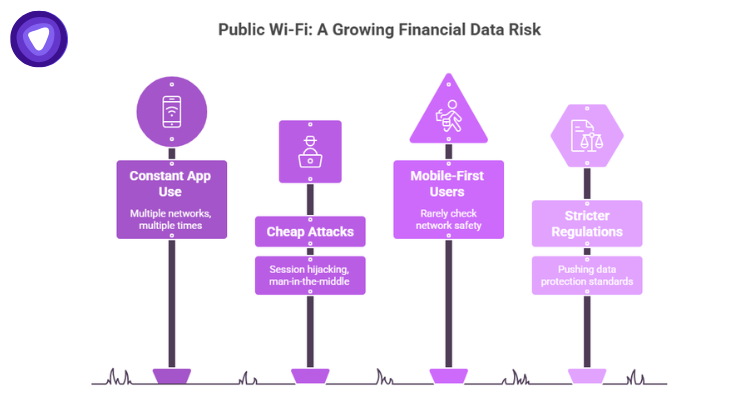
A few factors explain why unsecured connections became such a pressing problem for fintech specifically:
- Banking apps are used constantly, often multiple times a day, across many different networks
- Session hijacking and man-in-the-middle attacks are cheap to run against open Wi-Fi
- Mobile-first users rarely think to check whether a network is safe before opening a finance app
- Regulators are pushing stricter data protection standards onto companies that hold financial information
None of this required a new type of attacker. It required a new volume of exposure, and neobanks supplied it by putting a full banking relationship inside a mobile app. It travels everywhere with the user. This is the exact gap that VPN for neobanks and digital wallets is built to close.
How Premium Tiers Turn Protection Into Revenue
Traditional banks treated security as a cost center. Digital-first brands are treating it as a product feature, which changes the economics entirely. A VPN bundled into a premium tier does two jobs at once. It reduces the institution’s exposure to fraud and account takeover, and it gives the subscription plan something tangible that a free account does not have.
This matters because free-tier neobank accounts are hard to monetize on their own. Interchange fees are thin, and many digital banks still operate at a loss on their base offering.
A premium subscription with a clear, everyday benefit like a VPN gives customers a reason to upgrade that goes beyond a slightly better savings rate. Positioning VPN for neobanks and digital wallets as a premium perk gives product teams a monetizable feature that also lowers fraud exposure.
| Tier | Typical Features | Where VPN Fits |
| Free | Basic account, standard debit card, limited support | Not included |
| Plus | Higher limits, priority support, some fee waivers | Sometimes offered as an add-on |
| Premium | Travel perks, insurance, cashback, concierge support | Bundled as a core benefit |
| Metal/Elite | Full lifestyle bundle, lounge access, premium card | Full VPN access across devices |
The pattern is consistent across the neobanks experimenting with this model. VPN access rarely appears on the free tier. It shows up once the subscription starts competing with the kind of lifestyle bundle a premium credit card or travel card offers.
Why VPN for Neobanks and Digital Wallets Improves Retention
Cashback and fee waivers are easy to copy. Every competitor can match a 1 percent cashback rate within a quarter. A bundled VPN is harder to replicate quickly because it requires either building the infrastructure in house or partnering with a provider who already has it.
That difficulty works in the neobank’s favor. Features that are hard to copy are features that keep customers from switching providers over a marginal rate difference. A VPN also gets used constantly, unlike a travel insurance policy that a customer might touch once a year. Daily use builds a habit, and habits are what keep a subscription active month after month.
What a VPN Actually Adds to a Banking App
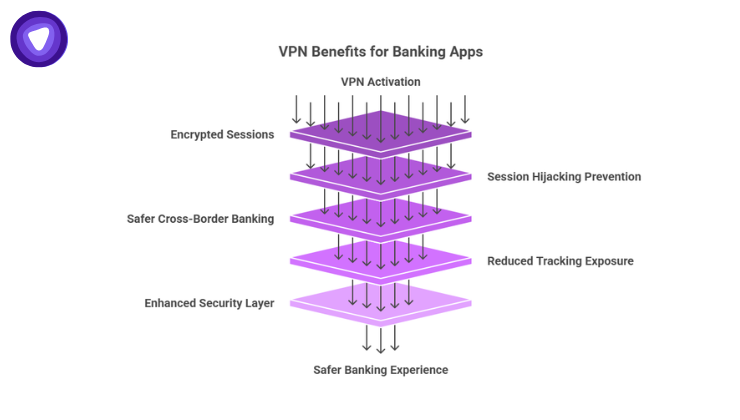
The value goes beyond hiding an IP address. For a financial services customer, the practical benefits of VPN for neobanks and digital wallets break down into a few clear categories.
- Encrypted sessions on public networks. Traffic between the app and the bank’s servers stays unreadable to anyone else on the same Wi-Fi network.
- Protection against session hijacking. Attackers who intercept unencrypted traffic can sometimes capture session tokens and impersonate a logged-in user. Encryption closes that path.
- Safer cross-border banking. Customers who travel or manage money across countries can avoid triggering fraud flags tied to unusual login locations, and can access services that geo-restrict by region.
- Reduced tracking exposure. A VPN limits how much network-level data brokers and advertisers can collect about a user’s location and browsing habits while using the app.
- A layer that complements, not replaces, existing security. Biometric login, two-factor authentication, and device encryption still matter. A VPN protects the network layer those other tools cannot cover.
None of these benefits require the customer to understand the technical details. They just need to know that turning on VPN protection before checking their balance from a coffee shop makes that action safer.
Build Versus Partner: The Practical Decision
Building VPN for neobanks and digital wallets from scratch is a serious undertaking. It means securing server capacity across regions, maintaining encryption protocols, handling regulatory requirements in every market served, and running a support team for a product that is not the bank’s core competency. For most neobanks, that workload competes directly against the engineering hours needed for the actual banking product.
This is where a white label VPN solution changes the calculation. PureVPN’s white label VPN offering lets neobanks and digital wallets embed VPN protection into their app under their own brand. It does this without standing up server infrastructure or a dedicated security operations team. The bank keeps full control over the customer relationship and the pricing tier the VPN sits in, while the underlying network, protocols, and uptime are handled by a provider that already runs at scale.
For a product team trying to launch a premium tier on a realistic timeline, that difference is often what separates a feature that ships this quarter from one that stays on a roadmap for a year.
Where This Is Headed
VPN access is becoming one more line item in the growing list of things a premium financial subscription is expected to include, alongside travel insurance, airport lounge access, and higher cashback rates. The difference is that a VPN gets used every day, not just on vacation or during a large purchase.
Neobanks that treat security as a paid, visible benefit rather than a hidden compliance cost are positioning themselves for a customer base that already expects privacy protection as part of the deal.