

- Different Risk Class: API keys and session tokens grant machine level access with no login screen and often no expiration, unlike a password.
- Speed Matters: Infostealer logs and stolen session cookies get bundled and resold on the dark web within hours, not weeks.
- Compliance Gap: A leaked token does not automatically trigger GDPR notification, but SOC 2 auditors still flag unrotated keys as a control failure.
- Response Sequence: Revoking a key without checking access logs first leaves no proof of what an attacker actually touched.
- Detection Method: Continuous domain based monitoring with webhook alerts catches leaks faster than scheduled polling or manual GitHub scans.
A stolen password locks a person out of one account. A stolen API key or session token often locks no one out at all. There is no login screen to notice. There is no user to complain. Often there is no expiration date forcing a reset.
API keys and session tokens on the dark web move differently than personal credentials. They trade fast and work immediately. They rarely trigger the alerts a password leak does. For SaaS companies running infrastructure through dozens of connected services, this creates a blind spot. Most security content never addresses it directly.
This piece looks at where these credentials actually surface. It covers why compliance frameworks struggle to classify a token leak. It explains what determines whether a company catches the exposure before an attacker uses it.
How API Keys and Session Tokens Differ From Stolen Passwords
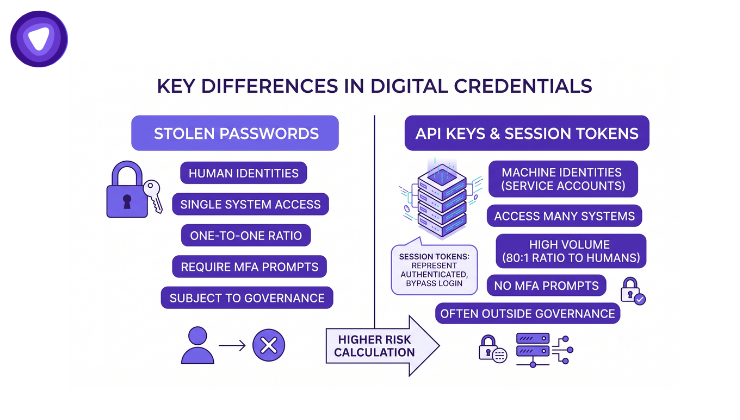
A password protects one person’s access to one system. An API key or session token often protects a machine’s access to many systems at once. That difference changes the entire risk calculation.
Non-human identities, meaning service accounts, API keys, and automated processes, now outnumber human accounts inside a typical enterprise. The ratio runs past 80 to 1. Most of these machine credentials sit outside the identity governance built for human logins. They do not get multi-factor prompts. Many never expire unless someone manually rotates them.
Session tokens carry a separate risk. They represent an already-authenticated state. A session token bypasses login entirely, since the system already confirmed the user’s identity once. Whoever holds the token inherits that trust without entering a password.
Where API Keys and Session Tokens Actually Surface
Generic security advice tells teams to avoid hardcoding credentials. It rarely explains where leaked API keys and session tokens end up once they escape a codebase.
Infostealer Logs and Cookie Markets
Infostealer malware harvests browser session data automatically. This often happens within minutes of infecting a device. SpyCloud recaptured more than 8.6 billion stolen session cookies in 2025 alone. Each one can bypass multi-factor authentication without touching a password. These logs get bundled and resold on dark web forums and Telegram channels within hours, not weeks.
That speed matters for SaaS companies specifically. A session cookie tied to a corporate SSO login can grant an attacker the same access as the employee. That access spans every connected app, since single sign-on was built to extend one login across many tools.
Most infostealer logs are not sold as single, isolated credentials. Buyers purchase entire logs from an infected machine, containing dozens of active sessions at once. One infected developer laptop can hand an attacker a code repository, a cloud console, and a project tool at once.
Public Repositories and CI Logs
API keys and session tokens on the dark web frequently start their journey in a public repository. Developers commit configuration files with live credentials. They often forget to remove them before pushing. GitGuardian detected 28.76 million secrets exposed on public GitHub in 2025. That figure marks a 34 percent increase over the prior year.
Most of those secrets stay active long after exposure. Rotation depends on someone noticing. Noticing depends on monitoring that most engineering teams do not have in place.
API Keys, OAuth Tokens, and Session Cookies Carry Different Risk
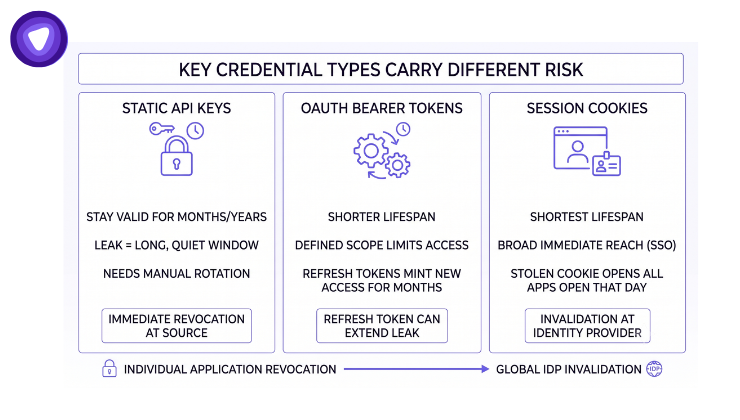
Generic advice treats every leaked credential the same way. That approach misses a real distinction that changes how a SaaS team should respond.
Static API Keys
A static API key rarely expires on its own. Once issued, it often stays valid for months or years unless someone rotates it manually. A leaked static key gives an attacker a long, quiet window, since nothing forces the access to end.
OAuth Bearer Tokens
An OAuth token usually carries a shorter lifespan and a defined scope. That scope limits what the token can touch, which is a real advantage. The tradeoff shows up in the refresh token paired with it. That refresh token can silently mint new access tokens for months. A scoped leak can still persist well past its stated expiry.
Session Cookies
A session cookie ties to a specific browser session and an identity provider. It carries the shortest natural lifespan of the three. It also carries the broadest immediate reach, through single sign-on. One stolen cookie can open every app the employee had open that day.
Treating all three the same way in an incident response plan wastes time. A static key needs immediate revocation at the source system. A session cookie needs invalidation at the identity provider, not just a forced logout on one app.
The Compliance Blind Spot in Token Leaks
Breach notification law generally triggers when personal data confidentiality is exposed. A leaked API key or session token rarely fits that definition cleanly. It resembles a set of keys more than a filled-out form. That leaves compliance teams uncertain how to log it.
GDPR Notification and Token Leaks
GDPR’s 72-hour notification clock applies to confirmed exposure of personal data. It does not automatically apply to every leaked credential. Many SaaS legal teams escalate token leaks anyway. A valid token can lead directly to personal data once an attacker uses it.
SOC 2 Audit Findings on Unrotated Keys
SOC 2 auditors increasingly flag unrotated API keys found in public repositories. This happens regardless of whether the key was confirmed exploited. The control being tested is prevention, not measured impact after the fact.
Incident ownership for a leaked machine credential usually falls to engineering first. Remediation means revoking and rotating a key. It does not mean resetting a person’s password through a help desk ticket.
This ownership gap creates a delay of its own. Security teams often detect the exposure, but engineering teams control the systems that generated the credential. Without a clear handoff process, a confirmed leak can sit for days between detection and revocation.
Detection Speed Decides the Outcome
The gap between exposure and detection is where most damage happens. A key exposed for an hour carries far less risk than one exposed for a month.
Monitoring systems built on scheduled polling check dark web sources at fixed intervals, often once a day. Stolen session data moves through resale channels within hours. A daily check can miss that window entirely. Systems built on webhook delivery push an alert the moment a match appears, closing that gap.
For API keys and session tokens on the dark web, detection speed is not a minor technical detail. It decides whether a company revokes a key before it gets used or after.
The First Hour After a Token Leak Is Detected
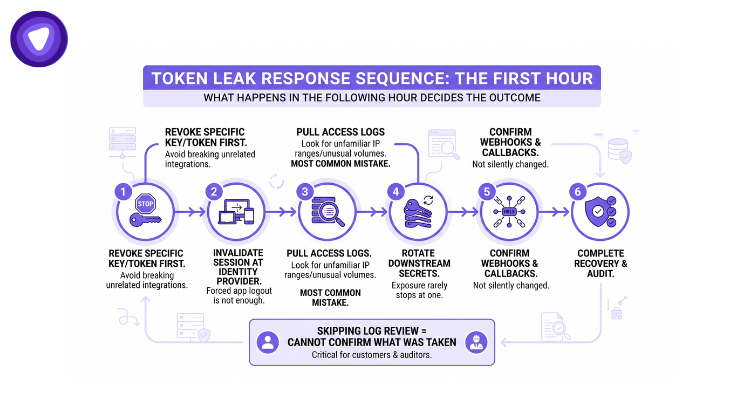
Detection alone does not stop an attacker. What happens in the following hour usually decides the outcome. A practical response sequence looks like this:
- Revoke the specific key or token first, not the whole account. This avoids breaking unrelated integrations.
- Invalidate the session at the identity provider level. A forced app logout alone does not kill the token elsewhere.
- Pull access logs for the credential’s recent activity. Look for calls from unfamiliar IP ranges or unusual data volumes.
- Rotate any downstream secret stored alongside the exposed one. Leaked logs and repositories rarely contain just one credential.
- Confirm webhook and callback URLs tied to the credential were not silently changed during the exposure window.
Skipping the log review is the most common mistake. A team that revokes a key without checking access logs cannot tell a customer or an auditor what was taken.
Build Versus Buy: The Economics of Monitoring
Building an internal pipeline to watch dark web marketplaces and paste sites is not a weekend project. It requires ongoing access to threat intelligence feeds and continuous parsing of unstructured data. It also requires a team that tracks new criminal marketplaces as old ones shut down.
The financial stakes justify the investment either way. Credential-based breaches cost organizations an average breach cost of 4.88 million dollars per incident. That figure keeps climbing year over year. For a SaaS company weighing build versus buy, this number sets the baseline for what a missed detection actually costs.
Smaller and mid-market SaaS vendors rarely have headcount to justify a dedicated threat intelligence team. Licensing existing infrastructure through a partner is usually faster than building a parallel one from scratch. That path also tracks API keys and session tokens across dark web channels sooner.
Comparing Detection Methods for Leaked Credentials
No single method catches everything on its own. Most SaaS security programs combine more than one of these methods to close the gaps below.
| Method | What It Catches | Main Blind Spot |
| Source code secret scanning | Hardcoded keys committed to repositories | Misses tokens stolen via malware or session hijacking |
| Manual key rotation policy | Reduces the lifespan of any single exposed key | Does not detect a leak already in circulation |
| Ad hoc dark web searches | Occasional visibility into forums and marketplaces | Not continuous, easy to miss fast-moving Telegram sales |
| Continuous domain-based monitoring | Ongoing alerts tied to a company’s own domain and email accounts | Requires integration effort or a ready-made API |
Closing the Coverage Gap
Most SaaS platforms already treat customer data protection as a baseline requirement. Far fewer apply that same standard to their own machine credentials, even though those credentials often carry broader access.
PureVPN White Label VPN Solution’s dark web monitoring closes this exact gap. It registers a company’s domain and its associated accounts, then runs continuous exposure checks against dark web sources. Alerts arrive through webhook connections instead of scheduled polling. A match surfaces the moment it appears, not at the next scan.
Partners get this backed by 17 years in privacy infrastructure. It carries SOC 2 Type II certification and a KPMG-verified no-log policy. It is not a monitoring feature bolted onto an unrelated product. A SaaS vendor offering dark web monitoring under its own brand inherits infrastructure and compliance work already done. Data broker removal is available as a separate add-on for teams that also need exposed personal data taken down.
The Practical Takeaway
API keys and session tokens on the dark web are not a future risk. They are already circulating and already valid in a large share of cases. They are already being resold within hours of exposure. The companies that catch these leaks early are not the ones with the largest security staff. They are the ones with monitoring built to close the exposure gap. Closing it early beats reacting after an attacker gets there first.