

- Leaked cloud credentials monitoring has to look past GitHub. A single month of Docker Hub scanning found over 10,000 container images with live secrets tied to 100+ organizations.
- Deleting a secret from a Dockerfile does not revoke it. Close to 75% of noticed leaks stayed valid at the provider because no one actually rotated the key.
- Secrets now leak through package registries and CI artifacts too, not just repos. Chat tools, tickets, docs, and published npm/PyPI packages all carry live credentials.
- AI assisted coding is widening the exposure window. Assistants that read environment files to wire up integrations leak secrets at roughly twice the rate of human written code.
- Personal breach monitoring and cloud credential monitoring solve different problems. Scoping detection to a client’s registered domains and namespaces is what turns alerts into action instead of noise.
A stolen password triggers a reset email within minutes. A leaked AWS access key or a Terraform state file sits quietly until someone finds it. Nobody resets a service account. Nobody gets a login-changed notice. The key just stays valid, waiting to be used. That gap is why leaked cloud credentials monitoring built around personal breach alerts misses the accounts DevOps teams worry about.
Personal Credential Monitoring Was Never Built for This
Most credential monitoring products were designed for a human login. An email gets paired with a password, exposed in a breach dump, then matched against a watchlist. Cloud infrastructure runs on a different credential type. Access keys, service tokens, SSH keys, and Terraform state values belong to a pipeline or a build server. They do not belong to a person. Verizon’s 2025 Data Breach Investigations Report puts the median remediation time for a leaked secret at 94 days. That is the delay after an enterprise already knows it leaked. That number describes a detection system working as intended, alongside a remediation process that still fails.
This piece is written for managed service providers and MSSPs building or reselling a credential monitoring line. Your clients run DevOps-heavy environments, not the average small business shopping for personal identity protection. The questions below are the ones that surface on an actual vetting call. They are not the generic “why monitor the dark web” pitch every reseller page repeats.
Why Personal Breach Monitoring Does Not Catch Machine Credentials
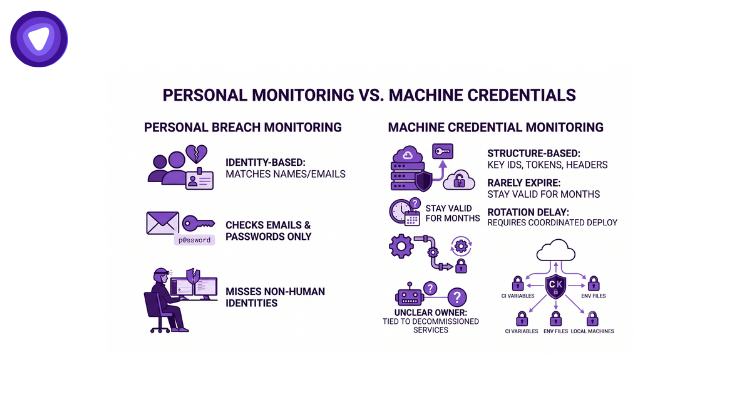
A watchlist built for emails and passwords checks a narrow set of identifiers. It rarely checks for an access key ID format, a bearer token pattern, or a private key header. Leaked cloud credentials monitoring has to look for structured secret formats. Matching a name against a breach dump is not enough.
The scale problem gets worse every year. GitGuardian’s 2026 State of Secrets Sprawl report counted 28.65 million hardcoded secrets added to public GitHub in 2025. That is a 34% year-over-year jump, the largest single-year increase the firm has recorded. Internal repositories carry even more exposure than the public ones most scanners watch by default.
The Non-Human Identity Blind Spot
Non-human credentials now outnumber human accounts inside most cloud environments. A few points explain why they stay exposed longer than a stolen password:
- Machine credentials rarely expire on a fixed schedule. A leaked key can stay valid for months without anyone noticing.
- Rotation usually requires a coordinated deploy, not a one-click reset. Teams delay it because it carries real operational risk.
- Ownership is often unclear. A key tied to a decommissioned service may have no human owner watching for alerts.
- Secrets get copied into multiple places: environment files, CI variables, teammates’ local machines. One leak rarely means one exposure point.
Where Cloud Credentials Actually Leak
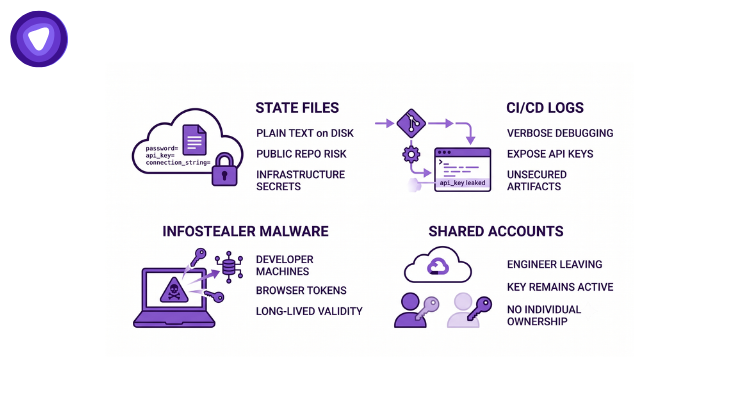
Three sources account for most of the exposure DevOps teams deal with. None of them look like a typical data breach.
Terraform State Files
Terraform stores resource attributes directly inside its state file. This includes generated database passwords and connection strings. Local state saves as plain text on disk. Remote state depends entirely on the backend’s own access controls. A state file pushed to a public repository by mistake hands over infrastructure secrets in one file. It is not one credential at risk. It is every credential the state file touched.
CI/CD Logs and Build Artifacts
Pipelines routinely echo environment variables into build logs during debugging. A single verbose log line in a public CI run can expose an API key. That key was never meant to leave the pipeline. Build artifacts stored in an unsecured bucket carry the same risk, often for longer. Nobody reviews an old artifact the way they review a live log stream.
Infostealer Logs on Developer Machines
A developer laptop infected with infostealer malware hands over browser-saved tokens and SSH keys. Active cloud console sessions go with them, all in one sweep. GitGuardian’s research found that 91.6% of secrets exposed this way were still valid five days after the organization was notified. Snyk’s analysis found internal repositories are roughly six times likelier to contain hardcoded secrets than public ones. The exposure a team cannot see from outside is usually larger than the exposure it can.
Shared Cloud Accounts and Long-Lived Access
Startups and fast-moving product teams often share a single cloud account across several engineers during early growth. Each engineer generates their own access keys under that shared account. When someone leaves the team, their key rarely gets revoked on day one. It sits active, tied to a shared account nobody is individually watching. Monitoring leaked cloud credentials catches this pattern because it checks the credential itself. It does not rely on knowing who once held it.
Why Data Broker Opt-Out Does Not Apply Here
This is the question every technically literate buyer asks on a call. Most reseller pages never answer it directly. Data broker opt-out removes a person’s name, address, and personal records from data broker and people-search sites. It has nothing to do with an access key sitting in a paste site or a stealer log.
Leaked cloud credentials monitoring is a dark web and exposure-intelligence function. It is not a broker-removal function, and the two should never be described as interchangeable. A partner selling both services under one umbrella needs to explain this distinction clearly. Otherwise a client assumes broker opt-out protects infrastructure secrets it was never built to touch. Selling the two together without separating the mechanics causes support tickets to pile up. The first false expectation usually starts on a sales call.
How Leaked Cloud Credentials Monitoring Actually Works
The underlying architecture matters more here than in consumer identity protection. The buyer is technical, and they will ask about it directly instead of taking a feature list at face value.
Exposure Check to Alert
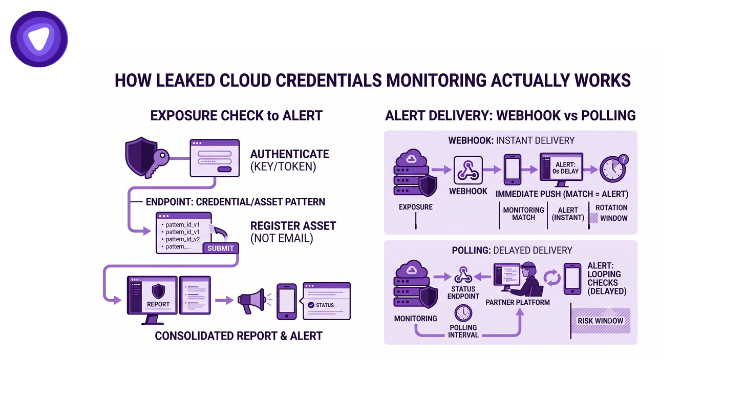
A working implementation authenticates through a secret key, exchanged for an access token. From there, the platform submits an identifier to an exposure intelligence endpoint. That identifier is a credential pattern or asset string, not an email. PureVPN White Label’s exposure intelligence endpoint returns a consolidated report on where and how an identifier surfaced. A partner platform routes that report into its own alerting layer. The account management API handles the asset registration side. It covers creating a monitored entry, checking its status, and disabling it once a credential rotates out of use.
Webhook vs Polling for Time-Sensitive Keys
Once an asset is registered, continuous monitoring watches dark web marketplaces, forums, and paste sites for a match. Two delivery models exist for the resulting alert. A webhook pushes the notification the moment a match occurs. Polling requires the partner platform to check a status endpoint on its own schedule instead.
For a leaked access key, the gap between exposure and rotation is the entire risk window. Webhook delivery removes the delay a polling interval would otherwise add. A partner evaluating a provider should ask which model is the default. Webhook support buried as an optional feature is not the same guarantee.
The Compliance Question Partners Get Asked
A security team evaluating this service asks how the underlying data is handled before it asks about pricing. PureVPN’s identity protection infrastructure encrypts monitored identifiers before transmission. It stores them using SHA encryption. This matters because it separates what the service stores from what it merely checks against exposed data.
That is a different compliance question than the no-log audit scope a VPN product goes through. Partners should keep the two separate when a client’s security team asks for evidence. One audit does not answer both questions. Blurring the two is the fastest way to lose credibility with a technical reviewer mid-call.
Partners should be ready to show three things on a due-diligence call:
- Which identifier formats get scanned, and whether that list covers access keys and tokens, not only emails.
- How long a monitored asset stays registered after a client offboards from the service.
- Whether alert data gets logged anywhere beyond the delivery webhook itself.
A vague answer to any of the three usually ends the conversation before pricing even comes up. Security reviewers at DevOps-heavy organizations tend to ask these questions in writing, not just on a call. A partner should have documented answers ready before the first pitch goes out.
Pricing Leaked Cloud Credentials Monitoring as Its Own Line
Bundling this service into a generic “dark web monitoring” SKU under-prices it against the risk it actually addresses. It also confuses the buyer about what is covered. The table below separates the three services that get bundled together most often. Conflating them is the single most common mistake on a reseller pitch.
| Service | What It Covers | What It Does Not Cover |
| Data Broker Opt-Out | Personal records on broker and people-search sites | API keys, service tokens, infrastructure secrets |
| Personal Credential Monitoring | Emails and passwords tied to a named individual | Non-human tokens, service accounts, build secrets |
| Leaked Cloud Credentials Monitoring | Access keys, SSH keys, Terraform state values, CI/CD secrets | Personal data removal, identity theft remediation |
Bundled security lines tend to retain clients longer than single-product contracts. A bundled security line added by one managed service provider partner reported a 15% increase in client retention. The same partner reported 25% revenue growth within two months of the launch. These are figures the partner reported directly, worth flagging as self-reported rather than independently audited. The underlying pattern still holds for a DevOps-focused monitoring line. A client that adopts a second security product from the same partner tends to churn less. A single point solution rarely earns that loyalty.
Pricing this line separately also protects margin. A generic dark web monitoring add-on gets compared against consumer-grade tools priced near zero. A named, technical, DevOps-facing monitoring line gets compared against dedicated secret-scanning vendors instead. Most of those charge enterprise rates. A partner that names the SKU clearly gives a client’s procurement team a specific line item to justify. A vague add-on buried in a general bundle rarely survives budget review.
Where PureVPN White Label Dark Web Monitoring Fits In
PureVPN White Label Dark Web Monitoring gives partners the exposure intelligence and monitoring layer described above. No one has to build a collection pipeline internally. The account management API handles asset registration, status checks, and webhook delivery. A partner platform integrates monitoring into an existing client dashboard instead of standing up a separate portal from scratch. This matters most for MSSPs whose clients run DevOps-heavy environments. Non-human credentials there easily outnumber the human logins a generic monitoring tool was built to track.
The service sits alongside PureVPN White Label’s broader identity protection stack. It does not replace a client’s existing secret-scanning tools, such as pre-commit hooks or repository scanners. Instead, it fills a different gap: credentials that already left the repository and surfaced outside the client’s own infrastructure. A partner that offers this as a distinct line has a clearer pitch. Pricing and explaining it separately from broker opt-out helps that clarity land. Its client base also understands exactly what it is paying for.
What This Means for Your Client Base
DevOps teams do not need another generic breach alert. They need leaked cloud credentials monitoring that understands the difference between a password and an access key. It needs to route alerts fast enough to matter. It also needs a straight answer about what it does and does not cover. Partners who separate this from broker removal and personal monitoring win the technical buyer’s trust faster. Pricing it as its own line closes the deal faster. Answering the compliance and architecture questions directly does the rest of the work.