


- Auditing a vendor is not the same as auditing your own network. Get written proof of the cipher suites in production, the patch cadence, and the no-logs audit scope before you sign.
- GLBA and PCI DSS both require encrypted VPN traffic. PCI DSS 4.0 also requires an annual review of cryptographic cipher suites and protocols.
- Ask for the exact protocol, not just the name. Confirm WireGuard with ChaCha20 and Curve25519, OpenVPN with AES-256-GCM, or IKEv2 with strong Diffie-Hellman groups, in writing.
- Confirm the no-logs audit covers your branded build. An audit of the parent retail brand does not automatically extend to a white label environment.
- Put the evidence into the contract, not just the sales call. Insist on a right to audit clause, a written patch response SLA, and a set re-audit cadence.
A VPN protocol security audit of a vendor differs from auditing a network your own team runs. Most VPN audit guides assume you already own the infrastructure being reviewed. A fintech buyer evaluating a white label VPN provider is reviewing someone else’s infrastructure instead. That infrastructure will carry your brand once you sign. Before you sign, you need written proof of three things. You need the cipher suites running in production today. You need the patch cadence the vendor commits to. You need the exact scope of any no-logs audit the vendor claims. A VPN protocol security audit that skips any of these is a feature comparison, not real VPN protocol due diligence.
What a VPN Protocol Security Audit Actually Checks
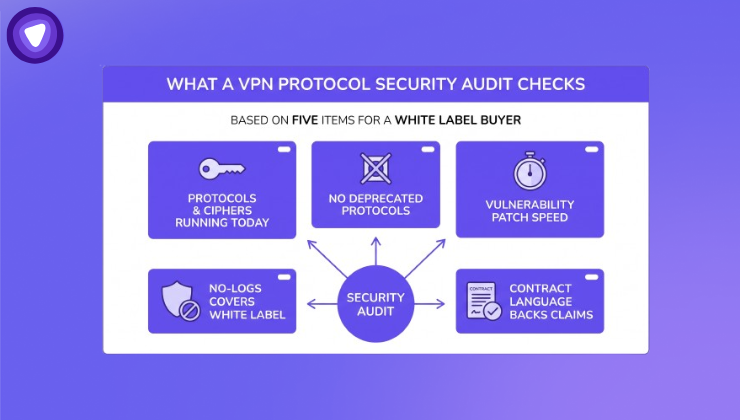
A VPN protocol security audit examines the cryptographic layer underneath a VPN service. It does not examine the app screens a user sees. That layer includes the tunneling protocol in use and the cipher suite negotiated during a connection. It also includes the key exchange method and how quickly the vendor closes a disclosed vulnerability.
For a white label buyer, the audit has a narrower and more practical goal than a general security review. You are confirming five things before you sign:
- Which protocols and cipher suites the vendor runs in production today
- Whether deprecated protocols are still enabled anywhere in the stack
- How fast the vendor patches a disclosed vulnerability
- Whether any existing no-logs audit actually covers the white label build
- What contract language backs up every claim above
Each of these five items gets its own evidence trail. A sales page restating “military-grade encryption” proves none of them.
Scope the audit before you start collecting evidence. Confirm which server regions and client tiers will actually route your traffic. Protocol and cipher configuration can vary by region, even inside the same vendor. A vendor unwilling to name specific regions in writing is not ready for a fintech buyer’s due diligence process.
Why a Feature Checklist Is Not an Audit
A feature checklist tells you a VPN supports OpenVPN. A feature checklist is not a VPN vendor security review. A VPN protocol security audit tells you which OpenVPN cipher suite is active. It tells you when it was last patched and who confirmed it in writing. That distinction matters more for a fintech buyer than for almost any other ICP.
Under the GLBA Safeguards Rule, financial institutions must encrypt customer information at rest and in transit. This falls under 16 CFR 314.4(c)(3), and it is the starting point for GLBA VPN vendor oversight. The rule does not name one algorithm. FTC guidance and enforcement history point to AES-256 for stored data. They point to TLS 1.2 or higher for anything transmitted across a network, including VPN tunnels carrying customer traffic.
PCI DSS VPN encryption requirements go further than GLBA’s baseline. Requirement 4.2.1 requires strong cryptography for any cardholder data crossing an open network. It also requires organizations to document and review their cryptographic cipher suites and protocols at least once a year. A fintech buyer who cannot produce that documentation is not ready for its own PCI DSS assessment. This holds true regardless of how the vendor markets its encryption.
Cipher Suite and Handshake Evidence to Request in Writing
Ask for the exact protocol and cipher suite running in production, not the protocol name alone. This is the core of encryption protocol verification for any VPN vendor. WireGuard, OpenVPN, and IKEv2 each carry a different verification checklist.
WireGuard uses the Noise protocol framework, ChaCha20 for encryption, and Curve25519 for key exchange. Confirm the vendor has not modified the handshake or fallen back to an older cipher for compatibility. OpenVPN should run AES-256-GCM or ChaCha20-Poly1305, never a legacy cipher suite kept alive for older client versions. IKEv2 paired with IPsec should use a Diffie-Hellman group of 2048-bit or stronger. Weaker groups remain a known audit finding.
A VPN protocol security audit fails the moment a vendor cannot answer which cipher suite is live today. That answer needs to come in writing, not from a sales page. Use the VPN security audit checklist below as a starting point for what to request.
| Evidence to Request | What It Proves | Red Flag If Missing |
| Cipher suite in production, by protocol | Actual cryptographic strength, not marketing language | Vendor only names the protocol, not the cipher |
| Patch cadence and last patch date | How fast known vulnerabilities get closed | No documented SLA on patch response time |
| No-logs audit scope, named in writing | Whether the audit covers your branded build | Audit letter references only the parent retail brand |
| Kill switch and leak test results | Whether traffic actually stops on tunnel failure | Vendor has never run or shared a leak test |
| Right-to-audit clause in the contract | Your ability to verify claims after signing | Contract is silent on ongoing verification rights |
Verifying Patch Cadence and Vulnerability Response
Patch cadence is where marketing claims and reality diverge fastest. In February 2025, attackers exploited CVE-2025-0282, a zero-day in Ivanti Connect Secure VPN. The flaw bypassed authentication and reached financial institutions and government agencies before a patch was widely deployed. That single case shows why a protocol name alone tells a buyer almost nothing about actual exposure.
The pattern is not isolated. Coalition’s 2025 Cyber Claims Report found that compromised VPNs were the entry point in 73 percent of ransomware intrusions. That figure only counts cases where the entry point was known. A VPN protocol security audit needs to confirm the vendor’s disclosed-vulnerability response time in writing. A recognizable protocol name is not a proxy for a fast patch cycle.
Ask a prospective vendor three direct questions. How long between a CVE disclosure and a patch reaching production. Whether patches roll out silently on the backend or require partner action. Whether the vendor discloses past incidents to partners even when a fix shipped before any partner noticed.
Confirming the Audit Scope Covers the White Label Build
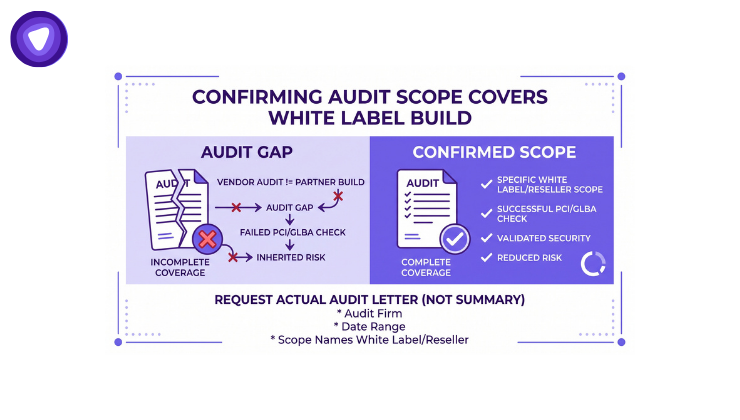
Getting VPN audit scope right for a white label build takes more than a badge on a landing page. Independent audits typically examine a sample of server configurations across a fixed window. That sample does not automatically extend to every white label partner’s branded build on shared infrastructure.
Request the actual audit letter or attestation, not a summary. Confirm three details directly. Ask which firm performed the audit and what date range it covered. Ask whether the scope names white label or reseller environments, not only the parent retail product. A vendor that hesitates on this question is telling a fintech buyer something important. That signal is worth hearing before a contract is signed, not after.
This distinction matters because a fintech buyer inherits the audit gap, not the vendor. A PCI DSS assessor or GLBA examiner can ask whether your VPN vendor’s audit covers your specific deployment. “The parent brand was audited” is not an acceptable answer.
Testing Kill Switch and DNS and IPv6 Leak Behavior Before Signing
Some claims are worth testing directly rather than taking on faith. Force the VPN interface down at the operating system level. Time how long traffic keeps flowing before the kill switch engages. A kill switch that takes several seconds to activate is not functioning as advertised.
Test for DNS leaks specifically over IPv6. Many demo and test devices run IPv6 disabled by default. That setting can hide a leak that reappears once a real user’s device has IPv6 enabled. Run this test before signing, not after your first client complaint.
A VPN protocol security audit that stops at document review skips this hands-on step. It leaves a fintech buyer trusting a claim it never actually verified.
What Belongs in the Contract, Not Just the Sales Call
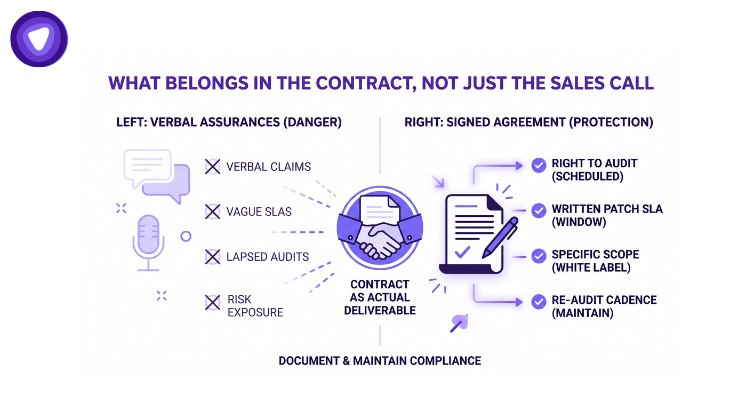
Verbal assurances and sales page language protect nobody once a vendor’s protocol stack shows a weakness. Everything confirmed during the audit needs to appear in the signed agreement.
Insist on a right-to-audit clause that lets your team request updated evidence on a defined schedule, not only at signing. Insist on a written patch response SLA with a specific time window, not a vague commitment to “prompt” remediation. Insist the no-logs audit scope names your white label environment explicitly, in the contract itself. A separate attestation letter can quietly lapse without you knowing.
A documented compliance posture at signing means little if the contract does not require the vendor to maintain it. Set a re-audit cadence in the same clause. A vendor’s protocol stack at signing will not be the same stack two years later. PCI DSS already sets an annual floor for cipher suite review. A fintech buyer’s own contract should match or beat that floor. Treat contract language as the actual deliverable of the audit, not a formality that follows it.
How This Differs From a Penetration Test
A third party VPN audit and a penetration test answer two different questions. The audit checks setup, paperwork, and proof of compliance. A penetration test tries to break in through whatever gaps the audit finds.
Run the audit first. It tells you what to test next. Some fintech buyers ask for a separate penetration test of the vendor’s white label build before they sign. This matters most when the deployment will carry payment data under PCI DSS. That step adds to the audit. It does not replace it.
How PureVPN White Label Approaches Protocol Security
PureVPN White Label VPN Solution puts protocol versions, cipher suites, and audit scope in writing before a partner signs. These details do not stay in a sales call. The platform carries a KPMG-verified no-logs policy and a SOC 2 Type II mark. Both come from outside auditors, not a self-declared claim.
Partners get the full picture on the risks that hit VPN infrastructure at large. That picture spans patch speed and audit scope too. A fintech partner walks into its next GLBA or PCI DSS review with proof in hand, not a promise.
Conclusion
A white label VPN vendor audit is not a courtesy step before you sign a deal. It is the paper trail a fintech buyer needs later. A compliance team, an examiner, or an outside auditor will ask how the vendor’s protocol security got checked. Buyers who cannot show that proof carry the risk alone.
Request a 20-minute protocol and compliance review call with PureVPN White Label before you pick a vendor.
Not ready for that call yet? Start with the protocol and authentication basics in Password Authentication Protocol (PAP) Security Explained. Come back to this checklist once you are ready to evaluate a specific vendor.