


- VPN bundle pricing should not blend all three products under one cost logic; the anchor product (VPN, monitoring, or opt-out) should match what the client already trusts the MSP for.
- Three tiers work better than five; Base (VPN), Standard (VPN plus monitoring), and Premium (adding opt-out) keep the decision simple and support costs predictable.
- Data broker opt-out cannot be priced as a one-time fee, since brokers relist removed data and generate recurring removal work long after the first cleanup.
- Billing should track active accounts rather than provisioned ones, since a disabled account should not carry the same cost weight as one still pulling monitoring data or routing VPN traffic.
- Attach rate, not list price, decides whether a bundle actually pays off; a lower-margin tier with wide adoption often beats a premium tier that few clients buy.
For an MSP, bundling VPN, dark web monitoring, and data broker removal can expand ARPU per client fast. Mispricing the recurring parts of that bundle can undo the gain just as fast. A data broker opt-out plan priced like a one-time cleanup looks fine on the invoice in month one. Every repeat removal request after that chips away at margin quietly, long after the client has already signed and onboarded.
Good VPN bundle pricing does not start with a discount. It starts with modeling where the recurring cost actually lives. That is not the same as adding another flat markup on the VPN tier. That means deciding which product anchors the tier. It also means deciding which product absorbs the ongoing operational cost. The last piece is a price a client will not question three months in.
This piece works through each of those decisions in order, using the actual mechanics behind VPN, monitoring, and opt-out.
Why Bundling Breaks Pricing Sheets That Worked Fine Standalone
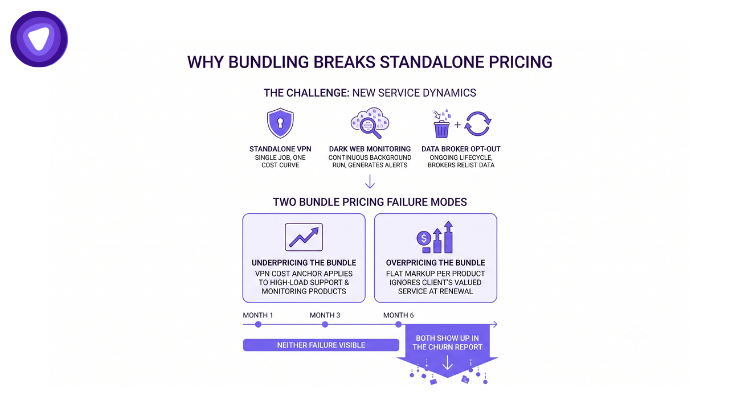
A standalone VPN has one job and one cost curve. Dark web monitoring changes that picture. It runs continuously in the background. It generates alerts a client did not request on any given day. Data broker opt-out changes it further. That product takes on a life cycle that never fully closes, since brokers relist removed data on their own schedule. Pricing all three the same way creates two failure modes.
- Underpricing the bundle, because the VPN cost anchor applies to products with a very different support and monitoring load
- Overpricing the bundle, because a partner adds a flat markup per product. That markup ignores which product the client actually values at renewal
Neither failure shows up in month one. Both show up in the churn report six months later.
What Moves ARPU When VPN Bundle Pricing Covers Three Products, Not One
VPN bundle pricing succeeds when the products layered on top add margin without adding matching cost. Telecom offers the clearest outside benchmark for this. Security add-ons are on track to reach 30 percent of ISP ARPU in developed markets by 2026. Cloud security and monitoring layers are driving that growth, not core connectivity pricing. MSPs are seeing the same shift play out on their own price sheets.
Managed service providers show a similar pattern from the security side. A recent survey found that 65 percent of MSPs reported increased revenue from security services in the past year. Flat per-device pricing is losing ground fast as bundled tiers take over instead. Margin data backs this up further. Endpoint detection bundled into a managed plan carries gross margins roughly 18 percentage points higher than antivirus sold alone.
The pattern across both segments is consistent. VPN bundle pricing works best when the add-on products drive the margin. The VPN itself stays the low-cost anchor. Its job is getting a client into the tier in the first place, not carrying the profit.
Choosing the Anchor Product Before You Set a Single Price
Every bundle needs one product that justifies the entry price. It also needs two products that justify the upgrade. Picking the wrong anchor is the most common reason bundled pricing underperforms simple a la carte pricing. Getting VPN bundle pricing wrong at this step is difficult to fix later without a full repricing project.
When VPN Should Anchor the Tier
VPN anchors work when an MSP’s clients already buy managed network or remote access services from that MSP. The VPN becomes the reason a client signs up for the tier. Monitoring and opt-out become the reasons they stay past the first renewal.
When Monitoring or Opt-Out Should Anchor It Instead
MSPs whose clients already buy managed detection, compliance monitoring, or identity services often see the opposite pattern. Those clients care first about exposure, not encryption. In that case, dark web monitoring or data broker opt-out should sit at the top of the pricing page. VPN becomes the layer that closes the loop between detection and prevention.
Structuring Tiers Without Turning the Price Sheet Into a Menu
Three products create six possible combinations if every one stays fully optional. That is too many decisions for a client to make at checkout. Most clients freeze when a checkout page shows more than three real choices. A tighter structure works far better in practice.
| Tier | Products Included | Pricing Logic | ARPU Role |
| Base | VPN only | Low entry cost, high volume | Acquisition |
| Standard | VPN + dark web monitoring | Monitoring priced as the margin driver | Retention |
| Premium | VPN + dark web monitoring + data broker opt-out | Opt-out priced highest due to ongoing lifecycle cost | ARPU expansion |
Three tiers, not five, keeps the decision simple. It also keeps support costs predictable across the base. Anything beyond three tiers tends to fragment the client base. That fragmentation rarely comes with a matching lift in average revenue per user.
The jump between Standard and Premium deserves more thought than the jump between Base and Standard. Clients already paying for monitoring have shown they value ongoing protection over a one-time fix. That makes them a better fit for opt-out than a client still deciding whether monitoring is worth it at all.
Pricing Data Broker Opt-Out When the Work Never Fully Finishes
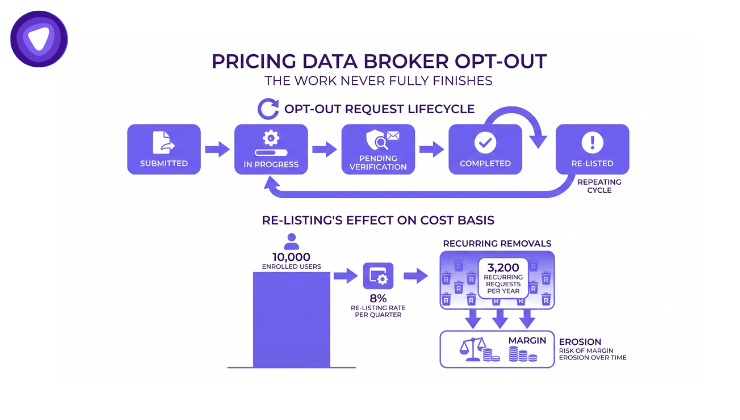
Data broker opt-out behaves differently from the other two products at the pricing level. A VPN connection either works or it does not. Dark web monitoring either finds an exposure or it does not. Opt-out requests move through stages instead, and completion is not permanent.
- Submitted, when the request enters the queue
- In progress, while the service contacts the broker directly
- Pending verification, when the broker requires confirmation before removal
- Completed, once the broker confirms the data is gone
- Re-listed, when the same data reappears and the system submits a new request automatically
What Re-Listing Does to Your Cost Basis
Re-listing means the cost of opt-out never stops once the first request completes. A client who signed up a year ago can still generate new removal work today. Flat per-user pricing for this layer only holds up if it accounts for repeat cycles. A one-time cleanup price will not cover it.
Round numbers make the risk concrete. Take a base of 10,000 enrolled users. If 8 percent trigger a repeat removal cycle each quarter, that is 3,200 recurring requests a year. A one-time opt-out fee never priced in that volume. Support and verification costs come on top of it. Partners who price opt-out like a single task tend to see margin erode quietly. That erosion grows as the client base grows.
Provisioning and the Seat Question Partners Always Ask
Every partner eventually asks the same operational question. Should billing track provisioned accounts, or active accounts instead. The distinction matters more than it first appears. It shows up directly in gross margin once the client base passes a few thousand accounts.
An account API that supports creating, enabling, disabling, and deleting accounts gives partners a way to separate the two. A provisioned account disabled mid cycle should not carry the same cost weight as an active one. An active account is one still pulling monitoring data or still routing VPN traffic.
Partners billing strictly per provisioned seat tend to overpay their backend for dormant accounts. Partners billing per active seat instead keep costs closer to actual usage. Partners check active seat status against real account status, not a signup date. That distinction alone can separate a profitable premium tier from one that quietly bleeds margin.
The Attach Rate Math That Decides If VPN Bundle Pricing Pays for Itself
Attach rate, not list price, decides whether VPN bundle pricing is worth building at all. A premium tier that only ten percent of the base adopts can still lose. A cheaper tier with wide adoption often wins on total margin.
- Calculate the incremental margin per upgraded client, not the incremental list price
- Multiply that margin by the expected attach rate at each tier, not the total client count
- Compare the result against the fixed cost of running monitoring and opt-out infrastructure
A tier adding five dollars of margin at 40 percent attach beats an eight-dollar tier at 15 percent attach. Most partners model the price closely. Fewer model the attach rate. That number is usually the one that actually breaks the plan.
MSPs rarely disagree on this math once they see it modeled side by side. The disagreement usually comes earlier, over which tier the sales team pushes hardest. A premium tier with low attach rate can look impressive on a pricing page. It still underperforms quietly against a wide, cheaper tier every quarter.
Compliance Deadlines That Change What You Can Charge
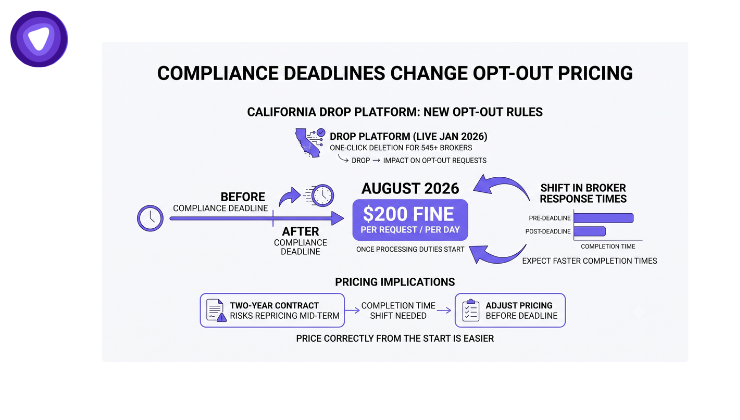
New rules are starting to affect data broker opt-out pricing directly, not just its marketing copy. California’s DROP enforcement deadline changes broker response times starting August 2026, when unresolved requests trigger daily penalties MSPs pricing opt-out today should model for that shift now, not after contracts are already signed.
That penalty structure changes broker behavior in every state that follows California’s lead. It also changes how fast opt-out requests actually clear once submitted. MSPs pricing this layer today should expect completion times to shift once the penalty period begins.
Pricing built around current broker response times may need revisiting before that deadline hits. An MSP locking in a two-year contract now, without accounting for this shift, risks repricing mid term. That conversation is harder than pricing it correctly from the start.
Where a Ready Backend Changes the Math
Building all three products independently means running three separate compliance checks. It also means mapping broker relationships and support workflows on three different timelines. The PureVPN White Label VPN Solution gives an MSP one VPN backend to build the Base tier on. Dark web monitoring and data broker opt-out sit on top as add-on modules.
The same account management API provisions both, alongside the VPN tier itself. That structure is what makes tiered VPN bundle pricing practical for an MSP team. It stops the plan from being a spreadsheet exercise that never survives real clients.
An MSP running a white label VPN alongside its existing security stack saw a 20 percent increase in enterprise clientele. The same MSP also cut operating costs by 32 percent within two months, according to a case study. Client retention rose 15 percent over the same period. Results vary by client base, but the pattern holds. Lower operating cost frees up room to price the Premium tier competitively, without giving away margin.
MSPs weighing this bundle can request a pricing worksheet built around the three tiers above. The worksheet reflects each MSP’s own client base and renewal cycle. It accounts for the August 2026 deadline that changes opt-out completion times.
Where This Leaves Your Price Sheet
VPN bundle pricing only works when the sequence is right. Pick the anchor product based on what the client already trusts the brand for. Price monitoring and opt-out based on their actual cost curve. Do not borrow a flat markup from the VPN tier. Track attack rate before locking in a premium tier. Build billing around active accounts, not provisioned ones that sit unused.
The partners getting this right are not the ones with the lowest price on the page. They are the ones whose tiers match how the products actually behave. That match holds once a client signs up and stays through renewal.
- VPN bundle pricing should not blend all three products under one cost logic; the anchor product (VPN, monitoring, or opt-out) should match what the client already trusts the MSP for.
- Three tiers work better than five; Base (VPN), Standard (VPN plus monitoring), and Premium (adding opt-out) keep the decision simple and support costs predictable.
- Data broker opt-out cannot be priced as a one-time fee, since brokers relist removed data and generate recurring removal work long after the first cleanup.
- Billing should track active accounts rather than provisioned ones, since a disabled account should not carry the same cost weight as one still pulling monitoring data or routing VPN traffic.
- Attach rate, not list price, decides whether a bundle actually pays off; a lower-margin tier with wide adoption often beats a premium tier that few clients buy.