

Key Takeaways
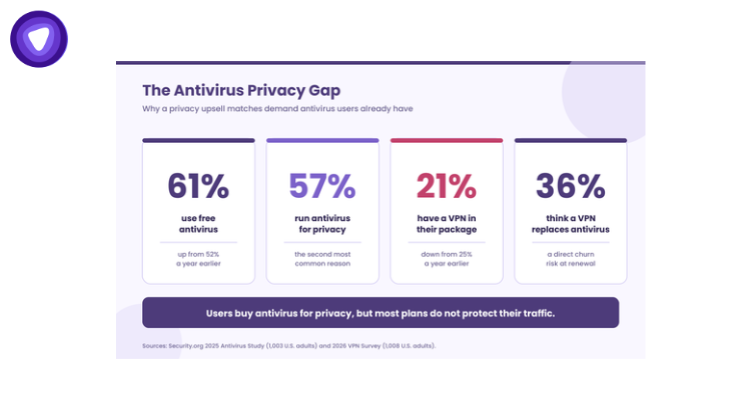
- Free antivirus use hit 61 percent in 2025, so detection alone no longer justifies a renewal charge.
- 57 percent of users cite privacy as a reason to run antivirus, yet only 21 percent get a VPN.
- 36 percent of Americans wrongly think a VPN replaces antivirus, so a VPN bought elsewhere is a churn risk.
- On Android, a separate VPN app can shut off antivirus web filtering, so build encryption into one app.
- Track weekly active use and cohort renewal, not just add-on sales, to prove the privacy upsell works.
Quick Answer: A privacy upsell adds a VPN layer to an antivirus plan as an add-on, tier, or default. It lifts renewal value because 57 percent of antivirus users already cite privacy as a reason to buy. It works best when the VPN lives inside the antivirus app and appears at risky moments.
Every antivirus renewal is now a value test. Users weigh the charge against free tools that already ship on their devices. A privacy upsell gives them a fresh reason to pay, one that malware scans alone no longer supply.
The pressure shows up in Security.org’s 2025 antivirus study of 1,003 U.S. adults. Free antivirus use rose to 61 percent, up from 52 percent a year before. Paid plans fell from 44 percent to 36 percent in the same span. Yet 57 percent of users name privacy as a reason they run antivirus at all. Only 21 percent say their package has a VPN, down from 25 percent.
That gap is the opening. People already buy antivirus partly for privacy, and most plans do not guard their web traffic. This guide covers placement, packaging, wording, store rules, and the metrics that prove a privacy upsell works.
Why Detection Alone No Longer Carries the Renewal
Three forces now squeeze the value of a scan-only plan. Each one shows up in the renewal data before it shows up in revenue.
Users Cannot See Detection Working
Malware detection still matters, but users rarely see it work. The same study found just 25 percent of users give antivirus its top score. Another 63 percent say safe browsing habits matter more than the software.
When a product works in silence, users do not notice what it blocked. They notice the renewal charge instead. Billing platform Recurly says voluntary churn above benchmark points to a value perception problem. Card retries and dunning emails cannot fix that churn. Only more product value can.
VPN Users Think They No Longer Need Antivirus
The second force comes from the VPN market. Security.org’s 2026 VPN survey found 42 percent of Americans now use a VPN, up from 32 percent in 2025. In the same survey, 36 percent wrongly believed a VPN replaces antivirus.
That belief is a direct churn risk. A user who buys a VPN elsewhere may drop antivirus at the next renewal. Owning the VPN inside the antivirus plan removes that reason to leave.
Free Tools Will Not Fill the Privacy Gap
Free tools are not filling the privacy gap either. The most-used antivirus brand in the 2025 study retired its VPN from its consumer app in February 2025. It cited a routine review of how often people used it.
The lesson is plain. A VPN that users never switch on adds cost and no renewal value. It also means a paid brand can still own the privacy layer, as long as people actually use it.
Why a Privacy Upsell Fits Antivirus Better Than Other Add-Ons
Antivirus brands can bolt on many extras, from cleanup tools to cloud storage. A privacy upsell has four clear edges over most of them. It also turns a single scanner into a true security suite.
Users Already Buy Antivirus for Privacy
The 57 percent privacy motive means the upsell does not need new demand. It needs a product that matches a reason to buy that already exists. A VPN locks the traffic between the device and the network, which a scan does not cover. So the privacy upsell extends the first purchase. It is not a jump into a new category.
The Antivirus App Already Sees the Risky Moment
Most security apps already watch the network. In the 2025 study, 64 percent of users said their package includes firewall or network protection. So the app can tell when a laptop joins an open hotspot at an airport or café. That moment is the most natural place to offer encryption. A standalone VPN brand never gets that signal from inside the user’s own security tool.
The Base Is Loyal, So the Upsell Costs Less Than Acquisition
The same study found 84 percent of users changed nothing about their antivirus in the past year. That loyalty makes the existing base the cheapest market a brand has. Selling to it needs no ad spend, only a well-timed prompt inside an app people already trust.
Competition Now Arrives From the VPN Side
The bundle race now runs both ways. In October 2026, one well-known VPN brand began to embed full antivirus in its desktop app. It now sells that combined product in three plan tiers. Antivirus brands that wait will face VPN brands that walk in with privacy already built in.
Why Renewal Rules Now Favor Value Over Price Increases
A higher renewal price is the fastest way to lift revenue per user. Renewal law has made that lever far more visible to each user. The details differ by level of government, so it helps to separate the two.
The Federal Rule Fell, but State Laws Remain
On July 8, 2025, a federal appeals court vacated the rule behind the FTC’s national click-to-cancel standard. That did not end the pressure. Law firm Greenberg Traurig notes that more than half of U.S. states now have auto-renewal laws. Many are as strict as the vacated rule, or stricter, and state attorneys general enforce them.
California Sets the Hardest Standard
California’s amended Automatic Renewal Law took effect on July 1, 2025. Law firm Cooley’s summary of amendments lists the changes that hit annual plans hardest:
- Firms must send a yearly reminder with the charge, how often it bills, and how to cancel.
- Users who sign up online must be able to cancel online, with no extra steps.
- A save offer may appear, but only next to a clear cancel button.
- A price change needs notice 7 to 30 days ahead, with cancel steps included.
- Plans with a first term of one year or more need notice 15 to 45 days before renewal.
So every annual antivirus user in California now gets a yearly prompt to think twice. A price rise arrives with cancel steps attached. A save offer must compete with a one-click exit.
Under these rules, added value is the safer growth lever. A privacy upsell gives the yearly reminder something new to say. Decide the bundle before your next reminder cycle, not after the cancels arrive.
Where to Place the Privacy Upsell Inside an Antivirus App
Placement decides whether users ever turn on the VPN they paid for. Standalone tools rely on manual activation, and people forget to switch them on. The best prompts come from signals the antivirus app already collects.
Trigger Moments That Convert
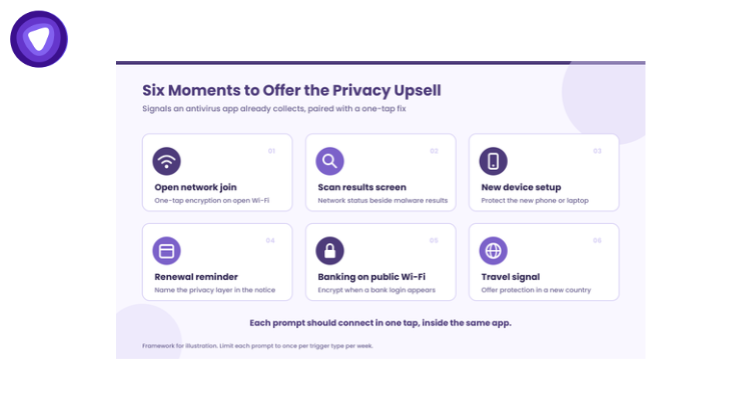
Each of these moments pairs a visible risk with a one-tap fix:
- Open network join: Offer one-tap encryption when the device joins an open or unknown Wi-Fi network.
- Scan results screen: Show network safety status next to malware results, so privacy reads as part of security.
- New device setup: Prompt protection for a new phone or laptop during setup, when attention is high.
- Renewal reminder: Name the privacy layer in the yearly reminder, so the charge maps to value people can see.
- Banking on public Wi-Fi: Suggest encryption when web protection spots a bank login on an open network.
- Travel signal: Offer protection when the device appears in a new country or time zone.
Each prompt should connect in one tap inside the same app. Sending users to a second app wastes the moment that triggered the prompt.
Desktop and Mobile Need Different Defaults
Desktops tend to stay on a few known networks, such as home and office. There, a quiet auto-connect rule for unknown networks works better than frequent pop-ups. Phones change networks all day, so short, contextual prompts fit them better.
Give users one switch for auto-protect on untrusted Wi-Fi. That single setting turns a one-time sale into daily use, and daily use is what defends the renewal.
Prompt Frequency Rules
Too many prompts train users to ignore them. Set clear limits from the start:
- Show the same upsell prompt no more than once per trigger type per week.
- Stop prompting after two dismissals of the same trigger, then retry after 30 days.
- Never place a prompt over an active threat alert, since the threat must come first.
Packaging the Privacy Upsell: Three Models Compared
The packaging model sets both the revenue path and the main risk. Most brands choose between three ways to build an antivirus VPN bundle.
| Model | How It Works | Best Fit | Main Risk | Metric to Watch |
| Paid add-on | VPN sold as an optional extra on any plan | Large paid base with flat revenue per user | Low attach rate if prompts are weak | Attach rate within 90 days |
| Premium tier | VPN included only in a higher plan | Brands with an existing tier ladder | Users stay on lower tiers | Upgrade rate at renewal |
| All-plan inclusion | VPN added to every paid plan | Brands under heavy free-tier pressure | Added cost without added price | Renewal rate against prior cohort |
How to Choose Between the Three
Start with the problem you need to solve. A paid add-on suits brands chasing new revenue from a stable base. A premium tier suits brands that already sell plan ladders and want a clear reason to move up. All-plan inclusion suits brands losing users to free tools, where renewal rate matters more than add-on revenue.
Many brands run a hybrid. They include a capped VPN in every plan and sell unlimited use in a higher tier. The capped version builds the habit, and the tier captures the users who rely on it most.
Illustrative Revenue Math
The math below is for illustration only. It uses round numbers, not any real brand’s data. Take an antivirus brand with 200,000 annual users and a 70 percent renewal rate. A three-point renewal lift keeps 6,000 more users each year. At a sample $50 yearly plan, that keeps $300,000 in revenue. If 8 percent also buy a $20 add-on, that adds $320,000 more. The two gains stack, so placement and packaging deserve equal care.
How to Word the Privacy Upsell in the Renewal Reminder
The yearly reminder now reaches every California user, so its wording carries real weight. A reminder that lists only a charge invites a cancel. A reminder that lists protection delivered gives the user a reason to stay.
Strong reminders follow a simple order:
- Lead with protection delivered: State threats blocked and networks secured over the past year, using the user’s own data.
- Name the privacy layer: Mention encrypted connections on public Wi-Fi as part of what the plan covers.
- Show the charge plainly: Give the amount and billing frequency, as the law requires, without burying it.
- Keep the cancel path clear: Include the cancel steps, since hiding them breaks the rule and loses trust.
One illustrative line: “This year, your plan secured 46 public Wi-Fi sessions and blocked 12 harmful sites.”
Figures like these must come from each user’s real activity, never from a template. When the numbers are real, the reminder reads as a report, not a bill.
The Mobile Detail That Breaks Bolted-On Bundles
Mobile is where many antivirus and VPN bundles fail in silence. The cause sits in how phones handle secure tunnels.
One Tunnel Per Phone
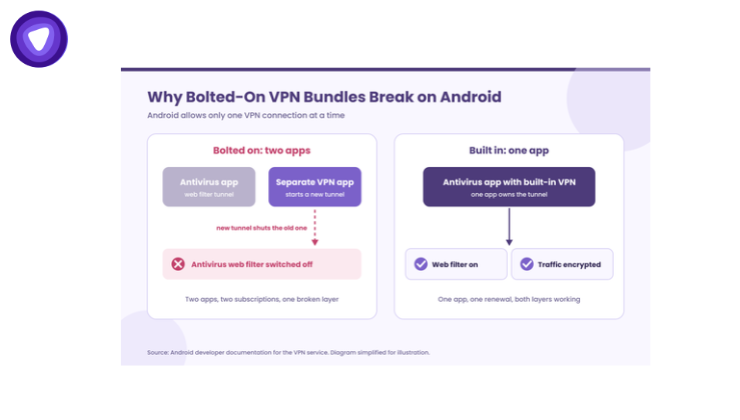
Many mobile security apps filter harmful links through a local VPN that runs on the phone. The consumer app named above confirms its iOS web filter still works this way. Android allows only one VPN connection at a time. Starting a new tunnel shuts down the one already running. So a separate VPN app can switch off the antivirus app’s own web filter.
The fix is to build encryption into the antivirus app, so one app owns the tunnel. A VPN SDK makes that possible on Android and iOS, plus Windows and macOS. Teams still need to plan how web filtering and encryption share that tunnel. Add that point to your provider vetting questions, next to audits and uptime.
Battery and Speed
Battery and speed matter too. Scans and encryption both run in the background, so test them together on low-end phones. Measure battery drain over a full day, not a five-minute demo. A slow or draining bundle earns one-star reviews faster than any missing feature.
App Store Rules to Clear Before Launch
Both major app stores treat VPN features as a special case. Planning for their rules early avoids a rejected update during launch week.
Google Play
Google Play’s VPN service policy lists anti-virus apps among its permitted uses. That permission comes with duties. The app must file a declaration form in Play Console, with a demo video of 90 seconds or less. It must also describe its VPN use on the store listing and encrypt data sent to the tunnel endpoint.
If the app collects personal data, it needs a prominent in-app disclosure with clear user consent. A privacy policy alone does not meet that bar. The policy also bans using the tunnel to reroute other apps’ ad traffic.
Apple App Store
Apple’s review guidelines only accept VPN apps from developers enrolled as an organization. Most antivirus brands already publish this way, so the main task is the review itself. Describe the VPN feature clearly in review notes, and update the privacy label to match. Resubmit the label whenever a new data flow ships.
Trust: The Hidden Requirement of a Privacy Upsell
A privacy upsell also raises the bar on trust. In the 2025 antivirus study, 57 percent of people feared some antivirus firms misuse personal data. Selling a privacy feature into that doubt takes proof, not promises.
Ask any white label VPN for antivirus partner for independent audit reports that cover its no-log claims. Then show the audit result inside the app and on the plan page. That is where the doubt forms, so that is where the proof belongs.
Check the audit scope with care. An audit of the VPN network does not cover your own app’s analytics or billing data. Those layers stay your responsibility, so document them in plain words for users.
Common Mistakes That Sink a Privacy Upsell
Most failed bundles fail for the same few reasons. Each one below is avoidable at the planning stage:
- Shipping a second app: A separate VPN app splits the experience and, on Android, can disable web filtering.
- Hiding the VPN in settings: A feature nobody finds builds no habit and no renewal value.
- Raising price in the same cycle: A new feature plus a price rise reads as a price rise.
- Counting sales, not use: Add-on revenue can look healthy while weekly use quietly falls.
- Skipping the trust story: An unaudited privacy claim invites the doubt the upsell must overcome.
Metrics That Show Whether the Privacy Upsell Works
Add-on sales are only the first signal. Renewal value depends on real use, so track the full chain:
- Attach rate: The share of paid users who add or upgrade into the privacy layer.
- Weekly active tunnels: The share of privacy users who connect at least once a week.
- Prompt conversion: Connections started from each in-app prompt, ranked by placement.
- Cohort renewal rate: Renewal for privacy users against similar users without it.
- Support load: Tickets per thousand privacy users, mainly about connection speed.
A VPN that sits unused will not defend a renewal. Weekly use is the early signal, and renewal rate is the result. Compare cohorts that joined in the same month, so seasonal swings do not skew the result.
A 90-Day Launch Plan for Antivirus Brands
A privacy upsell does not need a year-long project. A focused team can move in three phases.
Days 1 to 30: Decide and Integrate
Pick the packaging model and the first two trigger moments. Choose a provider, confirm its audit scope, and start the SDK integration. File the Google Play declaration early, since review can add days.
Days 31 to 60: Test and Soft Launch
Run battery and speed tests on low-end devices. Release the feature to a small share of users first. Track activation and support tickets before any wider rollout.
Days 61 to 90: Scale and Measure
Roll out to the full base and add the remaining triggers. Update the renewal reminder to name the privacy layer. Set up the cohort renewal report so the first renewal cycle produces clean data.
Proof: An Antivirus-Led Provider That Added VPN
An anonymized partner case shows the pattern at work. The partner is a U.S. managed service provider built on antivirus for over two decades. It did not ship a second app. Instead, it built VPN encryption into its existing antivirus app through an SDK.
Per the partner case study, client retention rose 15 percent after launch. Revenue grew 25 percent within the first two months. Enterprise clients grew 20 percent, and running costs fell 32 percent. These are the partner’s own reported results, not audited figures.
The buyer was a service provider, yet the move mirrors the consumer antivirus case. One app now carries two layers of protection, and one renewal covers both. The retention gain matters most here, since retention is where subscription value compounds.
How PureVPN White Label VPN Solution Helps
PureVPN White Label VPN Solution lets antivirus brands add a privacy layer under their own name. Teams embed it with SDKs for Windows, macOS, iOS, and Android, or launch fully branded apps. The network spans 6,500+ servers in 88+ countries, per the company’s own figures. Its no-log policy carries a KPMG audit, so a third party has checked the claim.
Building the same network in-house takes 12 to 18 months and $500,000+, by PureVPN White Label estimates. Brands that later want identity tools can extend the same deal into a wider privacy suite. That suite adds dark web monitoring and data broker removal as separate lines.
Conclusion
Antivirus users now judge each renewal against free tools, VPN rivals, and yearly reminders. Malware scans alone rarely win that test. A privacy upsell answers a motive users already hold, at moments the app already sees. Package it with care, build it into one app, clear the store rules, and track weekly use. Sales alone will not show whether it works. That is how a privacy upsell turns a renewal notice into a reason to stay.
Request API sandbox access for a 20-minute integration walkthrough.
Frequently Asked Questions
What is a privacy upsell for antivirus brands?
It is a privacy layer, usually a VPN, sold to current antivirus users as an add-on or premium tier.
Does adding a VPN to antivirus reduce churn?
Yes. One antivirus-led partner reported 15 percent higher client retention after building VPN into its existing app.
Should the VPN be a separate app or built into the antivirus app?
Built in. Android allows one VPN connection at a time, so a separate app can disable antivirus web filtering.
How should antivirus brands package a VPN upsell?
Pick a paid add-on, a premium tier, or all-plan inclusion, then track attach rate and cohort renewal.
Can an antivirus app use a VPN on Google Play?
Yes. Google Play lists anti-virus apps as a permitted VPN use, but requires a declaration and demo video.
Does a VPN replace antivirus software?
No. A VPN encrypts traffic, while antivirus detects malware, yet 36 percent of surveyed Americans believe otherwise.
How long does it take to build a VPN in-house?
It takes 12 to 18 months and over $500,000, while white label partners launch branded apps within two weeks.