

Key Takeaways
- Mobile service revenue growth is expected to stay below inflation through 2030, so flat ARPU means falling real revenue.
- Branded security lifts mobile ARPU through top-tier upgrades, paid add-ons, or short passes for prepaid and travel.
- Keep account safety free on every plan and charge for personal privacy tools subscribers can see working.
- Report blended and attached ARPU separately, and track activation and contribution margin per protected line.
- In the EU, paid add-ons need express consent, so pre-ticked checkout boxes are not allowed.
- Run a 90-day pilot comparing tier and add-on placement before a national rollout.
Connectivity alone no longer moves mobile ARPU. Operators sell more data every year, yet the monthly bill barely changes. Branded security features give operators a way to raise revenue per line without a straight price rise. This guide shows where security belongs in a plan ladder and how to measure the mobile ARPU lift honestly.
It also covers which features belong in the paid layer and which must stay free. Finally, it sets out segment playbooks, the KPIs to track, and a 90-day pilot plan.
Why Mobile ARPU Needs a New Lever
Revenue growth in mobile now trails the cost of living. The latest Analysys Mason forecast puts worldwide mobile service revenue near USD 1 trillion by 2030. However, it also expects that growth to stay below inflation. In real terms, flat mobile ARPU means operators earn less from each line every year.
Selling more data alone does not close that gap, since usage keeps rising while the bill stays flat. As a result, operators need a reason to pay more that has nothing to do with data volume.
Subscriber Worry Keeps Rising
At the same time, subscriber worry about security keeps climbing. Deloitte’s 2025 Connected Consumer survey found that 70% of respondents worry about data privacy and security online. Moreover, only 48% said the benefits of online services outweigh those concerns. That figure fell from 58% a year earlier.
The phone sits at the center of that worry. Consumers reported losing $470 million to scams that started with text messages in 2024, according to the Federal Trade Commission. The FTC also noted that this figure stood five times higher than in 2020. Fake package delivery alerts topped the list of reported text scams.
Operators Hold a Trust Advantage
Together, these trends point to one opening. Subscribers want protection, and they already trust their operator with identity and billing data. Therefore, security fits the plan itself, not a separate app store purchase.
Bundling also protects revenue after the sale. Parks Associates data shows more than one quarter of US households now buy a bundled broadband and wireless offer. Parks links that bundle to higher lifetime value and lower churn. Every month a subscriber stays adds to lifetime revenue, even when the monthly figure holds steady.
What Goes Into a Paid Security Layer
Before placement comes the product itself. A paid layer needs features that subscribers can see working each month. Four features meet that test, and each one answers a different subscriber fear.
Branded VPN for Public Wi-Fi and Roaming
A branded VPN encrypts traffic on hotel, airport, and cafe Wi-Fi. Subscribers notice it every time they connect away from home. For roaming users, a wide server footprint also keeps sessions stable in other countries.
Operators can set the VPN to switch on when the phone joins an open network. That moment gives subscribers a visible reminder of what they pay for. Moreover, the operator brand appears on screen each time, not a third-party logo.
Breach and Dark Web Alerts
Breach alerts tell subscribers when their email, phone number, or passwords appear in leaked data. Each alert names what leaked and suggests a next step. Consequently, the feature produces a steady stream of proof that it works.
These alerts also tie back to the scam problem above. An alert tells subscribers which of their details appear in leaked data. They can then change a password before a scammer uses it.
Data Broker Removal
People-search sites publish home addresses, phone numbers, and relatives’ names. Removal services find these listings and file opt-out requests on the subscriber’s behalf. A monthly report then shows how many listings came down.
This feature suits subscribers who already feel exposed. In addition, the report format fits a monthly bill, since each cycle brings a new update.
Password Management
A branded password manager stores logins in an encrypted vault across devices. It gives subscribers a daily-use tool inside the operator brand. Similarly to the VPN, daily use keeps the paid layer front of mind at renewal time.
Operators do not need all four features at launch. Instead, they start with the VPN and one identity feature, then add more as attach data comes in.
Where Security Fits in the Mobile ARPU Plan Ladder
Placement decides how mobile ARPU moves. The same feature can lift revenue through tier upgrades, through add-on sales, or through short passes. Each path suits a different segment, so most operators run more than one.
Included in the Top Tier
Here, a branded VPN and related protections sit inside the premium plan. The feature gives subscribers a concrete reason to step up from the middle tier. As a result, ARPU grows through plan mix, not through a separate line item.
This model works best for postpaid bases with a clear good, better, best ladder. It also keeps the checkout simple, since protection forms part of the plan price.
Sold as a Paid Add-On
In this model, any subscriber can attach security for a monthly fee. The add-on lifts revenue only for lines that take it. Consequently, attach rate matters more than headline price.
Add-ons suit operators with flat or unlimited plans and little room between tiers. They also give finance a clean revenue line to report.
Time-Boxed Passes for Prepaid and Travel
Prepaid subscribers rarely commit to a monthly extra. A 7-day or 30-day protection pass, matched to the top-up cycle, fits their buying habits better. Similarly, travel eSIM buyers value privacy on hotel and airport Wi-Fi during a trip. A pass sold beside the data pack meets that need at the moment of purchase.
The table below compares the three placements side by side.
| Placement | How Revenue Moves | Best Fit | Watch Out For |
|---|---|---|---|
| Included in top tier | More lines move up to the premium plan | Postpaid bases with a wide tier ladder | Upgrades that would have happened anyway |
| Paid add-on | Attached lines pay a monthly extra | Flat or unlimited plan line-ups | Low attach rate dilutes the blended lift |
| Time-boxed pass | Short purchases tied to top-ups or trips | Prepaid and travel segments | Low repeat purchase after the first pass |
The Free Versus Paid Line Subscribers Accept
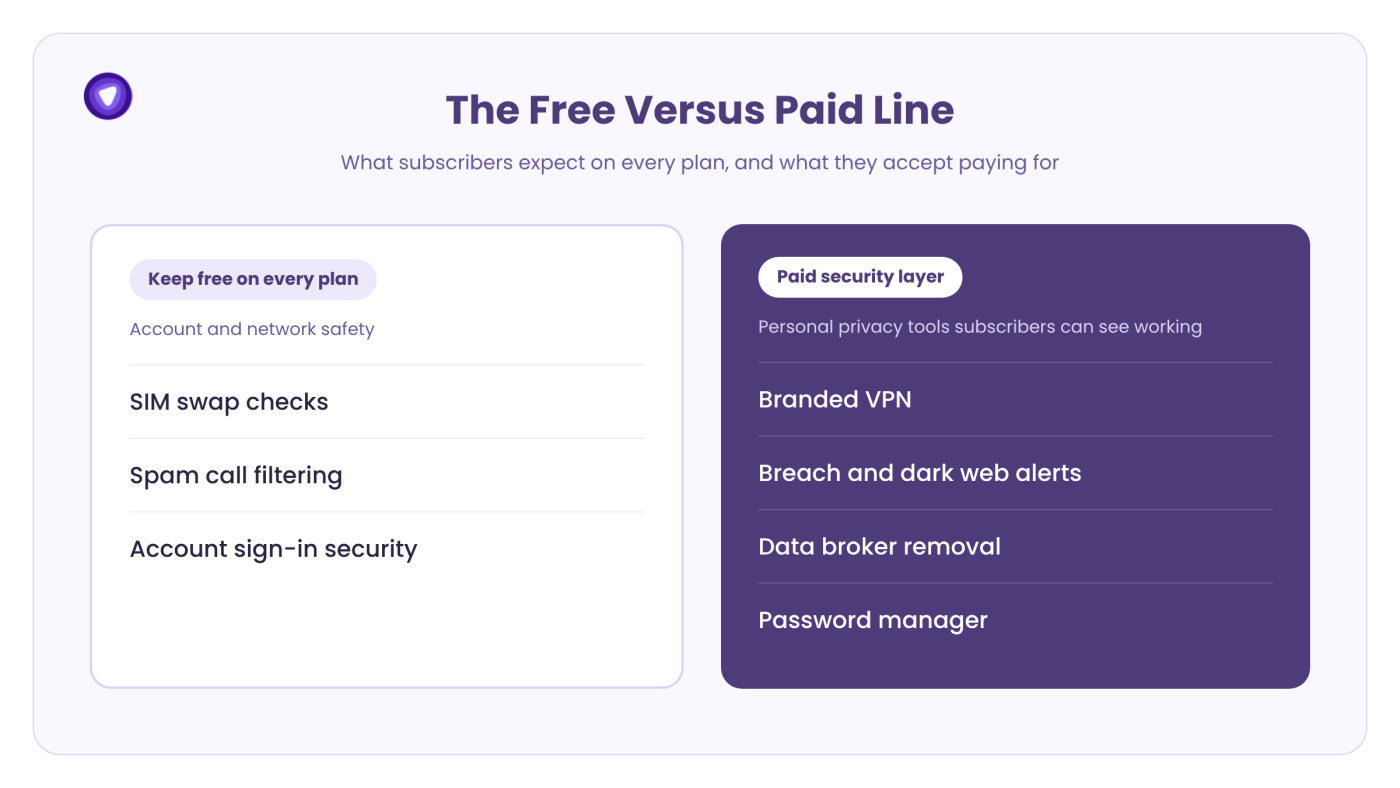
Not every security feature can carry a price. In July 2026, one Canadian carrier asked subscribers about an advanced security tier priced at $8 a month. The proposed tier covered SIM swap protection, spam call detection, and encrypted messages. Subscribers pushed back hard, since rival carriers already include basic protections at no extra cost. The carrier later said it had made no decision.
This reaction shows where the line sits. Subscribers treat account safety as part of the service they already pay for. For example, SIM swap checks and spam filtering protect the operator’s own network and number. Charging for them reads as a fee for basic care.
In contrast, features with a visible, personal output read as products. A branded VPN that protects public Wi-Fi sessions fits this group. So do breach alerts and data removal reports. Subscribers can see these working, so they accept a price for them.
The same logic applies outside telecom. Software platforms keep sign-in security free and charge for protection that reaches beyond their own app. That paid feature test maps cleanly onto mobile plans.
A practical rule follows from this split:
- Keep account and network safety free on every plan.
- Package personal privacy tools as the paid layer.
- Show subscribers a monthly summary of what the paid layer did.
Illustrative ARPU Math for a 400,000-Line Operator
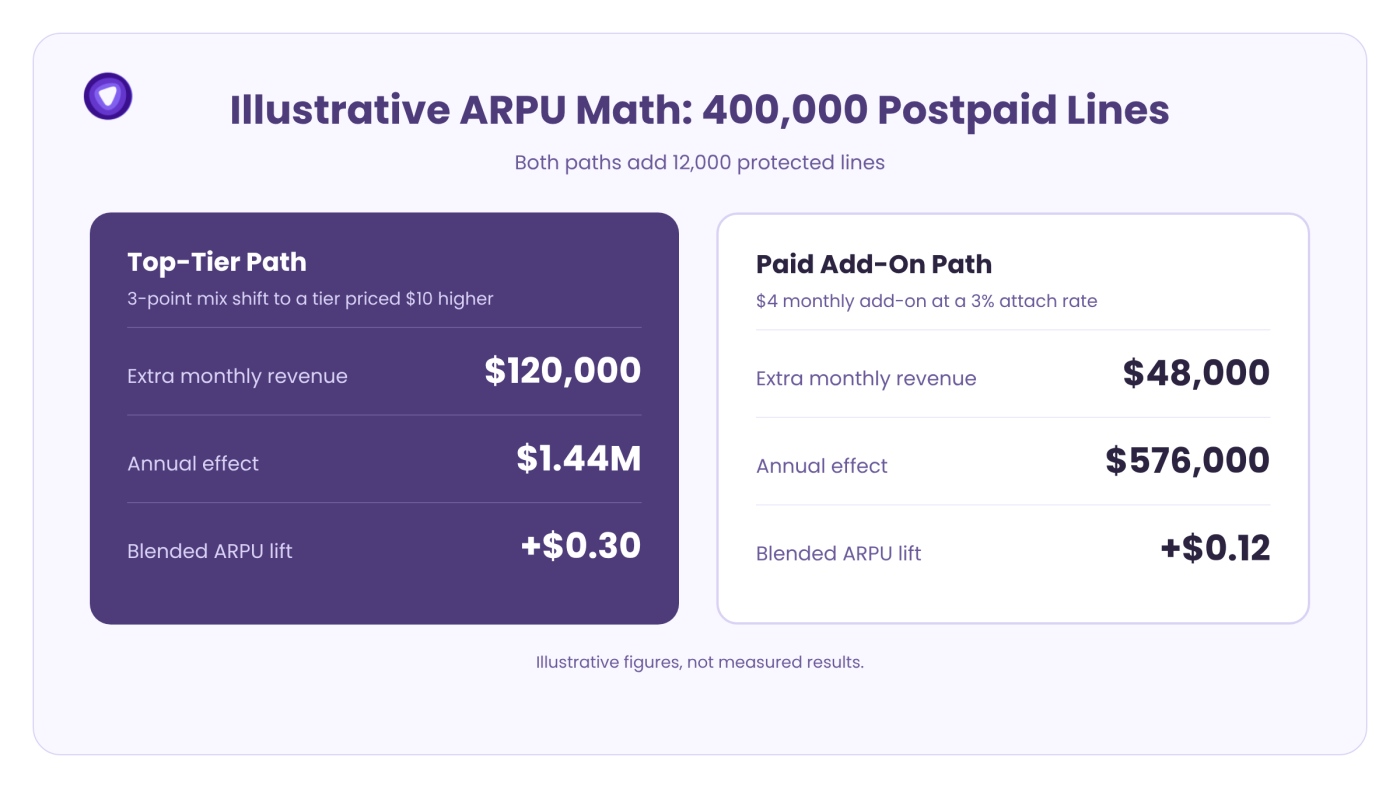
The numbers below are illustrative, not measured results. They show how each placement changes mobile ARPU across the full base.
Take an operator with 400,000 postpaid lines. Today, 20% of lines sit on the top tier, which costs $10 more than the middle tier. Adding branded security to the top tier moves three points of the base upward. That shift means 12,000 lines pay $10 more each month.
- Extra monthly revenue: $120,000
- Annual effect: $1.44 million
- Blended ARPU lift across all lines: $0.30
Now compare a paid add-on at $4 a month with a 3% attach rate. Again, 12,000 lines take the feature.
- Extra monthly revenue: $48,000
- Annual effect: $576,000
- Blended ARPU lift across all lines: $0.12
Both paths add the same number of protected lines. Yet the tier path lifts blended revenue more, because each upgrade carries a larger price gap. On the other hand, the add-on path avoids crediting upgrades that would have happened anyway. Run both models with your own tier gap and attach data before you set a mobile ARPU target.
Adding Retention to the Model
Revenue per month tells only half the story. Retention changes lifetime value, which matters more to the board. Suppose the protected lines in this example churn one point less per year than unprotected lines. On 12,000 lines, that gap keeps 120 extra subscribers each year.
At an illustrative $40 monthly plan, those 120 lines keep $57,600 a year on the books. That revenue never shows up in ARPU, yet it adds to total income. Therefore, track churn for protected and unprotected cohorts side by side.
Segment Playbooks for Operators and MVNOs
Each subscriber segment buys security for a different reason, so each one moves mobile ARPU differently. Consequently, the offer, the price point, and the sales moment should change by segment. Four segments cover most mobile bases.
Postpaid Families
Family accounts hold several lines under one bill. A household option that covers every line on the account suits that structure. In addition, one shared subscription raises account value without pricing each line separately.
Lead with the top-tier model here. Families already compare plans on the total monthly bill, so protection inside the tier keeps the choice simple.
Business and Small Office Lines
Business lines carry company data onto client sites and public networks. A branded VPN gives staff safe access in both places. Meanwhile, a per-line add-on matches how business accounts already buy services.
Sell the add-on through the business sales channel, not the consumer app. Then bundle it into the contract renewal so it renews with the lines.
MVNOs Without Network Ownership
An MVNO rents network capacity, so it cannot compete on coverage. Instead, it competes on price, brand, and extras. A branded security layer gives an MVNO an extra that carries its own brand, not the host network’s.
For MVNOs, the add-on model often fits best. It adds a margin line without changing the base plan price that wins new subscribers.
Travel and eSIM Buyers
Travel buyers need protection exactly when they leave home. eSIM adoption also keeps growing fast. GSMA Intelligence expects eSIM smartphone connections to double between 2025 and 2026. It forecasts 4.9 billion connections by 2030, equal to 55% of all smartphone connections.
For this segment, the time-boxed pass works best. Sell it on the same screen as the data pack, with an unticked opt-in box.
Four Sales Moments That Drive Attach Rate
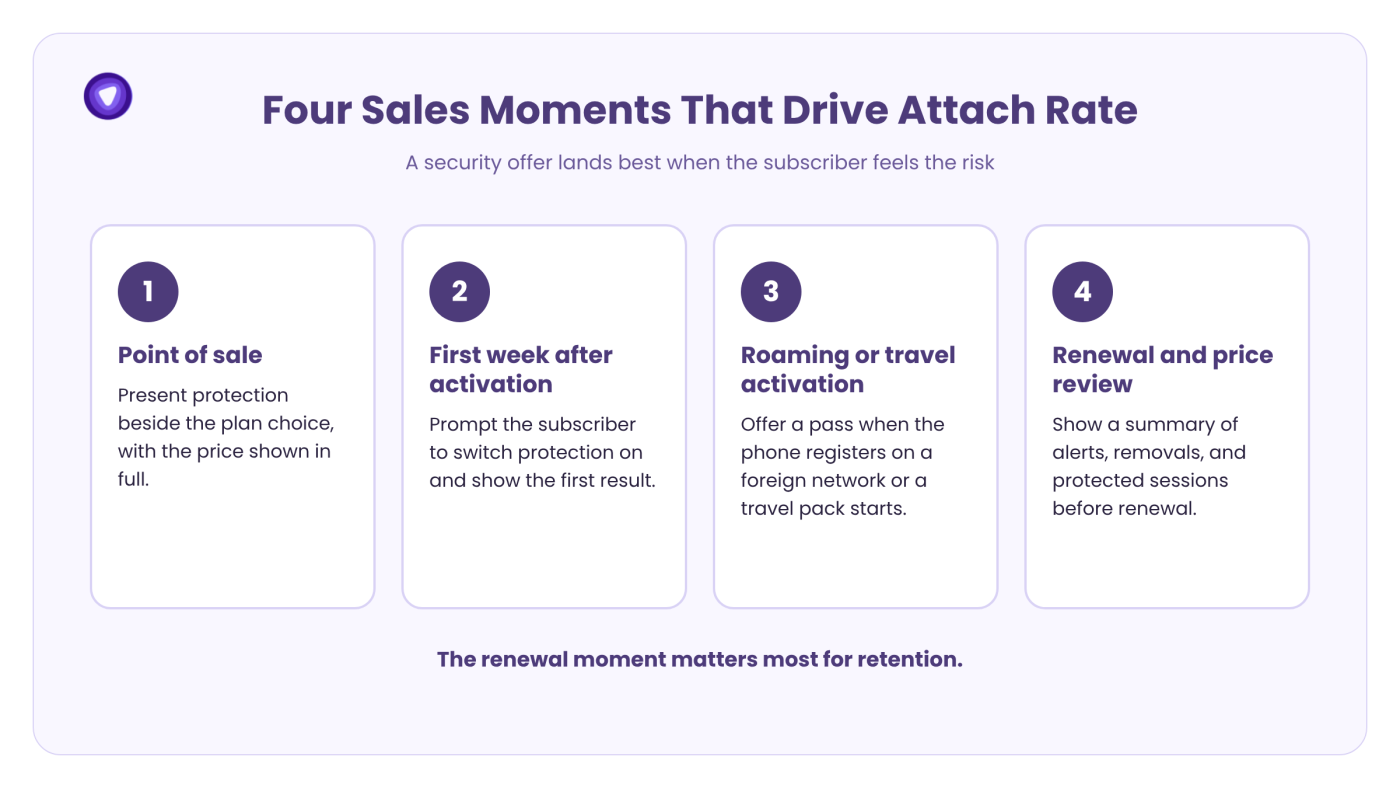
Placement sets the price, but timing sets the attach rate. A security offer lands best when the subscriber feels the risk. Four moments in the subscriber journey match that feeling.
- Point of sale. Present protection beside the plan choice, with the price shown in full.
- First week after activation. Prompt the subscriber to switch protection on and show the first result.
- Roaming or travel activation. Offer a pass when the phone registers on a foreign network or a travel pack starts.
- Renewal and price review. Show a summary of alerts, removals, and protected sessions before the renewal date.
The renewal moment matters most for retention. A subscriber who sees a year of results has a concrete reason to stay. By contrast, a subscriber who sees nothing has a reason to cut the extra.
How to Measure the Lift Without Misleading the Board
A security launch can look like a win in one report and a loss in another. The difference usually comes from what each team counts. Three measures keep the picture honest.
Report Blended and Attached ARPU Separately
Attached ARPU shows what protected lines pay. Blended ARPU shows what the whole base pays. A $4 add-on raises attached lines by $4. However, blended mobile ARPU rises only by the attach rate times $4. Report both figures, or the board will expect a lift the base cannot deliver.
Track Activation, Not Only Attach
A subscriber who pays for protection but never switches it on will churn from the feature. Activation within the first week predicts whether the line renews the add-on. Track it as closely as sales volume. Then use onboarding messages and in-app prompts to close the gap.
Watch Contribution Margin Per Line
Revenue alone hides support and delivery costs. Track contribution margin per protected line, which subtracts support cost from gross profit. A feature that drives care calls can lift ARPU while cutting profit. Compare care contacts per thousand protected lines against your plan average each month.
A KPI Set for Day One
The table below lists the core measures and why each one matters. Set a baseline for each before launch, so the pilot shows the real mobile ARPU change.
| KPI | What It Measures | Why It Matters |
|---|---|---|
| Attach rate | Share of eligible lines that buy protection | Drives the blended ARPU lift |
| First-week activation | Share of buyers who switch protection on | Predicts add-on renewal |
| Attached ARPU | Average bill for protected lines | Shows the price subscribers accept |
| Blended ARPU | Average bill across all lines | Shows the true base-wide effect |
| Cohort churn | Churn of protected versus unprotected lines | Shows the lifetime value gain |
| Care contacts per 1,000 lines | Support load from protected lines | Protects contribution margin |
Consent and Checkout Rules That Shape the Offer
Placement also changes your legal exposure at checkout. In the EU, the Consumer Rights Directive requires express consent for any extra payment. Under that rule, the European Commission bans pre-ticked boxes that add paid services by default.
For a paid add-on, that rule means a clear opt-in step at sale and in the app. A default-on add-on that subscribers must remove exposes the operator to refund claims. By comparison, a feature included in the tier price avoids this issue. The subscriber agrees to one plan price that already covers protection.
Three checkout habits reduce risk in every market:
- Show the add-on price next to the plan price, not in fine print.
- Let subscribers cancel the add-on in the app without calling care.
- Confirm the purchase on the next bill with a plain description.
A 90-Day Pilot Plan to Test the Lift
A pilot answers the placement question with your own data. Run it on one segment and one region before a national launch. The sequence below keeps the test clean.
Days 1 to 30: Set Up the Test
First, pick two comparable regions or store groups. Offer the top-tier model in one and the add-on model in the other. Next, record baseline attach, ARPU, and churn for each group.
Days 31 to 60: Run and Watch Activation
During this phase, track first-week activation every week. Send onboarding prompts to buyers who have not switched protection on. Also log every care contact tied to the new feature.
Days 61 to 90: Compare and Decide
Finally, compare blended ARPU, attached ARPU, and early churn across both groups. Pick the model with the stronger blended lift and lower care load. Then plan the wider rollout around that winner.
Common Mistakes That Erode the Lift
Even a strong offer can lose value after launch. Five mistakes erode the lift fastest:
- Charging for basic account safety that subscribers expect for free.
- Reporting attached ARPU as if it applied to the whole base.
- Selling protection that subscribers never switch on.
- Hiding the add-on price or using default-on checkout boxes.
- Showing no monthly proof of what the protection did.
Each mistake has a simple fix covered above. Above all, keep the free line clear and the monthly proof visible.
Proof: What Partners Report
Real deployments show how these placements play out. The two examples below are partner-reported and not independently audited.
A Director of Products at a European regional ISP bundled a white label VPN with a mid-tier broadband plan. The team launched within three weeks. According to the partner, upgrades covered the integration cost in the first month. This result comes from broadband, not mobile, but the tier-upgrade mechanic matches the top-tier model above.
Separately, a global device maker built a privacy layer into the Wi-Fi protection feature its phones already carry. Users received stronger privacy without installing a separate app. The case study does not publish revenue figures. Still, it shows the same principle operators need: protection works best inside an experience subscribers already use.
How PureVPN White Label VPN Solution Supports Mobile Plan Bundles
PureVPN White Label VPN Solution lets operators sell a white label VPN under their own brand, price, and customer relationship. Branded apps cover iOS, Android, Windows, macOS, and Linux, with developer kits that embed protection inside an existing operator app. A free billing integration connects to operator billing and provisioning systems for activation, suspension, and renewal. Per-plan settings support prepaid, postpaid, and business tiers. Features such as kill switch and split tunneling can vary by tier.
The network runs on 6,500+ servers in more than 80 countries. A Big Four audited no-log policy and 24/7 network monitoring back it. Pricing is usage-based and quoted per partner, with no upfront infrastructure cost. For a second paid layer, operators can add identity protection covering 400+ data brokers with monthly re-checks. A white label password manager is also available.
Conclusion
Mobile ARPU will not recover through data alone. Branded security gives operators a lever that subscribers value and can see working. Start with the product: a VPN plus one identity feature. Next, choose placement: top tier for postpaid, add-on for flat plans and MVNOs, passes for prepaid and travel.
Then keep account safety free, sell at the four risk moments, and measure blended and attached ARPU apart. Run a 90-day pilot before a national rollout. Once you settle placement, the launch work moves to your product catalog and bill.
Request a 20-minute revenue and churn-impact review.
Frequently Asked Questions
How do security features increase mobile ARPU?
They lift ARPU through top-tier upgrades, paid add-ons, or short passes for prepaid and travel users.
Should operators charge for SIM swap protection?
No, subscribers treat SIM swap checks and spam filtering as basic account safety that every plan should include.
How much does a security add-on raise blended ARPU?
Blended ARPU rises by the attach rate times the add-on price, so 3% attach at $4 adds $0.12.
Can EU operators switch on a paid security add-on by default?
No, the EU Consumer Rights Directive requires express consent and bans pre-ticked boxes for extra payments.
Which security placement suits prepaid subscribers?
A 7-day or 30-day protection pass matched to the top-up cycle fits prepaid buying habits best.