


Quick Answer
A white label VPN for telecom lets an operator sell a branded privacy app without building VPN infrastructure. The provider runs servers, protocols, and apps. The telco owns the brand, pricing, and billing. Most of the launch time goes into billing, entitlement, and care readiness, not into the VPN itself.
Key Takeaways
- Telecom service spending grew just 1.7% in 2025, so new revenue has to come from added services.
- A white label VPN for telecom removes the infrastructure build, which is the slowest part of a homegrown launch.
- The real critical path is the product catalog, the entitlement flow, and the carrier bill.
- A phased plan fits a full carrier launch into about eight weeks, starting with one premium segment.
- Most delays come from internal decisions, such as custom app requests or launches tied to large system upgrades.
Telecom service revenue barely moves anymore. IDC’s 2025 telecom services tracker projects worldwide spending growth of just 1.7% growth for the year. Meanwhile, subscribers want more privacy from the network they already pay for. A Harris Poll study for a US privacy carrier tested that demand directly. It found that 65% of Americans would consider switching providers for stronger privacy.
That combination creates a narrow window. Operators that add a branded privacy service now can lift revenue per user. They also give subscribers a reason to stay. Operators that wait risk losing high-value accounts to rivals that already sell privacy.
The obstacle is time. A homegrown VPN takes many months to build, and telco launch processes add months on top. A white label VPN for telecom removes the build step entirely. This guide shows where the remaining weeks go and how to stop them from turning into years.
Why Telco Privacy Launches Stall for Years
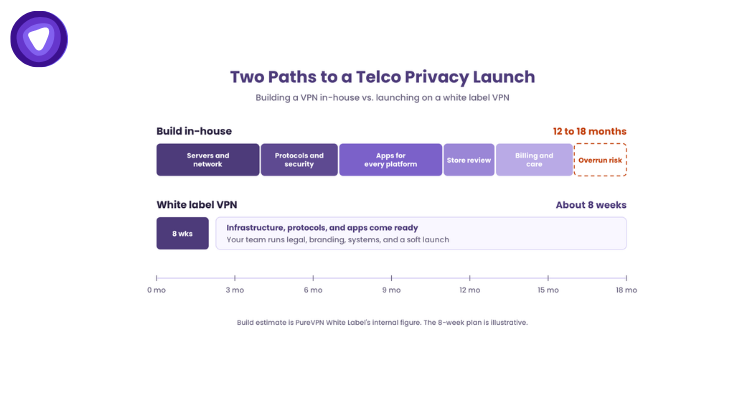
Two clocks run during every telco privacy launch. The first is the technology clock. The second is the internal launch clock that every new product must pass.
The technology clock dominates when an operator builds from scratch. A full VPN stack needs global servers, protocol engineering, apps for every platform, and constant patching. Published launch comparisons put an in-house build at 6 to 12 months before the first subscriber connects. Larger builds with custom apps and wider server coverage run longer still.
The internal launch clock runs at the same time. New services touch billing, charging, care, and retail systems. Omdia’s 2024 billing vendor survey found that a new billing platform takes an average of 4.6 months to implement. A privacy add-on should never wait on a project of that size. Yet it often does when teams treat it as a systems change instead of a catalog change.
Delay carries a real price. Consider an illustrative operator with 1,000,000 postpaid subscribers. Suppose 2% attach a $3 monthly privacy add-on. That equals 20,000 subscribers and $60,000 per month. A 12-month delay therefore forfeits about $720,000 in first-year add-on revenue. That loss lands before any build cost and before any churn impact. Every operator already fighting flat ARPU (average revenue per user) feels that gap directly.
The Real Critical Path Is the BSS, Not the VPN
A white label VPN for telecom removes the technology clock. What remains is the internal launch clock. Three parts of the business support systems (BSS) decide how fast that clock runs.
Product Catalog: Add a Product Code, Not a System
Most operators already sell partner services through their product catalog. Streaming bundles and device insurance follow the same pattern. A privacy service should enter the catalog the same way.
- Define one add-on product code and one bundled-tier product code at launch.
- Reuse existing eligibility rules for postpaid and prepaid segments.
- Map plan changes, suspensions, and cancellations to existing order types.
This approach keeps the launch inside normal product setup work. It also keeps large IT transformation queues out of the timeline.
Entitlement: Let Orders Create Accounts
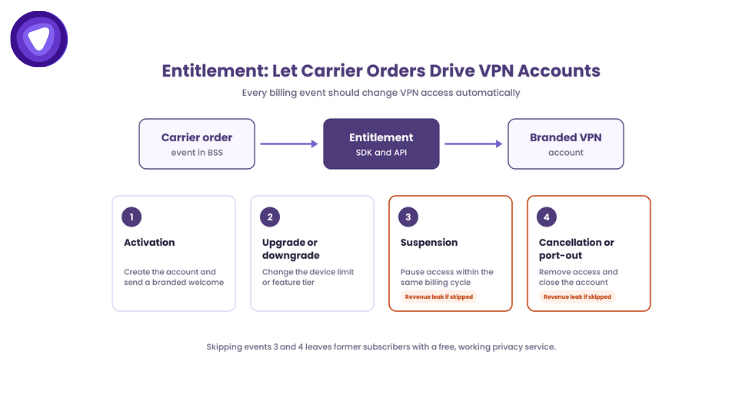
Entitlement is the step most launches underestimate. When a subscriber buys the add-on, the order event should create a VPN account automatically. White label platforms expose an SDK and API layer for this exact purpose.
A clean entitlement flow covers four events:
- Activation creates the account and sends a branded welcome message.
- A plan upgrade or downgrade changes the device limit or feature tier.
- Suspension for non-payment pauses access within the same billing cycle.
- Cancellation or a number port-out removes access and closes the account.
Teams that skip the last two events create a quiet revenue leak. Former subscribers keep a working privacy service that they no longer pay for.
Billing: Put the Service on the Carrier Bill
Subscribers trust the bill they already receive. Charging the privacy service as a line item removes a separate checkout step. It also removes a separate payment failure point. For this reason, carrier billing fits bundled tiers best. In-app purchase still suits prepaid and digital-only brands without a monthly bill.
Three Delivery Models for a White Label VPN for Telecom
Operators do not need to pick one delivery model forever. Most start with the model that fits current systems, then add a second one later. The table below compares the three common options.
| Delivery Model | How Subscribers Activate | BSS Change Needed | Best Fit |
| Standalone branded app | Download the app and sign in with the carrier account | One new add-on product code | Mobile operators testing demand |
| Bundled premium tier | Included in the plan with automatic sign-in | Tier update plus entitlement hook | Postpaid premium and family plans |
| Router or home gateway | Protection runs on the gateway for every device | Firmware and device provisioning | Broadband and fixed wireless operators |
Travel and eSIM brands follow a variant of the bundled model. Pairing data with privacy lifts basket value, a pattern covered in detail for eSIM bundles. Fixed operators often prefer the router path instead. It protects smart TVs and consoles that cannot run a VPN app. The wider economics of reselling partner services sit within white label telecom models.
A Week-by-Week Plan to Launch a White Label VPN for Telecom
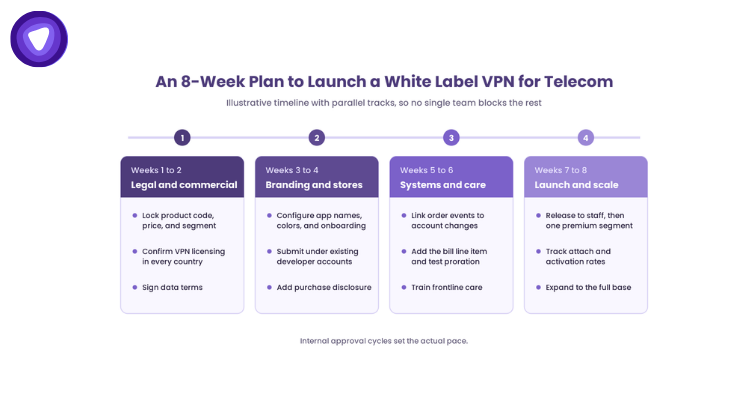
The plan below assumes the operator licenses an existing platform and launches one add-on product. The timeline is illustrative, and internal approval cycles set the actual pace. Each phase runs parallel tracks, so no single team blocks the rest.
Weeks 1 to 2: Commercial and Legal Setup
The first two weeks lock the commercial frame. Legal work starts here because it takes the longest to schedule.
- Lock the product code, price, and target segment.
- Confirm VPN licensing rules in every country of operation.
- Sign the data processing terms and review the vendor audit scope.
Weeks 3 to 4: Branding and App Store Submission
Next, branding and store work begins. Telcos hold one clear advantage here. They already run organization-level developer accounts, which Apple’s review rules require for any app that offers VPN services.
- Configure app names, colors, and onboarding screens.
- Submit apps under the operator’s existing developer accounts.
- Prepare the data collection disclosure screen that appears before purchase.
Weeks 5 to 6: Systems and Care Readiness
After that, the systems work connects the service to the business. Care training runs in the same window.
- Connect order events to account creation and removal.
- Add the line item to the bill and test proration.
- Train frontline care on the five most common questions and one escalation path.
Weeks 7 to 8: Soft Launch and Scale
Finally, the service reaches real subscribers in stages. A staged release protects the brand while the team learns.
- Release to employees first, then to one premium segment.
- Track attach rate, activation rate, and first-month cancellations.
- Expand to the full base once activation passes an internal threshold.
What Turns Weeks Back Into Years
Even a white label VPN for telecom can slip by quarters. Most delays come from decisions, not technology. Four patterns account for the slowest launches.
Tying the Launch to a Transformation Program
Large BSS upgrades run on multi-quarter schedules. Attaching a privacy add-on to one of them ties a small launch to a large program. Instead, keep the add-on on the standard catalog path.
Asking for a Custom App on Day One
A fully custom app restarts development and store review. Launch on branded standard apps first. Then move to an embedded SDK build once attach rates justify the spend.
Skipping Territory Licensing Checks
Some markets require a license to offer VPN services. Apple asks for that license in the review notes before approval. Missing paperwork can block a release in one country while other markets go live.
Mixing Up Vendor and Operator Compliance
A vendor no-log audit covers the VPN network layer. It does not cover the operator’s own subscriber records, billing data, or care logs. Those stay under the operator’s existing privacy obligations. A structured procurement checklist keeps both layers visible during legal review.
Pricing the Service So It Pays Back
Pricing decides whether the service lifts revenue or only adds cost. Three choices matter most at launch.
- Paid add-on: the highest margin per subscriber, with a lower attach rate.
- Bundled premium tier: a lower margin per subscriber, with a stronger retention effect.
- Free trial into paid: higher activation, but it needs clean conversion tracking.
Return to the illustrative operator from earlier. A bundled tier that raises the plan price by $2 for 50,000 premium subscribers adds $100,000 per month. That revenue holds regardless of daily app usage. The retention benefit sits on top, because a bundled service raises the cost of switching providers.
Proof: Turning Connectivity Into Recurring Revenue
No operator has yet published results for this exact launch path. The closest verified example comes from connectivity hardware. A router manufacturer embedded a white label VPN through documented APIs. As a result, every connected device gained protection without a separate app.
The partner’s own results in the router case study show 9x ARPU growth after the shift to subscriptions. The service also reached more than 110,000 monthly active users. In addition, the partner avoided roughly a year of in-house VPN development. These figures are self-reported by the partner, not independently audited. They map most closely to the router model for broadband operators.
How PureVPN White Label VPN Solution Supports Telco Launches
PureVPN White Label VPN Solution runs its white label VPN on 6,500+ servers across 88+ countries. A Big Four firm audits its no-log policy. For a white label VPN for telecom rollout, operators receive branded apps for eight platforms. They also get SDK and API access for entitlement and billing integration.
PureVPN’s own onboarding data shows partners receive apps and panel access within 24 to 48 hours. Branded apps can go live within two weeks. PureVPN estimates an equivalent build from scratch at 12 to 18 months and more than $500,000. These timelines are internal figures, not independent benchmarks.
Conclusion
Telcos do not need years to sell privacy under their own brand. A white label VPN for telecom removes the infrastructure build. What remains is a catalog, entitlement, and care project. Treat the service as a product code, connect it to order events, and launch to one segment first. The operators that move this quarter capture the revenue and retention gains first.
Request a 20-minute revenue and churn-impact review.
How long does it take a telco to launch a white label VPN?
Branded apps can go live as soon as two weeks, while billing and care readiness set the full timeline.
Does a telco need its own VPN servers?
No. The provider runs servers, protocols, and apps, while the telco owns the brand and billing.
Can a white label VPN appear on the carrier bill?
Yes. Operators bill it as a line item through their existing product catalog and charging system.
Who owns the subscriber in a white label VPN for telecom?
The telco owns the subscriber, brand, pricing, and billing data, and the provider stays invisible.
Do telco VPN apps face special app store rules?
Yes. Apple requires an organization developer account and a license note for markets that license VPNs.