

Key Takeaways
- Dark web monitoring for healthcare catches working logins before attackers use them.
- Healthcare breaches averaged $7.42 million and took 279 days to find and contain in IBM's 2025 data.
- Staff monitoring watches a verified work domain; patient monitoring needs opt-in and private alerts.
- Payer, Medicaid, and billing portal logins sit outside your SSO, so monitoring must cover them.
- Settle PHI handling and business associate terms with the provider before patient monitoring launches.
One set of stolen credentials disrupted a large share of US healthcare billing in 2024. Attackers logged in to a Change Healthcare remote access portal with stolen credentials. That portal had no multifactor authentication. In the end, the attack affected roughly 192.7 million people, according to HHS figures.
That is the core case for dark web monitoring for healthcare. Most breaches in this sector do not start with an exotic exploit. Instead, they start with a working login that someone else already holds.
The cost of missing that login is high. IBM’s 2025 Cost of a Data Breach report puts the average healthcare breach at $7.42 million. Healthcare breaches also took 279 days to identify and contain, the longest of any industry. Meanwhile, Verizon’s 2025 Data Breach Investigations Report found that 54 percent of ransomware victims had their domains in infostealer logs.
This guide to dark web monitoring for healthcare is written for health tech teams. That means health tech platforms and healthcare IT providers. It shows why staff and patient logins need separate models. It also covers the logins outside your control and what to settle before launch.
Why Healthcare Credentials Fail Differently
Healthcare runs on remote access, shared workstations, and dozens of connected vendors. As a result, one exposed credential can reach far beyond the account it belongs to.
One Login, One National Outage
The Change Healthcare timeline shows how short the window is. On February 8, 2024, a threat intel firm found a staff Citrix login in infostealer data. BleepingComputer reported the finding, but nobody has confirmed the attackers used those exact credentials.
Four days later, on February 12, attackers logged in with stolen credentials. Then they moved through the network for nine days. Ransomware followed on February 21.
The lesson holds even with that open question. An alert on an exposed remote access login gives a security team days to act. Here, the gap between that finding and the first login was four days.
Infostealers Take Sessions, Not Just Passwords
Infostealer malware copies saved passwords, browser cookies, and device details from an infected machine. Stolen session cookies let an attacker skip the login page, including the MFA prompt. Therefore, MFA alone does not close the gap once malware sits on a work laptop.
This matters in healthcare because doctors, billing staff, and contractors often sign in from home. One infected family laptop can then expose a hospital login.
Dark Web Monitoring for Healthcare Needs Two Models
It is easy to treat dark web monitoring for healthcare as one job. In practice, it is two jobs with different owners, consent rules, and alert paths.
Staff Credentials: Watch the Domain
Staff monitoring works at the organization level. First, the team verifies ownership of its work domain. Then the provider watches for every exposed address on that domain. Alerts go to the security or IT team, who can reset passwords and revoke sessions.
Staff personal addresses need different handling. Monitoring them should be opt-in, with alerts sent to the employee rather than the employer.
Patient Credentials: Monitor Each Person
Patient monitoring runs one person at a time. A patient portal or telehealth app handles per-user enrollment inside its own signup or settings flow. The patient chooses to join, and each alert goes to the patient privately.
The clinic does not need to see a patient’s leaked password list. Instead, the patient gets plain next steps, such as changing a reused password and turning on MFA.
Staff vs Patient Monitoring at a Glance
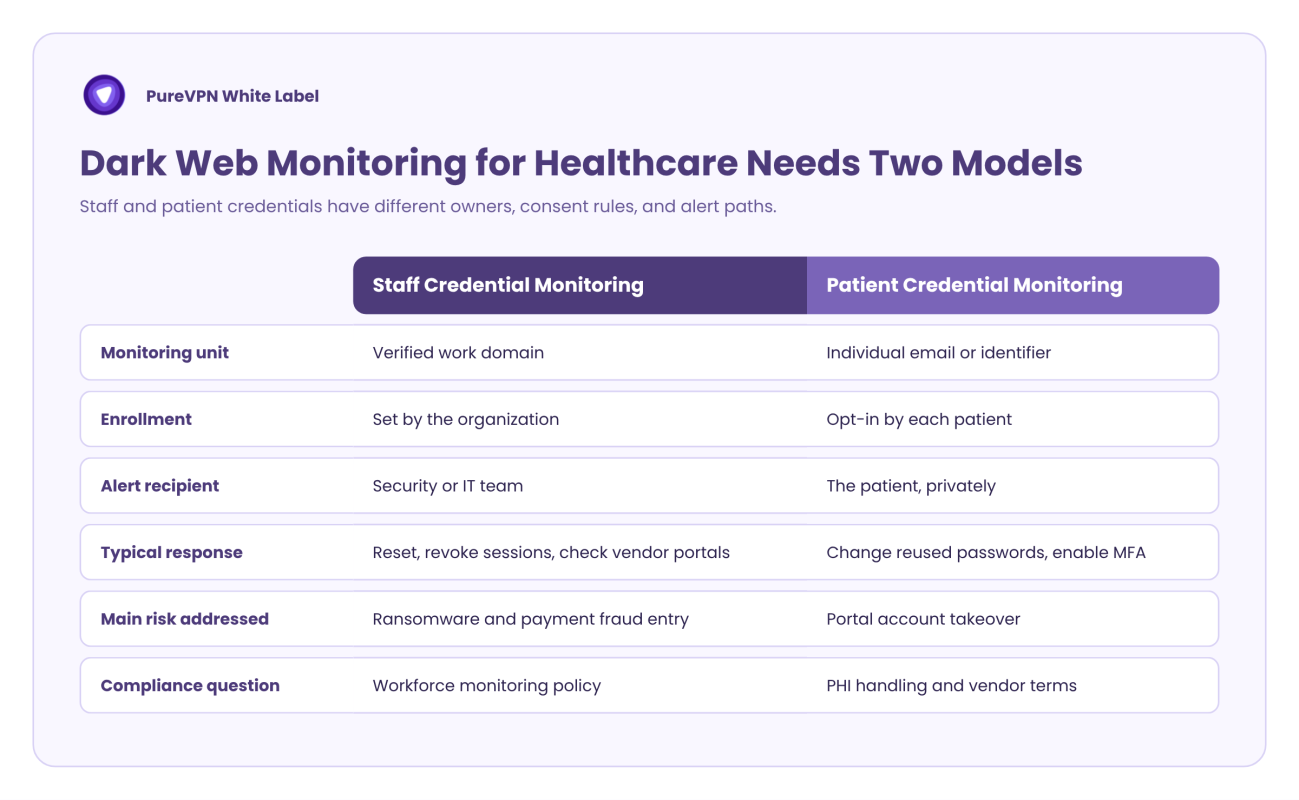
The table below compares the two models side by side.
| Factor | Staff Credential Monitoring | Patient Credential Monitoring |
|---|---|---|
| Monitoring unit | Verified work domain | Individual email or identifier |
| Enrollment | Set by the organization | Opt-in by each patient |
| Alert recipient | Security or IT team | The patient, privately |
| Typical response | Reset, revoke sessions, check vendor portals | Change reused passwords, enable MFA |
| Main risk addressed | Ransomware and payment fraud entry | Portal account takeover |
| Compliance question | Workforce monitoring policy | PHI handling and vendor terms |
The Logins Your SSO Never Sees
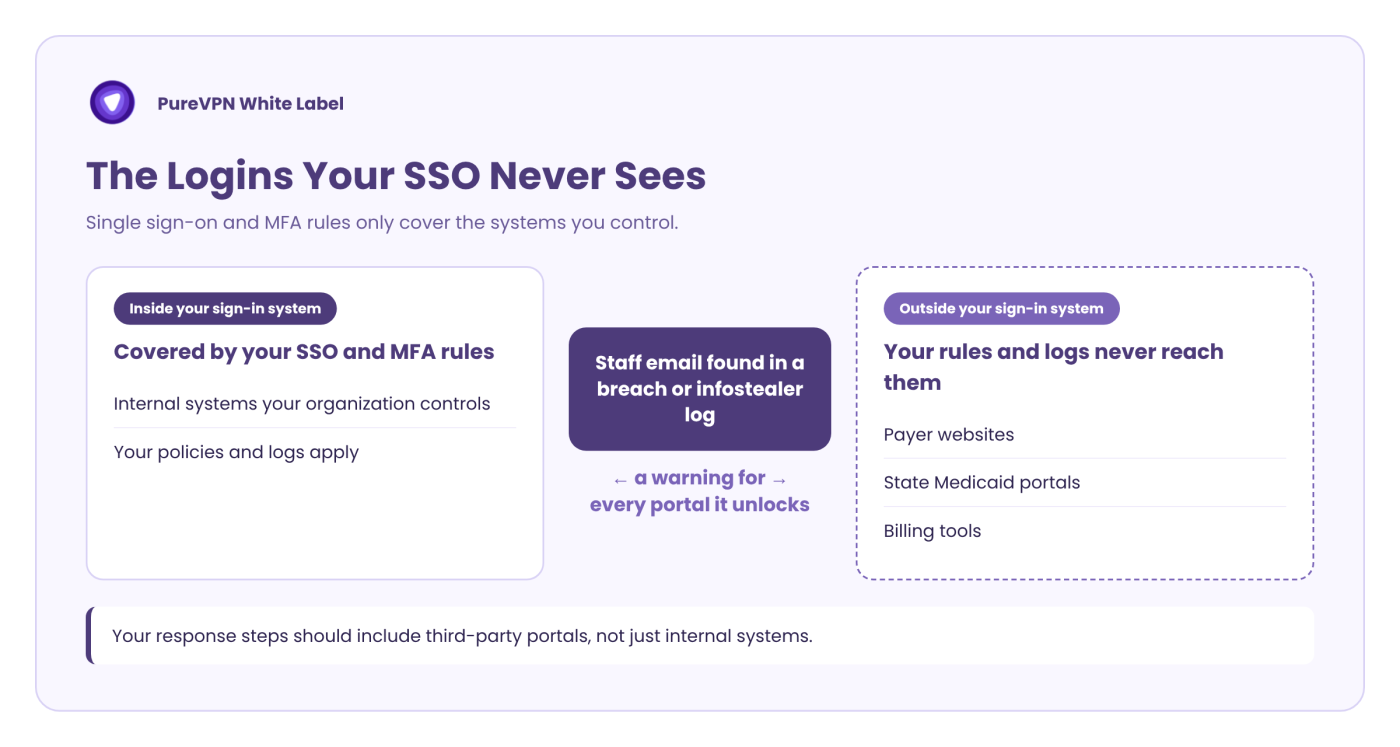
Single sign-on and MFA rules only cover the systems you control. However, healthcare staff also hold logins for payer websites, state Medicaid portals, and billing tools. Those logins sit outside your sign-in system, so its rules and logs never reach them.
A 2026 case shows the risk. An attacker used stolen Hartford HealthCare staff credentials to sign in to Connecticut’s HUSKY provider portal. The attacker then downloaded files covering about 22,500 people. The activity began on March 4, and the program learned of it on March 25.
Dark web monitoring for healthcare closes part of this gap. A staff email found in a breach or infostealer log is a warning for every portal that email unlocks. Therefore, your response steps should include third-party portals, not just internal systems.
The Help Desk Is the Second Door
Stolen passwords are not the only way in. In April 2024, a federal health security team at HHS warned about help desk attacks on healthcare organizations.
Callers posed as finance staff and asked the help desk to enroll a new MFA device. To pass identity checks, they gave the last four digits of the employee’s Social Security number. They also supplied a corporate ID number. According to the alert, attackers likely gathered these details from professional networking sites and open sources.
After gaining access, the attackers went after payer website logins. Next, they changed payment details to divert funds to accounts they controlled.
This is where monitoring alone falls short. Monitoring is a detection function, not a cleanup function. It flags leaked logins but leaves in place the personal details that answer identity checks.
Data brokers sell personal data of many kinds, even health and prescription records. Removing staff records from people-search sites leaves an attacker less to say on a help desk call.
The PHI Question Before Patient Monitoring Launches
Patient monitoring raises a question staff monitoring does not. Patient names kept in the same record set as health information count as PHI. HIPAA Journal explains this distinction in detail. As a result, a patient email list pulled from a clinical system can carry HIPAA obligations.
Settle these points with counsel and the provider before launch:
- Whether the provider will sign a business associate agreement for any PHI it receives.
- Whether the provider hashes or encrypts identifiers before storing them.
- Whether patients enroll their own identifiers through an opt-in flow.
- Which fields each alert shows, so raw stolen data never reaches clinic staff.
- How long the provider keeps identifiers after a patient leaves the program.
Clear answers protect patient trust. They also give your compliance team a written record for future audits.
An Alert Runbook for Health Tech Teams
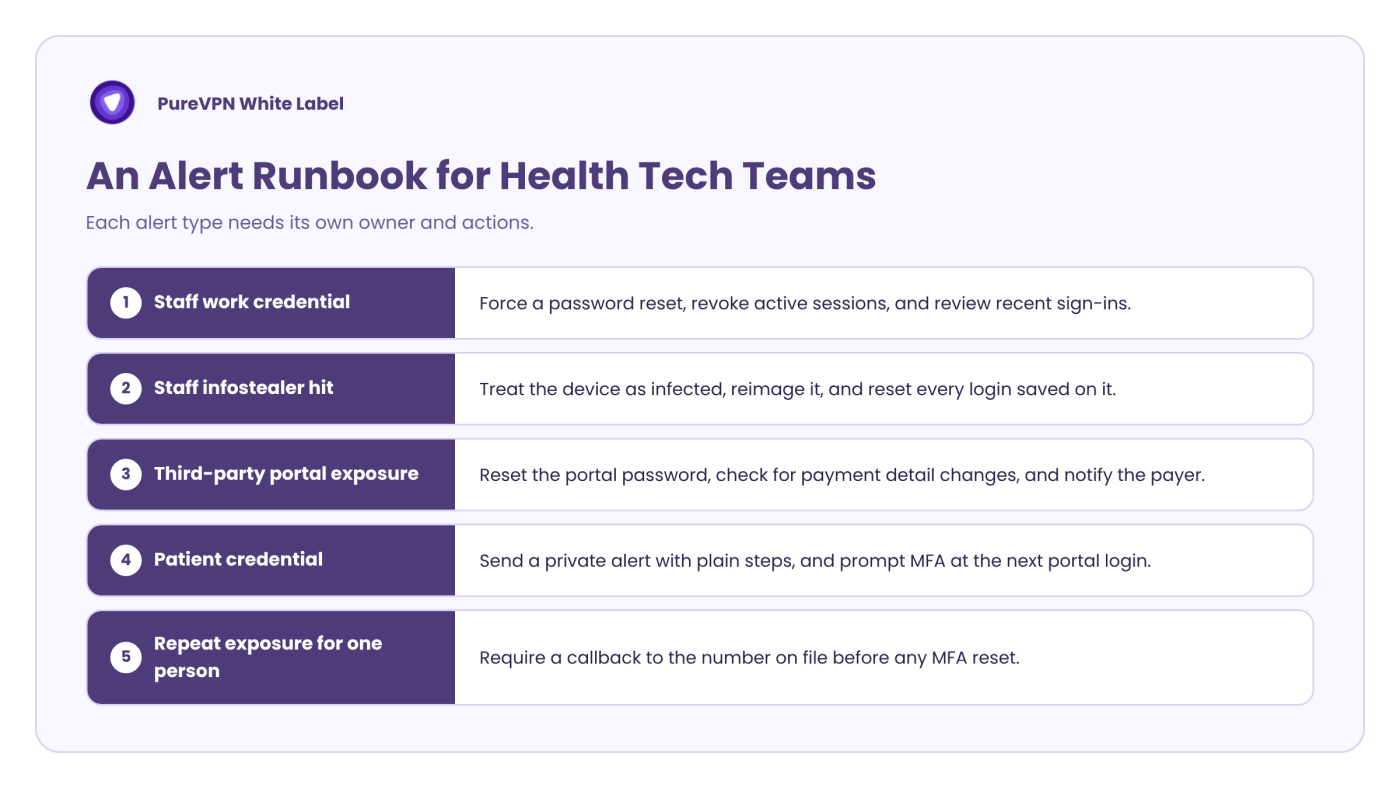
In dark web monitoring for healthcare, an alert only helps if someone knows the next step. For that reason, each alert type below needs its own owner and actions.
- Staff work credential: Force a password reset, revoke active sessions, and review recent sign-ins.
- Staff infostealer hit: Treat the device as infected, reimage it, and reset every login saved on it.
- Third-party portal exposure: Reset the portal password, check for payment detail changes, and notify the payer.
- Patient credential: Send a private alert with plain steps, and prompt MFA at the next portal login.
- Repeat exposure for one person: Require a callback to the number on file before any MFA reset.
A provider that dates every finding also helps here. That record shows regulators exactly when your team learned about an exposure.
Illustrative Math: The Cost of One Missed Alert
Consider an illustrative clinic network with 3,000 staff accounts. Suppose 1 percent of those logins, or 30 accounts, appear in fresh infostealer logs in a year. With monitoring, the help desk resets 30 accounts and revokes their sessions. That work takes hours, not weeks.
Without monitoring, the team learns about each exposure only after misuse. One missed remote access login can start an incident like the one above. At the IBM healthcare average, one breach costs $7.42 million. These figures are illustrative, not industry benchmarks.
Why the Delayed HIPAA Update Is No Reason to Wait
No federal rule names dark web monitoring for healthcare as a must. A planned HIPAA update would make encryption and MFA required. However, HHS has pushed final action on that update to July 2027.
Attackers do not work to that calendar. The HUSKY portal incident, the help desk campaign, and Change Healthcare all ran on stolen or faked identity. Decide on credential monitoring before your next product release, not after a breach notice forces the decision.
What to Ask a Dark Web Monitoring Provider
Claims about dark web monitoring for healthcare vary a lot between providers. So, ask each provider to confirm these points in writing:
- Infostealer log coverage, including cookies and device context, not only breach dumps.
- A source and date on every finding, so alerts hold up in an audit.
- Domain verification for staff scans, so nobody monitors a domain they do not own.
- Per-user enrollment through an API or SDK for patient-facing products.
- Business associate terms for any PHI the provider receives.
- Current independent audit reports, such as SOC 2 Type II and ISO 27001.
Written answers to these points separate a working engine from a polished sales demo.
Proof: What a White Label Security Layer Did for One Partner
No public case study on this site covers healthcare or dark web monitoring yet. The closest proof comes from a VPN partnership, so treat it as an adjacent example.
One MSP partner added a white label VPN to its antivirus suite instead of building one. It reported 20 percent growth in enterprise clients and a 15 percent lift in client retention. Revenue rose 25 percent within the first two months of launch. These figures are company-reported, not independently audited.
The pattern still applies to health tech teams. A branded security layer on an existing engine gives customers one more reason to stay.
PureVPN White Label Dark Web Monitoring
PureVPN White Label Dark Web Monitoring scans breach data and infostealer logs around the clock, both live and past. Its infostealer coverage reaches credentials, cookies, and device context. Every finding carries its source and date. Organization scans verify work domain ownership with a one-time code.
Health tech teams can launch a fully branded platform, add API and SDK modules, or run a hybrid setup. The platform holds ISO 27001 and SOC 2 Type II certifications. The company shares full audit reports with partners under NDA. Data broker removal is available alongside monitoring within Digital Privacy Protection. Partners that handle PHI should settle business associate terms during security review.
Conclusion
Healthcare breaches rarely start with a clever exploit. Instead, they start with a login that already works. It might come from a staff laptop, a payer portal, or a reused patient password. Dark web monitoring for healthcare finds those logins before attackers use them.
The strongest programs split the work in two. Staff monitoring watches the domain and alerts security. Patient monitoring runs on opt-in, with private alerts and settled PHI terms. For the remaining build and packaging steps, the launch guide covers the full rollout.
Request a 20-minute walkthrough of the dark web monitoring integration.
Frequently Asked Questions
What is dark web monitoring for healthcare?
It scans breach data and infostealer logs for staff and patient credentials linked to a healthcare organization.
Does HIPAA require dark web monitoring?
No, HIPAA does not name it, and the proposed Security Rule update now targets July 2027.
Why do staff and patient credentials need separate monitoring?
Staff monitoring watches a verified work domain, while patient monitoring needs per-person opt-in and private alerts.
Can stolen session cookies bypass MFA on healthcare portals?
Yes, a stolen session cookie represents a completed login, so the attacker skips the MFA prompt entirely.
How did attackers get into Change Healthcare in 2024?
They used stolen credentials on a Citrix remote access portal that had no multifactor authentication.