

Key Takeaways
- Data, not product: SpyCloud licenses exposure data and APIs, so partners still build the alert design, matching, and fixes.
- Three models: SpyCloud alternatives split into identity data APIs, infostealer feeds, and managed or white-label programs.
- The real gap: an alert without a fix adds to breach fatigue, which nearly half of consumers report.
- Five checks: test remediation, matching, data storage, bill shape, and change-of-control terms before you sign.
- Removal matters: only the managed programs in this comparison pair detection with data broker removal.
Consumer protection platforms sell one promise. They tell users about an exposure before a criminal uses it. Many of these platforms buy that signal from SpyCloud, which licenses its recaptured dark web data to partners. Teams start looking at SpyCloud alternatives when the data is fine but the product around it still feels unfinished.
The cost of an unfinished product is now easy to measure. In 2025, U.S. consumers reported $15.9 billion in fraud losses to the FTC, up from over $12 billion a year earlier. The Identity Theft Resource Center also counted 3,322 data breaches in 2025, an all-time high. A separate ITRC survey found 80% of consumers had received at least one breach notice in the past year. An exposure alert with no next step reads like one more notice. Users who see that pattern learn to ignore alerts, which weakens the reason they subscribed.
This guide compares SpyCloud alternatives by what each one leaves on your roadmap. For example, it covers data APIs, infostealer feeds, and branded identity programs. It also lists the questions that expose gaps before a contract is signed.
What SpyCloud Gives Consumer Protection Platforms
SpyCloud runs a data partnership program for consumer brands. It names identity theft protection apps, password managers, dark web monitoring services, and digital safety platforms as its target partners. Before comparing SpyCloud alternatives, it helps to be exact about what this program includes.
Where SpyCloud Is Strong
SpyCloud collects breach, malware, and phishing data from criminal communities. Its 2026 Identity Exposure Report counted 65.7 billion records in its datalake, a 23% rise in one year. In addition, partners reach this data through named consumer APIs:
- Password Exposure API: checks passwords against known compromises using k-anonymity, so the full password is never sent.
- User Exposure API: checks a user against breach, malware, and phishing records at login.
- Consumer IDLink API: links email, phone, username, and IP address to reveal wider exposure history.
The same report flagged 1.1 million password manager master passwords circulating in underground sources. For a password manager brand, findings like that are a strong reason to buy deep infostealer data.
What Stays on Your Roadmap
SpyCloud describes its partner offer as data and APIs. However, its partner page does not describe a branded consumer app or dashboard. It also does not mention data broker removal. Remediation guidance appears, but the partner presents it inside its own product.
Pricing also follows the same pattern. SpyCloud says consumer protection pricing is tiered by the number of customer accounts protected, and quotes are custom. So a partner still owns the alert design, severity rules, and support scripts. It also owns every fix the user expects next.
Why Teams Look at SpyCloud Alternatives
Most switching conversations start with one of four gaps. Each gap maps to a different type of vendor, which is why the alternatives below fall into groups.
- The alert-to-action gap: users learn about an exposure but cannot fix the source, such as a people-search listing.
- The build burden: the partner must design matching, alert copy, and a user interface on top of raw data.
- The data scope fit: a platform built on breach lookups may not need deep malware data, or the reverse.
- The bill shape: account-based tiers suit some growth curves, while usage-based or published plans suit others.
Meanwhile, these gaps matter more as breach volume grows. Two-thirds of 2025 breach reports listed Social Security numbers, according to ITRC report coverage. Nearly half of surveyed consumers also reported breach fatigue. A platform that sends alerts without a fix adds to that fatigue.
Three Kinds of SpyCloud Alternatives
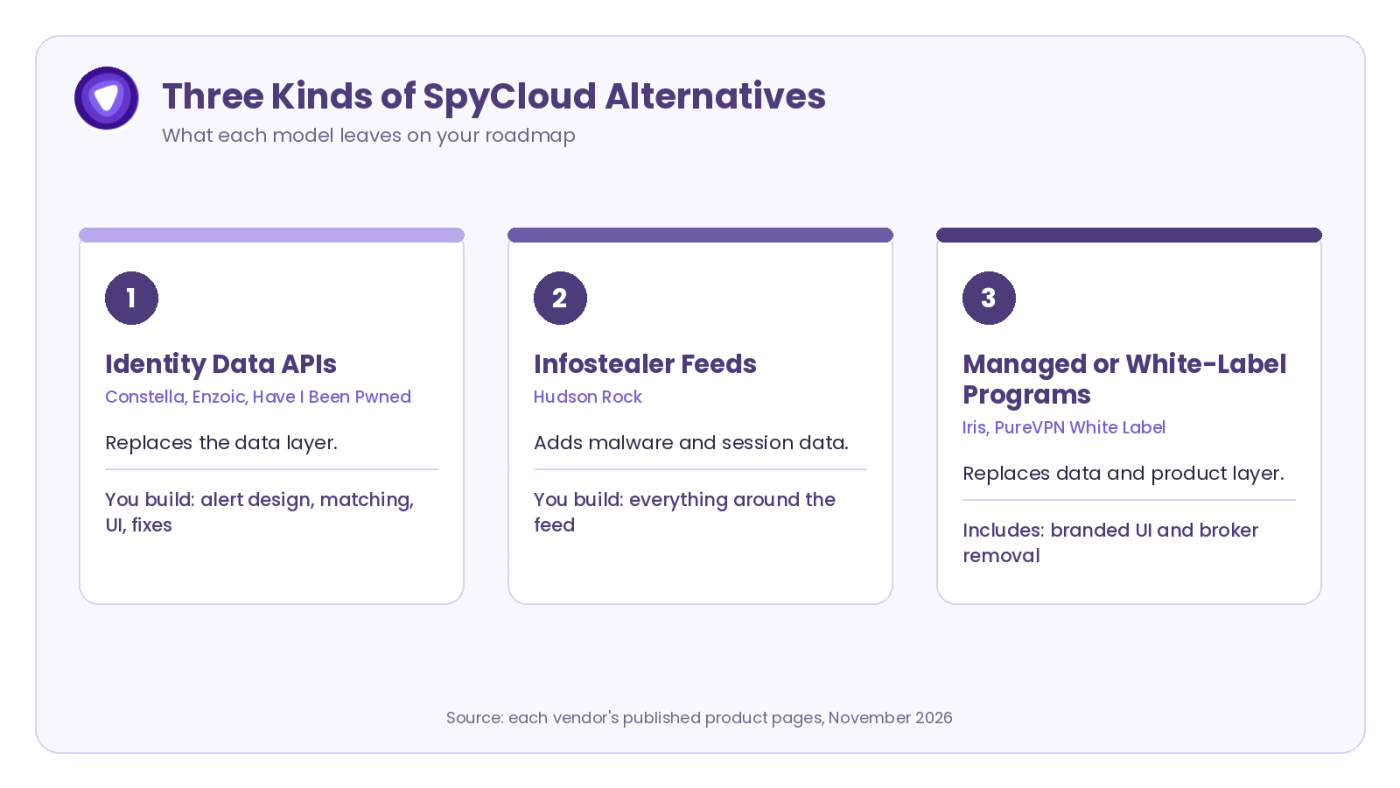
The market splits into three delivery models. Each one answers a different gap from the list above, so the right choice depends on which gap hurts most.
Identity Data APIs
First, these vendors replace the data layer and leave the product layer to you.
Constella Intelligence sells identity data through API, OEM, and reseller terms. Constella states that six of the top ten global identity theft providers use its Intelligence API. Its partner page says partners can present the data under white-label terms as native to their own platform. It also says an API partner can launch a monitoring tier in weeks, with a two-hour design workshop included. Constella monitors data broker sources, but its pages describe monitoring, not removal.
Enzoic offers Passwords, Credentials, Exposures, and Identity Breach Monitoring APIs. The company calls these APIs OEM-ready for commercial platforms. Enzoic says queries to its password and credential APIs are processed in memory and not retained. Plans are usage-based, and a free API key is available for testing. Its identity theft partners include IDShield, which embeds Enzoic screening across its product line.
Have I Been Pwned is the lightest option here. Its Pro plan starts from $379 per month, billed annually. Pro covers customer domains, k-anonymity email search, Pwned Passwords, and stealer log data. It works well as a breach lookup layer. However, it is built around email and domain search, not full identity monitoring.
Infostealer Intelligence Feeds
Hudson Rock focuses on one source type: infostealer malware infections. The company says its data comes from threat actors, not from database leaks. Its Cavalier data covers credentials, cookies, and compromised customers and users, delivered by web, API, or email. Hudson Rock lists an identity protection app among its API use cases. Its main product, however, targets security teams, insurers, and MSSPs. Consumer platforms should treat it as a feed to add, not a full replacement.
Managed or White-Label Identity Programs
By contrast, these vendors replace both the data and the product layer.
Iris offers three delivery options: an Identity Protection API, embeddable micro-experiences, and a branded OnWatch portal. Its main advantage is 24/7 access to human resolution specialists for identity theft victims. In 2026, Iris also launched Private Data Removal for people-search sites and large data brokers. In September 2026, Iris completed a management-led buyout from Redion Group and now operates independently.
PureVPN White Label pairs dark web monitoring with data broker opt-out in one bundle. The bundle ships as a hosted branded platform, as API and SDK modules, or as a hybrid of both. Its broker coverage and re-check cadence appear in the table below.
SpyCloud Alternatives Compared
The table compares SpyCloud alternatives on six shared factors. Every cell reflects what each vendor publishes. “Not published” means the vendor’s public pages do not state it, not that the feature is absent.
| Provider | Delivery Model | Core Data | Branded Consumer UI | Broker Removal | Pricing Disclosure |
|---|---|---|---|---|---|
| SpyCloud | Data partnership, APIs | Breach, malware, phishing | Not published | Not published | Quote, tiered by accounts protected |
| Constella Intelligence | API, OEM, reseller, widget | Breach, infostealer, dark web, surface web, broker sources | Widget option | Monitoring only | Quote |
| Enzoic | APIs, OEM | Passwords, credentials, PII, card data | Not published | Not published | Usage-based plans, free test key |
| Have I Been Pwned | API, web | Breaches, pastes, stealer logs | No | No | Published, Pro from $379 per month |
| Hudson Rock | API, Cavalier platform | Infostealer infections | Security team platform | No | Not published, free preview |
| Iris | API, micro-experiences, OnWatch portal | Identity and credit monitoring, resolution | Yes, branded portal | Yes, launched 2026 | Quote |
| PureVPN White Label | Hosted platform, API and SDK, hybrid | Dark web breaches, infostealer logs | Yes, hosted branded platform | Yes, 400+ brokers, monthly re-checks | Wholesale quoted, partner sets retail price |
Two patterns stand out. First, data APIs win on flexibility but leave the most work on your side. Second, only the managed programs close the alert-to-action gap with removal.
Five Checks to Run on Any SpyCloud Alternative
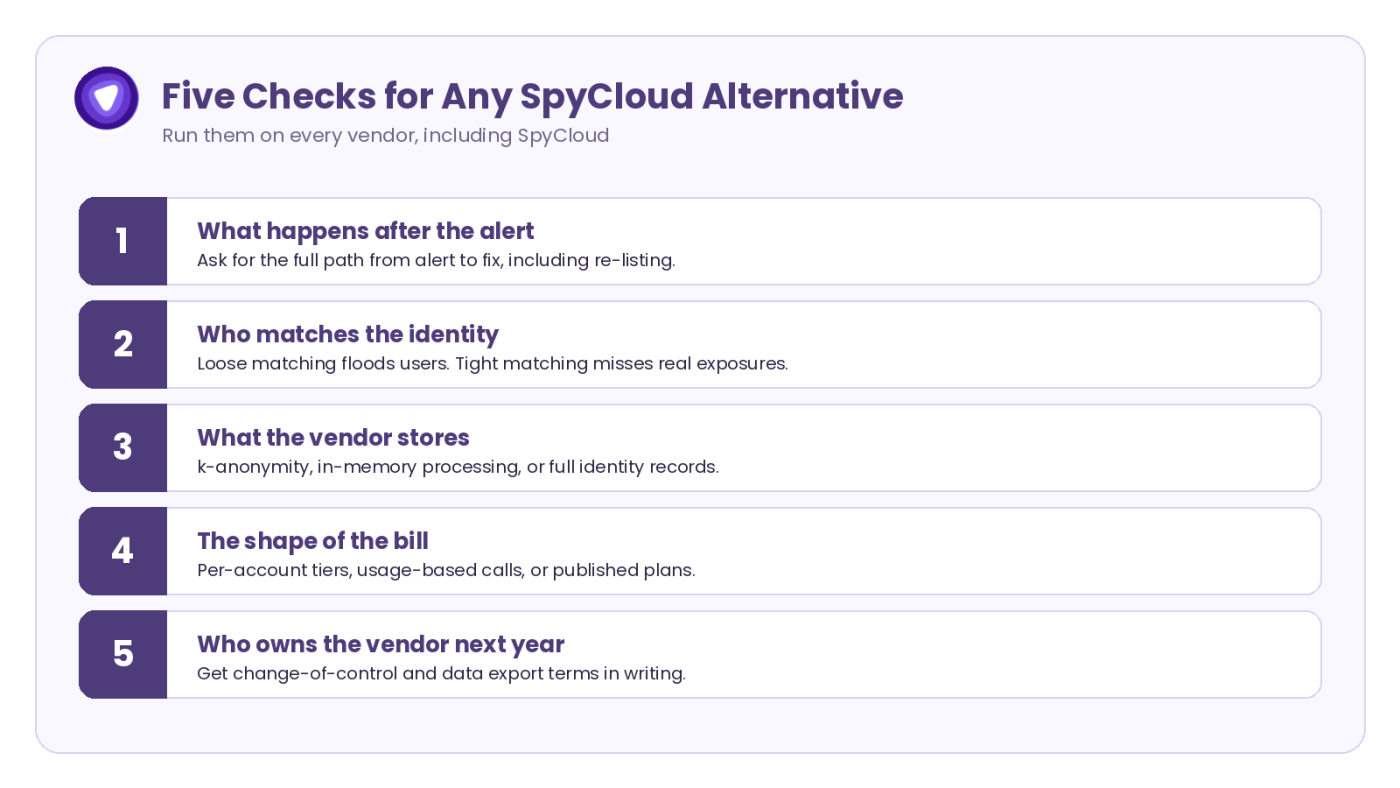
Demos show the best alert a vendor has. These five checks show the alerts your users will actually get. Run them on every vendor on the shortlist, including SpyCloud.
Check What Happens After the Alert
Ask the vendor to show the full path from alert to fix. A credential alert can end in a password reset. A home address on a people-search site needs a removal request instead. Removed records also come back when brokers reload their files. So ask how the vendor detects re-listing and whether removal reruns on its own. For a deeper view of the broker side, see how the data broker market resells records.
Check Who Matches the Identity
Next, raw breach data needs matching logic before it becomes an alert. Loose matching floods users with false alerts and creates alert fatigue. Tight matching misses real exposures. Ask each vendor for its false-positive handling and a sample alert for a common name. With a data API, your team writes most of this logic.
Check What the Vendor Stores About Your Users
Consumer platforms carry the privacy risk of every identifier they send out. Some vendors use k-anonymity, so they never see the full value being checked. Others process queries in memory and keep nothing. Managed programs often need full identity records to run monitoring and removal. Ask where that data lives, who can access it, and how deletion works.
Check the Shape of the Bill
In practice, pricing models shape margin more than list price does. Account-based tiers charge for every enrolled user, active or not. Usage-based plans charge per call, which can spike after a large breach. Published plans make forecasting simple but cap throughput. Model each option against your enrollment curve before comparing quotes.
Check Who Owns the Vendor Next Year
Finally, identity vendors change hands. The Iris buyout above shows how fast ownership can shift. A change of control can alter pricing, data sources, or support terms. Ask for assignment and change-of-control clauses in writing. Ask, too, for notice periods and data export terms if the relationship ends.
The Illustrative Cost of an Alert Without a Fix
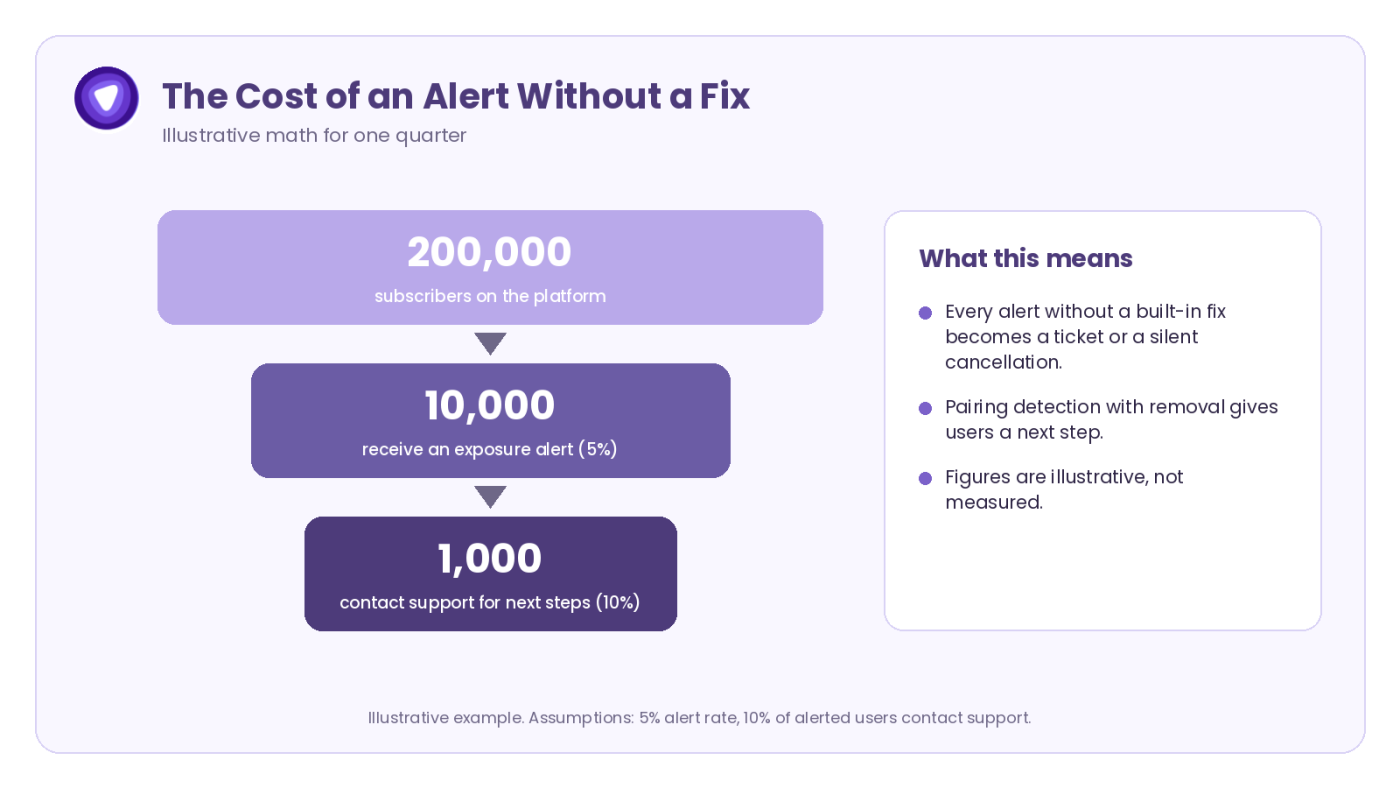
For example, consider an illustrative platform with 200,000 subscribers. Assume 5% receive an exposure alert in one quarter. That is 10,000 alerts. Now assume one in ten of those users contacts support to ask what to do next. That creates 1,000 extra tickets every quarter.
These numbers are illustrative, not measured. Even so, the pattern holds at any scale. Every alert without a built-in fix turns into a support cost or a silent cancellation. That is why the strongest SpyCloud alternatives for consumer platforms pair detection with a remediation step. A removal API is one way to add that step without rebuilding the product.
Which SpyCloud Alternative Fits Your Platform
The right pick depends on which team will own the product layer.
- Choose an identity data API if your engineers want full control of the user interface and alert logic.
- Add an infostealer feed if your users face session theft and your current data is breach-heavy.
- Choose a managed or white-label program if you need a branded product with removal in weeks, not quarters.
In practice, most consumer platforms land on a mix of these models. A password manager may keep its own interface and add a focused feed. An identity protection brand may prefer a full bundle, since its users expect fixes, not just findings. Both choices fit the broader digital privacy protection category.
How PureVPN White Label Digital Privacy Protection Fits
PureVPN White Label Digital Privacy Protection bundles dark web monitoring and data broker opt-out under your brand. Monitoring runs 24/7 across breaches and infostealer malware, with deep scans down to credentials, cookies, and device context. Opt-out covers 400+ people-search and broker sites, with listings, screenshots, and request status captured at each step. Removals are re-checked monthly, and removal reruns when data reappears. The platform holds SOC 2 Type II and ISO 27001, and partners receive full audit reports under NDA.
PureVPN White Label reports 150+ partners worldwide, which is company-reported data, not a third-party audit. Partners set their own retail pricing, and wholesale terms are quoted per partner. As proof, one published partner case study reports a 15% rise in client retention. It also reports 25% more revenue within two months of launch. That result came from an antivirus vendor bundling VPN, not from this bundle. Teams that also sell VPN can combine all three in one privacy suite.
Conclusion
SpyCloud alternatives differ less in data volume than in what they leave for your team to build. Data APIs give control but keep the alert design, matching, and remediation on your roadmap. Meanwhile, infostealer feeds deepen coverage for session theft. Managed and white-label programs close the alert-to-action gap with a branded product and broker removal.
Run the five checks before you sign with any provider. Then compare quotes against your own enrollment curve, not against a vendor’s sample. If users expect a fix after every alert, review how a white-label removal service launches first.
Request API sandbox access for a 20-minute integration walkthrough.