

Quick Answer: A broadband privacy bundle adds a branded VPN to an internet plan. It ships as a tier feature, an add-on, or a router setting. It earns new revenue and gives subscribers a reason to stay that is not a discount. It sells only when the ISP cannot see the traffic it protects.
Price is the main reason subscribers change fixed broadband provider, according to Analysys Mason. Each lost subscriber then costs acquisition spend to replace. A broadband privacy bundle gives an ISP added value at the exact moments subscribers compare prices.
There is a catch. PasswordManager.com surveyed US adults in January 2026. Among VPN users, 47% want privacy from their own ISP. So the bundle cannot work like a normal ISP product. It must keep the ISP out of the traffic it protects.
This guide starts with the cost of waiting and the trust design. It then covers bundle structures, attach points, router delivery, revenue math, and metrics.
Key Takeaways
- Price is the main reason subscribers switch providers, and every lost subscriber costs acquisition spend to replace.
- 47% of VPN users want privacy from their own ISP, so the bundle must keep the ISP out.
- Three structures work: a premium tier feature, a paid add-on, or a router-level default.
- 71% of US internet households get their router from their ISP, a channel app brands cannot reach.
- Measure activation and cohort churn, not attach rate alone, before you scale the bundle.
The Cost of Waiting on a Broadband Privacy Bundle
Churn is a revenue problem before it is a marketing problem. Consider an illustrative ISP with 50,000 subscribers paying $60 a month. At 18% annual churn, it loses 9,000 subscribers in a year. That removes $540,000 in monthly recurring revenue by year end. Replacement costs come on top of that loss.
New pricing rules also make every increase easier to compare. Since 17 January 2025, UK providers must state price rises in pounds and pence at sale. In the US, the FCC requires a broadband label that shows the standalone retail price. Subscribers now see the number clearly, so they also need to see what they get for it.
A save-desk discount answers price with a lower price. Margin shrinks, and the next increase restarts the same conversation. A privacy feature answers price with added value instead. That protects margin and gives the subscriber a reason to stay.
The Trust Condition Behind Every Broadband Privacy Bundle
Privacy demand is mainstream. The same survey found that 36% of Americans currently use a VPN. Many of them buy privacy partly to hide their activity from their ISP. As a result, the ISP must sell a product that keeps the ISP out. That sounds odd, but it is the design rule that makes the offer credible.
What the ISP Should Never See
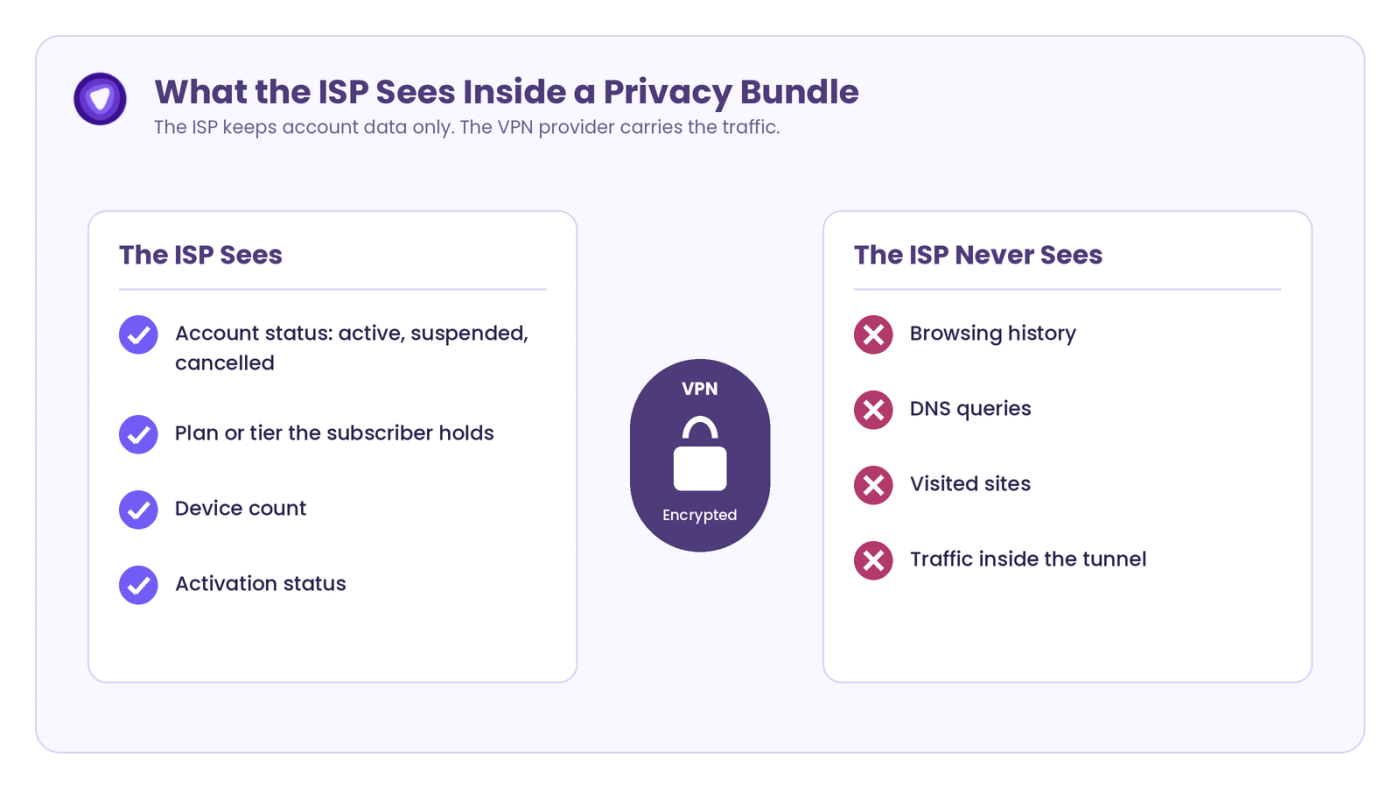
In a well-built bundle, the device or router encrypts traffic first. Traffic then leaves through the VPN provider’s servers, outside ISP inspection tools. The ISP keeps billing and account data only:
- Whether the account is active, suspended, or cancelled
- Which plan or tier the subscriber holds
- Device count and activation status
- No browsing history, DNS queries, or visited sites
How to Prove It to Subscribers
Claims alone will not convince a privacy-minded buyer. The VPN provider should hold a no-log policy that an independent auditor has checked. The audit scope should name the infrastructure your subscribers will actually use. Put those audit questions to every provider before you sign.
Disclosures matter just as much. Lawful intercept duties on the ISP’s own network stay with the licensed operator. The provider’s no-log policy covers activity inside the encrypted tunnel. State both points plainly in your privacy policy and plan terms. Also check the data retention laws in every server region before launch.
Three Ways to Structure a Broadband Privacy Bundle
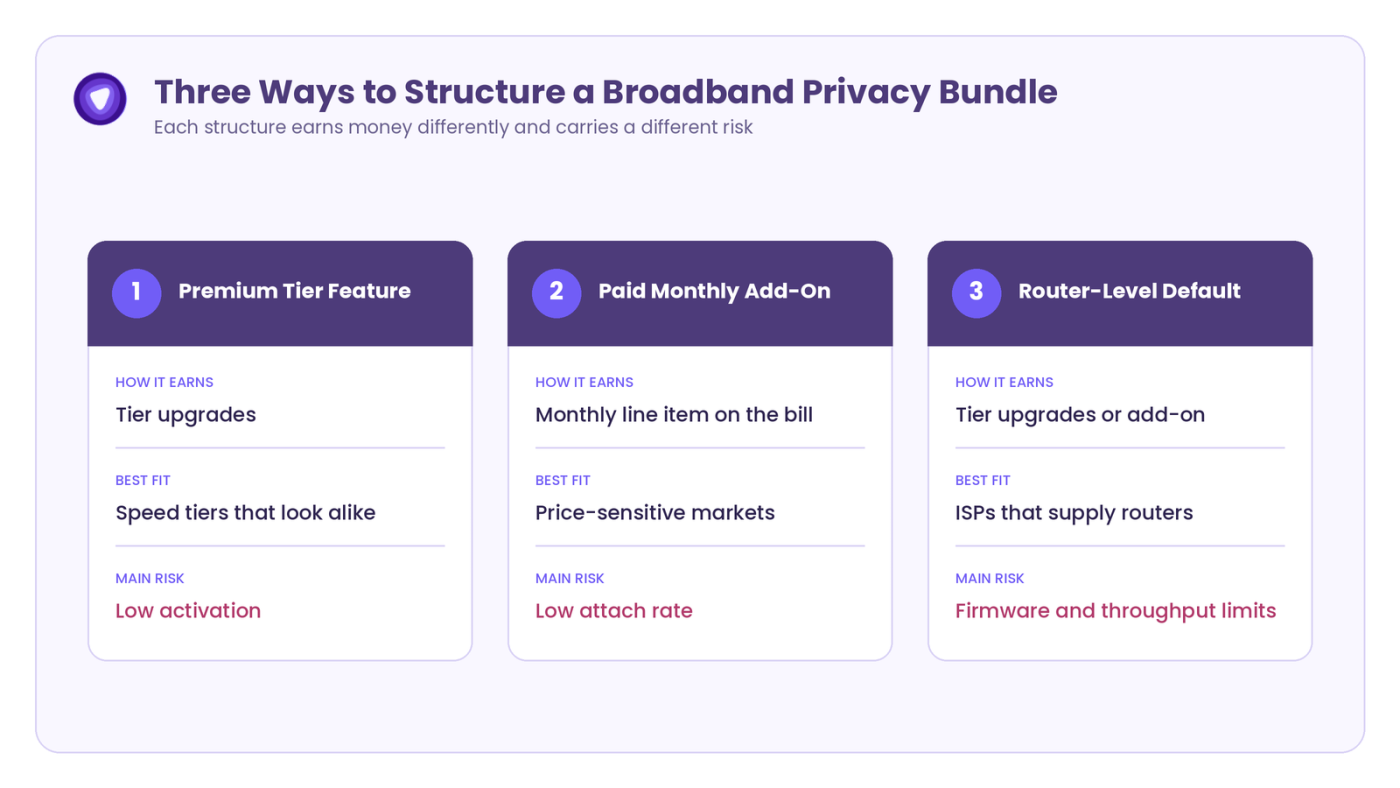
ISPs have tested several bundling models over the years. Most fall into three structures. Each one earns money differently and carries a different billing duty.
Included in a Premium Speed Tier
The VPN becomes a feature of a higher tier, such as a gigabit plan. Revenue comes from tier upgrades rather than a separate charge. This works best when two tiers need a clearer difference than speed alone. However, an included feature can sit unused, so activation needs its own campaign.
Paid Monthly Add-On
The ISP sells the VPN as its own line item on the broadband bill. This suits price-sensitive markets where subscribers want to opt in. Billing teams should treat it as a separate service, not a broadband fee. Under a 2023 FCC order, providers must itemize fees added to the base monthly price. A clean add-on line keeps the label simple.
Router-Level Default
Protection runs on the ISP-supplied router and covers every device on home Wi-Fi. The ISP can switch it on by default for a tier or let subscribers activate it in an app. This structure reaches devices that cannot run VPN apps. It stops protecting phones once they leave home, so pair it with device apps.
The table below compares the three structures side by side.
| Structure | How It Earns | Best Fit | Billing Note | Main Risk |
|---|---|---|---|---|
| Premium tier feature | Tier upgrades | Speed tiers that look alike | Price sits inside the tier | Low activation |
| Paid add-on | Monthly line item | Price-sensitive markets | Separate service line | Low attach rate |
| Router-level default | Tier upgrades or add-on | ISPs that supply routers | Tied to router and plan | Firmware and throughput limits |
Where to Offer a Broadband Privacy Bundle in the Subscriber Journey
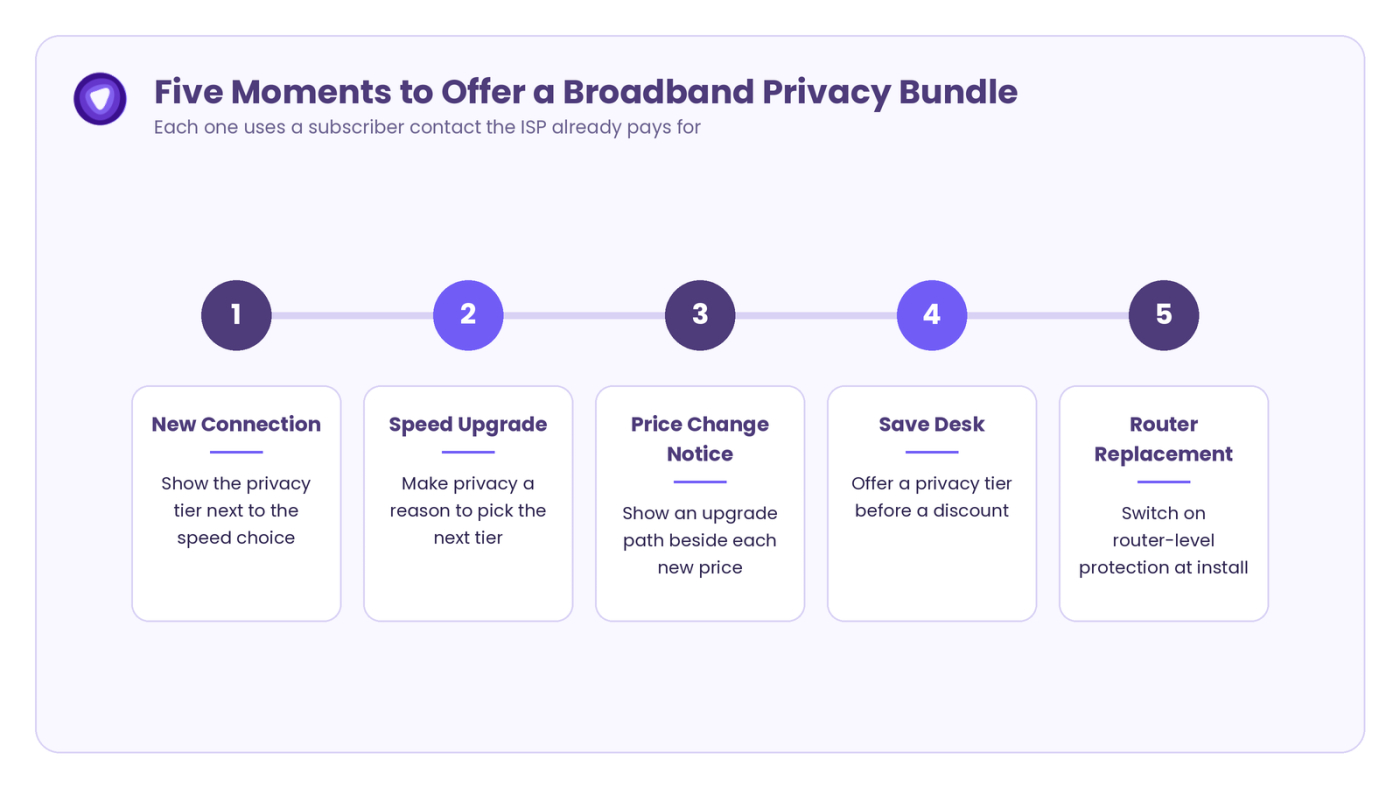
Timing shapes attach rate as much as price does. The strongest moments are the ones where subscribers already weigh value. Five points stand out:
- New connection checkout: Show the privacy tier next to the speed choice, not after payment.
- Speed upgrade: Present privacy as part of the reason to move to the next tier.
- Annual price change notice: Pair the new price with an upgrade path that adds protection.
- Save desk: Offer a tier with privacy before you offer a discount.
- Router replacement: Activate router-level protection during the swap visit or self-install.
Each point uses a contact the ISP already pays for. Therefore, reaching these subscribers needs no new acquisition spend.
Router Delivery Gives ISPs a Channel App Brands Lack
ISPs control the box in most homes. Parks Associates found that 71% of US internet households get their router from their ISP. That figure comes from a survey of 8,000 households, published in April 2025. App-only privacy brands cannot reach that channel without the ISP.
A router-level VPN also covers smart TVs and game consoles. Those devices rarely support VPN apps. Still, router delivery has limits. Firmware differs across router models, and encryption draws on router processing power. Test throughput on each supported model before you set speed promises.
Proof From a Router Partner
One white-label router partner built a VPN into its WiFi routers through documented APIs. After a shift to subscriptions, it reported 9x ARPU growth and more than 110,000 monthly active users. It also estimated the integration saved about a year of in-house development. A hardware maker reported these figures itself, and it is not an ISP. Even so, the result shows how router delivery turns one device sale into recurring revenue.
Revenue Math for a Broadband Privacy Bundle
The figures below are illustrative round numbers, so you can swap in your own. Start with the same ISP of 50,000 subscribers.
Add-On Revenue
Assume 8% of subscribers attach a $5 monthly privacy add-on. That gives 4,000 subscribers and $20,000 in new monthly revenue. Over a year, the add-on brings in $240,000.
Retention Value
Next, assume attached subscribers churn three points less each year than everyone else. Of 4,000 attached subscribers, 120 stay who would have left. At $65 a month combined, those 120 subscribers keep $93,600 a year on the books. Retention value also compounds each year the cohort stays. Track it next to add-on margin, since both lines count toward payback.
What to Measure After Launch
Attach rate alone can mislead you about a broadband privacy bundle. A subscriber who buys the bundle but never activates it brings revenue now and churn risk later. Before you scale, follow a staged launch plan and watch these numbers:
- Activation rate: Share of attached subscribers who connect at least once in 30 days.
- Weekly active use: Share of activated subscribers who connect each week.
- Cohort churn: Monthly churn for active users, inactive users, and subscribers without the bundle.
- Save-desk acceptance: Share of at-risk subscribers who take the privacy tier over a discount.
- Support tickets per 1,000 users: A rise points to setup friction in the app or router.
If active users churn less than inactive ones, push activation before you push attach.
Five Mistakes That Sink a Broadband Privacy Bundle
Most failed launches share a few avoidable errors. Each one either weakens trust or hides the product from the subscribers who would use it.
- Routing DNS through ISP resolvers: Subscribers who test for leaks will see the ISP, and trust ends there.
- Burying activation: Subscribers rarely turn on a feature hidden three menus deep.
- Promising full line speed: Encryption adds overhead, so publish tested speeds instead of plan maximums.
- Pointing users to a retail VPN app: A referral hands the brand, data, and renewal to someone else.
- Launching without a care script: Frontline agents need short answers on privacy, speed, and cancellation.
Fixing these before launch costs far less than repairing reputation after it. Each fix also feeds the activation and churn metrics above.
How PureVPN White Label VPN Solution Supports ISP Bundles
PureVPN White Label VPN Solution gives ISPs branded apps for iOS, Android, Windows, macOS, and Linux. It also supports router-level integration through documented APIs. A billing API connects to existing BSS and OSS systems to automate provisioning, suspension, and renewal. Pricing is usage-based and quoted per partner, so costs follow subscriber adoption.
The white label VPN runs on 6,500+ servers with SOC 2 Type II and ISO 27001 certifications. Its no-log policy carries an independent audit. One regional ISP in Europe bundled it with a mid-tier broadband plan within three weeks of signing. Many telecom operators run the same platform across broadband, mobile, and eSIM plans. ISPs can later add dark web monitoring and data broker removal. Our guide to bundle pricing explains that next step.
Conclusion
A broadband privacy bundle turns a price conversation into a value conversation. It earns tier or add-on revenue and gives subscribers a reason to stay. Yet it works only when the ISP stays blind to protected traffic and can prove it. Pick one structure, attach it at moments that already exist, and measure activation before scale. ISPs that wait will keep answering price with discounts.
Request a 20-minute revenue and churn-impact review.
Frequently Asked Questions
What is a broadband privacy bundle?
It adds a branded VPN to an internet plan as a tier feature, add-on, or router setting.
Can an ISP see traffic inside its own privacy bundle?
No, the VPN encrypts traffic before it reaches ISP systems, so the ISP sees only account status.
Should ISPs include privacy in a tier or sell it as an add-on?
Include it in a premium tier to drive upgrades, or sell an add-on where subscribers prefer to opt in.
Does a router-level VPN replace VPN apps on devices?
No, router protection covers home Wi-Fi devices only, so phones still need an app outside the home.
Which metric shows whether a privacy bundle reduces churn?
Compare monthly churn across active bundle users, inactive bundle users, and subscribers without the bundle.