

- Registration is closed, enforcement is next: brokers had until January 31, 2026 to register; processing duties under the California DELETE Act start August 1, 2026.
- The broker definition widened: tracking tech vendors and data-augmenting SaaS platforms can now qualify, even without a direct sales relationship.
- Penalties stack fast: $200 per day per unfulfilled deletion request, plus civil penalties up to $7,988 per intentional violation.
- Exemptions are narrow, not blanket: FCRA, GLBA, and HIPAA carve-outs cover only the specific activity they regulate, and California is now one of five states with broker rules.
- Compliance can double as a retention feature: partners who bundled privacy tools into their product saw measurable churn reduction and higher renewal rates.
California regulators no longer wait for consumer complaints before fining companies over data broker rules. They pull registration records directly and issue penalties before anyone files a report. A New York data firm found this out when it paid a fine for missing a filing deadline it did not think applied to its business. That is the enforcement climate SaaS platforms and privacy vendors are operating in right now.
The California DELETE Act changed how personal data moves through the broker economy. It also changed who counts as a broker in the first place. For SaaS vendors, privacy tool builders, and any platform that touches third-party data, the practical questions are no longer theoretical. They are operational, and they are due now.
The California DELETE Act Enforcement Timeline Nobody Reads Past Page One
Most coverage of the California DELETE Act stops at the headline date. Consumers gained access to a single deletion portal on January 1, 2026. That portal, run by the state privacy agency, lets a resident submit one request that reaches every registered broker at once. Coverage of that milestone was everywhere in January. What gets less attention is the sequence that follows.
Registration came first, and it was mandatory for any business that operated as a broker in 2025. The window closed January 31, 2026, and it carried a $6,000 fee plus processing costs. Missing that date is what got a Datamasters-style mailing list company and a global data provider fined within weeks of launch.
The second phase is the one that matters for product and engineering teams right now. Starting August 1, 2026, every registered broker must retrieve deletion requests from the platform at least once every 45 days, determine a resolution, and report status. This is not a policy update. It is a recurring technical obligation with a fixed cadence, and it applies whether or not a company thinks of itself as a data broker.
Does the California DELETE Act Apply to Your SaaS Platform
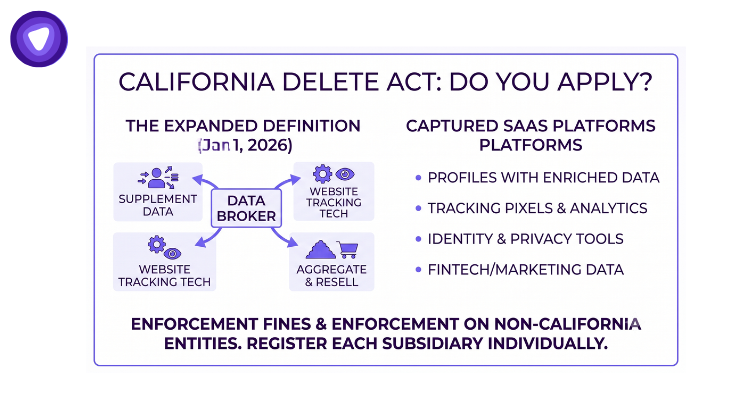
Most SaaS teams assume broker status belongs to companies that sell mailing lists or people-search data. Regulators do not read the law that narrowly anymore. New rules effective January 1, 2026 sharpened the definition to capture businesses that supplement first-party data with third-party sources, along with providers of website tracking technology.
That reach now includes platforms that never considered themselves brokers before:
- SaaS products that append third-party enrichment data to user profiles
- Analytics or tracking pixels embedded in a partner’s site that pass data back to the vendor
- Privacy or identity tools that aggregate exposure data across sources for resale or licensing
- Fintech and marketing platforms that monetize behavioral or transaction data indirectly
A recent enforcement decision against a New York-based data and technology provider resulted in a $62,600 fine for failing to register, and the company’s own initial defense, that it did not operate in California, did not hold up. Regulators also confirmed that a subsidiary cannot rely on a parent company’s registration. Each entity has to register on its own.
For a SaaS or privacy company, the practical test is not what the product is marketed as. It is what data flows through the backend. If a platform passes personal information to any third party outside a direct service relationship with the user, broker status is worth reviewing now, not after an inquiry letter arrives.
Who Is Actually Exempt From the California DELETE Act
Exemptions under the California DELETE Act exist, but they are narrower than most compliance checklists suggest. The statute carves out entities already regulated under the Fair Credit Reporting Act, the Gramm-Leach-Bliley Act, the Insurance Information and Privacy Protection Act, and HIPAA-related provisions of the California Consumer Privacy Act.
The critical detail is the phrase “to the extent.” A company is not exempt as a whole. It is exempt only for the specific activity already governed by one of those laws. A fintech platform covered by GLBA for its lending data can still qualify as a broker for a separate line of business that sells behavioral or marketing data outside that scope. A healthcare-adjacent SaaS tool covered by HIPAA for patient records can still be in scope for a wellness or analytics feature that sells de-identified or inferred data to advertisers.
There is no exemption for first-party businesses either. Collecting data directly from users does not remove a company from broker status once that data is sold or licensed to a third party the user never dealt with directly. SaaS teams that assume a first-party relationship shields them from the definition are working from an outdated read of the law.
California Is Not the Only State Watching This Closely
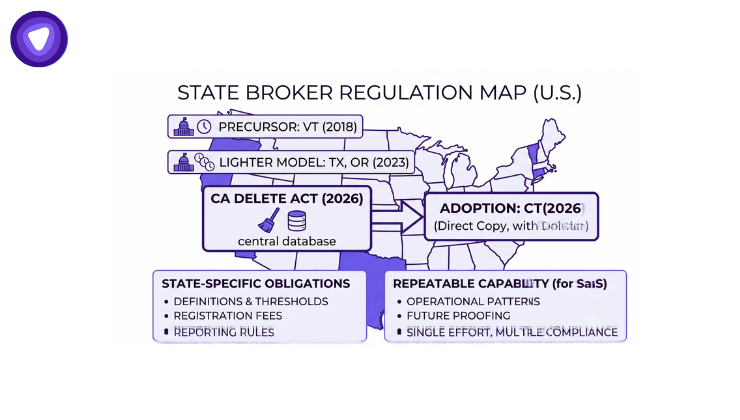
Framing the California DELETE Act as an isolated compliance project understates where broker regulation is headed. Four other states now require data broker registration in some form, and the list keeps growing. Vermont started this trend back in 2018. Texas and Oregon followed in 2023. Connecticut signed its own law in May 2026, and it directly copies California’s model, pairing a registry with a centralized deletion platform rather than the lighter disclosure-only approach used by Texas and Oregon.
For a SaaS or privacy company operating outside California, this matters for two reasons:
- Registration thresholds, fees, and definitions differ by state, so a compliance program built only around California’s rules will miss obligations elsewhere
- Connecticut’s deletion mechanism takes effect January 1, 2027, meaning the operational pattern SaaS teams build now for the California DELETE Act will need to run again on a second state’s timeline within twelve months
Treating broker compliance as a repeatable capability, rather than a one-time California project, is the difference between building this once and rebuilding it every time a new state signs a similar law.
The Real Cost of Getting the California DELETE Act Wrong
Penalty exposure under the California DELETE Act stacks in ways that generic privacy law summaries tend to flatten into one line. The table below separates the distinct cost categories a company can face.
| Requirement | Deadline | Financial Exposure |
| Annual broker registration | January 31 each year | $6,000 fee plus processing costs |
| Failure to register | Ongoing | Administrative fines plus agency investigation costs |
| Unfulfilled deletion request | After August 1, 2026 | $200 per day, per request |
| General civil violation | Ongoing | Up to $2,663 per violation |
| Intentional violation | Ongoing | Up to $7,988 per violation |
Regulators are not treating these as symbolic figures. Enforcement actions issued by the state privacy agency and the attorney general during the first quarter of 2026 alone totaled more than $4.22 million in penalties across multiple industries, including entertainment, education services, and connected vehicles. None of those sectors are traditional data brokers by trade. That is the point. Enforcement scope is expanding faster than most compliance calendars account for.
Processing DROP Requests Is an Engineering Problem, Not a Legal One
Legal teams can determine whether a company qualifies as a broker. They cannot build the pipeline that actually processes a deletion request. That work sits with engineering, and it is more involved than a single database delete statement.
A compliant deletion under the California DELETE Act has to account for:
- Derived data and inferences, not just the raw fields a user submitted
- Directing any downstream service providers or contractors to delete their copies
- Logging and reporting the outcome of every request pulled during a given retrieval cycle
- Repeating the retrieval and resolution cycle every 45 days without gaps
More than 215,000 residents had already registered on the state platform within weeks of its consumer launch. That volume does not disappear once August arrives. It becomes a processing queue that brokers are legally required to work through on a fixed schedule, indefinitely.
Companies that have modeled this internally describe it differently than a policy update. One cybersecurity suite company evaluating an in-house build estimated the broker integration work alone would take its engineering team more than six months, before accounting for ongoing maintenance as broker lists and formats change. That estimate reflects why more SaaS and privacy platforms are treating opt-out infrastructure as something to license rather than build from scratch.
Vendor and Sub-Processor Obligations Nobody Budgets For
A deletion request under the California DELETE Act does not stop at a company’s own database. The obligation extends to directing every service provider and contractor holding a copy of that data to delete it as well. For SaaS platforms built on a chain of subprocessors, cloud vendors, analytics tools, and enrichment providers, this turns a single deletion request into a coordination problem across an entire vendor stack.
Few SaaS contracts written before 2026 include deletion-on-request language mapped to a 45-day retrieval cycle. Reviewing vendor agreements for that gap is worth doing before an actual DROP request forces the issue. A deletion obligation that a company cannot pass down to its own vendors is a deletion the company cannot actually fulfill, regardless of what happens on its own servers.
The 2028 Audit Requirement Worth Planning For Now
Enforcement attention naturally concentrates on the August 2026 processing deadline, but the California DELETE Act includes a second deadline that is easy to lose track of. Starting January 1, 2028, registered data brokers must undergo an independent third-party audit at least once every three years, and audit records must be retained for six years afterward.
That requirement rewards companies that build clean, auditable deletion logs starting in 2026 rather than retrofitting documentation two years later. A processing pipeline built to simply satisfy the 45-day cycle, without structured recordkeeping behind it, becomes expensive to reconstruct when the audit clock starts. Building the reporting layer alongside the deletion pipeline now removes that problem before it exists.
Turning a California DELETE Act Requirement Into a Retention Feature
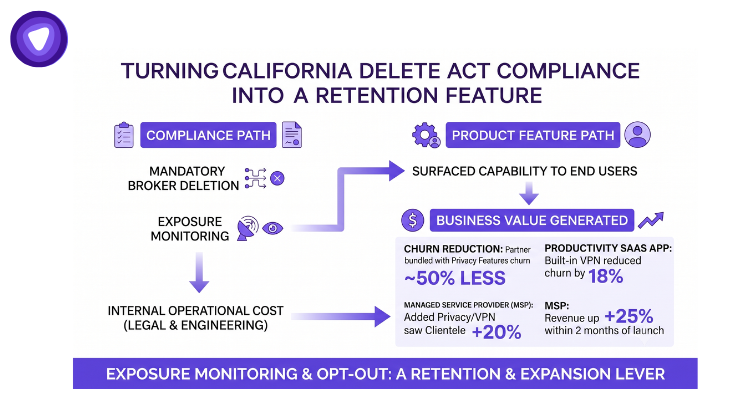
Compliance spend rarely improves a product roadmap. This is one of the exceptions. Once a platform has to handle broker deletion and exposure monitoring anyway, packaging that capability as a user-facing feature creates a second return on the same engineering investment.
The data on this is specific, not aspirational. A managed service provider that added VPN and privacy features alongside its existing antivirus suite saw enterprise clientele grow 20 percent, cut operational costs by 32 percent, and increased client retention by 15 percent, with revenue up 25 percent within two months of launch.
A separate productivity SaaS app that built in VPN protection reduced churn by 18 percent. Across partners generally, users who get privacy features bundled into a product they already pay for churn roughly 50 percent less than users offered privacy as a separate purchase, and MSPs cross-selling privacy services report renewal rates near 78 percent.
For SaaS platforms weighing whether the California DELETE Act is a cost center or an opportunity, those numbers answer the question. Exposure monitoring and broker opt-out, built to satisfy a legal requirement, double as a retention and expansion lever when surfaced directly to end users.
Where PureVPN White Label VPN Solution Fits
Companies facing this exact build-versus-license decision do not need to start from zero. PureVPN White Label VPN Solution offers data broker opt-out and dark web monitoring as modular, white-labeled products, covering removal across 400 or more broker and people-search sites under a partner’s own brand. The infrastructure runs on a SOC 2 Type II certified platform with a KPMG-verified no-log policy, and it deploys through a single API and partner dashboard rather than a multi-team engineering project.
Partners can add opt-out and monitoring as standalone modules or stack them into a full privacy suite alongside VPN, eSIM, and DNS protection. For SaaS vendors and privacy companies already mapping their California DELETE Act obligations, this turns a compliance deadline into a shipped product feature, without the multi-month build cycle in-house teams have estimated for equivalent broker integrations.
Closing Thoughts
The California DELETE Act moved from legislative text to daily operational reality faster than most privacy laws before it. Registration is closed. Enforcement has already produced fines against companies that did not see themselves as targets. August brings a recurring processing obligation that will not pause for a busy product roadmap. Companies that treat this as a checklist item will spend the next several years reacting to it. Companies that build the capability once, correctly, turn the same requirement into a feature their users actually notice.