

- Identity protection is now table stakes: Malware detection alone no longer wins renewals. Suites without data broker removal and dark web monitoring look incomplete next to Norton, Bitdefender, and Aura.
- Building in-house is slow and never finished: In-house broker removal and monitoring can take 6+ months to reach parity, and requires ongoing maintenance as brokers and dark web sources shift. Licensing an existing API cuts that to weeks.
- Compliance has to be built into the workflow, not bolted on: GDPR, CCPA, and DELETE Act framing should generate automatically with each removal request, backed by SOC 2 Type II certification and a verified no logs policy.
- Removal has to be a tracked lifecycle, not a one time scan: Requests move through defined stages, and brokers that re list scrubbed data trigger an automatic new opt out request.
- Bundled identity protection pays for itself: Bundled users churn roughly 50% less, and real partner deployments have shown double digit gains in retention, client growth, and revenue within months of launch.
Antivirus vendors spent a decade competing on malware detection rates. That fight is largely over. Norton, The leading names in the category now compete on identity protection. The products winning renewals bundle breach detection with removal.
A suite that only scans for malware looks incomplete next to one that also flags a leaked password. This is why white label dark web monitoring has become a procurement conversation inside product teams, not a marketing add-on. Vendors are no longer asking whether to add it. They are asking how fast they can license it.
Why Identity Protection Became Table Stakes for Endpoint Suites
Security suites used to stop at the device. That boundary no longer matches how breaches actually happen. Credentials get stolen from a third-party site, not from the user’s laptop, and an antivirus engine never sees it.
Three shifts forced the category to widen its scope.
- Personal data sits with 4,000+ active data brokers in the U.S. alone, most of it collected without direct consent.
- Breaches go unnoticed for 194 days on average. Attackers get a wide window before a user resets a single password.
- Consumer expectations have caught up. Roughly 85% of consumers now say they want direct control over their personal data.
Regulators are reinforcing the shift. California’s DROP platform went live in January 2026, letting residents request deletion across 545 registered brokers in one submission. Starting August 2026, brokers that ignore a valid request face a $200 daily penalty. Data removal stopped being optional the moment a state attached a fine to inaction.
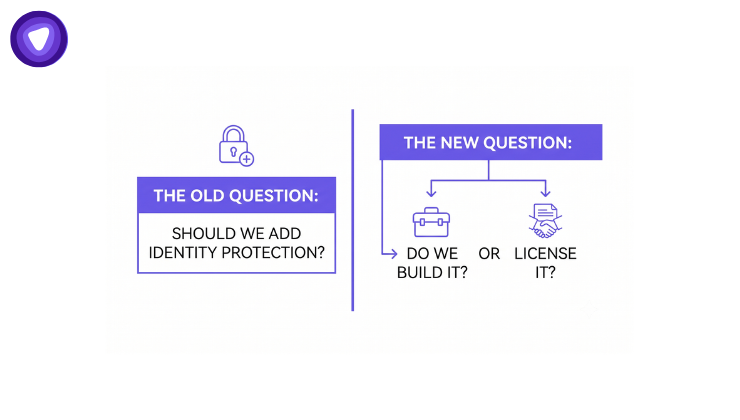
For a cybersecurity vendor, this means the product roadmap question changed. It is no longer “should we add identity protection.” It is “do we build it or license it.”
What White Label Dark Web Monitoring Actually Adds to an Endpoint Stack
White label dark web monitoring is not a single feature. It is two connected capabilities that most competitor content still treats as one.
The first is credential and PII surveillance. This scans breach dumps, stealer logs, and dark web marketplaces for a user’s email, passwords, session tokens, and identifiers. When something surfaces, the alert fires under the vendor’s own brand with a clear remediation step, not a generic warning.
The second is data broker opt-out. This removes a user’s name, address, and phone number from people-search and broker sites. It keeps checking afterward, because brokers routinely re-list scrubbed data within weeks.
Sold together, these two modules close a gap that antivirus alone cannot touch. Malware protection defends the device. White label dark web monitoring and broker removal defend the identity sitting outside it. A suite offering only one half is telling users it caught the fire but left the smoke detector unplugged.
Build In-House or License the Infrastructure
This is the question that actually shapes a roadmap meeting. Generic listicles never touch it.
Building broker removal in-house means negotiating opt-out workflows with hundreds of sites. Each site has its own form, email process, or identity verification step, and none of them coordinate with each other.
Dark web monitoring in-house means standing up scanners across forums, marketplaces, and stealer log repositories. Sources move constantly, shifting from open forums to Telegram or invite-only channels, so a static scanner goes stale fast.
One product leader at a cybersecurity suite company weighed both paths before choosing to license. The broker integration work alone was estimated at more than six months. That timeline was just to reach parity with an existing platform. That estimate did not include ongoing maintenance as brokers change their opt-out flows.
| Approach | Time to launch | Engineering load | Compliance ownership |
| Build in-house | 6+ months | High, ongoing broker maintenance | Fully internal |
| White label platform | Weeks | Low, API and SDK integration | Shared, vendor pre-frames requests |
| Do nothing | N/A | None | Exposure grows unaddressed |
Licensing does not remove engineering work entirely. It replaces broker-by-broker maintenance with one API and SDK integration. A partner dashboard then handles user management across the suite.
How Provisioning and Data Flow Actually Work: Dark Web Monitoring
This is the ground-level question product and engineering teams ask before signing anything. It rarely gets a straight answer on a vendor marketing page.
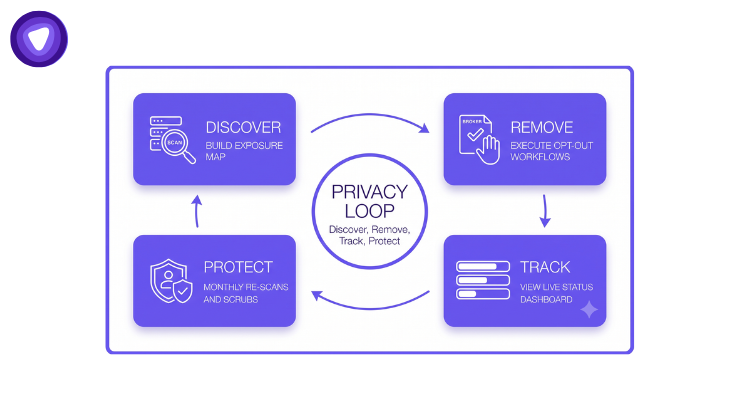
The Discover, Remove, Track, Protect Loop
A white-label privacy platform typically runs on a four-stage loop:
- Discover. The platform scans data broker sites and dark web sources to build an exposure map for each user.
- Remove. Broker-specific workflows execute the opt-out, whether that means an email request, a web form, or an identity verification step.
- Track. Users see live status, showing what is discovered, pending, or confirmed removed, inside the partner’s own branded dashboard.
- Protect. Monthly re-scans catch data that resurfaces, since brokers frequently re-aggregate and republish scrubbed records.
Authentication and Endpoint Architecture
On the monitoring side, integration runs through a documented authentication flow. A partner pulls a Secret Key from their console and exchanges it for an access token. The user is then registered through a User Management endpoint.
From there, two services do the actual work. An Identity Exposure Intelligence endpoint checks a submitted email, phone, or username against known breaches. It returns a report on where and how the data was exposed. A separate monitoring endpoint then registers ongoing assets. Emails, domains, or card numbers get watched continuously instead of rescanned by hand. Every exchange runs over an encrypted SSL connection end to end.
This is what lets a security suite activate white label dark web monitoring the moment a customer subscribes. There is no manual backend step and no support ticket to open. Integration happens at the account layer, not the interface layer. That distinction matters. The antivirus vendor keeps full control over how alerts, dashboards, and onboarding look to the end user. The underlying scanning and removal infrastructure stays entirely on the vendor’s side.
Who Owns Compliance When the Brand Is Yours
This question stops most cybersecurity vendors before they even scope a build. If a removal request goes out under your brand, who is legally answering for it under GDPR or CCPA?
In a properly built white-label setup, removal requests carry the correct legal basis for the jurisdiction automatically. GDPR-based requests cite the relevant data subject right. CCPA and California DELETE Act requests reference the applicable statute. Automated compliance documentation gets generated alongside each request. The vendor is not manually drafting legal language for every broker interaction.
Underlying infrastructure should also carry independent verification, not just a claim on a pricing page. Look for SOC 2 Type II certification and a third-party audited no-logs policy. These are the two credentials enterprise buyers and MSSPs actually check first.
This distinction matters more once the DELETE Act penalty phase begins in August 2026. A vendor whose monitoring and removal infrastructure is not compliance-ready by then puts partner brands at risk, not just itself.
What Happens When a Broker Ignores the Request
This is the operational detail that separates a real removal service from a one-time scan. It rarely makes it into vendor pitch decks for white label dark web monitoring.
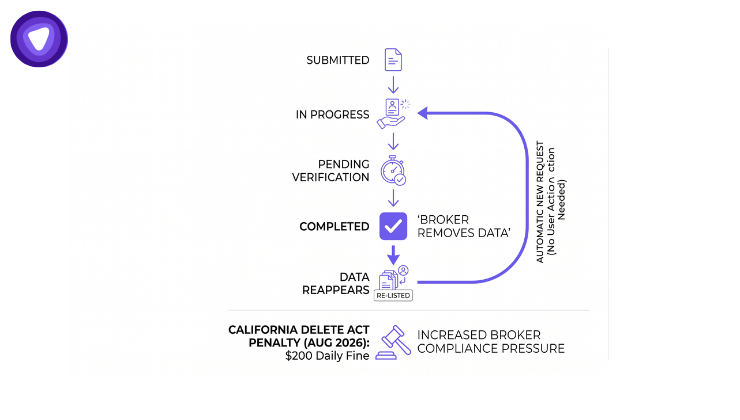
Data brokers do not comply on the first request. Some ignore opt-out emails entirely. Others confirm removal, then re-list the same record weeks later after refreshing their dataset from a new source. A removal product that runs once and stops is not solving the problem it claims to solve.
A properly built platform treats this as a tracked lifecycle, not a single transaction. Each request moves through defined stages. It starts as submitted, then moves to in progress while the broker is contacted. Some brokers require a pending verification step to confirm the removal. Once confirmed, the request closes as completed. If the data reappears after that, the status flips to re-listed. A new opt-out request then fires automatically, without the user or partner needing to notice first.
This is also where the California DELETE Act penalty changes vendor incentives. Brokers face a $200 daily fine for unfulfilled requests starting in August 2026. That pressure to actually close out removals, not just file them, is about to increase sharply. A monitoring platform that already tracks status end to end is positioned to prove compliance. That matters the moment a partner or regulator asks for it.
The Retention and Revenue Case
Every product team eventually asks whether this pays for itself, and the honest answer depends on structure, not just adoption.
Bundled privacy services measurably change retention. Users who bundle broker removal and dark web monitoring with an existing product churn roughly 50% less than single-product users. A managed service provider that layered VPN and identity protection onto its antivirus suite saw results across the board. Enterprise clientele grew by 20%, cut operational costs by 32%, and revenue rose 25% within two months of launch. A separate productivity SaaS platform that added built-in privacy protection saw an 18% reduction in churn after launch.
These numbers hold because identity protection changes the renewal conversation. A user canceling antivirus after a quiet year is easy to lose. A user watching a live dashboard track removed listings and flagged credentials has a reason to keep paying. The value is visible every month, not just during a scan.
Deployment Models: Standalone or Full Suite
Vendors do not need to launch every module at once. Data broker opt-out and white label dark web monitoring both work as standalone add-ons. They also work as a bundled privacy suite alongside VPN, eSIM, and DNS protection.
- Single module. Add just broker removal or just monitoring to an existing antivirus product. Pricing runs per user, with full branding control from day one.
- Bundled suite. Stack both privacy modules with VPN and eSIM under one partner dashboard and one API integration. This route typically carries volume pricing advantages over licensing modules separately.
Cybersecurity suites tend to see the highest average contract value when both modules ship together. It rounds out antivirus and identity protection into a single privacy platform. Customers get one system instead of a patchwork of point solutions to piece together on their own.
Where PureVPN White Label VPN Solution Fits
PureVPN White Label VPN Solution’s digital privacy protection modules cover data broker opt-out across 400+ sites. White label dark web monitoring runs continuously alongside it. Both deploy as standalone products or fold into a bundled suite with VPN and eSIM. The infrastructure is SOC 2 Type II certified with a KPMG-verified no-log policy. That sits on top of 17 years of privacy infrastructure experience and 150+ partners worldwide.
Partners get one API, one dashboard, and full control over branding, pricing, and how alerts appear to end users. GDPR, CCPA, and DELETE Act framing is built into the removal workflow rather than left for the partner to draft. For a cybersecurity suite closing the gap between malware protection and identity protection, speed and compliance readiness matter most.
Dark Web Monitoring: Final Thoughts
Security suites that treat identity protection as core infrastructure are the ones setting renewal benchmarks in this category now. Adding this to an antivirus suite is no longer a differentiator by itself. Competitors already ship white label dark web monitoring and broker removal. The real gap sits between two kinds of vendors. One licenses mature infrastructure and ships in weeks. The other is still scoping a build that takes quarters to reach the same coverage. The suites still deciding which side of that gap to stand on are watching it widen every quarter they wait.