

- AI Credential Attacks: AI-powered credential attacks now go far beyond stuffing login forms. Attackers steal session tokens and OAuth grants after authentication, meaning MFA alone no longer stops them. Nearly 1 in 5 login attempts on SaaS platforms is not a real user.
- Third-Party Risk: Third-party integrations are the most dangerous entry point in 2026. Nearly half of all confirmed breaches now involve a vendor or integration partner, and a single compromised SaaS provider can cascade into dozens of downstream customer environments simultaneously.
- Vulnerability Exploitation: Vulnerability exploitation has overtaken credential theft as the top initial access vector for the first time in 19 years of DBIR reporting. Attackers are exploiting known CVEs in hours, while the average organization takes 43 days to patch them.
- Cloud-Native Ransomware: Ransomware groups have gone cloud-native and now delete backups before triggering encryption. By the time a SaaS platform detects the breach, the recovery path is already gone. Immutable, air-gapped backups are no longer optional.
- API Authorization Gaps: 95% of API attacks come from authenticated users, not broken logins. The real vulnerability is authorization, not access. With 80% of organizations lacking real-time API monitoring, data is leaking at scale with no one watching.
Earlier this year, a breach at Anodot, a business monitoring SaaS provider, handed ShinyHunters something far more valuable than one company’s data. It handed them valid authentication tokens with trusted access into Snowflake, Salesforce, Vimeo, and over a dozen other platforms. No passwords cracked. No perimeters broken. One SaaS vendor breached, dozens of companies downstream hit with cybersecurity threats.
That is the attack model of 2026. And it is running at scale. These cybersecurity threats are reshaping how SaaS providers think about trust, authentication, and third-party risk.
5 Cybersecurity Threats SaaS Platforms Will Face
The cybersecurity threats below are not predictions. They are patterns already confirmed in breach data from the first half of this year. If you are building, running, or securing a SaaS platform, this is what the second half of 2026 looks like. Among the most significant cybersecurity threats facing SaaS platforms, credential-based attacks continue to evolve faster than traditional defenses.
1. Credential Attacks Have Gotten Smarter Than Your Defenses
Credential stuffing used to be a numbers game. Buy a leaked database, run it against login pages at scale, collect whatever sticks. Defenders got decent at catching it: rate limiting, CAPTCHA, behavioral analytics.
That version of the problem is mostly solved. The 2026 version is not.
The Attack Has Changed Shape
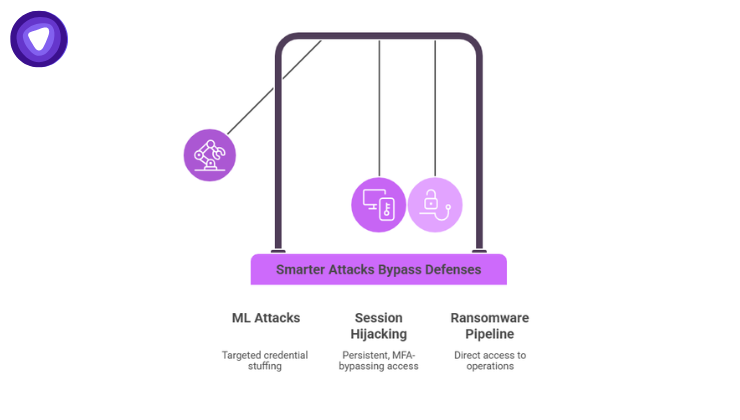
Attackers now use machine learning to decide which credentials to try first, on which platforms, at what time of day, using what device fingerprint. They rotate through residential proxies to look like real users. They target SaaS platforms specifically because SSO environments handle massive authentication volumes, and anomalous traffic blends in.
A report found 5.3 billion credential pairs circulating in criminal underground markets last year, with 4 in 10 corporate users having reused an exposed password. Credential stuffing accounted for a median of 19% of all daily authentication attempts across a two-year period. Nearly 1 in 5 login attempts hitting your platform right now is not a real user.
What Happens After the Login
Attackers today are not just accessing one account. They harvest session cookies, application tokens, and OAuth grants that give them persistent, MFA-bypassing access across connected tools.
Infostealers now function as a direct pipeline into ransomware operations. The 2026 DBIR confirmed that 73% of ransomware victims had an infostealer infection or credential leak event in the year prior to their attack.
MFA helps. It is not enough on its own. SaaS teams need continuous credential monitoring, session token invalidation as part of incident response, and behavioral detection that flags access patterns, not just failed logins. Third-party ecosystems have become one of the fastest-growing cybersecurity threats for modern SaaS businesses.
2. Your Integrations Are Someone Else’s Attack Surface
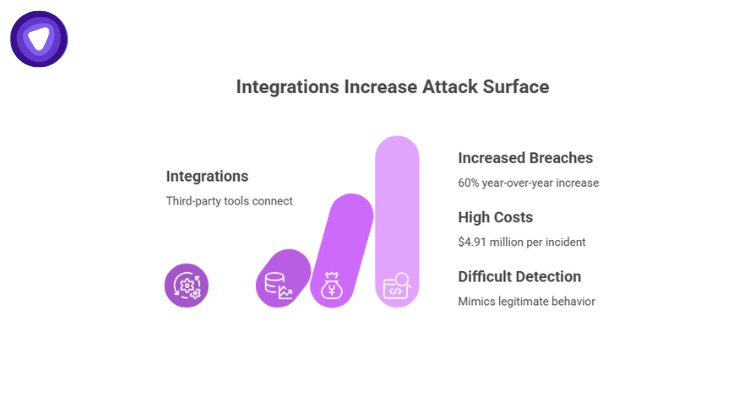
Most SaaS platforms are not a single product anymore. They are a hub. Dozens of third-party tools connect into them through APIs, OAuth grants, and shared credentials. That ecosystem is exactly where attackers are focusing.
The Numbers Are Hard to Ignore
A 60% year-over-year increase in third-party involvement in breaches was reported. Nearly half of all confirmed breaches now involve a vendor or integration partner as the entry point. IBM X-Force 2026 added five years of context: major supply chain compromises have nearly quadrupled since 2020, targeting CI/CD pipelines, trusted developer identities, and SaaS integration trust relationships.
Supply chain attacks are also the most expensive to resolve. IBM’s 2025 Cost of a Data Breach Report found they cost an average of $4.91 million per incident and take 267 days to fully contain. That is the longest breach lifecycle IBM tracks.
Why It Is So Hard to Catch
The SalesLoft breach in 2025 made the mechanics concrete. Attackers did not touch any proprietary code. They weaponized OAuth tokens shared between SaaS platforms and moved laterally through the trust relationships organizations had built with their own tools.
A compromised third-party token authenticates exactly like a legitimate one. The access pattern looks normal because it mirrors what the integration was designed to do. Detection requires knowing what normal integration behavior looks like well enough to catch when something deviates. That means vendor risk assessments need to be continuous, OAuth permissions need to be scoped and revocable, and any integration touching customer data should be treated as an extension of your own attack surface.
Unpatched software remains one of the most exploited cybersecurity threats in enterprise environments.
3. Unpatched Vulnerabilities Are Now the Fastest Path In
Here is the shift that deserves more attention than it is getting.
For the first time in its 19-year history, reports found that vulnerability exploitation has overtaken stolen credentials as the most common initial access vector. It now accounts for 31% of all confirmed breaches, up from 20% the prior year.
The Patching Gap Is Getting Worse
That jump did not happen because attackers got cleverer. It happened because organizations got slower. Only 26% of CISA’s Known Exploited Vulnerabilities were fully remediated in 2025, down from 38% the year before. Median remediation time stretched from 32 to 43 days. The number of known exploited vulnerabilities hitting the average organization climbed from 11 to 16.
AI is accelerating the attacker’s side of this equation. The 2026 DBIR documents cases where the time from CVE disclosure to active exploitation dropped from weeks to hours, driven by AI-assisted vulnerability discovery. The window to patch before exploitation is shrinking faster than most programs can keep up.
How the Breach Landscape Has Shifted
| Initial Access Vector | 2025 Share | 2026 Share | Change |
| Vulnerability Exploitation | 20% | 31% | +55% |
| Credential Abuse | 22% | 13% | -41% |
| Third-Party Involvement | 30% | 48% | +60% |
| Ransomware in Breach Chain | 44% | 48% | +9% |
The data shows how quickly today’s cybersecurity threats are shifting toward exploit-driven attacks and supply chain compromises.
SaaS platforms carry third-party code dependencies, customer-facing APIs, and integration middleware that can all contain unpatched CVEs sitting outside the core security team’s awareness.
Quarterly penetration testing against your own perimeter misses most of this. The 2026 attack surface runs through every vendor portal, service account, and OAuth flow connected to the platform. Those surfaces need to be in scope.
4. Ransomware Groups Have Gone Cloud-Native
The mental model most people still have of ransomware is a phishing email, an encrypted hard drive, and a Bitcoin wallet address in a pop-up. That model is five years out of date.
The New Playbook Targets Backups First
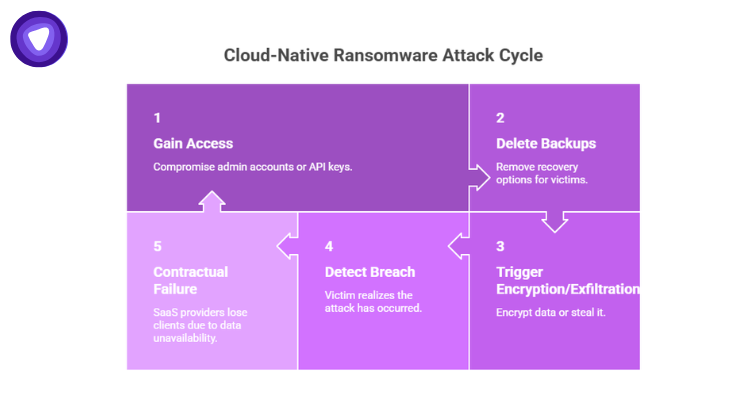
Ransomware in 2026 targets SaaS data pipelines, cloud backup stores, and multi-tenant databases directly. The sequence is: gain access through a compromised admin account or stolen API key, locate and delete backups, then trigger encryption or exfiltration. By the time the victim detects the breach, the recovery path has already been removed.
Ransomware is now present in 48% of all breach chains in the 2026 DBIR, up from 44% the year before. Active ransomware groups increased 49% year-over-year per IBM X-Force 2026. Cyble recorded 6,604 ransomware attacks in 2025 alone, a 52% jump from 2024.
IBM puts the average cost of a ransomware incident at $5.08 million, the highest of any attack category.
What This Means for SaaS Specifically
For SaaS providers, the failure mode is not just financial. It is contractual. Enterprise clients have SLAs tied to data availability. A ransomware event that takes customer data offline for weeks, or exposes it through double extortion, does not just cost money. It ends contracts.
Three things need to be true to defend against cloud-native ransomware:
- Backup immutability is non-negotiable. If backups can be deleted through the same admin credentials that run production, they will be deleted before the ransom note arrives.
- Service account auditing must be continuous. Ransomware affiliates move through accounts and API keys provisioned months or years ago and never reviewed.
- Detection needs to catch pre-encryption signals. Mass backup deletion, unusual API call volumes, and storage-level privilege escalation are the warning signs. Catching them is more valuable than detecting the encryption itself.
Ransomware-as-a-Service has made campaigns that previously required real technical depth accessible to far less sophisticated actors. The barrier has dropped. The SaaS attack surface has grown. That combination is what H2 2026 looks like.
5. APIs Are Leaking Data Quietly, and Most Teams Cannot See It
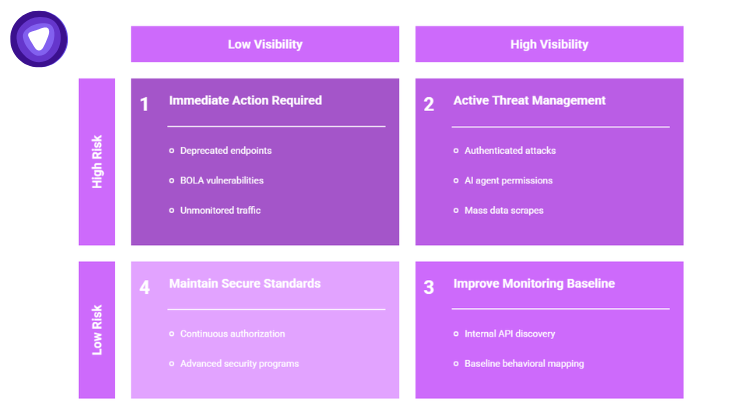
APIs are where SaaS platforms actually operate. They are how data moves between your platform and your customers’ systems, between your product and third-party tools, between mobile clients and your backend. They are also producing data exposure that most security teams do not have visibility into.
The Authorization Gap Is the Real Problem
A report found that 99% of organizations encountered API security problems in the past 12 months. Of production API issues reported, 37% involved vulnerabilities like injection attacks and Broken Object-Level Authorization, 34% involved sensitive data exposure, and 29% were tied to authentication weaknesses.
The stat that matters most: 95% of API attacks originate from authenticated sources. The attack is not trying to break authentication. It already passed it. What it exploits is the gap between what a user is allowed to do and what the API actually enforces.
That gap is called Broken Object-Level Authorization (BOLA). An attacker with a legitimate account manipulates object IDs in API calls to pull data belonging to other users or tenants. In a multi-tenant SaaS product, one compromised account can access another customer’s data without triggering a single authentication alert.
Monitoring Is Not Keeping Pace
A report found that 80% of organizations lack continuous, real-time API monitoring. Only 6% have an advanced API security program. Most are in planning stages or running no coherent strategy at all.
AI is making this harder. Wallarm’s 2026 analysis found that AI-related vulnerabilities grew 398% year-over-year, with 36% directly involving APIs. Generative AI in API development is introducing vulnerability patterns that traditional scanning tools are not built to catch.
What this looks like in practice:
- A developer account makes 40,000 API calls over a weekend. Normal integration or a mass data scrape? Without behavioral baselines, you cannot tell.
- A deprecated internal endpoint, still active in production, has no authentication controls because it was never supposed to be public. It is.
- An AI agent connected through a third-party MCP server fires API calls using inherited permissions that far exceed what the agent needs.
Runtime API discovery, continuous authorization testing, and behavioral monitoring of authenticated traffic are no longer advanced security capabilities. They are the baseline.
Where PureVPN White Label VPN Solution Fits Into This Picture
The cybersecurity threats outlined above all exploit gaps in trust across users, vendors, APIs, and cloud infrastructure. Every threat above exploits a gap in trust. Trusted credentials, trusted vendors, trusted API clients, trusted sessions. The attack patterns of H2 2026 are specifically designed to look like legitimate activity until it is too late to respond.
Enterprise clients have started asking harder questions at procurement. They want to know how data moves between their distributed workforce and the SaaS platform, what happens on an unsecured network, and whether the transport layer is protected or simply assumed.
This is where PureVPN White Label VPN addresses a real gap. SaaS providers can offer their business customers a branded VPN solution that secures network-level traffic between end users and the platform. For distributed teams, hybrid workforces, and clients in high-compliance industries, that closes an exposure window endpoint security alone does not cover.
Packaging this as a white-label, branded capability also shifts the positioning. Security stops being something customers source separately and becomes something your platform delivers. In an enterprise sales environment where trust is a purchasing decision, that distinction matters.
Final Thoughts
The breaches that define the back half of this year will look like normal vendor activity, normal API traffic, and normal authentication until suddenly they do not. That is the point. The threat landscape has evolved specifically to evade the alerts most SaaS security programs are built to catch.
Closing these gaps means treating security as a continuous operational discipline. It means knowing what every integration can access and revoking what it no longer needs. Monitoring API behavior in real time, not sampling it quarterly. Patching on a timeline measured in days, not release cycles.
The SaaS platforms that hold through H2 2026 will not be the ones with the most sophisticated tools. They will be the ones that built the fundamentals properly and kept watching.