


- Remote and hybrid work is now permanent, and every endpoint outside the corporate network is a security liability that enterprises can no longer ignore.
- Enterprise VPN buyers are evaluating for compliance readiness, audit logging, and centralized access control, not just encryption, making it a fundamentally different product category than consumer VPN.
- GDPR fines exceeded €2.1 billion in 2023 and the global average data breach now costs $4.88 million, giving enterprise procurement teams hard financial justification to invest in access security infrastructure.
- The enterprise VPN market is projected to reach $87.1 billion by 2026, and service providers who enter through a white label model can go to market in 30 to 90 days without building infrastructure from scratch.
- Providers who reframe VPN around security outcomes, compliance readiness, and workforce continuity, and back it with strong onboarding, win longer contracts and significantly higher customer lifetime value than any consumer segment.
The office perimeter is gone. It did not shrink gradually. It collapsed almost overnight, and it has not come back. Enterprise VPN demand is not just rising. It is fundamentally changing in who is buying it, why they are buying it, and what they expect from it.
Since 2020, enterprises have been operating across dozens, sometimes hundreds, of locations simultaneously. Home offices, co-working spaces, hotel lobbies, airport terminals. Every one of those endpoints is a potential breach point. And for service providers, that reality is one of the most significant commercial opportunities of the decade.
The Scale of the Remote Work Shift
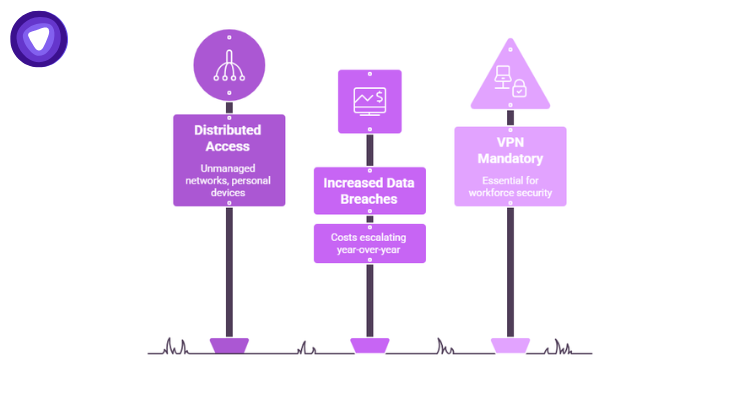
Remote and hybrid work is now structural, not situational. More than one in three workers (38%) are hybrid or remote, a 15% increase year-over-year, and the share of full-time in-office workers has continued declining.
That figure includes knowledge workers, IT teams, finance departments, legal teams, and customer operations staff who routinely handle sensitive data from outside corporate networks.
The security gap this creates is measurable. The global average cost of a data breach reached $4.88 million in 2024, a 10% increase from the prior year and the largest annual spike since the pandemic.
Organizations are now dealing with distributed access across unmanaged home networks, personal devices, and public Wi-Fi connections, and they know it.
For enterprise IT buyers, VPN is no longer a “nice to have”. It is a mandatory layer of access security for the entire workforce.
Why Enterprise VPN Demand Is Different from Consumer VPN
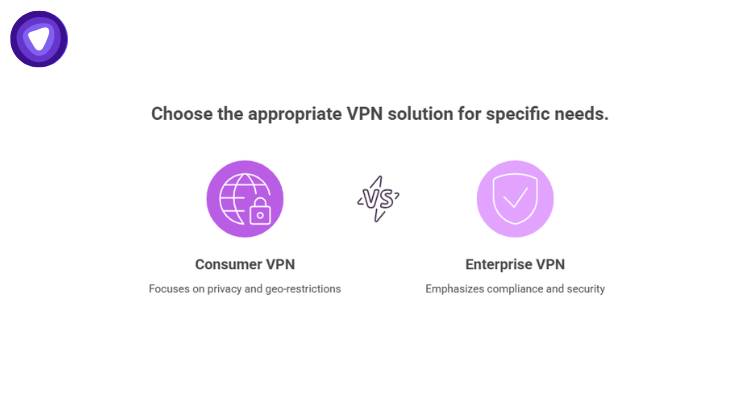
Understanding the difference between consumer VPN demand and enterprise VPN demand matters enormously for service providers.
Consumer VPN is largely driven by privacy preferences and geo-restriction use cases. Enterprise VPN is driven by compliance mandates, data governance requirements, and security architecture decisions made at the CISO level.
Enterprise buyers care about:
- Centralized user management with role-based access control
- Audit logging for compliance with frameworks like SOC 2, ISO 27001, HIPAA, and GDPR
- Split tunneling to route only relevant traffic through the VPN
- Static IP support for allowlisting internal resources
- Multi-protocol support across IKEv2, OpenVPN, and WireGuard
- Scalability to onboard hundreds or thousands of users without performance degradation
A consumer VPN product retrofitted with an enterprise label does not meet these requirements. Buyers know this, and they are increasingly sophisticated about evaluating the difference.
The Compliance Pressure Behind the Buying Decision
Regulatory pressure is a major driver of enterprise VPN procurement, and it is intensifying.
GDPR enforcement in Europe has escalated significantly. In 2023 alone, regulators issued over €2.1 billion in fines, driven by unauthorized data transfers and inadequate access controls.
In the United States, the SEC’s cybersecurity disclosure rules that took effect in late 2023 require public companies to report material cybersecurity incidents within four business days. That puts direct pressure on boards and C-suites to verify that access controls are demonstrably in place.
For enterprises operating across multiple jurisdictions, VPN infrastructure that enforces encrypted tunnels, restricts access by user role, and produces verifiable logs is not optional. It is an audit requirement.
Service providers who position VPN as a compliance tool, not just a security tool, speak directly to the budget holder making the procurement decision.
What This Means for Service Providers: A Market Snapshot
The enterprise VPN market is projected to reach $87.1 billion by 2026, up from $44.6 billion in 2022.
That growth rate reflects exactly what is happening on the demand side: more distributed workforces, more compliance pressure, and more frequent breaches linked to unsecured remote access.
For managed service providers (MSPs), telecom companies, and IT resellers, the question is not whether to offer VPN services. It is whether to build from scratch or deliver through a white label model.
The Build vs. White Label Decision
| Factor | Build In-House | White Label VPN |
| Time to market | 12–24 months | 30–90 days |
| Infrastructure cost | High (servers, maintenance, licensing) | Covered by provider |
| Protocol support | Dependent on engineering resources | Pre-built (WireGuard, OpenVPN, IKEv2) |
| Compliance features | Custom development required | Included (audit logs, access controls) |
| Branding | Full control | Full control under your brand |
| Support burden | Internal team required | Handled by white label partner |
| Scalability | Requires ongoing CapEx | Provider-managed |
The math rarely favors building. Infrastructure alone, accounting for server deployment, protocol engineering, uptime SLAs, and ongoing maintenance, runs into significant capital expenditure before a single customer is onboarded. White label models let providers bring a fully operational VPN product to market under their own brand without that overhead.
What Enterprise Clients Expect from Their Service Provider
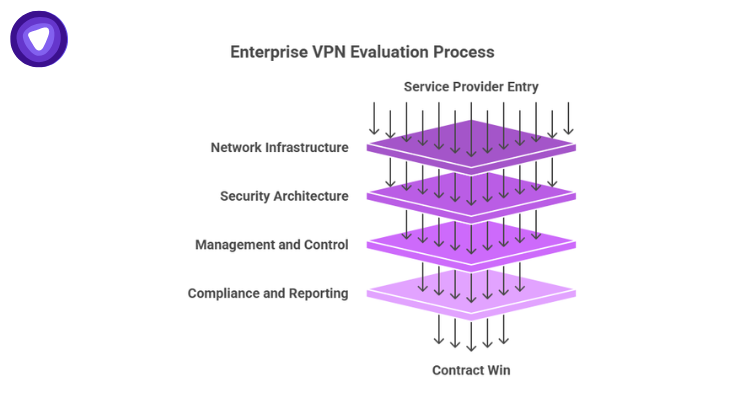
Service providers entering the enterprise VPN demand space face a more demanding buyer than they might expect. Enterprise IT decision-makers have become fluent in network security terminology. They run evaluations. They ask hard questions about infrastructure and SLAs.
Here is what the enterprise evaluation checklist typically looks like:
Network and Infrastructure
- Global server footprint with low-latency options across key regions
- Redundancy and failover capabilities
- Bandwidth guarantees under load
Security Architecture
- AES-256 encryption as a baseline
- A verified no-logs policy, ideally third-party audited
- Kill switch functionality to prevent traffic leaks on dropped connections
- DNS leak protection
Management and Control
- Dedicated admin dashboards for provisioning and monitoring
- API access for integration with existing identity providers (LDAP, Active Directory, SSO)
- Per-user and per-group policy enforcement
Compliance and Reporting
- Activity logging with configurable retention
- Exportable reports for audit purposes
- Data residency options for organizations with jurisdictional requirements
Providers who can tick all of these boxes, or partner with someone who can, are positioned to win contracts that renew annually and expand over time as client organizations grow.
The Pricing Opportunity in Enterprise VPN
Enterprise VPN is not priced like consumer VPN. Consumer products sell at $3 to $15 per user per month with high churn rates. Enterprise contracts operate on a different model entirely.
Per-seat pricing at the enterprise tier typically starts at $8 to $25 per user per month depending on feature set and volume. Dedicated server options, static IP provisioning, and compliance add-ons command additional margin. Annual or multi-year contracts reduce churn to near zero. And enterprise relationships frequently expand, adding users, adding locations, and adding adjacent security services over time.
For service providers, the LTV profile of an enterprise VPN customer is significantly stronger than any consumer segment.
Where Service Providers Are Leaving Revenue on the Table
The most common gap in service provider VPN offerings is not technical. It is positional.
Providers who treat VPN as a commodity feature bundled into a broader package are undervaluing the product and underserving the customer. Enterprise buyers want a dedicated, managed VPN solution with a clear service level, dedicated support, and a product roadmap they can rely on.
Providers who reframe their VPN offering around three things, security outcomes, compliance readiness, and workforce continuity, are far better positioned to win enterprise deals and retain them.
The other gap is onboarding. Enterprise clients do not want a self-serve portal and a knowledge base. They want guided deployment, integration support, and a named account contact. Providers who invest in the onboarding experience close faster and churn far less.
PureVPN White Label: Built for What Enterprise Clients Actually Need
For service providers looking to enter or expand in the enterprise VPN space, PureVPN’s White Label VPN solution gives you the infrastructure and product depth that enterprise clients evaluate for without the capital expenditure of building it yourself.
The platform runs on 6,500+ servers across 65+ countries, supports WireGuard, OpenVPN, IKEv2, and SSTP, and comes with the management tools, audit logging, and dedicated IP options that enterprise procurement teams require. You bring the client relationships and your brand. PureVPN provides the product layer beneath it.
It is a model designed for providers who want to move fast, maintain margin, and deliver a product that can stand up to enterprise scrutiny on day one. The white label structure means your clients see only your brand throughout, from the app interface to the admin dashboard to the support touchpoints.
Final Thoughts
Remote work did not create the enterprise VPN market. It transformed it. The shift from a concentrated, perimeter-secured workforce to a distributed, always-connected one changed both the risk profile and the buying behavior of enterprise organizations.
For service providers, the opportunity is concrete and growing. Enterprise VPN demand means that Enterprise clients need VPN solutions that are security-grade, compliance-ready, and centrally manageable. They are willing to pay for them on multi-year contracts. And they are looking for providers who understand their environment, not just the technology.
The providers who move into this space with the right infrastructure, the right positioning, and the right partner behind them are the ones who will own the long-term relationship.