

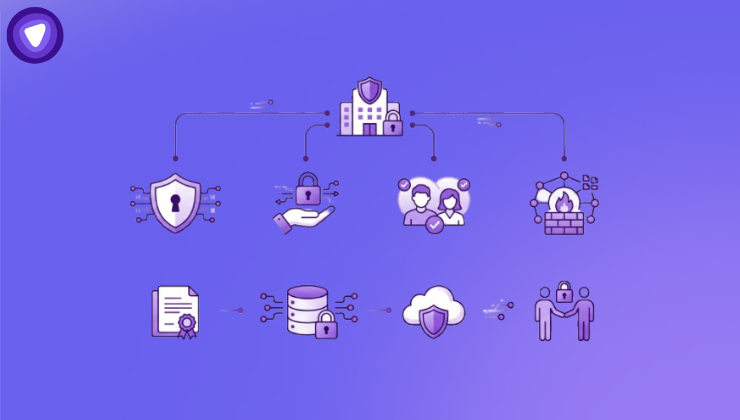
- Three connected functions: Digital privacy protection for business combines identity exposure intelligence, dark web monitoring, and data broker opt-out into one service.
- Scale of the problem: More than 4,000 data brokers operate in the US, and 85 percent of consumers want more control over their data.
- Compliance pressure is rising: California’s DROP platform enforces a $200 per day penalty per unresolved deletion request starting August 2026.
- Buying beats building for most businesses: An API based partner compresses a multi quarter engineering project into an integration measured in days.
- Bundling drives retention: MSPs that cross sell privacy services see renewal rates near 78 percent, well above standalone security add-ons.
A data broker does not need permission to sell someone’s home address, employer, or phone number. It only needs the record. That fact is why digital privacy protection for business moved from a compliance footnote to a product category.
Businesses now build it, buy it, or bundle it into what they already sell. This guide breaks down what the category actually includes. It covers how the technology behind it works. It also covers what the category costs to run in-house versus buying it as a service.
What Digital Privacy Protection For Business Actually Covers
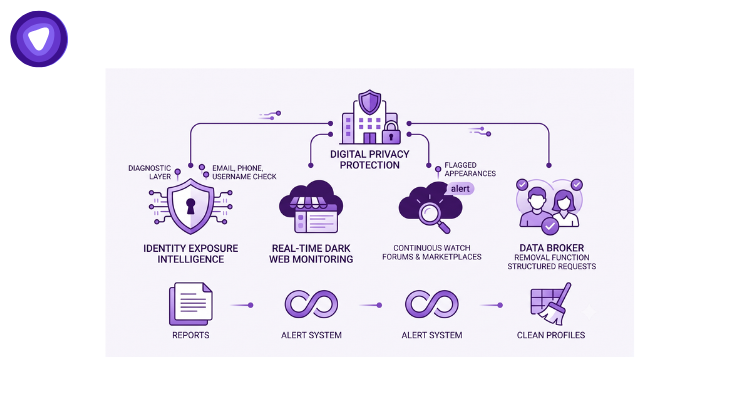
The term gets used loosely. As a business capability, it breaks into three distinct functions. They work together rather than describing the same thing three different ways.
Identity Exposure Intelligence
This is the diagnostic layer. A user’s email, phone number, or username gets checked against known breach databases and exposure sources. The output is a consolidated report. It shows where that identifier surfaced and what type of data was attached to it. Without this step, a business has no baseline. It cannot tell a client or employee what has already leaked before deciding what to monitor next.
Real-Time Dark Web Monitoring
Once exposure is known, the asset gets registered for continuous tracking. The system watches dark web marketplaces, forums, and paste sites on an ongoing basis. New appearances get flagged as they happen. This is not a one-time scan. It is a standing watch that runs for as long as the account stays active.
Data Broker Opt-Out
This is the removal function. A user’s profile details go out as structured removal requests across data broker and people-search sites. Each request gets tracked on its own. Brokers process removals on different timelines, and some require follow-up verification before they confirm.
What This Looks Like For A Client Who Has Never Used It
Most people encounter digital privacy protection for business through a dashboard, not a document. The sequence stays the same regardless of which brand sits on top of it.
- The client signs up and enters an email, phone number, or username to scan.
- Within minutes, they see a report showing where that information already surfaced online.
- They enable monitoring, and the system watches for new exposures from that point forward.
- Opt-out requests go out automatically to the brokers holding their data, no manual form-filling required.
- They get a notification only when something changes, not a constant stream of noise.
That last point matters more than it sounds. A tool that pings a client for every irrelevant match trains them to ignore alerts entirely. A tool that only surfaces confirmed exposures and removal updates keeps trust intact.
Why This Became A Business Problem
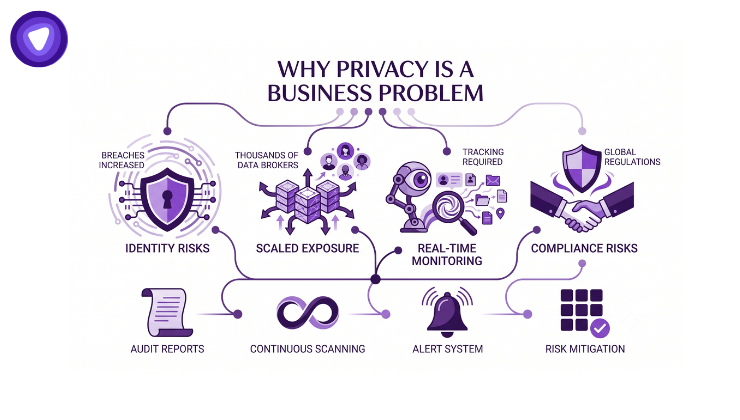
The scale of the exposure problem, and the revenue tied to solving it, comes down to a few numbers.
- More than 4,000 active data brokers now operate in the United States, each holding a different slice of the same person’s data.
- Surveys show 85 percent of consumers want more control over how their personal data gets collected and shared.
- Analysts project the data privacy market will reach 35 billion dollars by 2028.
- 94 percent of organizations say customers would not buy from them without proper data protection.
- GDPR breach notifications climbed 22 percent year over year in 2025, reaching 443 incidents reported per day across the bloc.
Most consumers have no visibility into which brokers hold their information. They have even less idea how to contact each one individually. That gap between expectation and reality matters. It turns digital privacy protection for business into a purchasing decision instead of a nice-to-have feature.
Businesses selling directly to consumers absorb that demand first. So do businesses handling employee data or running SaaS platforms with personal data flowing through them. They already carry the liability if that data gets exposed. It means the businesses least prepared to answer one question are exposed. “Was our data in that breach?” That question needs an exposure intelligence layer running at all times. An annual review will not catch it.
The Compliance Layer Businesses Cannot Ignore
California’s data broker rules changed the economics of ignoring this space. The state’s deletion platform opened in January 2026. Roughly 545 registered brokers must process consumer deletion requests through it. Brokers that miss a deletion cycle after August 2026 face a per-day fine of 200 dollars per unresolved request. That penalty stacks per request, not per company.
This changes the calculation for any business that qualifies as a broker under the state’s broad definition. It also changes what businesses expect from vendors selling digital privacy protection for business. A vendor that cannot show how opt-out requests move through a full lifecycle is not offering a compliance-ready product. That holds true no matter what the marketing page claims.
How This Fits Different Types Of Businesses
The core service stays the same across industries. What changes is which part of it matters most to a given buyer.
- Security vendors add it to bundle identity protection alongside antivirus and threat detection, competing directly with established suite providers.
- Telecom and mobile providers use it to raise average revenue per user without deploying new network infrastructure.
- Fintech platforms lean on the compliance and audit trail, since transaction security and regulatory scrutiny already sit at the center of their product.
- MSPs and MSSPs sell it as a new line item to existing SMB clients, with no backend engineering required on their side.
- SaaS platforms fold it into the core product to differentiate on trust and reduce churn among users already handling sensitive data.
- Crypto and Web3 platforms use it for account-level privacy and to support users navigating regional access restrictions.
The underlying API and dashboard stay identical across all of these. Only the framing on the sales page and the pricing model changes.
Three Questions Businesses Ask Before Buying This
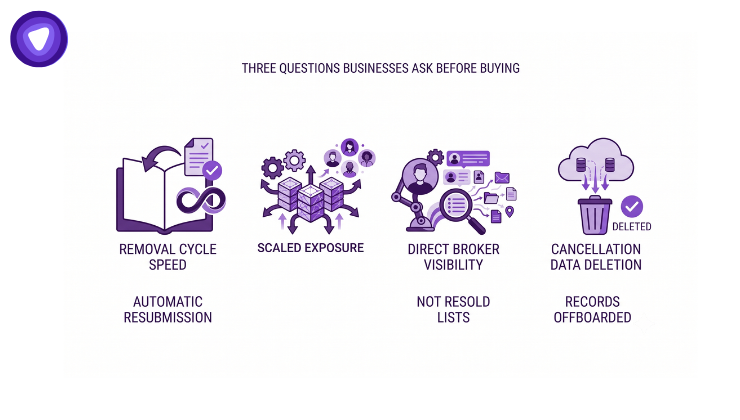
Generic privacy content skips the questions that actually decide a purchase. These come up in nearly every technical evaluation.
- How fast do removal requests get confirmed, and what happens if a broker ignores one? A lifecycle-based system resubmits automatically. A one-time scan tool does not.
- Does the vendor own the broker relationships, or resell someone else’s list? Resold lists lag behind broker policy changes, since the reseller has no direct visibility into them.
- What happens to data once a user cancels? A serious vendor documents deletion of exposure records on offboarding, not just suspension of monitoring.
How The Technology Actually Works Behind The Scenes
Generic privacy content stops at “we scan the dark web.” The real architecture runs through a defined sequence. That sequence matters, since it determines how fast alerts reach a user and how reliably removals get confirmed.
A typical implementation authenticates through a secret key exchanged for an access token. It then calls three core service layers in order: identity exposure intelligence, dark web monitoring registration, and broker opt-out submission. Each layer exposes its own endpoints rather than bundling everything into one call. That structure lets a business trigger only the function a specific user needs.
Webhook Alerts Versus Scheduled Rescans
The monitoring layer is where most vendors cut corners. Some systems rescan on a fixed schedule and notify users after the fact. A stronger architecture pushes alerts through a webhook the moment a monitored asset appears on a dark web source. It does not wait for the next scheduled poll. That difference sounds small. It stops sounding small once a stolen credential sits unflagged for days. It waits on a scan window that had not come around yet.
The opt-out side runs on a lifecycle rather than a single action:
| Stage | What Happens |
| Submitted | Request created and queued for processing |
| In Progress | Broker actively contacted for removal |
| Pending Verification | Broker requires confirmation before proceeding |
| Completed | Broker confirms data has been removed |
| Re-listed | Data reappeared, triggering automatic resubmission |
That last stage gets underestimated most often. Data broker records rebuild from public filings, resold lists, and new account signups. A single opt-out request rarely stays permanent. Continuous resubmission has to be built into the system, not treated as an edge case.
Who Ends Up Owning This Inside A Business
The question rarely gets asked before launch, and it causes friction after. IT teams assume compliance owns the vendor relationship. Compliance assumes product owns the client-facing feature. Product assumes IT owns the security posture behind it.
Digital privacy protection for business works best as a shared function with one clear owner. That owner handles renewals and escalations directly. That owner does not need deep technical skill. They need visibility into request volume, opt-out completion rates, and any broker that repeatedly re-lists the same records. Without that single point of accountability, alerts get triaged inconsistently. Removal backlogs grow until a client asks why their data resurfaced.
Smaller teams often assign this to whoever already owns the security or trust page. Larger organizations create a dedicated privacy operations role once client volume passes a few thousand monitored identities. Either way, the ownership question should get settled before the first client account goes live, not after the first escalation. Vendors that hand over a shared dashboard with role-based access make this decision easier. Ownership can shift between teams without losing visibility into open requests.
Build It In-House Or Buy It As A Service
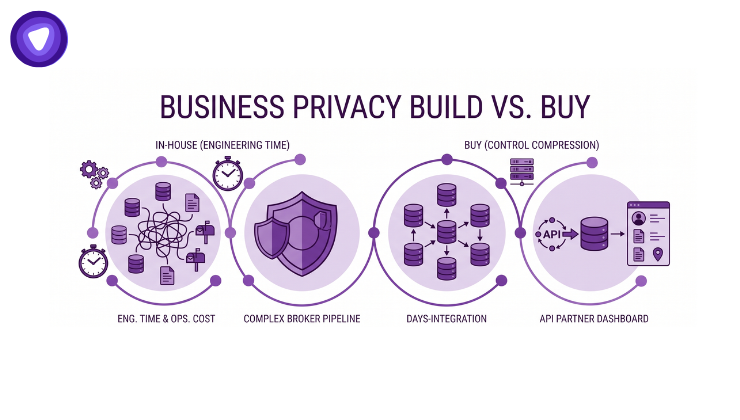
The decision comes down to engineering time versus control. Both paths work, but the cost structure looks different.
The Cost Of Building In-House
Building this internally means integrating against thousands of individual broker sites. Each one has its own submission format and verification process. Some accept structured API requests. Many still require manual web forms or postal mail. Maintaining that list alone requires a dedicated team. Someone has to track which brokers changed their opt-out process this month, since brokers alter their forms without notice.
The engineering cost compounds beyond the initial build. Broker sites change their form fields, add CAPTCHA layers, or restructure their verification flow without any public changelog. A team running this in-house needs someone monitoring those changes continuously, not just at launch. That is a standing operational cost, not a one-time project.
What Buying Compresses
Buying digital privacy protection for business through an API-based partner compresses that timeline. What starts as a multi-quarter engineering project becomes an integration measured in days. The API layer already exists. The broker list is already maintained. What a business adds is its own branding, its own pricing, and its own client-facing dashboard.
The economics favor buying for most companies outside the identity protection space itself. A cybersecurity vendor, a SaaS platform, or a telecom provider can add this as a line item. Each one gains the revenue and retention benefit without building broker relationships from scratch. The exception is a business large enough to justify a dedicated privacy engineering team year round. That tends to mean thousands of monitored identities. It also means a compliance obligation heavy enough to demand direct control over the pipeline.
What This Looks Like When It Is Embedded In A Real Product
Real deployments show the pattern more clearly than any market projection.
- One MSP that added a suite combining antivirus and VPN protection saw enterprise client growth increase 20 percent, client retention rise 15 percent, and revenue grow 25 percent within two months of launch.
- A productivity SaaS platform that built privacy protection directly into its core product saw churn drop 18 percent after launch.
- MSPs that cross-sell privacy services on top of existing IT contracts see renewal rates near 78 percent, well above renewal rates for standalone security add-ons sold separately.
None of that is a hypothetical outcome. It reflects what happens when identity protection stops being a standalone pitch and becomes part of an existing service relationship. Users who already trusted a platform with their work data extend that trust further. Their personal exposure data feels safe once the feature sits inside the same login. Bundling matters more than most vendors admit. Users who get privacy protection folded into a product they already pay for tend to stay longer. Users asked to buy it as a separate line item churn faster.
Where PureVPN White Label VPN Solution Fits
PureVPN White Label VPN Solution runs digital privacy protection for business through existing account infrastructure. The same system already powers VPN and eSIM services. Coverage spans identity exposure checks, continuous dark web monitoring, and broker opt-out across 400 plus sites. The platform carries SOC 2 Type II certification with a KPMG-verified no-log policy. That sits on top of 17 years of infrastructure experience and 150 plus partners running the same stack worldwide.
Partners integrate through a single API. They manage the entire opt-out lifecycle, from submission through re-listing, inside one dashboard. There is no need to stitch together separate vendors for exposure checks, monitoring, and removal. Branding, pricing, and alert delivery stay fully under partner control from the first integration call.
Closing Thoughts
Digital privacy protection for business stopped being a feature request. It became a revenue line the moment data brokers turned into a regulated, penalized category. Businesses that treat this as three connected functions build products that hold up under scrutiny. Exposure intelligence, continuous monitoring, and tracked removal each carry their own weight, and regulators check for all three. The ones still offering a single dark web scan are selling a fraction of what the category now demands.