


- The Penalty: Starting August 1, 2026, data brokers owe $200 a day for every unprocessed deletion request, stacking per request and per day.
- The Scale: Over 260,000 California deletion requests are already queued, putting theoretical exposure near $1.5 billion for one missed 30 day cycle.
- The Operational Trap: Brokers must retrieve requests every 45 days and report prior status before pulling new ones, so falling behind blocks new batches and lets penalties pile up.
- The Coverage Gap: DROP only reaches California registered brokers, leaving 291 unregistered companies and every non California resident without a centralized removal option.
- The Business Shift: Rising compliance pressure is turning data removal into a bundled product opportunity for MSPs, cybersecurity vendors, and telecoms rather than just a cost center.
California turned a privacy request into a billable event. Starting August 1, 2026, every registered data broker that misses a deletion deadline owes $200 a day, per unresolved request. That single enforcement mechanism, built into a state compliance platform, is reshaping how businesses budget for data removal. Delete Act penalties are no longer a legal footnote for privacy counsel to flag once a year. They are the reason procurement teams are calling privacy vendors this quarter instead of next.
The law itself is not new. Senate Bill 362, known as the Delete Act, passed in 2023. What changed is enforcement. The Delete Request and Opt-Out Platform, called DROP, opened to consumers on January 1, 2026. Registered brokers must retrieve and process deletion requests through that platform starting August 1, 2026. From that date, Delete Act penalties apply to every missed cycle, not just to brokers who ignore the law entirely.
What the $200-a-Day Number Actually Means
More than 260,000 California residents filed queued deletion requests before enforcement even started. Each request accrues its own daily fine once a broker misses the 45-day retrieval window. At the state privacy agency’s own math, roughly 250,000 unresolved requests left for thirty days produce theoretical penalty exposure near 1.5 billion dollars. That figure is a ceiling, not a forecast. It still explains why compliance leads now treat Delete Act penalties as balance-sheet risk instead of a checkbox item.
The penalty stacks per request, per day. A broker sitting on ten thousand unprocessed requests owes two million dollars for a single missed day. Multiply that against the 45-day cycle and exposure compounds before most legal teams finish a first review.
Who Actually Qualifies as a Data Broker
The definition is broader than most companies assume. California regulators have said that collecting personal data outside a consumer’s direct awareness counts as indirect collection, and indirect collection triggers broker status. A company does not need to sell data lists to strangers to qualify.
More than 600 data brokers are now registered with the state, up from under 500 a year earlier. Registration itself carries a $200-per-day penalty for late filers, separate from the deletion-processing fines. S&P Global paid $62,600 for an administrative gap that left it unregistered for 313 days. That penalty predates the deletion-processing deadline entirely, which shows regulators were already enforcing before the bigger Delete Act penalties around DROP even activated.
Registration itself is not free. Brokers pay $6,000 annually to stay listed, on top of any penalty exposure. The compliance runway also keeps extending past August 1. Independent privacy audits become mandatory in January 2028, with first results due to regulators in January 2029. Businesses treating this as a one-time deadline are underestimating the timeline.
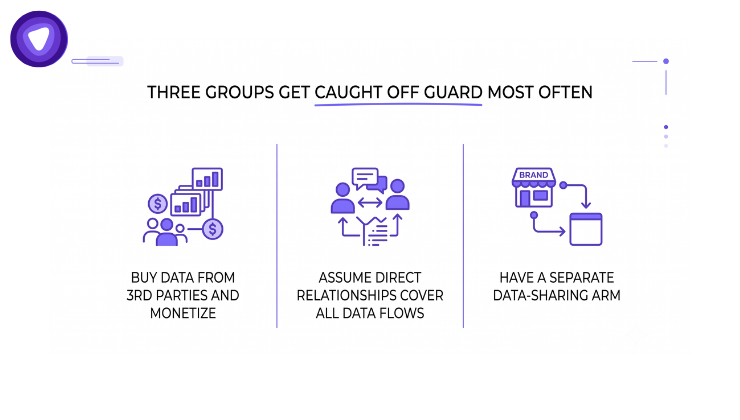
Three groups get caught off guard most often:
- Businesses that buy consumer data from third parties and monetize it.
- Companies that assume a direct customer relationship covers all their data flows.
- Consumer-facing brands that also run a data-sharing arm they treat as separate.
The Operational Reality Behind Delete Act Penalties
Compliance here is a recurring workflow, not a one-time project. Brokers must retrieve DROP requests at least every 45 days, match them against internal records using standardized identifiers, and complete a determination within 90 days.
A procedural detail adds friction most compliance teams miss on first read. Brokers must report the status of every outstanding request from the prior cycle before the platform releases a new batch. Falling behind on reporting blocks access to new requests, and penalties keep accruing on the untouched backlog while that block is in place. Suppression lists add a further obligation. Once data is deleted, the broker must prevent it from being re-collected or resold, or the request reopens as a re-listing. The compounding structure behind Delete Act penalties is exactly what forces this into daily operations instead of an annual audit.
The two systems below solve different problems, and the gap between them is where most unmanaged exposure sits.
| Factor | California DROP | National private removal |
| Coverage | California residents only | Nationwide, including non-CA states |
| Broker reach | 600+ registered CA brokers | 400+ brokers and people-search sites tracked |
| Cost to end user | Free, government-run | Subscription-based |
| Identity verification | Login.gov plus a commercial identity provider | Account-based, partner-controlled |
| Re-listing handling | Broker resubmits manually | Continuous monitoring with automatic resubmission |
The Verification Bottleneck Even the State Didn’t Expect
Identity verification turned out to be the hardest part of DROP to build, according to the state’s own technology team. Roughly 30 percent of consumer verifications route through Login.gov, a federal identity service. The remaining 70 percent go through a commercial identity provider, added specifically because not every resident can use the federal option.
That split matters beyond government infrastructure. Any partner submitting opt-out requests on a user’s behalf needs the same verified-identity layer, or a broker can reject the request as unconfirmed. Verification is not a formality here. It is the gate that decides whether a deletion request gets processed at all.
The Opt-Out Request Lifecycle, In Practice
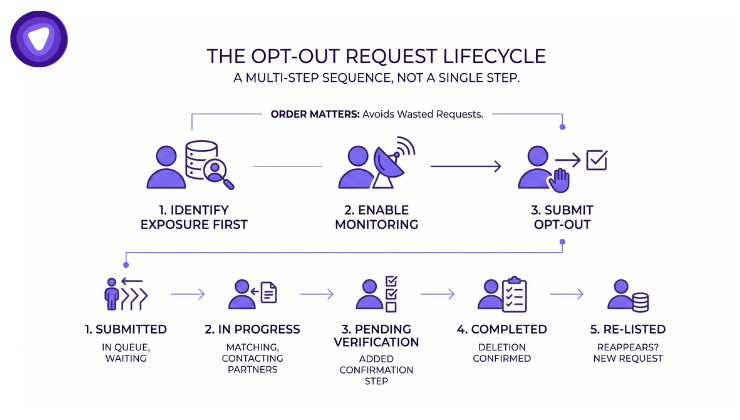
A deletion request does not resolve in one step. It moves through a sequence, and each stage carries its own failure point.
The sequence matters as much as the individual steps. An effective removal workflow checks identity exposure first, to confirm where a person’s data actually surfaced. It enables monitoring second, so new exposures get caught going forward. Opt-out submission comes third, once exposure is confirmed and monitoring is active. Skipping that order wastes opt-out requests on data that may not even be exposed yet.
- Submitted: the request enters a queue and waits for the next retrieval cycle.
- In progress: the broker matches the request against records and contacts downstream processors.
- Pending verification: some brokers require an added confirmation step before finalizing removal.
- Completed: the broker confirms deletion and updates its suppression list.
- Re-listed: if the data reappears from a new source, a fresh request opens automatically.
Monitoring does not mean manual re-checking. A properly built system uses webhook alerts, so a partner’s dashboard updates the moment a monitored asset surfaces on a new site, instead of waiting on the next scheduled scan.
Partner platforms that expose this lifecycle through an account-management API let a business track every stage programmatically instead of polling a portal by hand. That distinction matters once request volume moves from dozens to thousands, which is exactly the range Delete Act penalties now push brokers toward.
Why This Is Becoming a Product, Not Just a Cost
DELETE Act penalties are pushing brokers toward compliance spending they did not budget for. They are also creating a buying signal on the other side of the market. Consumers who watched deletion requests sit unprocessed are actively looking for a service that removes their data before a broker relationship even forms.
Cybersecurity vendors are bundling removal services to compete with consumer suites that already include this category. Managed service providers are adding it as a new line item for small business clients who cannot build compliance infrastructure themselves. Telecom and ISP brands are testing it as a value-added service tied to existing subscriptions.
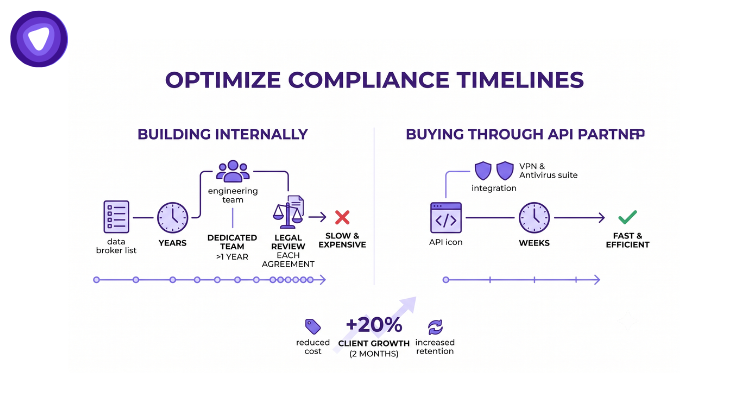
The economics favor bundling over building. Infrastructure that tracks data broker coverage across hundreds of sites, runs continuous monitoring, and handles re-listing automatically takes years to build internally. Replicating broker relationships, matching logic, and suppression-list handling from scratch usually needs a dedicated engineering team for more than a year, before legal review of each broker agreement even starts.
Buying that infrastructure through a partner API compresses the timeline to weeks. One partner integration that layered removal services into an existing antivirus and VPN suite produced 20 percent growth in enterprise clientele within two months, alongside a measurable cut in operational cost and a rise in client retention.
The Exposure DROP Cannot Close
DROP only reaches brokers registered in California. Privacy researchers identified 291 unregistered companies operating in other states without California registration, despite likely qualifying under the law’s own definition.
The platform also serves California residents exclusively. Anyone outside the state has no equivalent centralized deletion mechanism, government-run or otherwise. Deleted data can resurface, too. Suppression lists address re-collection inside DROP’s own ecosystem, but public records such as court filings, voter rolls, and property records stay open to new data collection efforts entirely outside the platform’s reach.
This is the coverage gap driving demand for a national, always-on removal layer that does not wait for a state legislature to catch up.
How PureVPN White Label VPN Solution Fits
PureVPN White Label VPN Solution runs a data privacy protection layer built for exactly this gap. It covers identity exposure checks, real-time dark web monitoring, and data broker opt-out requests across more than 400 broker and people-search sites, all tracked through an account-management API a partner can plug into an existing product without building removal infrastructure from scratch. More than 150 partners worldwide already run on this same infrastructure, so the workflow above is proven at scale, not theoretical.
Partners running this layer see the retention effect directly. Bundled privacy services cut churn by roughly half compared to standalone offerings, and cross-selling data removal to an existing client base drives renewal rates near 78 percent. The infrastructure runs on 17 years of privacy operations, backed by SOC 2 Type II certification and a KPMG-verified no-log policy, which matters when a partner’s own brand is the one making promises to end users.
Final Thoughts
Delete Act penalties will not stay a California story for long. Other states are already discussing centralized deletion platforms modeled on the same enforcement structure. Businesses that treat data removal as a bundled product now, rather than a compliance scramble later, will be the ones setting the terms when the next state passes its own version of this law.