

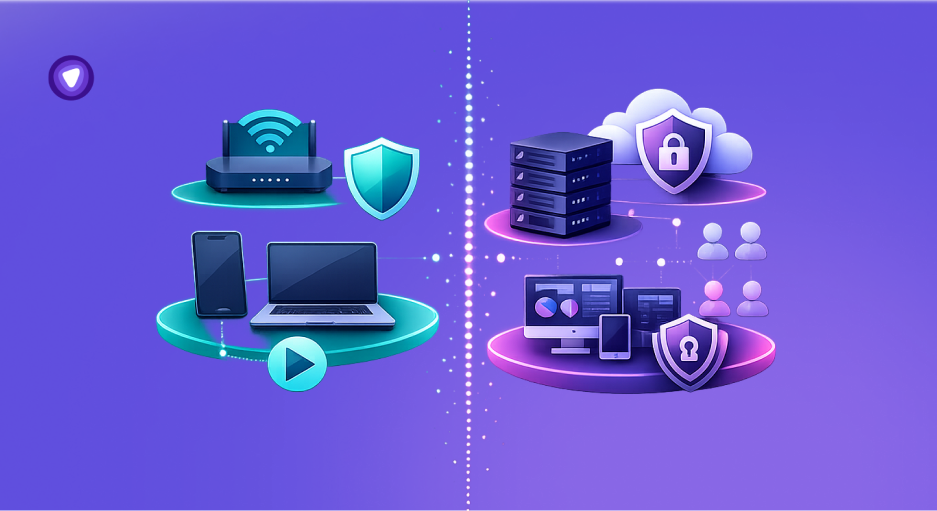
- Enterprise vs Consumer Focus: Enterprise VPNs are built for organizations with centralized control and secure access, while consumer VPNs focus on individual privacy and browsing protection.
- Business Use Case: Enterprises rely on VPNs to securely manage remote employees, contractors, and distributed systems across multiple locations.
- Scalability Gap: Consumer VPNs lack the scalability, visibility, and access governance required for structured business environments.
- Enterprise Features: Enterprise VPNs include Dedicated IPs, MFA, role-based access controls, and centralized administration for stronger security.
- Remote Work Reality: As remote operations expand, enterprise VPNs have become essential for maintaining secure and controlled access to business infrastructure.
Most VPN discussions focus on privacy, streaming access, or hiding an IP address. Businesses deal with a different challenge entirely.
An employee logs in from a hotel Wi-Fi network, a contractor accesses internal systems from another country, and remote teams connect to shared infrastructure throughout the day.
At that point, a VPN becomes operational infrastructure, not just a privacy tool.
Enterprise VPNs and Consumer VPNs Serve Different Purposes
Consumer VPNs are built for personal browsing security and encrypted internet access. Enterprise VPNs are designed for organizations that need centralized control, secure remote access, user management, and scalable connectivity across teams, devices, and systems. The difference is not branding. It is control, visibility, scalability, and access management.
According to a global survey of IT and cybersecurity professionals, remote employee access remains the primary reason organizations use VPNs. As remote work and cloud-based operations continue expanding, businesses increasingly require VPN environments that support stable access and centralized administration.
What Is a Consumer VPN?
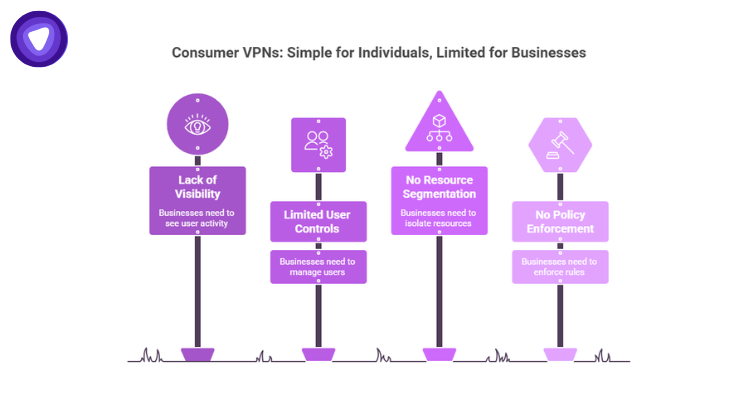
A consumer VPN is designed for individual users. Its main purpose is securing internet traffic between a device and the VPN provider’s server. Most consumer VPN services focus on:
- Encrypting browsing activity
- Hiding public IP addresses
- Securing public Wi-Fi sessions
- Accessing region-restricted content
- Improving personal privacy
The setup is usually simple:
- Install the app
- Select a server
- Connect
That simplicity works well for personal use. It becomes limiting inside a business environment where organizations need visibility, user-level controls, secure resource segmentation, and policy enforcement.
Consumer VPNs prioritize ease of use. Enterprise VPNs prioritize operational control.
What Is an Enterprise VPN?
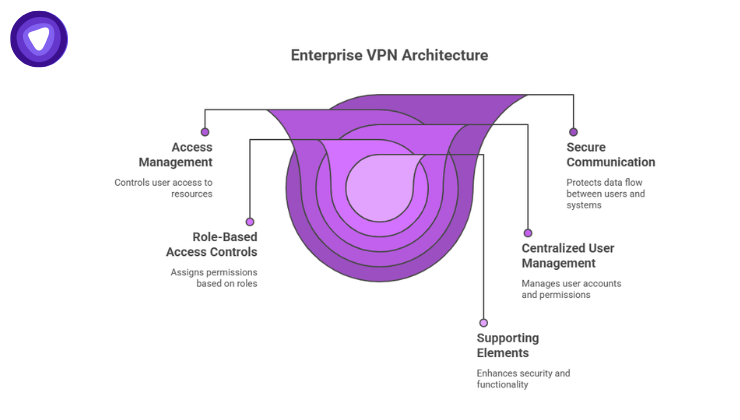
An enterprise VPN is designed for organizational access management. Instead of protecting a single user’s browsing activity, it secures communication between employees, systems, applications, offices, and cloud environments.
Enterprise VPN infrastructure typically includes:
- Centralized user management
- Role-based access controls
- Dedicated IP environments
- Authentication policies
- Device management integrations
- Secure access to internal systems
- Team-level permission controls
- Traffic visibility and logging
Enterprise VPNs also support large-scale deployments where hundreds or thousands of users require simultaneous secure access.
This becomes critical in environments involving:
- Remote employees
- Hybrid teams
- Contractors and third parties
- Cloud applications
- Distributed operations
- Cross-border collaboration
Research found that 96% of organizations still rely on VPNs to secure access to private applications, while 80% specifically use VPNs for remote employee access.
Enterprise VPN vs Consumer VPN: Core Differences
The table below summarizes key differences between enterpriseVPN and consumer VPN.
| Feature | Consumer VPN | Enterprise VPN |
| Primary Use | Personal privacy and browsing security | Organizational access control |
| User Management | Individual accounts | Centralized admin controls |
| Access Policies | Limited | Role-based permissions |
| Infrastructure | Shared public servers | Dedicated or segmented environments |
| Authentication | Username/password | MFA, SSO, identity integrations |
| Visibility | Minimal admin oversight | Logging and monitoring capabilities |
| Scalability | Small user counts | Large distributed teams |
| Compliance Support | Basic | Business-grade governance support |
| Dedicated IPs | Usually optional | Frequently required |
| Network Segmentation | Rare | Standard enterprise requirement |
| Device Control | Minimal | Managed access environments |
| Support Model | Consumer-focused | Business operations support |
1. Security Requirements Are Completely Different
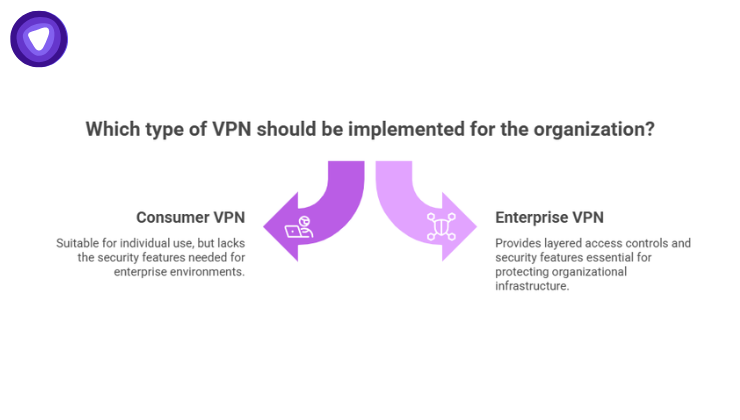
A consumer VPN protects an individual connection. An enterprise VPN protects organizational infrastructure. That changes everything.
Businesses need to manage:
- Employee access rights
- Internal applications
- Sensitive client data
- Shared systems
- Cloud environments
- Authentication workflows
- Vendor access
- Access revocation
A basic VPN connection is not enough.
Enterprise environments require layered access controls that reduce exposure across multiple users and devices. This matters because remote access systems remain a major attack target.
A VPN Risk Report found that 56% of organizations experienced at least one VPN-related cyberattack during the previous year.
Another report found that remote access tools were involved in 58% of ransomware attacks, with self-managed VPNs heavily represented among those incidents.
The challenge is not encryption alone. The challenge is managing access securely at scale.
2. Centralized Management Changes Operations
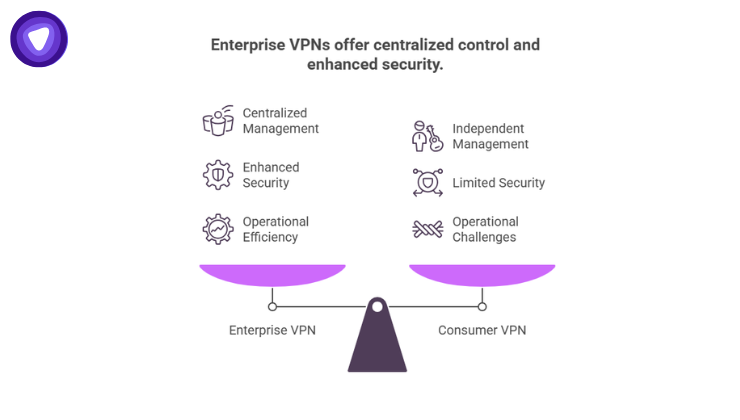
One of the biggest gaps between consumer and enterprise VPNs is administration. Consumer VPNs operate independently. Each user manages their own settings, devices, and credentials.
That model creates operational problems for businesses. Enterprise VPNs solve this through centralized administration.
IT teams can:
- Add or remove users instantly
- Control permissions by department
- Restrict access to internal systems
- Monitor connection activity
- Enforce authentication policies
- Manage team-wide configurations
This reduces both security risks and operational overhead. Without centralized management, organizations often struggle with:
- Shared credentials
- Inconsistent configurations
- Unauthorized access retention
- Lack of visibility
- Unmanaged contractor access
These problems become harder to control as companies scale.
3. Scalability Matters More Than Most Businesses Expect
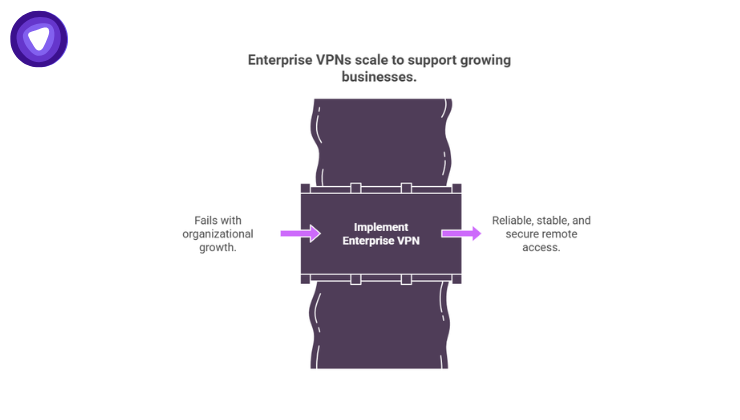
A consumer VPN may work fine for a small team of two or three people. It starts failing operationally when organizations grow. Enterprise environments require infrastructure that can support:
- Large concurrent connections
- Multiple office locations
- Cross-region access
- Cloud integrations
- Dedicated routing environments
- Stable session persistence
Many organizations now depend on three or more VPN gateways to support distributed workforces and remote access demands.
Scaling introduces challenges that consumer VPN platforms were never designed to handle:
- Access segmentation
- Routing consistency
- Authentication orchestration
- Team-level permissions
- Traffic prioritization
- Performance stability
For businesses, VPN performance is not measured by download speed screenshots. It is measured by:
- Session reliability
- Latency consistency
- Uptime stability
- Access continuity
- Reduced connection failures
That operational difference directly impacts employee productivity.
4. Dedicated IP Infrastructure Becomes Important
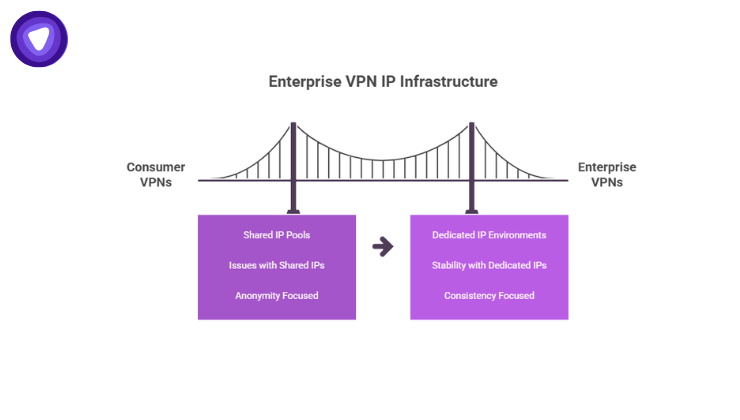
Consumer VPN services usually rely on shared IP pools. Thousands of users may rotate through the same addresses. That works for anonymity. It creates issues for business systems.
Shared IPs often trigger:
- Login verification loops
- Suspicious access flags
- Blocked SaaS logins
- Failed authentication checks
- Security alerts
Enterprise VPNs frequently use Dedicated IP environments to maintain stable identity verification across systems.
This becomes especially important for:
- Financial platforms
- Admin dashboards
- Internal applications
- CRM systems
- Cloud infrastructure
- Whitelisted business environments
Dedicated infrastructure also improves consistency for distributed teams accessing the same internal resources.
5. Enterprise VPNs Support Identity-Based Access
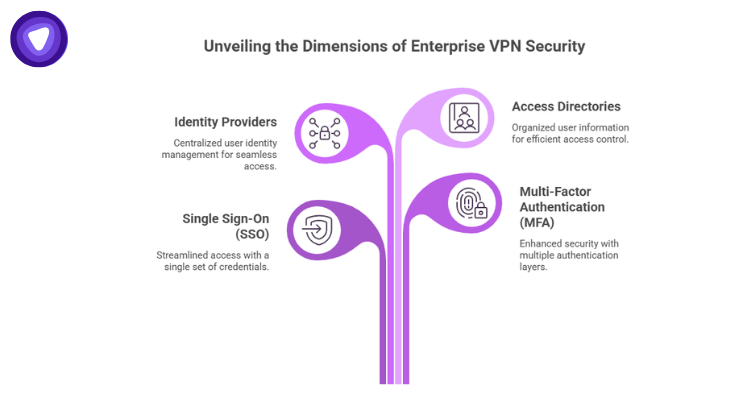
Modern business security depends heavily on identity management. Enterprise VPNs integrate with systems such as:
- Single Sign-On (SSO)
- Multi-Factor Authentication (MFA)
- Identity providers
- Access directories
This allows businesses to enforce security policies based on user identity rather than just device connections.
Consumer VPNs rarely support this level of integration. That limitation creates visibility gaps for organizations trying to manage hundreds of users securely. Identity-based access management helps reduce those risks.
6. Logging, Monitoring, and Visibility
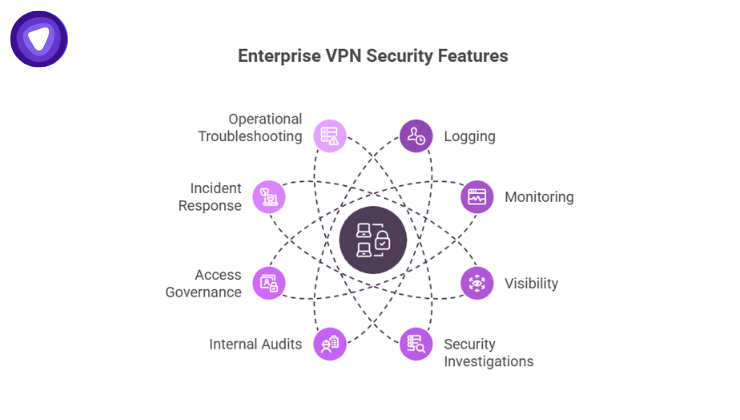
Consumer VPN users often prioritize minimal logging.
Businesses require the opposite.
Organizations need visibility into:
- Login activity
- Access patterns
- Suspicious connections
- Authentication attempts
- Failed access requests
- User session history
This visibility supports:
- Security investigations
- Internal audits
- Access governance
- Incident response
- Operational troubleshooting
Enterprise VPNs provide centralized oversight that consumer platforms are not designed to deliver. That distinction becomes important during security incidents, especially in remote work environments where users connect from multiple locations and devices.
Remote Work Increased Enterprise VPN Complexity
Remote work permanently changed how businesses approach secure connectivity. Employees now connect from home networks, shared coworking spaces, airports, hotels, personal devices, and multiple countries. This shift has significantly expanded the attack surface, introducing more entry points for potential threats.
Security researchers continue to highlight the risks associated with remote work environments, including phishing exposure, insecure home networks, and unmanaged devices.
Enterprise VPNs have evolved to address these conditions through policy-based access, segmented environments, authentication enforcement, device-aware security, and team management controls. Consumer VPNs were not designed to handle this level of operational complexity.
Where Consumer VPNs Still Make Sense
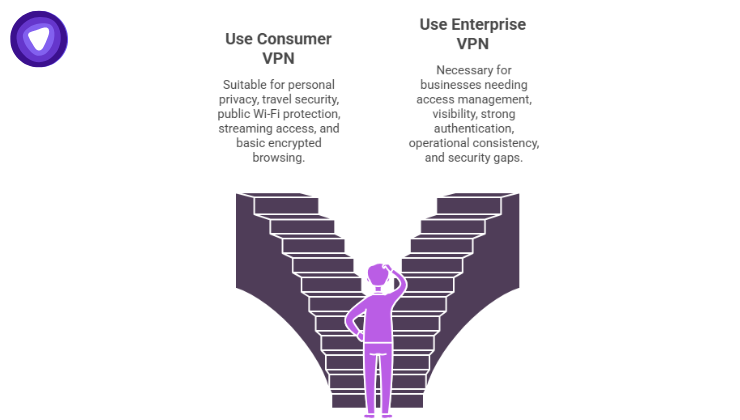
Consumer VPNs still serve legitimate purposes.
They work well for:
- Personal privacy
- Travel security
- Public Wi-Fi protection
- Streaming access
- Basic encrypted browsing
For individuals, freelancers, or very small teams without shared infrastructure, a consumer VPN may be enough. The issue appears when businesses attempt to scale consumer-grade VPN setups into organizational environments.
That usually creates:
- Access management issues
- Visibility limitations
- Authentication weaknesses
- Operational inconsistency
- Security gaps
At that point, the organization is already operating beyond the platform’s intended scope.
Where PureVPN White Label VPN Fits
As businesses expand remote operations, many providers now look for VPN infrastructure they can deploy under their own brand while maintaining centralized control and scalable management capabilities.
PureVPN White Label VPN Solution offers a business-focused approach designed for organizations that need branded VPN services without building infrastructure internally. The platform supports features aligned with enterprise requirements, including user management, Dedicated IP support, scalable deployment environments, and centralized administration. That makes it relevant for MSPs, telecom providers, SaaS companies, hosting providers, and businesses offering secure remote access services to customers or internal teams.
A VPN connection alone no longer solves business security requirements. Organizations now manage distributed teams, cloud environments, third-party access, and remote infrastructure across multiple regions simultaneously. That changes what businesses need from a VPN platform.
Consumer VPNs focus on personal privacy and simple encrypted browsing. Enterprise VPNs focus on access governance, operational control, scalability, and infrastructure security. The gap between those two models continues widening as remote work environments become more complex and organizations demand stronger control over how users connect to critical systems.
Final Thoughts
A consumer VPN can secure an individual connection. An enterprise VPN secures how an organization operates. That difference becomes critical once businesses start managing remote teams, cloud platforms, contractors, and sensitive internal systems across multiple locations.
As organizations scale, VPN infrastructure needs stronger access controls, centralized management, stable connectivity, and visibility into user activity. Consumer-grade solutions are not built for those operational demands. Enterprise VPNs are.
For businesses looking to deliver secure remote access under their own brand, PureVPN White Label provides a scalable framework built for centralized control, Dedicated IP support, and business-grade VPN deployment without the overhead of building infrastructure internally.