


- Data privacy in 2026 is not one law. It is a layered system spanning GDPR, 20 active US state laws, the EU AI Act, and fast-moving frameworks across Asia-Pacific and the Middle East, all enforced simultaneously.
- GDPR fines crossed EUR 6.7 billion since 2018, and enforcement has expanded well beyond Big Tech into mid-market companies, retailers, and SaaS businesses.
- The EU AI Act is now in full force for high-risk systems. Any app using AI for profiling, credit, or recruitment faces mandatory risk assessments, documentation, and fines of up to 7% of global turnover.
- Broken consent flows are the most common enforcement trigger. Regulators in both the EU and US are actively targeting non-functional opt-out buttons, dark pattern UX, and systems that ignore Global Privacy Control signals.
- Non-compliance adds an average of USD 1.22 million to total breach costs. The financial risk goes far beyond the fine itself, covering remediation, legal fees, notifications, and mandatory audits.
Data privacy regulation in 2026 has become one of the most operationally demanding compliance challenges for app builders. Every app that collects a name, an email, or a device ID is now operating inside a web of overlapping legal obligations that grew significantly more demanding this year. This is not a trend. It is the new baseline for building and distributing software globally.
The regulatory environment has shifted from a handful of landmark laws to a dense, multi-jurisdictional system. App builders who treat compliance as a one-time checkbox are already behind. Those who understand the current landscape can build with confidence, enter new markets faster, and avoid the kind of fines that now routinely run into hundreds of millions of euros.
This guide covers what has changed, what is being enforced, and what your development and infrastructure decisions need to account for right now.
The Regulatory Map Has Changed
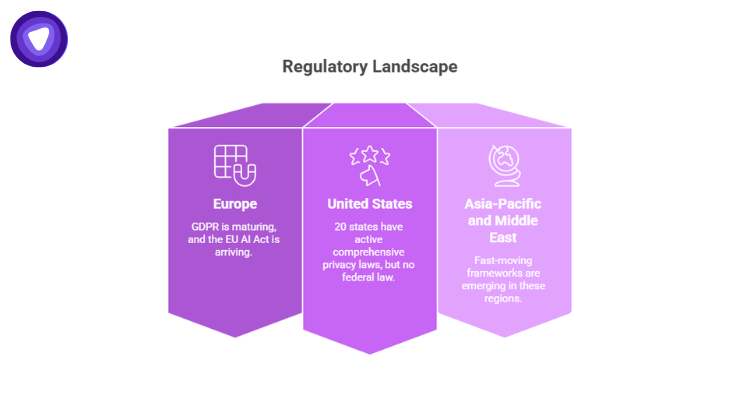
Three years ago, most app teams could manage compliance by covering GDPR and CCPA. That approach no longer works. The data privacy regulation map has expanded significantly, and the obligations differ in ways that matter at the code level. Regional laws now carry enforcement teeth, and regulators across multiple jurisdictions have moved past the warning stage.
Europe: GDPR Matures, EU AI Act Arrives
The GDPR is now in its eighth year of enforcement, and European regulators have moved from laying groundwork to aggressive, targeted action. GDPR fines since 2018 have exceeded EUR 6.7 billion, with 2025 alone accounting for EUR 2.3 billion, a 38% year-over-year increase.
The focus in 2026 has shifted to transparency obligations, consent mechanisms, and third-party vendor oversight. Two developments demand specific attention from app builders:
- The EU AI Act reached full enforcement for high-risk systems in 2026. Apps using AI for decision-making in areas such as credit, recruitment, or user profiling now face mandatory risk assessments, activity logs, and human oversight requirements. Non-compliance carries fines of up to 7% of global annual turnover.
- The Digital Omnibus proposal, introduced in late 2025, aims to simplify certain GDPR obligations for businesses with fewer than 750 employees. It is still moving through the legislative process. Until it passes, existing GDPR obligations remain fully in force.
The EU-UK adequacy decision was renewed in December 2025 and extends through 2031. Both updates reflect how data privacy regulation in Europe is becoming more layered, not less. Data transfers between the EU and UK can continue without additional mechanisms, but the UK’s own Data Use and Access Act is phasing in across 2026 and introduces its own set of updates to UK GDPR.
The United States: 20 States, Zero Federal Law
The US continues to operate without a comprehensive federal privacy statute. What exists instead is a patchwork of state laws that differ in applicability thresholds, consent standards, and sensitive data definitions.
As of January 2026, 20 US states now have active comprehensive privacy laws, including Indiana, Kentucky, and Rhode Island, all of which took effect on January 1, 2026. Three more state laws add obligations through the remainder of the year.
Key requirements that affect app architecture and UX:
- Most state laws grant consumers rights to access, correct, delete, and opt out of data sales or targeted advertising.
- Oregon prohibits the sale of precise geolocation data within a 1,750-foot radius of a user’s location.
- Connecticut expanded its sensitive data categories to include neural data, financial information, and government-issued IDs, with new transparency obligations for mobile apps and AR/VR.
- California now requires annual cybersecurity audits for companies earning over 50% of revenue from selling or sharing personal data.
- Eight states mandate Global Privacy Control (GPC) signal recognition, meaning your app must honor opt-out preferences signaled at the browser or device level.
State attorneys general remain the primary enforcement authorities. Compliance requires state-by-state analysis. A single blanket approach to data privacy regulation does not hold.
Asia-Pacific and the Middle East: Fast-Moving Frameworks
India’s Digital Personal Data Protection Act entered enforcement in 2025 and applies to any app processing personal data of Indian residents, regardless of where the business is incorporated. Australia is mid-reform, with tighter rules on children’s privacy, mandatory impact assessments, and shortened breach notification timelines.
The UAE’s Personal Data Protection Law applies at the federal level. The Dubai International Financial Centre operates its own closely aligned GDPR-style regime with strict cross-border transfer controls. Saudi Arabia requires prior regulatory approval before data leaves the country.
For any app with a user base extending into these regions, local compliance is no longer optional.
What App Builders Are Actually Liable For
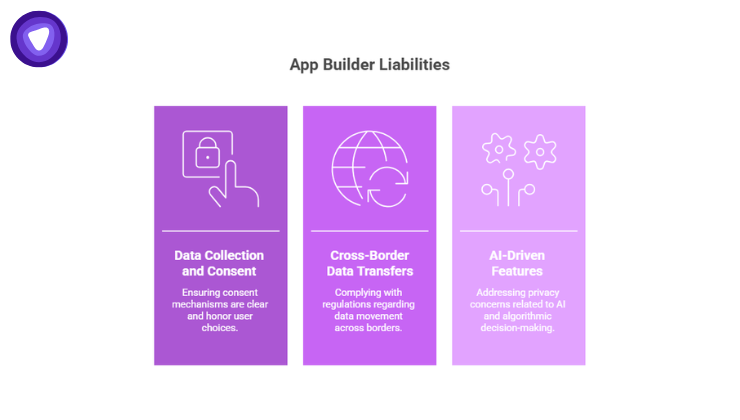
Understanding that laws exist is different from understanding what triggers enforcement. The obligations that consistently generate regulatory action fall into three operational areas.
Data Collection and Consent
The most common compliance failure is not malicious. It is a consent mechanism that does not function as it should. Regulators in both the EU and the US have specifically targeted broken opt-out buttons, dark pattern consent UX, and systems that collect consent but fail to honor it downstream in data processing.
App builders need to account for:
- Consent flows that meet GDPR’s “freely given, specific, informed, and unambiguous” standard
- One-click reject options that carry equal visual prominence to accept buttons
- Global Privacy Control signal processing implemented at the technical level
- No pre-ticked boxes, no bundled consent across unrelated processing purposes
- An auditable record of when and how consent was obtained
Cross-Border Data Transfers
Where user data physically resides and travels is a compliance variable, not just an infrastructure decision. The US Department of Justice bulk data rule, effective April 2025, prohibits sharing sensitive American personal data with countries classified as high-risk. Saudi Arabia requires prior regulatory approval before transferring data across borders.
For GDPR-covered transfers, Standard Contractual Clauses remain the primary legal mechanism. Apps also need Transfer Impact Assessments to verify that SCCs provide adequate protection given the data protection environment in the destination country.
If your app relies on third-party SDKs, analytics platforms, or cloud services that route data internationally, each of those vendors introduces a compliance obligation. Regulators now hold data controllers liable for processor failures. Vendor oversight is part of your liability surface.
AI-Driven Features and Algorithmic Accountability
The intersection of AI and privacy is a regulatory priority in multiple jurisdictions simultaneously. Colorado’s AI Act, Texas’s Responsible AI Governance Act, and California’s AI Transparency requirements all took effect in 2026. Combined with the EU AI Act, they create overlapping obligations for any app that uses automated decision-making or profiling.
The common thread across these frameworks is transparency. Users must be informed when automated systems make decisions about them. High-risk systems must be documented. Bias and discrimination risks require formal assessment.
The Cost of Getting It Wrong
Enforcement is not hypothetical. The table below reflects actual regulatory action and illustrates the financial stakes at each level of the market.
| Company | Violation | Regulator | Fine |
| TikTok | Illegal data transfers to China | EU (GDPR) | EUR 530 million |
| Meta | Consent manipulation | EU (GDPR) | EUR 479 million |
| Vodafone | Vendor security failures | EU (GDPR) | EUR 45 million |
| Tractor Supply Co. | Non-functioning “Do Not Sell” button | CCPA (California) | USD 1.35 million |
| American Honda | Malfunctioning opt-out mechanism | CCPA (California) | USD 632,500 |
Beyond direct fines, non-compliance adds USD 1.22 million on average to total breach costs through remediation, mandatory notifications, legal fees, and mandated security improvements. For smaller development teams and SaaS builders, even a mid-range CCPA penalty can be financially severe.
Spain alone has issued 1,033 actions to date, with the majority targeting mid-market companies rather than large tech platforms. GDPR enforcement is not a Big Tech issue.
Key Compliance Requirements for App Builders in 2026
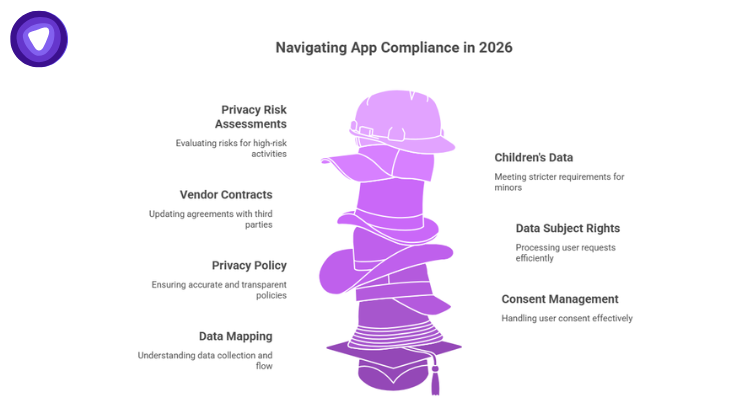
Getting compliant with data privacy regulations across multiple jurisdictions is operationally complex. It is also achievable when broken into clear priorities.
Data Mapping Know exactly what personal data your app collects, where it goes, how long it is retained, and which vendors touch it. This is a prerequisite for almost every other compliance action and a requirement under several state laws for data protection impact assessments.
Consent Management Implement a consent management platform capable of serving jurisdiction-specific flows, honoring GPC signals at a technical level, and maintaining an auditable record of user consent by time and context.
Privacy Policy and Transparency Policies must accurately reflect current data practices. Multiple state laws require explicit disclosure of data sales, third-party sharing arrangements, and automated decision-making. Vague or outdated policies are themselves an enforcement target.
Data Subject Rights Workflows Build request-handling processes for access, correction, deletion, and opt-out. Most US state frameworks require a verified response within 45 days, with a 45-day extension available in limited cases.
Vendor Contract Updates Update data processing agreements with all third-party vendors to include AI governance clauses, breach notification timelines, audit rights, and restrictions on sub-processing.
Children’s Data If your app can be accessed by users under 16, consent requirements are significantly stricter across California, Oregon, Connecticut, and multiple international jurisdictions. Age assurance mechanisms are increasingly required rather than recommended.
Privacy Risk Assessments Required under California’s CPRA, most US state frameworks, and GDPR for high-risk processing activities. This includes AI-driven features, profiling, sensitive data handling, and data sales.
Where PureVPN White Label Fits In
For SaaS companies, telecom operators, and app developers building for global markets, compliance obligations do not stop at the application layer. Network-level privacy, encrypted tunneling, and IP masking are technical controls that feed directly into data privacy regulation posture. Several data protection frameworks now expect organizations to demonstrate not just documented policies but active, verifiable technical safeguards.
PureVPN’s white label VPN solution gives development teams a ready-to-deploy, branded privacy infrastructure without building the underlying network from scratch. That matters when regulators ask for evidence of technical controls, not just paperwork.
The white label model also supports the go-to-market reality that compliance teams increasingly face: different jurisdictions require different configurations and regional server coverage.
PureVPN’s infrastructure spans the deployment flexibility and protocol depth that app builders need to serve regulated markets, keep user data within required geographic boundaries, and satisfy data minimization and transfer restriction obligations. It is a practical compliance tool that sits at the infrastructure layer, where many regulatory requirements actually apply.
The Bottom Line
Data privacy regulation in 2026 is precise, actively enforced, and still expanding. App builders can no longer treat compliance as a legal department concern handled separately from product development. It is a technical requirement, a vendor selection criterion, and a market access dependency.
The jurisdictions that matter to your users are already watching how your app collects, processes, and transfers personal data. Building with that reality embedded into your architecture, your vendor stack, and your consent flows is not compliance overhead. It is the condition for operating in markets that matter.