

- White label dark web monitoring scans forums, marketplaces, paste sites, leak sites, and Telegram channels, not just one source, to catch stolen credentials and data early.
- Speed is the core value: breached credentials often surface on dark web forums within 48 hours, so continuous scanning beats weekly or daily batch checks.
- Alerts only work if they are clear and specific, naming what was exposed and what action to take, rather than vague warnings that customers ignore.
- This feature converts well because it answers a fear customers already have, delivers a fast first result, and requires no technical setup on their end.
- Resellers can skip building scanning infrastructure from scratch, since PureVPN’s white label VPN solution already includes dark web monitoring as a ready, brandable component.
A password sold on a criminal forum today can unlock a customer account tomorrow. That gap, sometimes hours, sometimes months, is where most account takeovers start. For any reseller building a security portfolio, white label dark web monitoring closes that gap before a stolen credential turns into a support ticket, a chargeback, or a churned client.
This piece breaks down what the technology actually finds, how alerts move from raw data to a usable notification, and why this single feature tends to convert trial users into paying subscribers faster than almost any other add-on.
What White Label Dark Web Monitoring Actually Scans
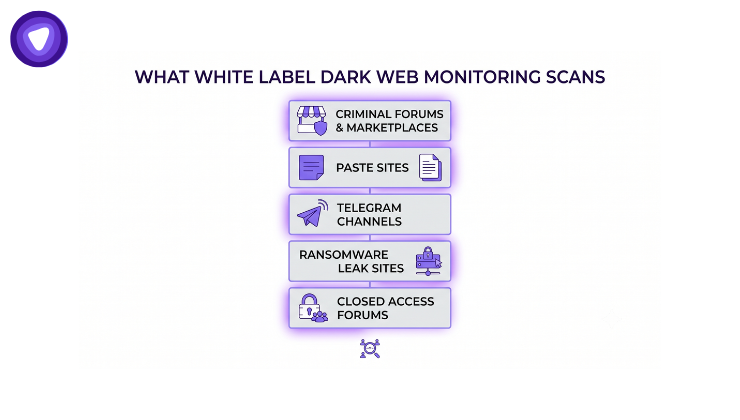
White label dark web monitoring is not a single scanner pointed at one site. It pulls from several overlapping sources at once.
- Criminal forums and marketplaces where credentials are traded in bulk
- Paste sites where hackers dump partial breach data for proof or bragging rights
- Telegram channels used to sell stealer logs and access tokens
- Ransomware leak sites where stolen company data gets published after a refused ransom
- Closed access forums that require vetting or invitation
Coverage across these sources matters because criminals rarely use one channel exclusively. A credential set might surface on a paste site first, then get repackaged and sold privately weeks later. A monitoring service that only checks public forums misses that second, more dangerous sale.
Credential and Login Data
Usernames, passwords, and password hashes make up the bulk of what circulates. Leaked credentials accounted for 22 percent of breaches in 2024, and the volume in circulation rose sharply through 2025. That single category of exposure remains the fastest and cheapest way for an attacker to get inside an account.
Financial and Personal Records
Card numbers, bank account details, and government ID numbers also trade hands on these networks. This data feeds identity theft and fraud long after the original breach is forgotten by the company that suffered it.
Corporate and Domain Mentions
Beyond individual accounts, monitoring tools track mentions of a company’s domain, executive names, and internal system references. This catches cases where an employee’s work email shows up in a breach dump unrelated to the employer, a signal that often gets missed until it is too late.
How the Alert Pipeline Actually Works
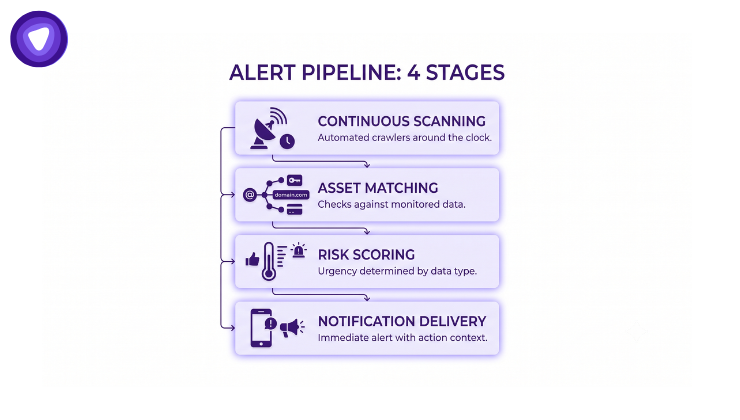
Finding stolen data is only half the job. White label dark web monitoring earns its value in how fast and how clearly it turns a raw match into something a customer can act on.
The pipeline generally runs in four stages.
- Continuous scanning. Automated crawlers and API feeds pull new listings around the clock rather than on a fixed schedule.
- Matching against monitored assets. Each new data point gets checked against the customer’s registered emails, domains, or card ranges.
- Risk scoring. Not every mention carries the same urgency. A financial record with a live card number ranks higher than an old, already changed password.
- Notification delivery. The customer receives an alert through email, dashboard, or app push, with enough context to act immediately.
Speed defines the value of this pipeline. Research shows that breached credentials tend to surface on dark web forums within 48 hours of the original compromise. A monitoring system that checks weekly instead of continuously misses the window when action still matters.
Why Real Time Detection Beats Periodic Scans
Older monitoring tools ran batch scans once a day or once a week. That model fails against how fast stolen data now moves. Real time scanning treats exposure like a live event, not a report to review later. This is the core operational difference behind modern white label dark web monitoring platforms compared to the static breach checkers of a few years ago.
Alert Clarity Matters as Much as Alert Speed
An alert that says “your data was found” without context creates confusion, not action. Strong alerts specify what was exposed, where it appeared, and what the customer should do next, such as resetting a password or freezing a card. Clear, specific alerts drive higher response rates than vague warnings.
Why It Converts: The Business Case for Resellers
Security features sell differently than most software add-ons. Customers do not buy dark web monitoring because it sounds impressive. They buy it because it answers a fear they already have: has my information already leaked without my knowledge.
That fear is grounded in real numbers. The average cost of a data breach reached $4.88 million in 2024, a figure that keeps security spending high across every business size. At the individual level, the exposure feels personal rather than abstract, which is exactly why this feature converts so well at checkout.
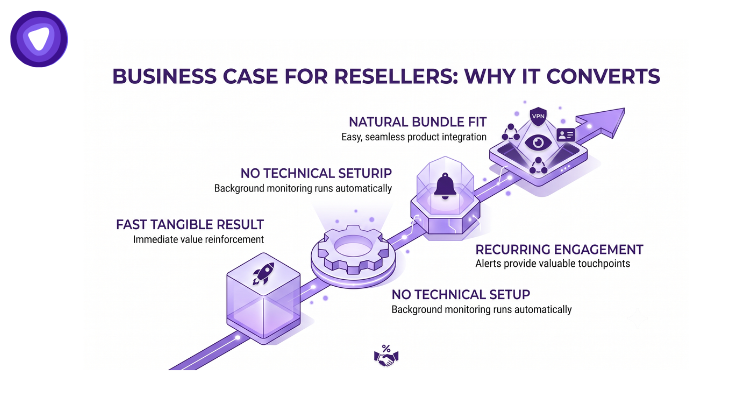
A few reasons this add-on outperforms other security upsells:
- It delivers a tangible result fast. A new customer often gets their first alert within days of signing up, reinforcing the value of the purchase immediately.
- It requires no technical setup from the customer. Unlike a VPN configuration or firewall rule, monitoring runs entirely in the background.
- It creates recurring engagement. Each alert is a touchpoint that reminds the customer why they are paying for the service.
- It fits naturally into a bundle. Resellers can package white label dark web monitoring alongside VPN and identity protection without asking customers to learn a new product.
Building the Business Case: Reactive Security vs Continuous Monitoring
The table below compares the old reactive model against a continuous monitoring approach, the model most white label dark web monitoring platforms now run on.
| Factor | Reactive Security Model | Continuous Monitoring Model |
| Detection timing | After a breach is publicly reported | Within hours of data appearing on dark web sources |
| Customer awareness | Learns from news or third party notice | Learns directly from the provider |
| Data sources checked | Limited to known breach databases | Forums, marketplaces, paste sites, leak sites, Telegram channels |
| Action window | Often weeks after exposure | Same day in most cases |
| Perceived value to customer | Passive, one time compliance check | Active, ongoing protection |
This comparison is not theoretical. The dark web monitoring market was valued at $1.2 billion in 2025 and is projected to grow at a compound annual rate of 14.6 percent through 2034. That growth reflects a shift in expectation. Customers no longer see this as optional. They expect it bundled into any serious digital protection package.
What Makes a Client Actually Trust the Alert
Detection and delivery only work if the customer trusts what they are seeing. A few design choices separate monitoring tools that build trust from those that get ignored after the first week.
Alerts need plain language, not security jargon. A message about a “credential exposure event” means less to most users than one that says a specific email and password combination appeared in a breach. Specificity builds credibility.
Dashboards also matter. A customer who logs in and sees a running history of scans, even when nothing was found, trusts the service more than one that stays silent between alerts. Silence reads as inactivity, not safety.
Finally, the follow up action has to be simple. A monitoring alert paired with a one click password reset link or a direct link to freeze a card turns a warning into a resolved problem within minutes.
Where PureVPN Fits Into This Picture
For resellers building out a privacy and security portfolio, adding this capability from scratch means building scanning infrastructure, data source access, and alert logic independently. PureVPN’s white label VPN solution includes dark web monitoring as a ready component, built on the same infrastructure trusted by millions of existing VPN users worldwide.
Partners get a branded, fully working monitoring layer without managing the underlying data feeds or alert engineering themselves. That means a reseller can launch white label dark web monitoring under their own name within days rather than months, while customers get the continuous scanning and clear alerts this article has covered.
Final Thoughts
The exposure problem is not slowing down. Every year brings more stolen credentials, more leak sites, and more customers asking whether their information is already out there. A monitoring service that answers that question quickly, clearly, and without technical friction earns its place in any security lineup, and keeps earning it every time it sends an alert that actually helps.