

- Architecture, not endpoint: A dark web monitoring API is a system, not a single endpoint. It combines token based auth, a data pipeline, and a delivery mechanism, so treat it as an architecture decision, not a checkbox.
- Coverage tiers: Coverage comes in tiers. Base dark web sources catch stolen passwords, but infostealer coverage is what catches stolen session tokens, which can bypass MFA entirely.
- Webhook reliability: Webhooks beat polling for real time alerts, but only if you handle retries, backoff, and signature verification correctly. Skipping this creates silent delivery gaps in production.
- Remediation lifecycle: Remediation is a lifecycle, not a single call. Opt-out requests can move to a re-listed state after completion, and integrations need to track that, not just the initial success response.
- Compliance impact: Compliance details like data retention windows, PII masking, and data processing agreements directly affect your product’s liability once user data starts flowing through the API.
Most dark web monitoring API integrations do not fail during vendor evaluation. They fail during the auth flow or the webhook implementation, months after the contract is signed. Sales decks rarely cover token scoping, event delivery guarantees, or what happens when a monitored record gets reprocessed. Those details decide whether alerts reach production in time to matter.
This piece skips the marketing layer and looks at the actual architecture. It covers authentication, endpoint design, coverage tiers, event delivery, and the remediation lifecycle a serious implementation needs to handle correctly.
Why a Dark Web Monitoring API Is an Architecture Problem, Not a Feature List
A dark web monitoring API is not one endpoint. It is a small system built from an auth layer and a data ingestion pipeline running behind the scenes. One or more delivery mechanisms sit on top of that pipeline. Those mechanisms push findings to your application as they get confirmed. Treating this as a single call that returns a boolean exposure flag leads to brittle integrations. Those integrations tend to break under real production load.
Two request patterns exist inside almost every provider’s API surface, and they solve different problems.
Point-in-Time Exposure Checks
An identity exposure endpoint accepts an identifier, typically an email, phone number, or username. It returns a consolidated report of where that identifier appeared in known breach data. This is a synchronous call. You send a request, you get a response, and the transaction ends there.
Continuous Monitoring Registrations
Registering an asset for ongoing monitoring is a different operation entirely. Instead of returning data immediately, the API stores the asset and watches for new matches over time. Results arrive later, often through a webhook, sometimes minutes or days after registration.
A Simplified Request and Response Cycle
A typical exposure check follows a predictable shape. Your backend sends an authenticated POST request with an identifier in the body. The response returns a status code, a list of matched sources, and a timestamp for each match. Nothing here is exotic, but small details still trip up new integrations.
- Always check the HTTP status code before parsing the body. Rate limited or malformed requests can still return a 200 with an error payload on some providers.
- Store the raw response alongside your parsed fields. Providers occasionally add new fields, and strict parsing can silently drop useful data.
- Log the request identifier the provider assigns, not just your own internal user ID. This makes support tickets faster to resolve when something looks wrong.
Monitoring registrations follow a similar request shape, but the response only confirms that the asset was accepted. The actual findings arrive later through whichever delivery channel you configured.
Authentication and Token Scope for Dark Web Monitoring API
Most production grade APIs in this category use a two step credential model. A partner account holds a secret key, which never travels with client requests directly. That key gets exchanged for a short lived access token through a dedicated auth endpoint. The token is what authorizes each subsequent call.
This separation matters for a specific reason. If a token leaks from a compromised client, it expires on its own schedule and carries limited scope. A leaked secret key, by contrast, can mint new tokens indefinitely. Confirm during evaluation that the secret key never leaves a secured backend. Transport should stay encrypted end to end over SSL or TLS at every step. Make no exceptions for internal test environments.
Coverage Tiers and What Each One Actually Adds
Not every dark web monitoring API covers the same sources. Providers increasingly split coverage into tiers rather than offering one flat feature set. Understanding what each tier adds prevents both underpaying for insufficient coverage and overpaying for sources you do not need.
| Tier | Sources Covered | Best Fit |
| Base dark web monitoring | Forums, marketplaces, paste sites, breach compilations | General credential exposure alerts for consumer apps |
| Dark web plus infostealer monitoring | Adds session tokens and credentials pulled from infostealer logs | Products handling authenticated sessions or SaaS logins |
| Full coverage: dark web, infostealer, surface web, and leakage sources | Adds surface web mentions, misconfigured storage, and additional leak channels | Enterprise or agency tools needing broad brand and identity coverage |
Session tokens deserve extra attention during evaluation. A stolen session token can bypass multi factor authentication completely. The attacker resumes an already authenticated session rather than logging in from scratch. Any provider that stops at password pairs is leaving a meaningful gap uncovered.
Event Delivery: Webhooks, Polling, and Dashboards
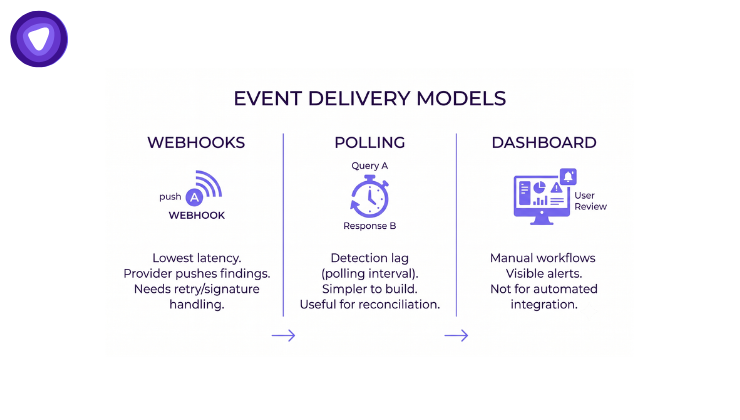
Once an asset is registered, new findings need a delivery path. Three models exist, and most providers support more than one.
- Webhooks: the provider pushes a payload to your endpoint the moment a new match is confirmed. Lowest latency, but requires you to handle retries and signature verification correctly.
- Polling endpoints: your system queries a status endpoint on a schedule. Simpler to build, but it introduces detection lag equal to your polling interval.
- Dashboard and partner console alerts: useful for human review workflows. Not suitable as the sole integration point for an automated product.
For anything resembling real time protection, webhook delivery should be the default path. Polling belongs in reserve for reconciliation only.
Webhook Reliability: Retries and Signature Verification
Webhook payloads fail to deliver more often than most developers expect. A deploy window, a transient network error, or a slow endpoint timeout are common causes. A provider worth trusting will retry failed deliveries on a backoff schedule rather than dropping the event after one attempt.
Before going live, confirm the following behavior with the provider directly.
- How many retry attempts occur, and over what total time window, before a failed delivery is abandoned.
- Whether a signed header, typically an HMAC signature, is included. This lets you verify the payload actually came from the provider and was not tampered with in transit.
- Whether replayed or duplicate deliveries are possible. If so, your handler needs to be idempotent, not assume each webhook call is unique.
Skipping signature verification is a common shortcut during early development. It quietly becomes a security gap once the integration reaches production traffic.
Rate Limits, Pagination, and Sandbox Access
A dark web monitoring API that works fine in a demo can still fail under real traffic. Operational limits often go unchecked until then. This section is easy to skip during evaluation and expensive to discover later.
- Rate limits: confirm limits per token, not just per account, since a shared account can throttle multiple services unexpectedly.
- Pagination: exposure reports for widely breached identifiers can return large result sets. Cursor based pagination handles this better than offset based pagination at scale.
- Sandbox environment: a test tier with seeded sample data lets you validate parsing logic and webhook handling. Do this before production traffic touches the integration.
- SDK support: official client libraries reduce the chance of malformed auth headers or incorrect retry logic in a custom implementation.
Skipping sandbox testing is a common reason a dark web monitoring API integration passes code review. It still misbehaves once real production traffic starts. Bugs in webhook signature validation rarely surface until real payloads start arriving.
A Testing Strategy That Actually Catches Problems
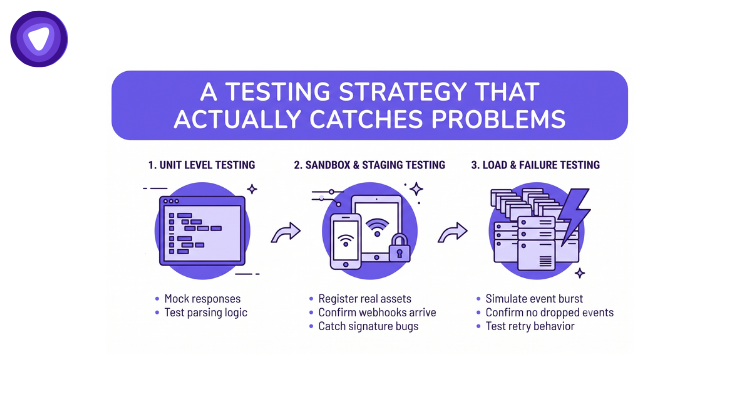
Most teams test the exposure check endpoint thoroughly. They barely touch the monitoring and webhook path, since it returns nothing during a quick manual test. That gap is exactly where production incidents come from.
Unit Level Testing
Mock the provider’s response shapes, including error codes and empty result sets. This exercises your parsing logic without depending on live network calls.
Sandbox and Staging Testing
Use the provider’s sandbox tier to register real test assets. Confirm webhook payloads actually arrive at a staging endpoint. This is the most reliable way to catch signature verification bugs before launch.
Load and Failure Testing
Simulate a burst of webhook deliveries to confirm your handler processes them without dropping events under load. Also test what happens when your own endpoint goes briefly unavailable, since that is when retry behavior actually gets used.
Designing Around the Remediation Lifecycle
Exposure detection is only half the workflow. Many providers now bundle a remediation service, most commonly a data broker opt-out flow. This introduces a state machine your integration needs to respect, not a single fire and forget call.
A typical opt-out request moves through several distinct states.
- Submitted: the request is queued.
- In progress: the provider is actively contacting the data broker.
- Pending verification: the broker requires a confirmation step before removal proceeds.
- Completed: the broker has confirmed removal.
- Re-listed: the data reappeared, and a new request gets submitted automatically.
The re-listed state is the one developers most often build around incorrectly. Treating completion as a permanent end state means your product will silently miss reappearing data. Track the full lifecycle, not just the completed event.
Data Handling and Compliance Requirements
Passing personal identifiers through any third party service creates compliance obligations regardless of how the data gets used downstream.
- Confirm data retention windows for both raw exposure records and submitted user identifiers
- Check whether PII can be masked or hashed before storage on your side
- Verify regional compliance support, particularly for GDPR and similar regional frameworks
- Review whether the provider logs your API traffic, and for how long
- Ask whether the provider has a documented data processing agreement available for review before contract signing
- Confirm whether monitored identifiers can be deleted on request, and how quickly that deletion propagates
Data processing agreements matter more than they get credit for during evaluation. If a provider cannot produce one quickly, that is a signal worth taking seriously. It is not a detail to defer until legal review.
These are not abstract legal concerns. The global average cost of a data breach reached 4.44 million dollars in 2025. Organizations still needed a mean of 241 days to identify and contain an incident. Weak data handling upstream extends that exposure window further.
Common Integration Mistakes: Dark Web Monitoring API
These issues surface repeatedly in real implementations, usually after launch rather than during testing.
- Treating a monitoring registration endpoint like a synchronous search call, then wondering why no data returns immediately
- Ignoring webhook retry behavior, which causes silent gaps when a delivery attempt fails
- Hardcoding a completed opt-out status instead of tracking the full state machine, including re-listed events
- Storing the secret key in client side code instead of a secured backend
- Assuming broader source coverage always outweighs event delivery speed
Third party exposure compounds these risks further. Recent breach research found that third party involvement in breaches doubled year over year. It reached 30 percent of all cases studied. A dark web monitoring API scoped only to first party domains will miss a growing share of that risk.
Choosing an API Built for This Architecture
Developers building identity protection or privacy tooling need more than a single exposure check endpoint. They need token based auth with proper scoping. They need tiered coverage that scales from basic credential checks to infostealer and surface web data. They also need webhook delivery for real time alerts, plus a documented remediation lifecycle rather than a single opt-out call.
PureVPN’s white label platform structures its Data Privacy Protection API around exactly this model. Authentication moves from a secret key to a scoped access token. An Identity Exposure Intelligence endpoint handles point-in-time checks. Real-Time Dark Web Monitoring covers continuous registration and alerts. A tracked Data Broker Opt-Out service manages its own lifecycle states. For teams building on a white label VPN backend, this removes the need to design that architecture from scratch.
Final Thoughts
Evaluating a dark web monitoring API on architecture, not just source count, matters more than most teams assume. It separates integrations that hold up under production traffic from ones that quietly fail months after launch. Token scoping, delivery guarantees, and lifecycle handling are not implementation details to defer. They are the product.