

- Market Growth: Privacy as a service is valued near 4.76 billion dollars in 2026 and heading toward 14.86 billion by 2035.
- Pricing Models: Resellers can charge per seat, per feature, or by opt-out request volume, keeping the spread between wholesale and retail cost.
- Recurring Revenue: Brokers re-list removed data on their own schedule, which is why webhook delivery speed matters more than the initial scan.
- Vertical Divergence: Telecom operators add this as a margin line while ARPU flattens, while fintech buyers add it to close a compliance documentation gap.
- Renewal Ownership: A white label resale model keeps pricing and renewal control in-house, unlike building or licensing the capability.
A two-dollar line item can survive a pricing committee meeting that kills every other proposal in the room. That is happening right now inside telecom pricing teams, MSP leadership meetings, and fintech product reviews. Identity protection has quietly become the rare add-on nobody argues about. A privacy platform for businesses is the infrastructure making that possible.
A privacy platform for businesses packages identity exposure checks, dark web monitoring, and broker opt-out into one API. A company can resell that API under its own brand. This is not a pitch for adding a VPN icon to a pricing page. It is about what happens on the back end once a company decides to sell identity protection as a service. It covers where that decision pays off, and where it does not.
Why Privacy Turned Into a Line Item Instead of a Feature
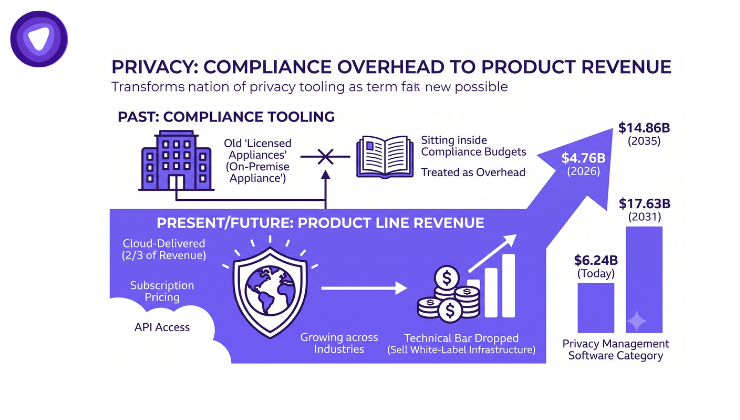
Privacy tooling used to sit inside compliance budgets. It was treated as overhead, not product. That framing is breaking down fast, and the numbers explain why.
- The privacy as a service segment is valued near 4.76 billion dollars in 2026, headed toward 14.86 billion by 2035.
- The broader privacy management software category is climbing from roughly 6.24 billion dollars this year toward 17.63 billion by 2031.
- Cloud delivery already accounts for two-thirds of that revenue, expanding faster than on-premise deployment ever did.
- Buyers already expect subscription pricing and API access. They do not want a licensed appliance someone has to install.
That detail matters for anyone weighing a privacy platform for businesses as a new product line. Demand for the underlying capability is growing across industries at once. Meanwhile the technical bar for offering it has dropped, since anyone can sell someone else’s infrastructure under their own brand.
How Pricing Actually Works for a Privacy Platform for Businesses
Generic privacy content skips the question every finance team asks first. How does a reseller price something it does not build.
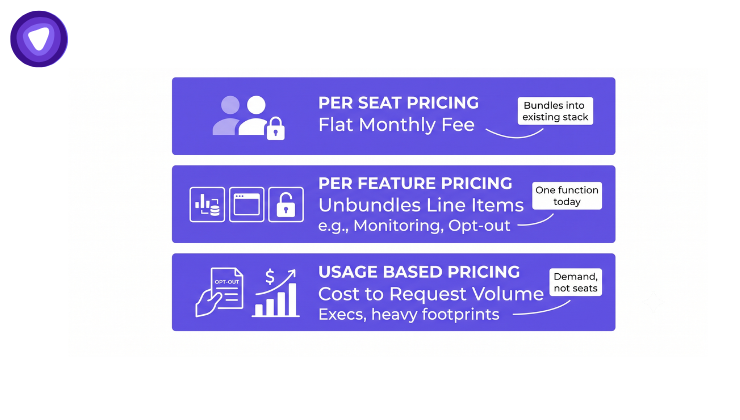
- Per seat pricing charges a flat monthly fee per protected user. This works cleanly for MSPs bundling privacy into an existing seat-based stack.
- Per feature pricing unbundles exposure checks, dark web monitoring, and broker opt-out into separate line items. This suits buyers who want one function today.
- Usage based pricing ties cost to opt-out request volume. This fits businesses whose users carry heavy public data footprints, such as executives.
None of these models require the reseller to contact a data broker directly. The partner sets retail pricing and keeps the spread between wholesale and retail cost. It never staffs a team to negotiate removals with individual broker sites. That is where most build versus buy conversations end, once someone prices out what an in-house removal team actually costs.
The math is simple once wholesale cost is known. Direct-to-consumer removal services typically charge 15 to 20 dollars a month on their own. A reseller bundling the same protection into an existing plan rarely charges that much on top.
The base product already carries most of the value. A partner reselling at a five-dollar markup per seat across 2,000 users clears 10,000 dollars a month in gross margin. Removal processing runs on the vendor’s side, so that margin arrives before support costs. Scale that across an existing customer base instead of a new one. The acquisition cost most revenue lines carry disappears entirely.
What Happens After a Removal Is Not the End of the Story
This is what separates a one-time service from a recurring privacy platform for businesses. A broker opt-out request does not close the file once it succeeds. Records get re-listed on the broker’s own schedule, which is why a scan-and-forget tool underdelivers on renewal.
The detail that actually decides the subscription’s value is delivery, not detection. A partner receiving removal status through webhooks gets near real time updates. That update lands the moment a broker confirms a removal or a record reappears. A partner relying on manual status polling introduces delay and extra API load instead. That gap shows up directly in how fast a partner can alert its own end users. For any business marketing this as protection rather than cleanup, delivery speed on re-listed records is the actual product. The scan itself is not.
Where the Telecom and Fintech Math Diverges
Not every industry adopts this at the same pace, or for the same reason. Generic privacy write-ups rarely separate the two.
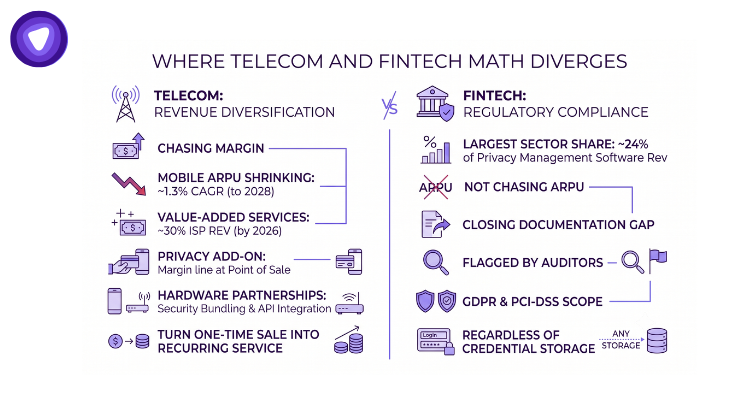
Telecom operators are chasing this for a specific reason. Mobile ARPU is projected to shrink at roughly a 1.3 percent compound annual rate through 2028 in mature markets. Analysts expect value added services to reach 30 percent of ISP revenue in developed markets by 2026. A privacy add-on sold at the point of sale gives a carrier a margin line connectivity no longer supplies. Hardware and device partnerships follow the same pattern. Mobile security bundling and router level API integration turn a one-time hardware sale into a recurring service line.
Fintech buyers weigh a different question entirely. Financial services already account for close to 24 percent of privacy management software revenue. That is the largest single vertical share of any sector. A digital bank adding identity exposure monitoring is not chasing ARPU. It is closing a documentation gap an auditor will eventually flag. Customer login data sits inside GDPR and PCI-DSS scope, whether or not the bank ever stores the credentials itself.
What the Compliance Overhead Actually Looks Like
A privacy platform for businesses does not remove compliance work. It changes what kind of work it is.
- Twenty U.S. states now carry comprehensive privacy statutes.
- Enforcement bodies are treating global privacy control signals as mandatory opt-out mechanisms, not optional settings.
- A reseller inherits a version of that obligation the moment its brand sits on someone else’s data pipeline.
- Its own customers will hold it accountable for how requests get honored.
The practical question a compliance officer asks is narrower than it sounds. Can the vendor produce an audit trail showing when a request was submitted, verified, and completed, without a manual export.
This is also where a poorly built privacy platform for businesses creates more risk than it removes. A partner that cannot show request-level status on demand is effectively vouching for a process it cannot see. That gap surfaces fastest during a regulator inquiry or a customer complaint, not during a routine sales call.
Who Owns the Renewal, Not Just the Launch
Most build-versus-resell comparisons stop at launch speed and setup cost. That misses the number that actually determines whether a privacy platform for businesses becomes a real revenue line. Who owns the renewal decision once the first year ends.
| Model | Who Prices It | What Drives Renewal | Where Margin Leaks |
| Build in-house | The builder, from day one | Whatever retention work the builder invests in | Engineering time spent maintaining broker coverage instead of improving the product |
| License a platform | Set by contract terms, rarely flexible | Vendor’s own roadmap and support quality | Licensing fees rise as usage scales, often faster than reseller revenue |
| White label resell | The reseller, end to end | Whether the reseller’s own brand kept the customer’s trust | Support tickets the reseller has to absorb if reporting is unclear |
Licensing gets left out of most comparisons entirely, and it is worth ruling out on its own terms. A licensed platform still runs on someone else’s roadmap. A price increase or a feature deprecation on the vendor’s side becomes the reseller’s problem to explain. None of the pricing control a white label arrangement keeps in-house survives that setup.
Where PureVPN White Label Solution Fits
PureVPN White Label Solution runs the identity exposure checks, dark web monitoring, and broker opt-out lifecycle behind an API. A partner plugs it into an existing dashboard without building any of the underlying infrastructure. The account management layer handles user creation, exposure checks, and monitoring enrollment through documented endpoints.
A partner’s engineering team integrates against a spec instead of negotiating removal terms with individual broker sites. The infrastructure runs under a SOC 2 Type II certification. Compliance officers check that detail before a contract gets signed, not after.
Partners running this as a privacy platform for businesses set their own retail pricing on top of wholesale access. The underlying opt-out lifecycle, re-listing detection, and status delivery already run on infrastructure covering hundreds of data broker sites. That structure lets a telecom operator, an MSP, or a fintech compliance team launch the service in weeks. A from-scratch build typically takes a year or more to reach the same point.
The Decision Comes Down to Timing
The businesses treating this as a real revenue line are not waiting for a mandate to force their hand. They are pricing it now, while ARPU keeps flattening and compliance officers keep asking harder questions about vendor accountability. A privacy platform for businesses works as a margin line under one condition. Re-listing, verification, and audit trails have to get treated as the actual product. Everyone else is still selling a one-time scan, wondering why renewal rates lag.