

- Protocol Impact: VPN protocols directly impact speed, security, latency, and connection stability, making them a core factor in any White Label VPN Solution infrastructure.
- OpenVPN: OpenVPN is the most flexible and widely compatible protocol, offering strong security and reliable firewall traversal, but with higher CPU usage and moderate speed.
- WireGuard: WireGuard delivers the best performance with a lightweight architecture, low latency, and high throughput, making it ideal for modern, speed-focused VPN deployments.
- IKEv2: IKEv2 is optimized for mobile environments, maintaining stable connections during network switching and offering strong performance for roaming users.
- Multi-Protocol Strategy: A multi-protocol approach using OpenVPN, WireGuard, and IKEv2 together provides the best balance of performance, security, and compatibility for scalable VPN services.
A VPN connection can fail long before encryption becomes the problem.
Slow speeds, unstable mobile sessions, dropped connections, and high latency are often tied to the VPN protocol running underneath the service. The protocol determines how encrypted tunnels are created, how traffic moves between networks, and how efficiently devices maintain secure connections under real-world conditions.
That is why protocol selection matters in every White Label VPN Solution deployment. The wrong protocol can increase infrastructure load, reduce connection stability, and negatively affect user experience at scale.
What is a VPN Protocol?
A VPN protocol is the set of rules that controls how data is encrypted and transmitted between a device and a VPN server. Different protocols prioritize different outcomes. Some focus on security and compatibility, while others prioritize speed, mobility, or lightweight performance.
OpenVPN, WireGuard, and IKEv2 are currently the three most widely deployed VPN protocols across commercial VPN services and enterprise remote access environments. Each solves a different infrastructure challenge, and understanding those differences is critical for businesses building scalable VPN services.
Why VPN Protocol Selection Matters More Than Most Businesses Expect
VPN protocols are often treated as a settings option inside an app. In practice, they define how encrypted tunnels are established, authenticated, maintained, and recovered during network interruptions.
That affects:
| Infrastructure Area | Protocol Impact |
| Remote workforce stability | Session persistence during network changes |
| Streaming and low-latency traffic | Encryption overhead and packet efficiency |
| Enterprise security | Cipher support and authentication methods |
| Battery usage | Handshake frequency and tunnel maintenance |
| Scalability | CPU consumption and concurrent tunnel efficiency |
| Firewall traversal | Ability to bypass restrictive networks |
A protocol that performs well for enterprise branch connectivity may perform poorly for consumer mobile traffic. A protocol optimized for speed may introduce deployment limitations for legacy environments.
The protocol layer influences both operational cost and customer retention.
Credential abuse and unauthorized access remain among the most common breach vectors, increasing pressure on organizations to secure remote connectivity infrastructure with properly configured encrypted tunnels.
- OpenVPN: Mature, Flexible, and Security-Focused
OpenVPN has remained the industry standard for years because of its flexibility and battle-tested architecture.
It operates using the OpenSSL library and supports a broad range of encryption algorithms, authentication methods, and deployment models. It can run over both TCP and UDP, making it adaptable across restrictive networks and enterprise firewalls.
Core Technical Characteristics
| Feature | OpenVPN |
| Release Year | 2001 |
| Transport Support | TCP / UDP |
| Encryption | OpenSSL-based |
| Authentication | Certificates, username/password, MFA |
| Codebase Size | Large |
| Firewall Traversal | Excellent |
| Mobile Roaming | Moderate |
| Performance Efficiency | Moderate |
Security Architecture
OpenVPN supports:
- AES-256-GCM
- ChaCha20
- RSA certificates
- TLS authentication
- Perfect Forward Secrecy
- Multi-factor authentication integration
Its mature cryptographic ecosystem makes it suitable for organizations with strict compliance and security requirements.
The tradeoff is complexity.
OpenVPN’s larger codebase increases maintenance overhead and introduces more processing requirements compared to newer lightweight protocols.
Performance Considerations
OpenVPN performs well under stable network conditions, but encryption overhead affects throughput, particularly on mobile devices and lower-powered hardware.
TCP mode introduces additional latency because of retransmission handling. UDP mode improves performance but still consumes more CPU resources than WireGuard.
In enterprise deployments, OpenVPN remains widely used because:
- It integrates well with legacy infrastructure
- It handles restrictive firewalls effectively
- It supports granular configuration controls
- It works across nearly every operating system
For a White Label VPN Solution, OpenVPN often becomes the default compatibility protocol because it supports the widest deployment range.
- WireGuard: Lightweight Architecture Built for Performance
WireGuard changed VPN infrastructure expectations by dramatically reducing protocol complexity.
Instead of supporting multiple cryptographic combinations and configuration layers, WireGuard uses a minimal codebase with opinionated cryptographic standards.
This design improves:
- Speed
- Tunnel establishment time
- CPU efficiency
- Battery consumption
- Scalability
Core Technical Characteristics
| Feature | WireGuard |
| Release Year | 2015 |
| Transport Support | UDP |
| Encryption | ChaCha20 |
| Authentication | Public/private key pairs |
| Codebase Size | Very small |
| Firewall Traversal | Good |
| Mobile Roaming | Excellent |
| Performance Efficiency | Very high |
Why WireGuard Is Faster
WireGuard reduces protocol overhead significantly compared to OpenVPN.
The smaller codebase means:
- Faster handshake completion
- Lower memory usage
- Reduced CPU load
- Faster packet processing
Benchmark testing from multiple independent studies consistently shows WireGuard outperforming OpenVPN in throughput and latency.
In many deployments, WireGuard delivers:
- Lower connection setup times
- Higher sustained speeds
- Lower packet overhead
- Better mobile battery performance
A 2024 report from NetDev 0x18 conference benchmarks showed WireGuard achieving substantially lower latency and higher throughput compared to OpenVPN in Linux kernel-level testing environments.
Security Model
WireGuard uses a fixed cryptographic suite instead of allowing broad customization.
This includes:
- ChaCha20 for encryption
- Poly1305 for authentication
- Curve25519 for key exchange
- BLAKE2s hashing
This simplifies security auditing and reduces configuration mistakes.
The smaller attack surface is one of WireGuard’s strongest advantages.
Limitations Businesses Should Understand
WireGuard is not universally ideal.
Its simplified design introduces challenges for:
- Complex enterprise identity management
- Dynamic IP assignment
- Some legacy infrastructure environments
- Certain compliance workflows
Traditional implementations also required storing client IP mappings on the server, though many commercial VPN providers now abstract this operationally.
For a modern White Label VPN Solution, WireGuard is often prioritized for performance-focused consumer environments and mobile-first deployments.
- IKEv2: Stability and Mobility for Mobile Networks
IKEv2, commonly paired with IPSec, focuses heavily on connection reliability and roaming support.
It was designed to maintain VPN stability during network transitions, making it highly effective for mobile users moving between:
- Wi-Fi
- Cellular data
- Public hotspots
- Enterprise networks
Core Technical Characteristics
| Feature | IKEv2/IPSec |
| Release Year | 2005 |
| Transport Support | UDP |
| Encryption | IPSec suite |
| Authentication | Certificates, EAP |
| Codebase Size | Moderate |
| Firewall Traversal | Moderate |
| Mobile Roaming | Excellent |
| Performance Efficiency | High |
MOBIKE Advantage
IKEv2 supports MOBIKE (Mobility and Multihoming Protocol).
This allows VPN sessions to survive network changes without requiring tunnel re-establishment.
For mobile users, this creates:
- Fewer disconnects
- Better session persistence
- Improved VoIP stability
- More reliable video conferencing
This matters heavily for enterprise mobility environments.
Security Architecture
IKEv2 with IPSec supports:
- AES-256 encryption
- Perfect Forward Secrecy
- Certificate-based authentication
- Strong integrity validation
Its security profile remains highly respected across enterprise deployments.
Weaknesses
IKEv2 struggles more than OpenVPN in restrictive firewall environments because it relies on specific UDP ports.
Some networks block IPSec traffic entirely.
Compared to WireGuard, configuration complexity is also higher.
Still, IKEv2 remains highly effective for:
- Corporate mobile access
- Remote workforce deployments
- Persistent mobile sessions
- Enterprise-issued mobile devices
OpenVPN vs WireGuard vs IKEv2: Technical Comparison
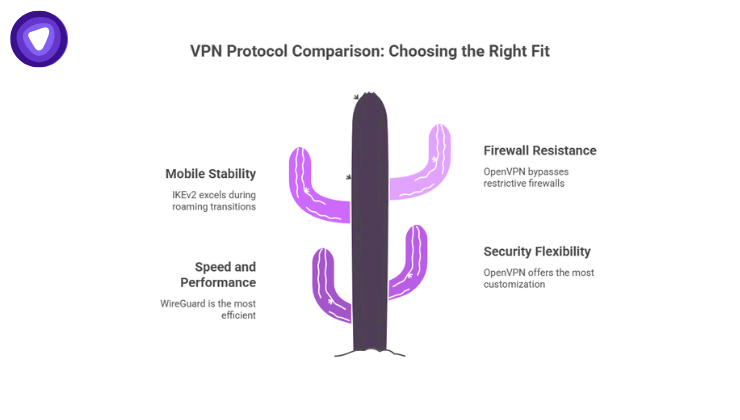
Performance differences between VPN protocols are driven by architecture choices, encryption design, and transport efficiency across different network conditions.
Speed and Performance
WireGuard leads in raw efficiency.
Its lightweight architecture consistently produces:
- Faster connection times
- Lower latency
- Higher throughput
- Lower CPU utilization
IKEv2 also performs well, especially on mobile networks.
OpenVPN prioritizes flexibility and compatibility over maximum speed.
Security Flexibility
OpenVPN provides the highest configuration flexibility.
Security teams can customize:
- Cipher suites
- Authentication layers
- Port configurations
- TLS controls
WireGuard intentionally avoids broad customization to reduce complexity.
IKEv2 balances enterprise-grade encryption with standardized IPSec implementations.
Mobile Stability
IKEv2 performs exceptionally well during roaming transitions.
WireGuard also handles mobility effectively because of its lightweight reconnect behavior.
OpenVPN sessions are generally less seamless during network switching.
Firewall Resistance
OpenVPN remains the strongest option for bypassing restrictive firewalls because it can operate over TCP port 443, blending with HTTPS traffic.
WireGuard and IKEv2 rely heavily on UDP traffic, which some restrictive environments block.
Which VPN Protocol Is Best for Business Deployments?
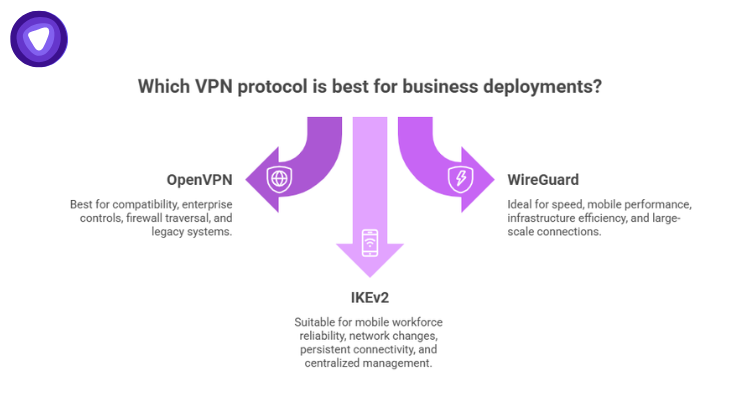
The answer depends on infrastructure priorities.
Choose OpenVPN When:
- Compatibility matters most
- Enterprise controls are extensive
- Firewall traversal is critical
- Legacy systems are involved
Choose WireGuard When:
- Speed is the top priority
- Mobile performance matters
- Infrastructure efficiency matters
- Large-scale concurrent connections are expected
Choose IKEv2 When:
- Mobile workforce reliability is essential
- Devices frequently change networks
- Persistent connectivity matters
- Corporate device management is centralized
Many commercial VPN providers now deploy multiple protocols simultaneously because no single protocol solves every operational requirement.
That multi-protocol flexibility is increasingly important in enterprise VPN architecture.
Why Protocol Diversity Matters in a White Label VPN Solution
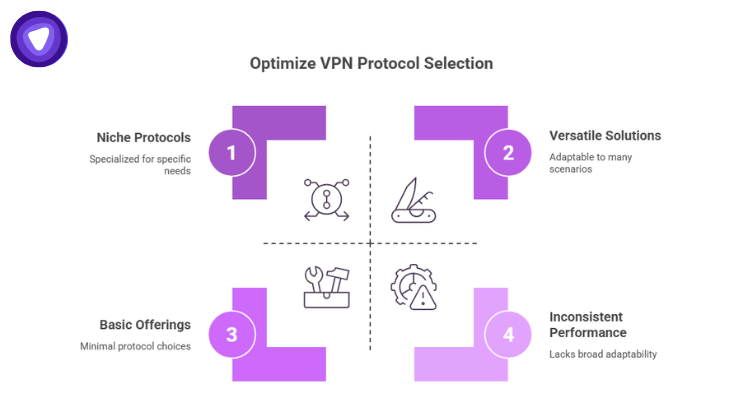
Businesses launching VPN services through a White Label VPN Solution often focus first on branding, applications, and server coverage.
Protocol architecture has a larger long-term impact.
A VPN platform serving:
- Streaming users
- Remote employees
- Financial institutions
- Travelers
- Developers
- Mobile-first teams
requires different traffic handling characteristics across those environments.
Supporting OpenVPN, WireGuard, and IKEv2 together allows providers to optimize connections based on:
- Device type
- Network conditions
- User behavior
- Security requirements
- Regional restrictions
This improves:
- Session reliability
- Speed consistency
- User retention
- Infrastructure efficiency
According to Statista, global VPN usage continues expanding across both enterprise and consumer environments, particularly as remote work and privacy-focused connectivity become standard operational requirements.
Quick Summary: OpenVPN vs WireGuard vs IKEv2
Each protocol is optimized for different priorities, making this comparison essential for selecting the right VPN architecture for performance, security, and mobility needs.
| Feature | OpenVPN | WireGuard | IKEv2 |
| Best For | Security & compatibility | Speed & efficiency | Mobile stability |
| Encryption | AES, ChaCha20 | ChaCha20 | AES/IPSec |
| Performance | Moderate | Very high | High |
| Mobile Roaming | Moderate | Excellent | Excellent |
| Firewall Bypass | Excellent | Good | Moderate |
| CPU Usage | Higher | Very low | Moderate |
| Codebase Size | Large | Small | Moderate |
| Enterprise Flexibility | Very high | Moderate | High |
| Setup Complexity | Higher | Simple | Moderate |
How PureVPN’s White Label VPN Solution Helps
PureVPN White Label VPN Solution is built for businesses that want to launch VPN services without managing backend infrastructure internally. The platform supports OpenVPN, WireGuard, and IKEv2, allowing providers to optimize connections based on device type, network conditions, security requirements, and performance expectations.
PureVPN also reduces operational overhead through global VPN server infrastructure, branded VPN applications, centralized management, Dedicated IP support, scalable backend systems, and cross-platform compatibility. Supporting multiple VPN protocols helps businesses deliver more stable and consistent connectivity across enterprise users, remote teams, mobile devices, and high-performance environments.
Final Verdict: Which VPN Protocol Should Businesses Choose?
There is no universal “best” VPN protocol. The right choice depends on the environment, user behavior, and infrastructure priorities.
OpenVPN remains the strongest option for businesses that need broad compatibility, advanced configuration control, and reliable firewall traversal. It continues to perform well in enterprise environments where flexibility matters more than raw speed.
WireGuard delivers the best overall performance. Its lightweight architecture reduces latency, improves throughput, lowers CPU usage, and scales efficiently across high-concurrency environments. For modern consumer VPN platforms and mobile-first deployments, WireGuard has become the preferred protocol.
IKEv2 performs best in mobility-focused environments. It maintains stable sessions during network changes and performs reliably on smartphones, tablets, and remote workforce devices that frequently switch between Wi-Fi and cellular networks.
For most providers building a scalable White Label VPN Solution, supporting all three protocols creates the strongest operational model