

Key Takeaways
- Resellers launch in days, but the provider keeps the brand, the user account, and the renewal.
- Private label puts your brand on a complete product, with launch in about two weeks on a mature platform.
- Embedded adds privacy inside an existing app or device through an SDK, typically in six to ten weeks.
- In private label and embedded models, you become the GDPR controller and can demand your data back at exit.
- Write a migration window, data export format, and credential handoff terms into the contract before signing.
Picking the wrong white label partnership model costs more than a slow launch. It decides who owns your users, who keeps the margin, and what leaving will cost you later. Yet most partners make this choice in the first sales call, then live with it for years.
The stakes are large because security is now sold through partners. Canalys research expects over 90% of the projected $281 billion in 2025 cybersecurity spending to involve partners. That means your competitors are choosing a model right now. In practice, the ones who pick well keep the customer. The ones who pick fast often hand the customer back to their provider.
This guide compares the three models side by side. It covers ownership, compliance duties, launch time, revenue shape, and exit cost. It closes with a model fit for each type of business.
Why the White Label Partnership Model Sets Your Margin Before Launch
At its core, every privacy product rests on the same infrastructure layer. The difference between models is who sits on top of it. In turn, that position decides your revenue ceiling.
Building that layer yourself is rarely the answer. Teams that build from scratch typically spend 12 to 18 months and over $500,000 before the first user connects. So the real choice is not build or buy. Instead, it is which white label partnership model you buy into.
Consider an illustrative example with round numbers. Assume 2,000 paying users at $6 per month, or $12,000 in gross monthly revenue.
- Reseller at an illustrative 30% share: you earn $3,600 per month, and the provider keeps the billing relationship.
- Private label at an illustrative $2 per-user cost: you keep $8,000 before support and marketing. You also own every account.
- Embedded at no separate price: value shows up as retention, not a new line item.
These figures are illustrative, not quotes. Still, the shape holds across providers. In short, resellers earn a share, private label partners earn a margin, and embedded partners earn retention. For a deeper view on raw earnings, this revenue comparison runs similar math.
The Three Models in Plain Terms
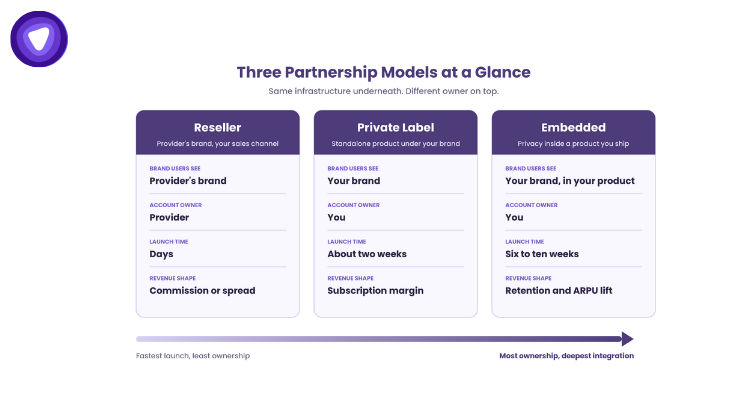
The labels get mixed up in sales decks, so clear definitions matter. Below, each white label partnership model is defined by what the end user sees and who holds the account.
Reseller: The Provider’s Brand, Your Sales Channel
A reseller sells the provider’s own product. In this model, the end user downloads the provider’s app and often signs up on the provider’s page. You earn a commission, a revenue share, or a wholesale spread on account bundles.
- What you control: pricing in some programs, plus your own sales and marketing.
- What you do not control: the app, the brand, the user account, or renewal messaging.
- Best fit: testing demand before you commit budget, or adding a quick upsell to an existing catalog.
The trade-off is simple. On one hand, you launch in days, but the customer relationship sits with someone else.
Private Label: A Standalone Product Under Your Brand
A private label partner sells a complete product under its own name. As a result, you get branded apps, your own store listings, your own website, and your own billing. The provider runs servers, protocols, and app updates behind the scenes.
- What you control: brand, pricing tiers, onboarding, user accounts, and customer data.
- What you take on: Tier 1 support, app store obligations, and data controller duties.
- Best fit: businesses that want a new product line with its own revenue.
Over time, partners often see the return in loyalty. One MSP partner reported double-digit retention gains after selling VPN under its own brand. Typical launch time on a mature platform runs about two weeks.
Embedded: Privacy Inside a Product You Already Ship
An embedded partner adds privacy features to an existing app, device, or platform. In other words, there is no second app. The provider supplies an SDK or API, and your engineers place the feature inside your interface.
- What you control: the full user experience, plus where and how the feature appears.
- What you take on: engineering time, release testing, and platform policy compliance.
- Best fit: SaaS platforms, device makers, banks, and carriers with an installed base.
Users also favor this model because it removes setup. In the Acronis 2025 survey, nearly 30% of consumers said security tools are too complex to use. An embedded feature removes that friction because the user never installs anything new. SDKs now cover mobile and desktop platforms. A typical integration takes six to ten weeks from design to release.
Side-by-Side: How Each White Label Partnership Model Compares
Next, the table below maps the three models against the factors that decide long-term value. Read it row by row, not column by column.
| Factor | Reseller | Private Label | Embedded |
| Brand the user sees | Provider’s brand | Your brand | Your brand, inside your product |
| Who owns the user account | Provider | You | You |
| App store listing | Provider’s listing | Your organization account | Your existing app, updated |
| GDPR role toward end users | Provider is controller | You are controller | You are controller |
| Tier 1 support | Provider or shared | You | You |
| Typical launch time | Days | About two weeks | Six to ten weeks |
| Revenue shape | Commission or spread | Subscription margin | Retention and ARPU lift |
| Cost to switch providers later | Users stay behind | Account migration | SDK swap and app release |
The last row matters most at renewal. A reseller who switches providers loses the user base entirely. By contrast, private label and embedded partners keep their users and only move the plumbing.
Five Tests That Pick the Model for You
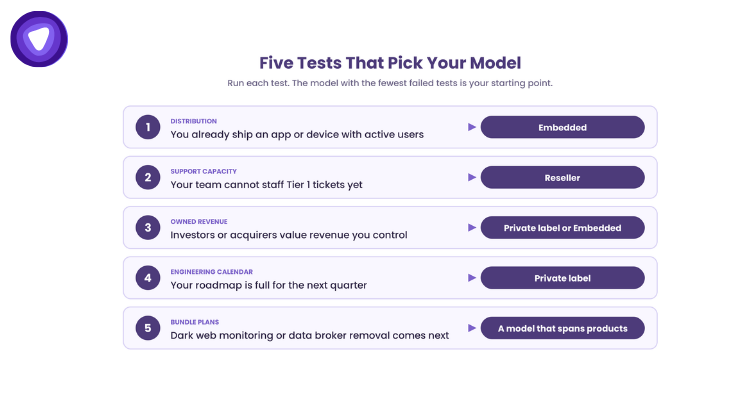
Instead of debating labels, run five plain tests. Each one points toward a single white label partnership model.
- Check your distribution. If you already ship an app or device with active users, embedded wins. A new app splits attention you already earned.
- Check your support capacity. If your team cannot answer Tier 1 tickets, start as a reseller. Private label and embedded both route first-line support to you.
- Check your need for owned revenue. If investors or acquirers value recurring revenue you control, choose private label or embedded. Commission income never shows up as your own subscriber base.
- Check your engineering calendar. If your roadmap is full for a quarter, private label launches faster than embedded. You can move to embedded later.
- Check your bundle plans. If dark web monitoring or data broker removal comes next, pick a model that spans products.
In most cases, partners pass three tests clearly and fail one or two. The model with the fewest failed tests is your starting point. For deeper vendor checks after that, use these vetting questions.
The Ownership Tests Most Buyers Skip
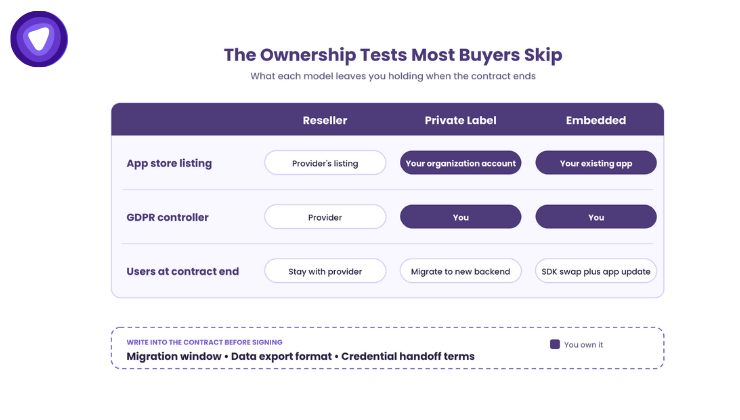
At first glance, feature lists look similar across providers. However, three ownership details separate the models in practice. Each one shows up months after signing, when changes cost the most.
Who Files the App Store Listing
Apple limits VPN service apps to organization accounts, not individual developers. Those apps must also commit in their privacy policy to never sell or share user data. Under a reseller deal, the provider carries this burden on its own listing.
Under private label, however, the listing sits in your organization account. That gives you the reviews, the ranking history, and the store presence. Under embedded, your existing app takes on the same rules the day it adds the feature. Therefore, legal review of your privacy policy belongs in the project plan, not after launch.
Who Holds the Data Controller Role
Similarly, GDPR splits duties between a controller and a processor. In a reseller model, the provider acts as controller for the end user. In private label and embedded models, you become the controller, and the provider acts as processor.
This shift brings new duties and new power at once. Under Article 28, a processor must delete or return personal data when the service ends, at the controller’s choice. As a result, private label and embedded partners can demand their data back at exit. Resellers have no such right because the data was never theirs.
Who Owns the Account on Day 400
Finally, the last test is the exit. Ask what happens to every active user if the contract ends tomorrow. A reseller’s users renew with the provider directly. A private label partner moves accounts to a new backend under the same brand. An embedded partner swaps the SDK and ships an app update.
Write the answer into the contract before signing. Specifically, request a migration window, a data export format, and credential handoff terms. These three clauses decide whether switching providers costs weeks or your entire user base.
Which Model Fits Each Type of Business
In general, model choice follows business shape more than company size. The patterns below reflect where each model tends to fit first.
- MSPs and MSSPs: private label for a branded service line across clients, with reseller as a low-risk pilot.
- Telecom operators and ISPs: embedded inside the carrier app, or private label as a branded add-on plan.
- SaaS platforms and IoT device makers: embedded, because users already live inside your product.
- Fintech and neobanks: embedded, since trust signals work best next to accounts and cards.
- Cybersecurity vendors: embedded into an existing suite, so one install covers several protections.
- Insurance carriers and HR or benefits providers: private label, badged as a policyholder or employee benefit.
Partners can also mix models. For example, a carrier can embed VPN in its main app. It can then sell a private label plan to business customers. Consequently, the best providers support all three models on one backend.
Moving Between Models Without Losing Users
Many partners start as resellers and move up once demand is proven. That path works, but each move carries a different cost.
- Reseller to private label: the hardest jump, because existing users hold provider accounts. Plan a win-back campaign, not a transfer.
- Private label to embedded: a smoother move, because you already own accounts and billing. The work sits in SDK integration and release testing.
- Embedded to private label: useful when a feature grows into its own product line. Your existing accounts carry over directly.
For this reason, start one step higher than feels comfortable when you can. Each upward move after launch costs more than starting there.
Proof: Three Models Running on One Infrastructure
To illustrate, the same provider infrastructure already runs all three models in production. Each deployment below is described from the provider’s own published case studies.
- Referral model inside a device maker’s app: a global router maker added VPN to its apps for a commission. New users buy a plan from the provider, as the router case describes.
- Embedded model inside an antivirus suite: a US-based MSP folded VPN into its existing antivirus app through an SDK. Per its antivirus case, the MSP reported 32% lower operating costs. Revenue also grew 25% within two months.
- OEM embedded model at device level: a global smartphone maker built identity masking directly into its secure Wi-Fi feature. Users get the protection with no second app, as the smartphone case explains.
These results are the partners’ own reported outcomes, not independent audits. Even so, they show that one backend can serve each white label partnership model without a rebuild.
How PureVPN White Label VPN Solution Supports All Three Models
PureVPN White Label VPN Solution runs reseller, private label, and embedded deployments on one network. That network spans 6,500+ servers across 88+ countries and supports WireGuard, OpenVPN, and IKEv2. The no-log policy carries an independent Big Four audit. Server figures are PureVPN’s own reported data.
In addition, partners can start with branded apps and add SDK or API integration later without changing providers. For identity protection, the privacy platform offers dark web monitoring and data broker removal. Both come in the same three deployment styles.
Conclusion: Choose the Model You Can Grow Into
The right white label partnership model is the one that matches your distribution, support capacity, and revenue goals today. It should also leave room for the next step. Resellers launch fastest but give away the customer. Private label partners own the customer and the margin. Embedded partners turn privacy into retention inside a product people already use.
Run the five tests, check the three ownership details, and write exit terms before signing. Then pick the white label partnership model you would still choose in two years.
Request a 20-minute partnership model review.
What is the difference between a white label partner and a reseller?
A reseller sells the provider’s brand, while a white label partner sells its own brand and owns each account.
Is private label the same as white label?
No. Private label traditionally means an exclusive build, so your contract should define brand, account, and data ownership.
Which partnership model fits a SaaS platform or device maker?
Embedded fits best, since an SDK adds privacy inside the existing product in six to ten weeks.
Who owns customer data in a white label partnership?
The partner acts as GDPR controller, so the provider must return or delete user data when the contract ends.
Can a reseller switch to private label later?
Yes. The move works, but reseller users hold provider accounts, so plan a win-back campaign instead of a transfer.