


- Scale: Over 5,000 companies now operate inside the data broker industry, with combined revenue past $340 billion.
- Misclassification risk: Broad state definitions mean a business can qualify as a data broker without ever intending to, simply through ad pixels, data-sharing deals, or vendor relationships.
- Compliance deadline: California’s DROP platform now forces registered brokers to process deletion requests every 45 days starting August 2026, with $200 per unfulfilled request, per day, in penalties.
- Removal isn’t permanent: Brokers rebuild records from public filings and reseller networks, so protection has to run as a continuous cycle, not a one-time opt-out.
- Build vs. buy: Offering broker removal as a feature requires ongoing account-level API infrastructure, which is why partners are increasingly bundling it in rather than building it from scratch.
A company can be classified as a data broker under state law without ever calling itself one. That distinction is now reshaping compliance checklists for platforms that assumed this problem belonged to someone else. The data broker industry has operated for decades on one premise. Personal information earns more once it changes hands quietly. Data gets aggregated, repackaged, and resold to parties the original user never approached.
Understanding how this industry actually functions is no longer a side topic. Anyone running a digital product that touches user records needs to know who buys the data. Recent rule changes make that knowledge urgent. It is no longer safe to assume broker status applies only to household names like credit bureaus.
Inside the Data Broker Industry: What Actually Gets Sold
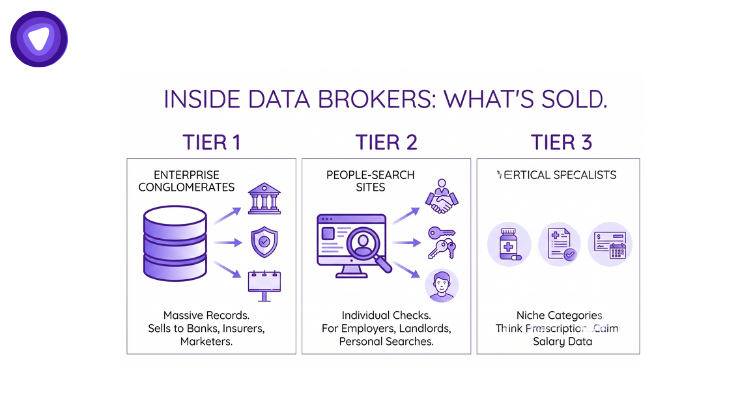
The data broker industry is not one company or one business model. It splits into three distinct tiers. Each tier sells different data to different buyers.
The Three Tiers Selling Personal Data
- Enterprise data conglomerates. These firms hold consumer records at massive scale. They sell primarily to banks, insurers, and marketing agencies. The industry now spans 5,000+ firms with combined revenue past $340 billion.
- People-search sites. These sell directly to individuals. Employers running background checks, landlords screening tenants, and anyone searching a name are typical buyers.
- Vertical specialists. Smaller firms trade in a single category only. Think prescription histories, insurance claims records, or employment and salary data.
Why Your Own Platform May Already Qualify
California’s Delete Act defines a data broker broadly. Any business that knowingly collects and sells personal information of a consumer with no direct relationship can meet that bar. A company running third-party ad pixels can qualify without intending to. So can one selling anonymized behavioral segments, or passing user data to an ad exchange.
Regulators have already fined a large financial data firm over unregistered status that lasted months. The cause was an internal administrative gap, not a deliberate decision to avoid registration. Treating broker status as someone else’s problem is a real compliance risk now, not a theoretical one. Legal and product teams should review data-sharing agreements together. The definition often turns on contract language neither team reads alone.
What the Data Broker Industry Charges for Personal Data
Brokers acquire a single data record for a fraction of a cent. They resell it for far more once it is packaged with other attributes and cross-referenced against additional sources. That pricing markup alone explains why the data broker industry keeps expanding even as regulation tightens around it. A record on its own is worth almost nothing. The same record linked to income, location, and browsing behavior becomes a different product entirely. Pricing varies sharply by category as a result.
| Data Category | Primary Buyers | Regulatory Coverage |
| Health and prescription records | Insurers, pharmaceutical firms | Partial, HIPAA gaps remain |
| Financial and credit history | Lenders, landlords, employers | FCRA, GLBA |
| Location and movement data | Retailers, logistics firms | Largely unregulated |
| Behavioral and browsing data | Marketers, ad agencies | GDPR, CCPA/CPRA |
For companies weighing whether to offer removal services to their own users, this pricing structure matters directly. Manual, broker-by-broker removal does not scale past a handful of accounts. Each broker uses a different submission method. Some require email requests, others use web forms, and some demand identity verification. Most require repeat follow-up before a record actually disappears.
The Data Broker Industry’s New Compliance Deadline
California forced the issue first. The data broker industry now operates under a state-run deletion platform. That replaces thousands of separate, broker-by-broker requests.
How the 45-Day Deletion Cycle Works
California’s deletion platform launched in January 2026 with roughly 545 brokers registered. Consumers submit one verified request instead of contacting each broker separately. Starting August 2026, brokers must retrieve that request queue at least every 45 days. They standardize and hash their own records, then match against the submitted list. Each match receives a status. It can be deleted, exempted under a statutory carve-out, opted out of future sale, or marked record not found. Brokers that fail to report their prior cycle lose access to the next batch. That means a backlog compounds fast.
What Happens When Your Company Is the One Being Asked
Registration alone costs $6,000 a year. Missing that deadline brings a flat administrative penalty. Missing deletion cycles after August 2026 costs $200 per request per day. Regulators have already issued recent enforcement actions exceeding $100,000 combined against firms that miscalculated their broker status entirely. That penalty applies per unfulfilled request, not per company. A broker sitting on a large unprocessed queue accumulates liability daily rather than facing a single fine.
Why One Opt-Out Request Never Ends the Problem
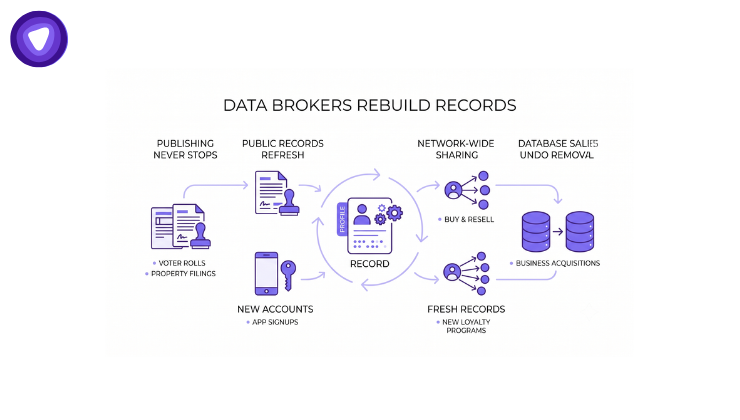
Deletion is not permanent. The data broker industry rebuilds records constantly from sources that never stop publishing.
- Public records like voter rolls and property filings refresh on their own schedule, independent of any opt-out request.
- Brokers buy and resell data between each other, so removal from one source rarely covers the wider network.
- New app signups, loyalty programs, and account registrations continuously generate fresh records tied to the same person.
- Data brokers that go out of business often sell their entire database to a competitor before shutting down, which can undo months of prior removal work in a single transaction.
What Continuous Protection Actually Requires
A workable removal system runs four stages on a loop. First, it builds a full exposure map across active brokers. Second, it submits broker-specific opt-outs using whichever method each site requires. Third, it tracks outcomes and resubmits anything ignored or stalled. Fourth, it rescans monthly, because brokers re-aggregate data that was already removed. Skipping any one stage means the data quietly resurfaces within a few months. A broker cleared one month often reappears the next. New filings and reseller feeds constantly refresh the underlying source data. That is exactly why a single sweep never holds for long.
How Data Broker Rules Differ Outside California
California moved first, but it is not the only state regulating this space. Oregon, Texas, and Vermont each maintain their own data broker registries. None of them currently run a centralized deletion platform like DROP. Consumers in those states must still contact each broker separately, and a single request can take weeks to resolve. New Jersey, Delaware, and Alaska have registration laws in development. They follow the same disclosure-first model California used before DROP existed.
Cross-border comparisons matter just as much for global platforms. GDPR gives EU residents a right to erasure that any data holder must honor within thirty days. Fines can reach 4% of global revenue. That baseline is stronger than most current US state laws. It still lacks a single automated request platform like California’s.
That gap means EU enforcement relies more on individual complaints than a centralized queue. A business operating across the US and EU faces two different deletion mechanics at once. One is a state-run automated queue. The other is dozens of individual manual requests everywhere else. Compliance teams building for one region should not assume the other will look the same anytime soon.
How Provisioning Actually Works Behind a Broker Removal Product
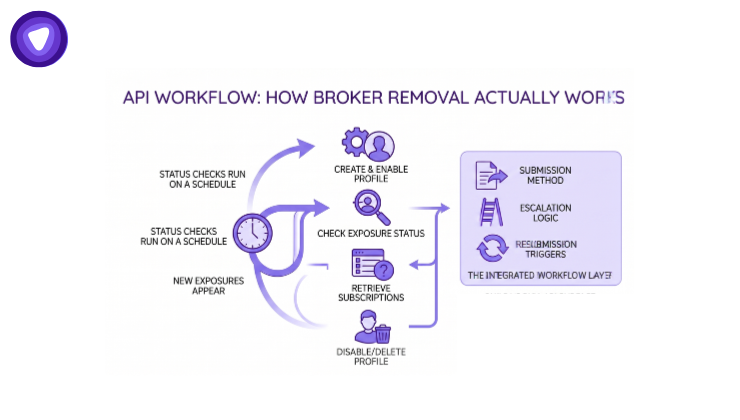
For a platform that wants to offer this as a feature rather than a manual service, the underlying build is mostly account-level API work. A functioning system needs four core endpoints:
- Creating and enabling a user’s monitoring profile
- Checking exposure status per broker
- Retrieving which brokers and data categories are currently subscribed
- Disabling or deleting that profile once a user cancels
Status checks need to run on a schedule, not only at signup. New exposures appear between the initial scan and any later manual review. A system that only checks once misses most of what matters.
Practically, this means the removal workflow itself sits behind that same account layer. The submission method per broker, escalation logic, and resubmission triggers are part of that same system. None of it runs as a separate manual process per user. Teams weighing a build versus buy decision should treat this API surface as the real cost driver:
- It matters far more than the number of brokers covered on a feature list
- Building broker-specific workflows for even a modest coverage list takes meaningfully more engineering time than most teams budget for upfront
- Each new broker added to a coverage list brings its own submission quirks
- The workflow layer grows in complexity well past what the initial scope suggests
Turning Data Broker Risk Into a Retention Lever
Businesses holding user data face a choice. They can treat broker exposure as legal risk only, or build a product around solving it for users directly. Most consumers already want more say over how their information gets collected and used. That makes removal and monitoring a feature people will pay for. It stops being just a compliance line item buried in a privacy policy nobody reads.
How PureVPN’s White Label Solution Helps
PureVPN’s White Label Solution runs this exact architecture for partners instead of asking them to build broker-removal infrastructure from scratch. The platform automates opt-outs across 400+ data brokers. It layers in continuous dark web credential monitoring. Everything deploys entirely under the partner’s own brand through a single API and partner dashboard. Partners can launch data broker opt-out, dark web monitoring, or both together. Either module bundles with an existing VPN or eSIM product without a separate integration for each piece.
The Track Record
These outcomes are not evenly distributed. They cluster around partners who treated broker removal as a feature to ship, not a checkbox to satisfy. An MSP that layered antivirus, VPN, and this exact opt-out architecture together saw client retention rise 15%, enterprise account growth reach 20%, and revenue increase 25% inside two months, while operational overhead fell 32%.
The pattern holds outside the MSP channel too. A productivity SaaS platform folded the same monitoring into its core product and brought churn down 18%. Renewal data across the broader partner base tells a similar story: partners cross-selling privacy services see renewal rates near 78%, and accounts with privacy bundled into an existing subscription churn at roughly half the rate of single-product accounts.
None of this required the engineering effort outlined above. SOC 2 Type II certification and a KPMG-verified no-log policy back the underlying infrastructure, which has run for 17-plus years and now supports 150-plus partners bundling privacy modules worldwide. For a team that just finished estimating what four custom API endpoints and ongoing broker-workflow maintenance would cost to build in-house, that is the actual counterfactual: the same account-level API work, already built, already audited, and already measured against these outcomes.
Final Thoughts
The data broker industry is not going away. Public pressure is only formalizing the rules around it faster than most companies expected. Your business may sit inside a regulator’s expanding definition of a data broker. Or you may be protecting users from the ones already selling their records. Either way, the requirements are converging on the same standard.
That standard is continuous discovery, verified removal, and proof of follow-through. Companies that build for that standard now gain a real advantage. They will spend the rest of 2026 answering compliance questions with evidence, instead of scrambling for it after enforcement begins.