


Key Takeaways
- SIM swap cases reported in the UK rose 1,055 percent between 2023 and 2024.
- An estimated 96 percent of SIM swap cases rely on social engineering, not a network exploit.
- FCC rule 23-95 requires secure authentication, but it does not address data broker exposure.
- Data broker removal covers 400+ broker and people-search sites, with monthly re-scanning.
- MVNOs carry the same CPNI compliance risk as facility-based carriers under FCC rules.
- Data broker removal is priced per subscriber, which changes the cost curve compared to per-incident fraud losses.
When it comes to telecom fraud prevention, a fraudster rarely needs to breach a telecom network to steal a phone number. They only need enough personal data to sound convincing on a support call. That data is often for sale before the call ever happens. Data broker removal changes what an attacker has to work with before they reach your call center at all.
In 2024, unauthorized SIM swaps reported to the UK’s National Fraud Database rose 1,055 percent. Cases climbed from 289 to nearly 3,000 in a single year. In the United States, the FBI’s Internet Crime Complaint Center logged 982 SIM swap complaints for the year. Reported losses reached $25.9 million. Almost all of these incidents share the same starting point. Personal information is pulled from broker sites and used to pass a carrier’s identity checks. Telecom providers spend heavily on authentication technology. Few spend anything on removing the raw material that defeats it. Data broker removal fills that gap, and it belongs in the telecom fraud prevention conversation alongside authentication and network controls.
Quick answer: Data broker removal reduces telecom fraud by stripping the name, address, date of birth, and partial Social Security number that attackers buy from broker sites to pass a carrier’s identity checks. It works upstream of authentication rules, port-freeze controls, and real-time detection, covering the one stage those layers do not touch.
Key Terms: SIM Swap, Port-Out Fraud, CPNI, and Data Broker Removal
A short set of definitions keeps the rest of this guide precise. Fraud and security teams outside telecom do not always use these terms the same way.
- SIM swap fraud: transferring a subscriber’s number to a new SIM card the attacker controls, on the same carrier.
- Port-out fraud: moving a subscriber’s number to a different carrier entirely, without authorization.
- CPNI: Customer Proprietary Network Information, the account and usage data carriers must protect under Section 222 of the Communications Act.
- Data broker removal: the ongoing process of finding and removing a subscriber’s personal data from broker and people-search sites, then monitoring for reappearance.
How a Data Broker Listing Becomes a Weapon Against Your Call Center
Before a fraudster ever dials a support line, they build a profile. A full name, date of birth, and home address are standard fields. So are the last four digits of a Social Security number. These are the exact details a carrier agent asks for to verify a caller’s identity. All four are commonly available through people-search and data aggregator sites for a small fee.
Security researchers tracking SIM swap cases have found a pattern. Attackers routinely pull this data from data broker lists costing as little as ten dollars. They then use it to answer knowledge-based verification questions a legitimate customer would also know. This is not a technical exploit. It is impersonation built on purchased data. That is why an estimated 96 percent of SIM swap cases involve social engineering, not a network vulnerability. More than 4,000 active data brokers operate in the United States alone. Most subscribers have no idea how many hold a current copy of their identity fields.
Data broker removal does not erase someone from the internet. It targets the specific fields carrier verification scripts rely on. Those fields include:
- Full legal name paired with a current or former home address
- Date of birth
- Partial Social Security number listings
- Known mobile carrier and phone number associations
Strip those fields from broker inventories. A caller claiming to be the subscriber then has far less to work with. A support agent asking the standard verification questions gets fewer correct answers back.
The Fraud Volume Telecom Providers Are Already Absorbing
SIM swap and port-out fraud are not marginal problems. Javelin Strategy’s 2024 Identity Fraud Study attributed $23 billion in consumer losses to account takeover in 2023. Telecom accounts were a primary entry point. eSIM provisioning has made the attack faster to execute. Some incident analyses show attackers completing a swap in under five minutes once they clear a carrier’s verification step.
Account takeover data tells a similar story from a different angle. Facility takeover filings tracked by fraud prevention networks show telecom-linked cases making up a majority of reported incidents. That share has grown sharply year over year. None of this volume originates inside the network itself. It originates with an attacker who already has enough personal data to sound legitimate on the first call.
Why FCC Authentication Rules Do Not Close the Real Gap
In refenrece to telecom fraud prevention, The Federal Communications Commission introduced Report and Order FCC 23-95 to address SIM swap and port-out fraud directly. The rule took effect for most carriers in January 2024. It requires wireless providers, including resellers and MVNOs, to use secure authentication methods before completing a SIM change. The same requirement applies to port requests. It also bars customer service agents from accessing Customer Proprietary Network Information until a caller is properly authenticated.
Enforcement has teeth. The FCC proposed a $20 million fine against two carriers over this exact issue. Both had failed to protect subscriber CPNI under Section 222 of the Communications Act. Carriers that treat authentication as optional carry real regulatory risk.
MVNOs face the same obligation as facility-based carriers under this rule. Riding on a host network does not transfer fraud liability downstream. If a subscriber’s data is used in a fraudulent SIM swap, the MVNO owns the CPNI compliance risk. The host network does not. That distinction matters for MVNO fraud teams weighing this layer. The decision to add data broker removal sits with the brand that owns the subscriber account. It does not depend on the underlying network operator’s own controls.
What the Rule Requires, and What It Assumes
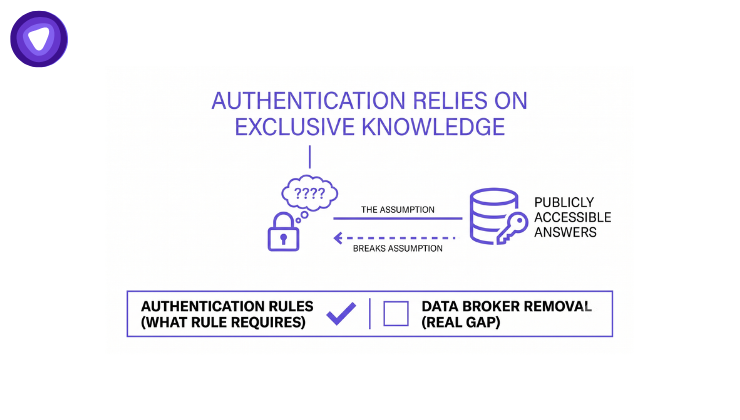
The rule strengthens how a carrier checks a caller’s identity. It does not touch what information is available for that caller to present. Every authentication method the FCC leaves carriers free to choose assumes one thing. It assumes the answer is something only the real subscriber knows. Data broker exposure breaks that assumption directly. A knowledge-based question is not secure if the answer is for sale.
This is the part generic fraud prevention content skips. Authentication and data broker removal are not competing solutions. They protect two different points in the same attack chain. A carrier that only invests in one is still exposed at the other.
What Data Broker Removal Covers, and Where It Stops
Fraud and security teams evaluating this as a fraud prevention layer usually ask one question first. How does this fit next to controls we already run? The honest answer is that data broker removal is one layer among several. It is not a replacement for any of them.
| Layer | What It Stops | When It Works | Limitation |
| Data broker removal | OSINT used to answer identity checks | Before a fraud attempt is made | Does not stop insider bribery or signaling-level exploits |
| Port-freeze and PIN controls | Unauthorized port-out without a PIN | At the moment of a port request | Ineffective if the PIN itself was phished or guessed |
| Real-time network API detection | A swap already flagged as risky | During or right after a request | Reacts to an attempt already in motion |
Data broker removal is the only layer here that acts before an attacker contacts a call center. Port-freeze controls and real-time detection both operate at or after the request itself. Together, the three layers cover the data-gathering stage, the request stage, and the transaction stage. None of them is redundant with the others.
How Provisioning Actually Works at the Account Level
Fraud teams also want to know how this actually runs. Does it require a separate app subscribers install and manage themselves? It does not. It runs through an account-management API. A partner authenticates against the API using a secret key, which is exchanged for an access token.
Once authenticated, the partner registers a subscriber through a user management endpoint. From there, an identity exposure intelligence call checks whether that subscriber’s data already appears across broker and breach sources. If exposure turns up, opt-out requests are submitted automatically against the relevant broker sites. Each request moves through a defined lifecycle. It starts as submitted, moves to in progress, then pending verification, then completed. If a broker re-lists the same data later, the status shifts to re-listed and a new request goes out automatically.
That last stage matters more than it looks. Data brokers re-aggregate information from public records and other feeds on their own schedule. A one-time removal is not a permanent one. Continuous monthly re-scanning keeps a subscriber’s exposure low instead of letting it creep back within months. That difference separates a real fraud prevention layer from a single cleanup exercise a carrier runs once and forgets.
The Economics: What Broker Removal Costs Against What Fraud Costs
Here is an illustrative example, not a sourced figure. Take a carrier with 500,000 subscribers and a modest 0.05 percent annual SIM swap rate. That works out to roughly 250 confirmed incidents a year. Each one typically involves a support escalation and a fraud team investigation. Many also involve a goodwill credit or chargeback tied to a banking or payment partnership. A growing share triggers a CPNI compliance review under Section 222. At a few hundred dollars of resolution cost per case, 250 incidents alone clear six figures. That is before any lawsuit or regulatory inquiry enters the picture.
Data broker removal is priced per subscriber, not per incident. That changes the shape of the cost curve. Instead of paying reactively for each swap that succeeds, a carrier pays a flat per-user cost. That cost shrinks the pool of subscribers whose data is exposed in the first place. PureVPN’s own partner data shows bundled users churn roughly 50 percent less than unbundled ones. The company reports this as internal data, not a third-party audited claim. It still lines up with the retention economics telecom providers already track for other value-added services. This is important in reference to telecom fraud revention.
Build Versus Buy: What the Integration Timeline Actually Costs
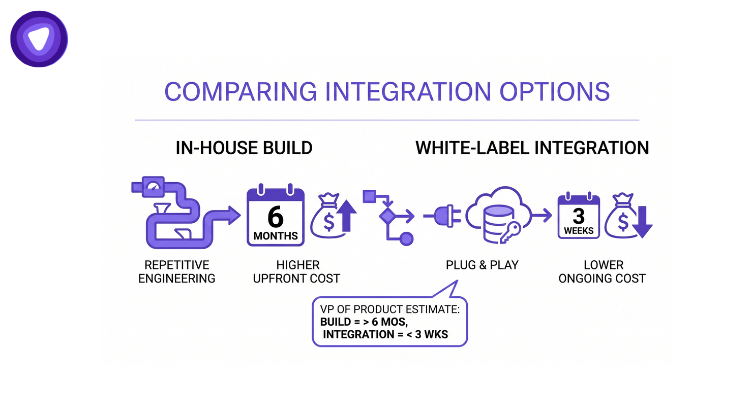
The build-in-house option rarely moves as fast as it looks on a roadmap. One partner’s own VP of Product estimated the in-house alternative directly. Building direct integrations across hundreds of individual broker sites would have taken over six months of engineering time. Moving to a white-label integration instead brought that same partner live, fully branded, in under three weeks. That gap is engineering time a fraud or security team spends elsewhere instead. Broker-specific scraping and opt-out workflows change without notice and require ongoing maintenance either way.
Where PureVPN White Label VPN Solution Helps
PureVPN White Label Data Broker Removal delivers this as part of a broader Data Privacy Protection bundle. That bundle also includes dark web monitoring. It runs on infrastructure covering more than 400+ data brokers. The same infrastructure serves 150+ partners worldwide, built over 17 years in privacy operations. The platform is SOC 2 Type II certified and GDPR and CCPA compliant. Every removal request is tracked through the same submitted-to-completed lifecycle, visible on a partner dashboard rather than a spreadsheet.
For telecom providers specifically, the module deploys through the same account-management API used for provisioning, for telecom fraud porevention. It can trigger automatically at account creation or SIM activation. It does not depend on a subscriber opting in later. That timing matters. Exposure removed before a fraud attempt is far more useful than exposure removed after the fact.
The module also runs independently of whichever authentication vendor or port-freeze process a carrier already has in place. A telecom fraud prevention team does not have to rip out existing controls to add this layer. It sits ahead of them, under the carrier’s own brand. In fact, it is priced and reported per subscriber. It does not disappear inside a larger suite with no visibility into what the broker piece is doing.
Final Thoughts: Telecom Farud Prevention
Telecom fraud prevention has treated authentication as the whole story for years. Data broker removal does not replace that work. It closes the gap ahead of it, denying attackers the exact data that makes a fraudulent SIM swap sound legitimate. Carriers that add this layer are not choosing between authentication and data broker removal. They are covering both ends of one attack chain, which is what telecom fraud prevention actually requires today.
The carriers that move first on this get a narrow but real advantage. Fraud volume tied to purchased personal data keeps climbing. Every subscriber whose exposure is already reduced is one less call a fraud team has to investigate later. Request a walkthrough of how data broker removal fits your existing fraud stack, before the next swap attempt tests it for you