

- Detection collapses the breach window: Dark web monitoring catches credentials the moment they’re harvested and sold on criminal markets, reducing detection time from 194 days to 1-2 days.
- Four exposure surfaces demand different responses: Stealer logs need immediate credential resets (24-hour exploitation window), ransomware leaks require legal and PR coordination, dark web mentions need investigation depth, and executive exposure demands incident response.
- Real-time alerting with integrated workflows separates operational security from theater: Effective monitoring requires webhook integration to your SIEM, credential reset triggers to your identity provider, and ticket auto-creation so alerts become immediate action, not manual triage.
- Bundled dark web monitoring with VPN drives measurable retention gains: Mid-market security vendors bundling dark web monitoring with encryption tools see 15% improved customer retention because monitoring makes privacy risk visible and VPN makes the response actionable.
- ROI is measured in breach acceleration, negotiation advantage, and regulatory positioning: One ransomware negotiation advantage detected early or detecting a breach 150+ days earlier than legacy methods typically justifies the entire annual platform cost.
Brand impersonation, credential leaks, and executive exposure don’t happen on your company network. They materialize first on private forums, ransomware leak sites, and Telegram channels where threat actors trade stolen data before weaponizing it. Dark web monitoring serves a single purpose: detect what’s already exposed before it becomes a headline or a breach.
Most brand protection conversations stop at “what to monitor.” The harder question is what to do when you find something, how fast you can act, and which exposures actually threaten revenue or reputation. This guide walks through the operational reality of dark web monitoring for brand teams. It covers the detection workflows, the economics that justify it, and the response playbooks that turn intelligence into containment.
What’s Actually Happening on the Dark Web Today
Verizon’s 2025 report found that 88% of basic web application attacks involved stolen credentials. The path from breach to exploit is no longer days or weeks. Average breach detection takes 194 days according to IBM, but that delay does not happen because attackers are patient. It happens because credential packages sell on criminal marketplaces within hours of extraction.
Infostealer malware harvests an entire device’s saved logins, session cookies, and browser data in seconds, and those packages get sold on Telegram channels and criminal marketplaces within hours. Your brand’s employee credentials, admin tokens, and customer payment data are indexed on the dark web long before your detection systems flag anomalies.
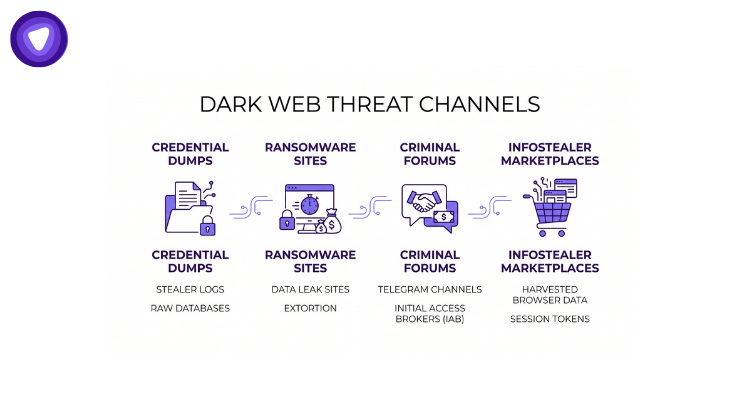
The threat surfaces simultaneously across four channels:
- Stealer logs and credential dumps. Raw password databases harvested by malware.
- Ransomware leak sites. Data packaged as extortion collateral and published to force payment.
- Criminal forums and Telegram channels. Locations where initial access brokers (IABs) sell compromised VPNs, RDP, and SaaS logins.
- Infostealer marketplaces. Real-time feeds of harvested browser data and session tokens.
IBM X-Force report shows a 12% increase in infostealer credentials advertised on dark web marketplaces. That acceleration is the operational reality brand teams now face.
The Four Surfaces Brand Protection Teams Must Monitor
Brand exposure lives on multiple fronts. Single-channel monitoring leaves 75% of threats invisible. Here’s how the coverage actually breaks down:
| Exposure Surface | Threat Type | Detection Window | Response Path |
| Dark web mentions | Forum discussion, listing, sale of brand access | Hours to days | Takedown request, escalation to law enforcement |
| Stealer logs | Harvested employee/customer credentials from malware | Real-time (log published within hours) | Credential reset, MFA enforcement, account freeze |
| Ransomware leak sites | Stolen databases published as extortion collateral | Days to weeks | Negotiation, law enforcement notification, customer disclosure |
| Executive credential exposure | Named executive emails/passwords in breach dumps | Real-time to days | Immediate password reset, forced re-authentication, incident response |
The operational weight differs per surface. Stealer logs demand the fastest response (credentials are exploited within 24 hours). Ransomware leaks demand the broadest coordination (legal, PR, customer relations). Dark web forum mentions demand investigation depth (is this real access or idle chatter?).
Detection in Action: The Workflow That Matters
Right platform catches your exposed data on Tor sites, encrypted messaging channels, criminal forums, and breach dumps before attackers can monetize it. The gap between detection and monetization is where containment happens.
A working dark web monitoring workflow looks like this:
Phase 1: Automated Discovery Your monitoring platform continuously scans Tor forums, paste sites, and stealer log marketplaces for your monitored identifiers. Email addresses get flagged. Domain credentials surface in infostealer packages. Brand names appear in forum chatter. The system duplicates findings the same credential appearing across three different paste sites counts as one exposure and prioritizes by risk.
Phase 2: Validation and Context Not every finding is actionable. False positives dilute the signal. Working platforms attach source context to each alert: where was this found, how old is the data, has this source produced accurate intelligence before? Your team gets “j.doe@companyname.com in Marketplace X stealer feed from yesterday” rather than “your email was exposed somewhere.”
Phase 3: Real-Time Alerting Speed separates containment from chaos. Automated playbooks integrate password reset triggers, SIEM and SOAR integration, and a clear path from alert to action. When a privileged account’s credentials surface, the alert triggers immediately to your security team and your identity provider. Minutes matter here.
Phase 4: Coordinated Response Different exposures demand different paths. Employee credentials get password resets. Executive exposure gets incident response. Brand mentions tied to phishing kits get takedown workflows. Ransomware leaks get legal and PR coordination. The platform either automates these paths or documents them clearly enough that your team does not reinvent the wheel every time.
The Economics: Why Brand Protection Teams Justify Dark Web Monitoring
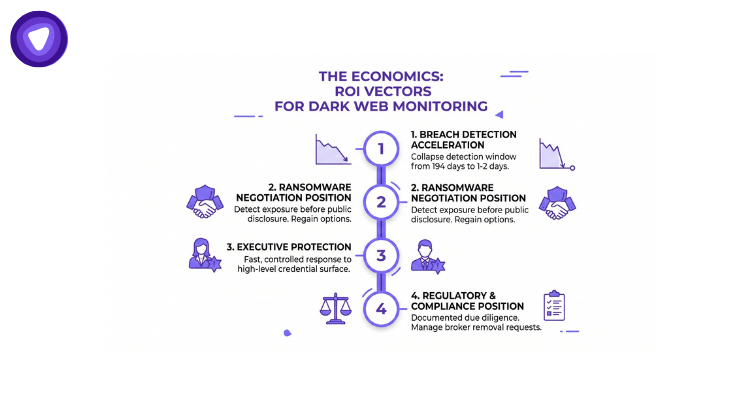
Brand protection spend is often framed as insurance rather than investment. That framing is understandable but incomplete. The economics actually break down into four clear ROI vectors:
1. Breach Detection Acceleration
Without dark web monitoring, you detect credential compromise through anomalous login attempts or customer complaints. With it, you detect the moment credentials are harvested. Average breach undetected is 194 days. Dark web monitoring collapses that window from 194 days to 1-2 days. The financial impact is direct: each day of undetected compromise costs credential reset cycles, customer notification, forensics, and potential regulatory fines.
2. Ransomware Negotiation Position
When your data surfaces on a ransomware leak site, you are already negotiating from a weak position. When you detect it before public disclosure, your options expand: negotiate quietly, notify only strategic partners, manage PR on your timeline rather than the attacker’s. One negotiation advantage is worth far more than the annual cost of monitoring.
3. Executive Protection and Insider Threat Clarity
When an executive’s personal credentials surface on the dark web, the risk is not just account takeover. It is business email compromise, credentials chained to larger network attacks, and personal reputation damage that affects the company. Dark web monitoring flags this immediately. Response is fast and controlled.
4. Regulatory and Compliance Positioning
California DROP enforcement now allows consumers to request deletion from all 545 registered brokers in a single click, and starting August 2026, brokers face $200/day per unfulfilled request. Regulators now expect companies to monitor and respond to exposure events. Documented dark web monitoring becomes evidence of due diligence in breach investigations and regulatory inquiries.
These vectors make dark web monitoring budgeting easier: it is not “how much can we spend on monitoring?” but “how much exposure can we afford to miss?”
The Technical Layer: How Detection Actually Works
Brand protection teams often inherit dark web monitoring without understanding the infrastructure underneath. That gap creates blind spots.
Modern monitoring platforms work by continuously crawling and indexing multiple data sources:
Source Coverage and Deduplication Platforms maintain indexed copies of major Tor forums, ransomware leak sites, paste sites (Pastebin, GitHub gists), and stealer log marketplaces. This requires dedicated infrastructure. Just staying synchronized with a single ransomware leak site’s daily updates is a non-trivial engineering problem. Different platforms have different source coverage depth. Specialized credential-focused platforms index infostealer feeds extensively. Broader digital risk platforms spread coverage across brand mentions, lookalike domains, and social media fraud.
Real-Time vs. Batch Processing The fastest platforms process stealer logs in real-time (alerts fire within minutes). Batch processors scan daily or weekly and lose the window where credentials are most dangerous. For operational teams, this speed difference is the difference between proactive containment and reactive crisis management.
Webhook and Integration Architecture A working platform does not just email alerts. It publishes findings via webhook to your SIEM, your identity provider, or your incident response system. That integration enables automated response. Credential reset flows trigger without manual intervention when a privileged account surfaces.
The technical investment required to do this correctly is substantial. That is why most brand protection teams outsource rather than build.
Common Implementation Gaps and How Teams Fail
Even well-intentioned dark web monitoring deployments miss critical exposures. Here is what goes wrong:
Gap 1: Incomplete Asset Inventory Teams monitor five executive email addresses but do not monitor domain-controlled credentials or application service accounts. The exposures come through accounts the team did not know existed.
Gap 2: No Incident Response Choreography The platform sends alerts. No one owns response. Three days later, a credential is still sitting on a marketplace waiting to be weaponized. Fast detection with slow response is theater.
Gap 3: Alert Fatigue and Triage Burden Some platforms generate 200 alerts per week, 90% of which are false positives or duplicates. Team stops reading them within two weeks. The real exposure gets buried in noise.
Gap 4: Blind Spot on Ransomware Negotiation Sites Ransomware leak sites are not searchable in most dark web monitoring. A team can miss their own data because the data is not indexed in their platform. Some platforms require manual inclusion of specific ransomware sites you are worried about.
Gap 5: No Legal or Regulatory Framework Detection without context creates liability. If you find your customer data on the dark web, what is your obligation to notify? Which regulator? What timeline? The operational team should not be inventing this workflow during an incident.
Building Your Dark Web Monitoring Toolkit: What to Evaluate
Effective brand protection monitoring is not a single tool. It is a layered stack. Here is how teams typically build it:
Layer 1: Credential Monitoring (Required) Focus: Detect employee and customer credentials in stealer logs and breach dumps. Speed of detection matters here. Real-time or near-real-time beats daily batch processing. Integrate with identity provider or SIEM for automated response.
Layer 2: Brand Mention Monitoring (Recommended) Focus: Detect your brand name in forum discussions, ransomware leak sites, marketplace listings. This catches early-stage threats before they materialize. Priority: capture intent signals (sell, ransom, impersonate) vs. neutral mentions.
Layer 3: Executive Exposure Monitoring (Recommended) Focus: Named executives’ personal credentials, social media handles, and mentions on threat actor forums. Deduplication essential here (same executive’s email surfaces across multiple dumps).
Layer 4: Takedown and Remediation (Value-Add) Focus: Automated or managed takedowns of phishing kits using your brand, lookalike domains, impersonation profiles. This closes the response loop.
No single vendor does all four equally well. Most teams pick a strong primary platform (usually credential or brand-focused) and layer in specialized tools for coverage gaps.
Real Response Playbooks: What Teams Actually Do
When alerts fire, here is how mature brand protection teams respond:
Scenario 1: Employee Credential in Stealer Log Alert fires: “john.smith@company.com:password123 in Marketplace X infostealer feed”
- Minute 0: Alert hits security team and john’s manager
- Minute 5: IT forces password reset and re-authentication for john’s account
- Minute 10: MFA requirement is enforced if not already enabled
- Minute 30: Forensics checks for unauthorized logins in john’s email audit logs
- Hour 2: john’s manager confirms john recognizes the incident and confirms no sensitive actions were taken on his account
Scenario 2: Brand Name on Ransomware Leak Site Alert fires: “Company name detected on ransomware site leak page”
- Hour 0: Security team and general counsel notified immediately
- Hour 2: Forensic investigation starts (do we actually have data on this site, or is this a bluff?)
- Hour 4: Crisis communication team prepared to draft customer notifications
- Day 1: Formal decision on negotiation vs. law enforcement escalation
- Day 3-5: Customer notification and regulatory filings if applicable
Scenario 3: Executive Personal Credential Surface Alert fires: “ceo@personal_email.com:password in breach dump”
- Minute 0: Immediate notification to executive and executive protection team
- Minute 5: Password reset guidance provided (personal account, not corporate)
- Hour 1: Assessment of whether personal compromise could chain to corporate access
- Day 1: If chaining risk exists, corporate password reset and MFA review
These playbooks are not invented during crisis. They are documented, tested, and automated where possible.
Bundling Dark Web Monitoring Into Broader Security Stacks
Most brand protection teams do not deploy dark web monitoring in isolation. They layer it into broader privacy and security infrastructure.
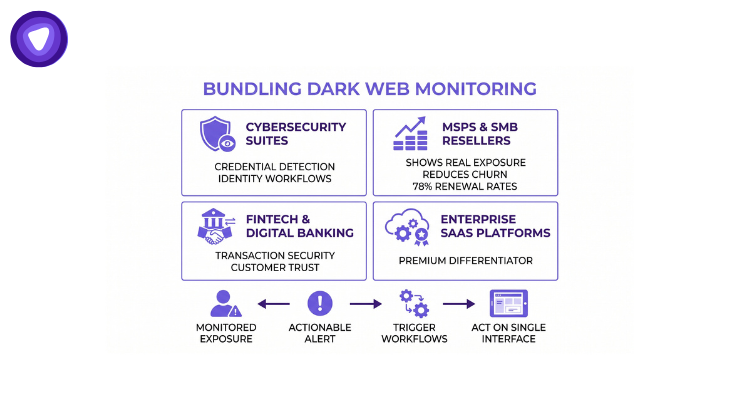
For cybersecurity suites bundling antivirus, identity protection, and VPN services, dark web monitoring becomes a logical extension: credential detection feeds directly into identity protection workflows. For MSPs reselling security to SMB clients, adding dark web monitoring as an upsell service shows real exposure on presales calls and reduces churn. MSP renewal rates reach 78% when bundled with existing security offerings.
For fintech and digital banking platforms, dark web monitoring rounds out transaction security and customer trust positioning. For enterprise SaaS platforms, it becomes a premium feature differentiating the product from competitors.
The integration pattern is consistent: monitored exposure becomes an actionable alert, the alert triggers workflows in your existing security infrastructure, and the team acts on a single pane of glass rather than toggling between dashboards.
Making the Dark Web Monitoring Investment Stick
Dark web monitoring deployments fail most often not because the technology is weak but because implementation falters:
Governance Problem Who owns dark web monitoring? If security owns it but incident response does not, findings go nowhere. If leadership is looped in for every alert, false positives create alert fatigue at the executive level. Ownership must be clear and incident response workflows must be mapped before deployment.
Staffing Reality Dark web monitoring adds triage burden. If your team is already stretched thin, monitoring without staffing creates chaos. Many teams underbuy their platform, start with five monitored assets, and discover they need to monitor 50 within three months. Initial scoping is critical.
Alert Calibration Platforms default to aggressive alerting. Turn it down immediately. Tune for high-confidence findings and clear incident response paths. After 30 days of tuning, reassess. Most teams operate at 80% sensitivity rather than 100%.
Integration Discipline Get the boring integrations right first. Webhook to your SIEM. Credential reset trigger to your identity provider. Ticket auto-creation to your incident response system. These integrations make the difference between theater and operational security.
See It in Action: How Bundled Dark Web Monitoring Works in Practice
A mid-market EDR vendor faced a common challenge: their endpoint detection and response platform was mature, but customers increasingly wanted integrated privacy and credential protection. Building this capability from scratch would consume months of engineering resources and delay other roadmap priorities.
Instead of building, the vendor licensed PureVPN’s Digital Privacy Protection platform and bundled it into their existing offering. Within months, the addition drove measurable business impact: new customer acquisition accelerated, retention improved among bundled users, and the privacy module became a standard upsell.
For brand protection specifically, this integration meant customers got real-time alerts when their credentials appeared on the dark web or their brand was mentioned in forums. Those alerts triggered automatically within the EDR platform, not as a separate dashboard or vendor integration. Security teams saw exposure and responded without context-switching.
The economic impact validated the bundling thesis: customers perceived real value across multiple security layers (endpoint detection + credentials + privacy), not just one. Bundled retention rates climbed. And because the vendor outsourced the dark web monitoring infrastructure instead of building it, they freed engineering capacity for other features while capturing new recurring revenue.
This operational model requires bundled integration, clear response workflows, and unified customer experience. That is what makes dark web monitoring investment sustainable. For the full case study details, see this MSSP case study.
How PureVPN White Label VPN Solution Helps
Dark web monitoring detects exposure. VPN encryption prevents the exposure from happening in the first place. For security teams and cybersecurity vendors, this layered approach combines detection with prevention. It creates a complete privacy posture that customers actually value.
PureVPN White Label VPN Solution integrates directly into existing security suites as a branded, managed service. When dark web monitoring alerts flag a credential on the dark web, the VPN layer ensures that future connections from that user are encrypted end-to-end, preventing new credential harvesting via network interception. For brand protection teams, this means executives traveling on public networks, remote teams accessing sensitive systems, and customer connections all benefit from the same privacy infrastructure.
The bundled adoption model works because dark web monitoring makes the privacy risk visible (your credentials are already exposed), and the VPN makes the response actionable (encrypt future traffic). Security vendors packaging these together see measurable retention gains. MSPs cross-selling the bundle to SMB clients see faster sales cycles because the exposure detection justifies the encryption investment on presales calls.
For teams already running dark web monitoring, adding VPN doesn’t require parallel infrastructure or separate vendor management. The same white-label branding applies, the same alerting pathway works, and the same team owns the entire privacy stack. That operational simplicity is what drives adoption beyond the initial dark web detection use case.
Conclusion
Dark web monitoring for brand protection is no longer a nice-to-have for large enterprises. It is operational infrastructure for anyone managing credential risk, executive exposure, or customer trust. The operational value sits not in the monitoring itself but in the speed of detection, clarity of response, and integration with existing security workflows.
The teams that get the most value from dark web monitoring share common practices: they own the triage workflow before deployment, they integrate alerts into existing response systems rather than creating parallel workflows, and they treat exposure management as a continuity issue rather than a line-item software purchase. Those disciplines transform dark web monitoring from a data feed into a critical operational tool.