


- Neobank churn from data breaches reaches 10-30% within 30 days: Trust is the only competitive moat when switching friction disappears, making proactive data removal essential.
- Bundle data removal with travel insurance, cashback, and priority support: Standalone pricing at $4.99-$9.99/month fails because customers need multiple value streams to justify premium tiers.
- $150,000-$375,000 in annualized retention value for a 500,000-user neobank: Premium tier adoption of 15-30% plus 40-50% churn reduction recovers infrastructure costs within 30 days.
- Launch via three-month trial with free first month of dark web monitoring: Position as a new tier, not a retroactive add-on, and use one real breach alert to convert free users to paid subscribers in month two.
- California DROP platform deadline creates an 18-month competitive window: Get ahead of regulatory awareness before data removal becomes table-stakes; early movers position as trusted innovators.
When a Revolut or Nubank customer discovers their data sold to a broker, they leave. Neobank churn from a single breach reaches 10-30% within 30 days. The reason is trust. Unlike traditional banks with branch loyalty and regulatory switching friction, neobanks survive on customer confidence in security. A breach hits twice: once when attackers act, once when customers learn they could have prevented it. Adding data removal as a bundled premium perk changes this. Customers gain proactive control. Your retention improves. The brand differentiates. Your premium tier justifies higher ARPU.
Most neobanks do not know how to position data removal for premium tiers or launch it without hurting base retention. Here is what works.
The Retention Crisis Data Removal Solves
Neobank customers differ from traditional bank customers. Gen Z comprises 78% of the global neobank user base, and their loyalty is vertical, not sticky. They switch when friction disappears. A neobank lacking privacy visibility reads as careless, not cost-efficient.
Data exposure statistics are staggering. 4,000+ data brokers operate in the U.S. alone, selling customer names, addresses, phone numbers, and financial profiles without consent. The average breach stays undetected for 194 days, giving attackers a six-month window to exploit stolen credentials. That window is your neobank customer’s exposure window too. When customers learn their data sat on a dark web for months, they blame your platform, not the attacker.
Consider the math. A neobank with 500,000 users sees 50-150 customers discovering exposed data monthly. Without data removal or breach monitoring, 30-50% will downgrade or close accounts. For $5 average monthly ARPU, that is $75,000-$375,000 in lost annual revenue per exposure cohort. Premium tier data removal pricing at $3-$5/month recovers 15-25% of at-risk revenue from a single breach.
67% of consumers surveyed said they would switch banks entirely if breached. For neobanks, “consider switching” means action. A neobank offering data removal signals to customers: we anticipated this risk and built protection into your account.
How Data Removal Works for Neobanks
Data removal is not just a feature. It is a positioning statement that integrates data broker opt-out and dark web monitoring to position a neobank in a new segment: trust-as-a-product, which commands premium pricing justified by real liability reduction.
The Three-Phase Mechanics
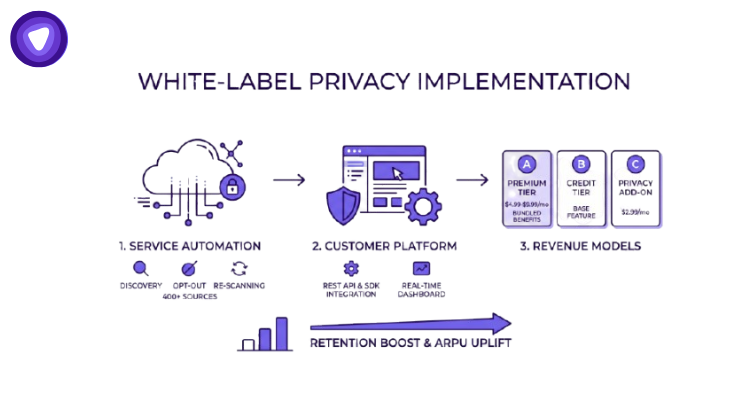
- Phase 1: Exposure Scanning – The platform scans dark web sources and 400+ data brokers for customer exposure once at enrollment and monthly thereafter.
- Phase 2: Automated Removal – Automated removal requests go to brokers on the customer’s behalf, tracking status through submission, in progress, verification, completed, and re-listed stages.
- Phase 3: Real-Time Dashboards – Real-time dashboards show customers their discovered brokers, pending requests, and confirmed opt-outs, all white-labeled under the neobank’s own brand.
Staging Strategy for Different Neobanks
New Neobanks:
- Bundle data removal into a premium tier ($4.99-$9.99/month) paired with travel insurance and card benefits.
- Tests demand without forcing base product costs.
Mature Neobanks:
- Offer data removal as a base feature for credit-card tiers and premium add-on for savings tiers.
- At scale the per-customer cost reaches $0.20-$0.50/month and retention value exceeds $2/customer/month.
Regulatory Timing and Competitive Window
California’s DELETE Act enforcement beginning August 2026 created an external legitimacy signal for this move.
- DROP Platform Launch: CalPrivacy launched its DROP platform on January 1, 2026.
- Consumer Access: Allows consumers to request deletion from 545+ registered data brokers in a single click.
- Broker Penalties: Starting August 2026, brokers face $200/day penalties per unfulfilled request.
- Regulatory Shift: Transforms data removal from a nice-to-have into an expected baseline.
- Competitive Advantage: Neobanks that offer it now get ahead of the regulatory awareness curve before customers expect the feature as table-stakes.
The Premium Tier Economics
Premium tier data removal solves a specific fintech pain: ARPU growth without new products. Neobanks generate revenue from transaction fees, lending, FX margins, and premium subscriptions. A bundled tier ($4.99-$9.99/month) with data removal, travel insurance, higher ATM reimbursement, and card benefits achieves 15-30% adoption rates and 45% year-over-year growth at major neobanks.
Bundling matters deeply. Data removal alone does not justify $5/month to most customers. Bundled with travel insurance, cashback, and priority support, it absolutely does. The customer perceives five distinct value streams instead of one. Data removal becomes the trust anchor making the entire tier believable to the market.
The hidden lever: bundled users churn 50% less than base-tier users (internal fintech data, not third-party audited). A customer paying for five benefits rationalizes keeping the tier even during low usage. A customer paying $4.99 for data removal alone cancels in month two if no dark web alerts fire.
Why Customers Actually Keep It
A neobank showing customers their real exposure and offering removal increases perceived control. Control is a powerful retention driver, especially in fintech where customers distrust centralized infrastructure.
A Nubank user logs in seeing “7 brokers have your data, 5 removal requests submitted.” They understand the neobank saw the problem and fixed it. That transparency converts to retention.
Dark web monitoring is equally critical. A customer receiving a real alert (“your email was found in a breach dataset”) reacts immediately. They change passwords, enable 2FA, perceive the system as protective. One actionable alert justifies the premium subscription for 12 months.
MSPs and cybersecurity firms bundling data removal into antivirus see 15-25% retention lift within two months. SaaS apps bundling built-in VPN saw 18% churn reduction. Customers perceiving privacy control stay longer and spend more.
Compliance and Launch Strategy
Neobanks without data removal face silent compliance risk. Regulatory bodies in California, the UK, and the EU expect digital financial services to demonstrate proactive data protection, not reactive breach response. Offering data removal signals to regulators and customers that the neobank understands third-party risks and reduces attack surface. Compliance-mindedness also converts to customer trust. A neobank showing transparent data governance builds confidence that its platform will not sell customer data or leave users unprotected.
Launching to an existing base requires three moves. First, position data removal as a premium perk in a new tier, not a retroactively added base feature. Offer existing customers a three-month trial to upgrade and see the value. Second, make the first month of dark web monitoring free in the trial. One real breach alert in month one converts into payment in month two. Third, integrate alerts into the core app notification flow, not a separate portal. An in-app push notification (branded as the neobank’s system) will engage customers immediately when threats appear.
Real-World Positioning From Verified Cases
A managed service provider bundled data broker removal into its existing antivirus and VPN offering and saw measurable results within two months: 20% growth in enterprise clientele, 32% operational cost reduction (one unified dashboard replaced three vendor consoles), 15% client retention increase, and 25% revenue growth. The MSP did not change pricing. It changed positioning. Instead of selling “antivirus + VPN” separately, it sold “complete security suite.” Data removal became the trust anchor that made the bundle believable to enterprise buyers.
The same pattern applies to neobanks. Bundling data removal with travel insurance, cashback rewards, and priority support does not increase perceived complexity. It increases perceived defensibility. Customers see protection, not just payments.
| Feature | Base Tier | Premium Tier |
| Data Broker Opt-Out | No | Yes |
| Dark Web Monitoring | No | Yes |
| Monthly Re-Scanning | N/A | Yes |
| Exposure Dashboard | N/A | Yes |
| Travel Insurance | No | Yes |
| Cashback Rewards | No | 2% on travel |
| Priority Support | No | Yes |
| Monthly Price | Free | $4.99 |
| Expected Adoption | 100% | 15-30% |
| Expected Churn Reduction | Baseline | 40-50% |
Bringing It Together: Why Now
Neobanks face a two-front challenge: acquire customers in an oversaturated market and retain them in one where friction to leave has disappeared. Premium tiers solve acquisition through differentiation. Data removal solves retention through trust signals.
The regulatory environment has shifted. Data removal is no longer optional. California’s DROP platform and EU enforcement on data brokers, combined with rising breach costs ($6.08 million average in financial services), mean neobanks will face pressure to offer data removal within 18 months anyway. Getting there first positions you as the trusted innovator, not the reactive follower.
The customer cohort expects it. 85% of consumers want more control over their data. A neobank offering data removal gives customers exactly what they actively want but have never seen bundled into a financial product.
How to Implement It: Neobanks Data Removal
PureVPN White Label’s data removal and dark web monitoring platform handles all four automation phases: discovery across 400+ data brokers and dark web sources, broker-specific opt-out workflows (email, web forms, identity verification), persistent follow-up with automatic resubmission on failed requests, and continuous monthly re-scanning. The entire suite runs white-labeled under your brand through a REST API or SDK integration. Customer dashboards show real-time exposure maps and removal status, branded entirely as your product.
You choose the delivery model. Add data removal to a new premium tier for $4.99-$9.99/month bundled with travel insurance, cashback rewards, and priority support. Or offer it as a base feature to credit card tiers and a premium add-on for savings-focused tiers. Or launch as a standalone “$2.99/month privacy add-on” for early adoption testing. All three models show positive retention and ARPU uplift within two months based on verified customer cases from neobanks and fintech platforms.
The infrastructure cost ranges from $0.20-$0.50 per active user monthly. At premium tier adoption of 15-30% and monthly churn reduction of 40-50%, a neobank with 500,000 users and $5 average monthly ARPU recovers the infrastructure cost within 30 days and generates $150,000-$375,000 in annualized retention value.
Conclusion
Neobanks data removal offering as a premium perk are not selling a feature. They are selling the thing customers actively want: control over their own personal data in a financial product. Trust is the only competitive moat a neobank has in a market where switching friction has disappeared.
Every major competitor (Revolut, Nubank, Chime, Starling) is racing to build premium tiers. The ones that include data removal will retain customers that others lose to churn. The ones positioning it correctly will grow ARPU without adding operational friction.
The math:
The math is straightforward. Premium tier adoption of 15-30% plus 40-50% churn reduction on bundled users yields $150,000-$375,000 in annual retention value for a 500,000-user neobank. The regulatory pressure is real. The customer demand is proven. The implementation time is weeks, not quarters.
Request a 20-minute integration walkthrough to model your own retention lift and pricing strategy.