

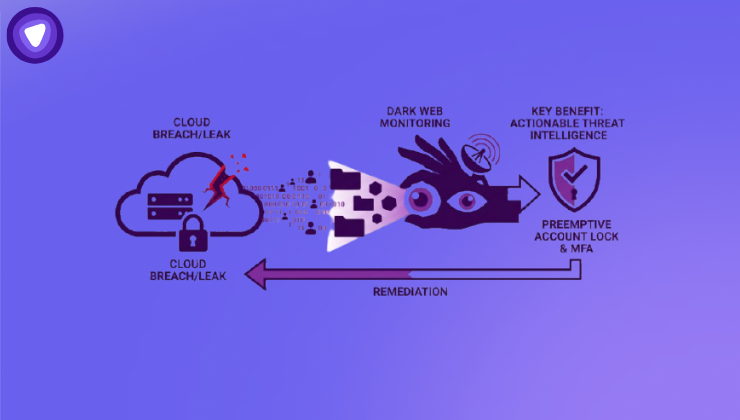
- Timing Over Detection: The key benefit of dark web monitoring services is timing. It flags a stolen credential before reuse, not after a breach report.
- Detection Lag: Breaches involving stolen credentials take 292 days to identify and contain, longer than any other attack vector.
- Beyond Passwords: Cloud relevant monitoring has to cover session tokens and API keys, not just personal identifiers like email and passport data.
- Long-Lived Credentials: 59% of AWS IAM users carry an access key older than one year, the exact credential type this closes.
- Real-Time Alerting: Dark web monitoring alerts arrive by webhook the moment a match is confirmed, with no polling delay.
Quick Answer: The key benefit of dark web monitoring services for cloud security teams is closing a gap Zero Trust cannot see on its own. Zero Trust verifies each access request. It does not verify whether the credential behind that request was already stolen. Dark web monitoring checks that separately, before the credential gets reused.
Zero Trust architecture starts from one assumption. Every identity requesting access has already been verified. Dark web monitoring services exist because that assumption fails constantly, silently, and long before a breach alert fires. The key benefit of dark web monitoring services for a cloud security team is not detection for its own sake. It is what that detection does to a trust model built on identities nobody has re-checked since onboarding.
Breaches that start with stolen credentials take 292 days to identify and contain, longer than any other attack vector. A cloud security team enforcing Zero Trust policies still authenticates that stolen credential correctly every time it gets used. Zero Trust checks the request. It does not check the credential’s history before that request was ever made.
What Is a Key Benefit of Dark Web Monitoring Services for Cloud Security Teams?
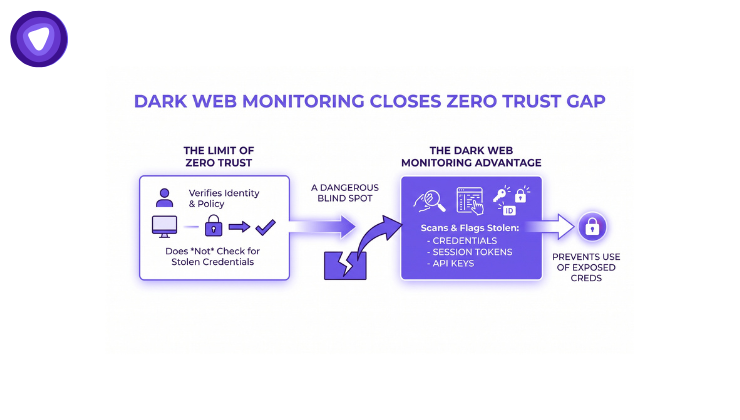
Zero Trust access controls verify who is asking and whether the request fits policy. They do not verify whether the credential behind that request was already stolen somewhere else. Dark web monitoring services close that specific gap. They scan the forums, marketplaces, and paste sites where stolen credentials, session tokens, and API keys surface, then flag a match before that credential gets used against your own systems. That is the actual key benefit of dark web monitoring services. It turns a static trust decision into one that gets re-checked against real-world exposure, continuously, not once at login.
Why Zero Trust Alone Does Not Catch This
Zero Trust was designed to stop lateral movement after initial access, not to detect a credential’s theft before it gets reused. A stolen session token replayed from a device on an approved network still passes device posture checks. Identity is now the highest priority risk area in most organizations’ Zero Trust strategy, ranked above network segmentation and device trust combined.
What Changes When Monitoring Closes the Gap
Once dark web monitoring is wired into an existing access-control stack, three things change:
- A leaked credential triggers forced rotation before it gets used, not after a breach report.
- Security teams gain a documented exposure timeline for every flagged identity.
- Access reviews shift from scheduled audits to event-driven response.
Credentials That Actually Matter to a Cloud Security Stack
Consumer dark web monitoring tools were built to watch personal identifiers such as email addresses, phone numbers, and passport numbers. A cloud security team cares about a narrower, more dangerous set of exposures. This is where the key benefit of dark web monitoring services becomes concrete for a cloud stack instead of a personal one.
Session Tokens and API Keys, Not Just Passwords
Monitoring built for this ICP extends coverage to session tokens and API keys traded alongside personal data, a distinction most consumer-grade services skip entirely. A leaked API key behaves like a master password to whatever system it authenticates against. Consumer-facing dark web monitoring tends to track monitored identifiers such as email, phone number, credit card, and passport data, encrypted before transmission and stored using SHA hashing. Cloud-relevant monitoring has to go further and watch machine credentials too.
Where Long-Lived Cloud Credentials Fit In
Long-lived credentials are the exact category attackers profit from once they surface on the dark web. This year, 59% of AWS IAM users carried an access key older than one year. An old, unrotated key that leaks in a build log or container image behaves exactly like a stolen password once it reaches a marketplace. Neither expires on its own, and neither gets flagged by an access-control policy that only checks the request in front of it.
What Zero Trust Catches vs. What Dark Web Monitoring Catches
The difference is easiest to see side by side. Zero Trust access controls evaluate the request itself. Dark web monitoring evaluates the credential’s exposure history before the request ever happens. Here, the key benefit of dark web monitoring services shows up as a timing difference, not a feature checklist.
| Attack Signal | Zero Trust Access Controls Alone | Dark Web Monitoring |
| Stolen session token replayed from a trusted device | Passes, matches a known device | Flags the token as compromised before reuse |
| Leaked API key used within normal rate limits | Passes, request looks routine | Flags key exposure at the source, before misuse |
| Reused employee password found in a breach dump | Passes if MFA is not enforced | Flags the password before credential stuffing begins |
| Service account credential sold on a dark web forum | Not evaluated, no live request yet | Flags exposure before any request is ever made |
How Monitoring Data Reaches an Existing Security Stack
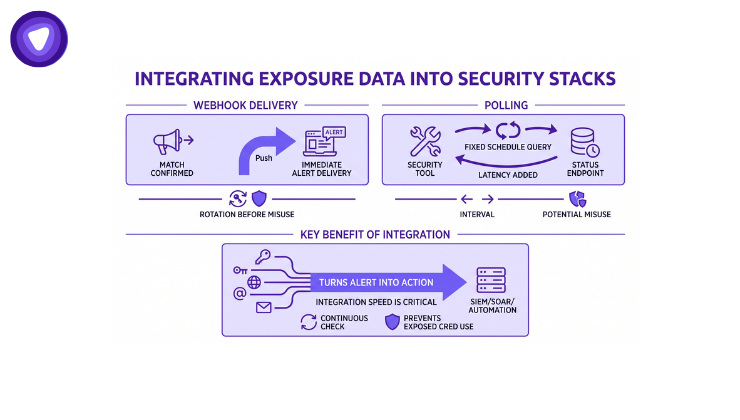
A dashboard nobody checks provides no real coverage. Coverage depends entirely on how exposure data reaches the tools a cloud security team already runs day to day. The key benefit of dark web monitoring services depends on how fast that alert reaches your stack, not on how the alert looks in isolation.
Provisioning and Identity Registration
Coverage starts by registering an identifier, such as a service account email or a monitored domain, through an authenticated API call. The underlying flow follows a fixed sequence: exchange a secret key for an access token. Register the identifier through user management, then check exposure through identity exposure intelligence. Once registered, that identifier gets checked continuously against dark web sources, not on a single one-time scan.
Webhook Delivery vs. Polling
White label dark web monitoring APIs typically support two delivery models. A webhook pushes an alert into a SIEM or SOAR platform the moment a match is confirmed. Polling requires the security team to query a status endpoint on a fixed schedule, which adds latency equal to the polling interval itself. For a credential that could already be for sale, that interval is the difference between rotation before misuse and rotation after it.
The Economics of Buy vs. Build for a Cloud Security Vendor
Cloud security vendors selling into enterprise accounts increasingly need to show a credential-exposure capability during procurement review, not just a roadmap slide. The key benefit of dark web monitoring services shows up on a procurement scorecard too, well before it shows up in a dashboard.
Building broker and dark web source coverage in-house means securing access across forums, marketplaces, and paste sites that rotate constantly. One under three weeks white-label integration replaced an in-house build a cybersecurity suite vendor had estimated at six or more months of engineering time, launched fully branded on its own pricing and dashboard. That gap matters most during a competitive sales cycle, when a missing capability can stall a deal a competitor already closed.
Compliance and Audit Fit for Regulated Cloud Environments
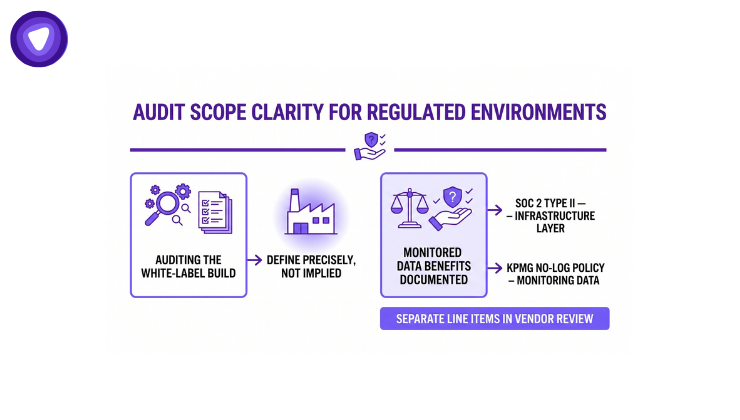
A cloud security team evaluating a monitoring vendor needs the audit scope defined precisely, not implied by a badge on a page. Independent audit scope should state clearly whether the review covers the white-label build itself, not only the parent brand’s infrastructure.
Auditors also want this key benefit of dark web monitoring services documented, not just claimed in marketing copy. SOC 2 Type II certification and a KPMG-verified no-log policy are two different claims covering two different layers. The infrastructure layer and the monitoring data itself, and both should appear as separate line items in any vendor review, not one blended statement.
How PureVPN White Label Dark Web Monitoring Fits
PureVPN White Label Dark Web Monitoring delivers this key benefit of dark web monitoring services through a single API, covering personal identifiers, session tokens, and API keys under one partner dashboard. The infrastructure runs on 17 or more years in privacy infrastructure and 150 or more partners worldwide. Both figures reported directly by PureVPN White Label rather than independently audited.
For a cloud security or Zero Trust vendor evaluating build versus buy, the module sits alongside broker opt-out and VPN offerings, deployable standalone or bundled for higher average revenue per user. Partners running bundled privacy products report churn roughly 50% lower than single-product accounts, a figure the company also reports as internal data rather than third-party audited.
Where This Leaves Cloud Security Teams
The key benefit of dark web monitoring services for a cloud security team is timing. Zero Trust checks whether a request fits policy right now. Dark web monitoring checks whether the credential behind that request was already sold, leaked, or traded before the request was made. Both are necessary. Neither replaces the other, and a stack missing either one is verifying identities it cannot fully trust.
For a security vendor bundling this into an existing Zero Trust or IAM product, the build decision comes down to engineering months against a working API.