


- Not Redundant: Dark web monitoring is not redundant with MFA, firewalls, or SIEM tools. Those defend live infrastructure, while dark web monitoring is the only layer that flags credentials already exposed from a past breach.
- Buyer Pressure: The cost of skipping it already shows up in sales cycles. 97% of software buyers now involve a security stakeholder before closing a deal, and SaaS was the top targeted sector for credential stuffing in 2025.
- Build vs License: Building this in-house is slower than most teams expect. One documented case put the internal build timeline at more than six months, versus three weeks through an existing API.
- Alert Ownership: Coverage alone does not solve the problem. Alerts need severity tiers and a clear owner, or a live monitoring feed just becomes noise for an already stretched team.
- Liability Scope: Offering monitoring does not make a SaaS platform liable for third-party breaches, but it does create a duty to act reasonably once an exposure is known, which GDPR and CCPA both treat as a separate obligation.
Quick Answer: Yes, for most SaaS platforms already running MFA, a firewall, and a SIEM. Those tools defend live infrastructure. None of them detect credentials already exposed in a past breach, and that gap is what enables account takeover.
SaaS breaches jumped 300% year over year, and nearly all trace back to compromised identity rather than an infrastructure gap. Dark web monitoring closes that specific blind spot instead of duplicating one already covered. Licensing it through an API typically costs far less than building it in-house. Skipping it becomes hard to defend once security review enters the sales cycle.
A SaaS product team can run multi-factor authentication, a firewall, and a fully staffed SOC. It can still have zero visibility into whether its own users’ credentials already sit on a criminal forum. That gap is not theoretical, and it is not cheap.
IBM’s 2025 Cost of a Data Breach Report put the global average cost of a breach at $4.44 million. Obsidian Security’s 2025 SaaS threat report found SaaS breaches jumped 300% year over year between September 2023 and 2024. Nearly every one traced back to compromised identity, not a broken firewall rule. That single fact reframes the question. The real issue is whether dark web monitoring is necessary for online businesses that already feel well defended.
This is not a generic security pitch. Product teams asking whether dark web monitoring is necessary for online businesses are usually three tools deep already. The honest answer depends on what those tools actually cover. It depends on build cost against vendor pricing. It depends on who owns the fallout when an alert gets missed. Those are the questions this piece answers, in order.
What Dark Web Monitoring Actually Watches for a SaaS Product
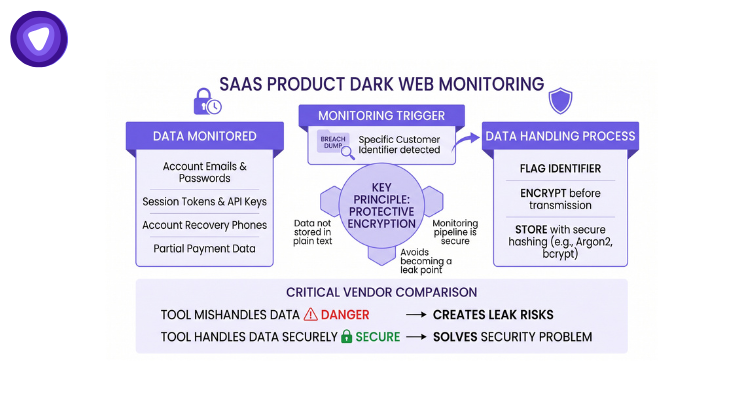
Dark web monitoring for a SaaS platform is narrower than the marketing language suggests. It is not a general threat feed. Rather, it tracks specific identifiers tied to a company’s own user base. It flags the moment one of those identifiers appears in a breach dump, a stealer log, or a marketplace listing.
For a typical SaaS product, that identifier set usually includes:
- Account email and password pairs
- Session tokens and API keys tied to customer accounts
- Phone numbers used for account recovery
- Payment-adjacent identifiers such as partial card data, where applicable
Once an identifier is flagged, the service has to encrypt and store it correctly first. On the identity side of PureVPN’s infrastructure, monitored identifiers are encrypted before transmission. They are stored using a secure hashing standard, not plain text. This matters. A careless monitoring pipeline becomes a second place user data could leak from. That storage detail rarely shows up in vendor comparisons, and it should. A tool that mishandles the data it protects creates the exact problem it claims to solve.
The Real Cost of Not Asking Whether Dark Web Monitoring Is Necessary for Online Businesses
Skipping this evaluation has a price, and it shows up before a breach even happens. A 2025 Radware analysis of credential stuffing campaigns found technology and SaaS companies were the top targeted sector. That ranking put SaaS ahead of financial services and travel combined. This is not a coincidence. Attackers go where reused passwords and thin session security concentrate. Multi-tenant SaaS products are full of both, and the targeting is happening now, not on some future deadline.
The buyer side has shifted just as fast. G2’s 2024 Software Buyer Behavior Report found that 97% of buyers now involve a security stakeholder before closing a deal. That is up from 86% a year earlier. Separately, Gartner Digital Markets found 47% of buyers say security concerns triggered a purchase in the past year. A vendor that cannot explain how it detects exposed credentials answers that conversation with silence. That happens in this year’s sales cycle, not a future one.
Detection speed compounds the cost further. The same 2025 report puts the global average breach lifecycle at 241 days, start to full containment. Every one of those days is a window where a leaked credential still works. Nothing in a standard security stack flags that it is already gone.
Put a number on it for a mid-size product. A SaaS platform with 40,000 registered users has real exposure to consider. At a 2% credential-reuse rate, roughly 800 accounts sit at risk from any single third-party breach. That figure is illustrative, but the reuse rate behind it is realistic.
What It Catches That Your Other Security Layers Miss
This is the question generic content skips entirely. It is also the one that decides whether dark web monitoring is necessary for online businesses running a mature stack. Each layer in a typical setup solves a different problem, and none of them solve this one.
| Security Layer | What It Actually Detects | What It Misses |
| Multi-factor authentication | Blocks login attempts without the second factor | Credentials already sold or reused before MFA was enabled |
| Password manager | Reduces password reuse going forward | Historical breaches involving passwords set before adoption |
| Web application firewall | Malicious traffic patterns hitting the app itself | Data already exfiltrated and sitting on a criminal forum |
| SIEM or EDR | Suspicious activity inside the company’s own network | Anything happening on infrastructure the company does not control |
| Dark web monitoring | Credentials, tokens, and PII already exposed externally | Active attacks in progress against live infrastructure |
None of these tools overlap with dark web monitoring in any real way. A firewall has nothing to say about a password that leaked two years ago. A SIEM only sees activity inside a company’s own perimeter. Dark web monitoring answers one question instead. Has this identifier already left the building, and does someone already have it.
Build It, License It, or Skip It
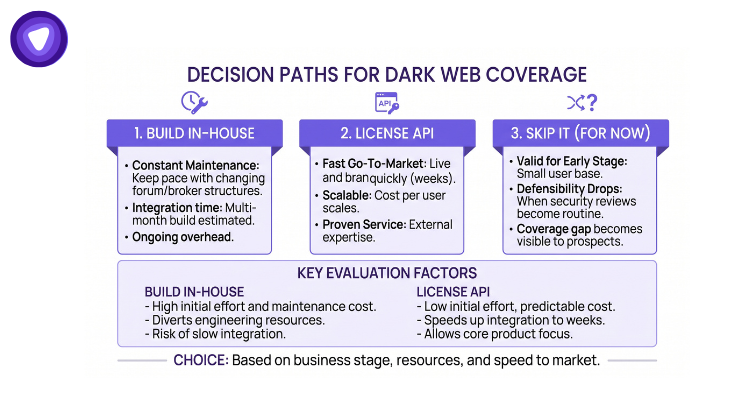
Once the coverage gap is clear, the decision becomes economic, not technical. This is where the answer to whether dark web monitoring is necessary for online businesses gets decided by budget. Product teams generally weigh three real paths.
Building In-House
A homegrown scraper covering forums, marketplaces, and stealer log dumps sounds simple at first. The maintenance load is where it stops being simple. Broker and forum structures change constantly. A team has to keep pace indefinitely, not just at launch. One product executive evaluating this exact build described it plainly on PureVPN’s own privacy platform page. Internal engineering estimated the integration work alone at more than six months, before ongoing maintenance was even counted.
Licensing Through an API
Embedding an existing monitoring service through an API skips the multi-month build entirely. The same executive had the module live and branded within three weeks after switching paths. It ran on their own pricing from day one. The tradeoff is a per-user or usage-based cost that scales with the customer base. That cost needs to be weighed against the deal-loss risk covered earlier.
Skipping It for Now
Skipping monitoring is a fair choice for an early product with a small user base. It works as long as no enterprise buyer is asking security questions yet. It stops being defensible once security review becomes routine in the sales cycle. That is exactly the stage where the coverage gap becomes visible to a prospect.
The Operational Question Nobody Answers: Who Owns the Alert
Coverage is only half the decision. The other half is what happens after an alert fires. This is where sound rollouts often stall. Answering whether dark web monitoring is necessary for online businesses means little if the alerts never reach the right person.
A live monitoring feed generates a steady stream of hits. Not every hit is equally urgent. A good setup sorts alerts by severity and source instead of dumping everything into one queue:
- Critical: active password-and-email pairs found in a fresh breach dump
- High: session tokens or API keys with an unclear expiry window
- Informational: PII fragments with no direct account-access risk attached
Each alert should also carry a next step someone can act on right away. That might be a forced password reset, a session revocation, or a two-factor prompt. A feed that reports exposure without a fix just adds noise to an already stretched team. Whoever owns this queue needs that decided before launch, not during the first real incident.
Where Liability Actually Sits
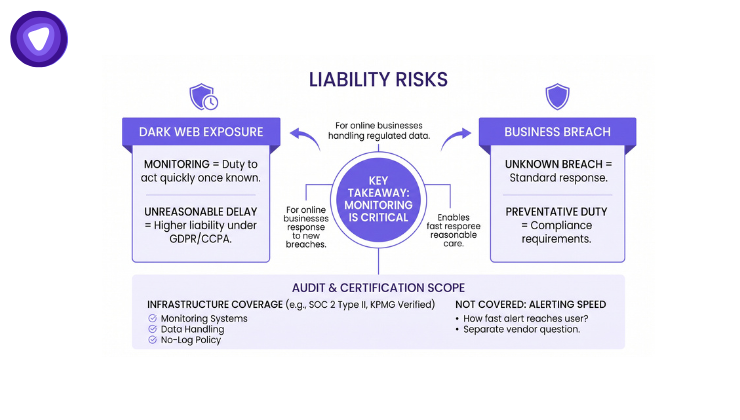
The compliance angle gets murky fast, and it is worth being precise about it. A SaaS platform offering dark web monitoring does not take on liability for third-party breaches. It does not control those sites. What it does take on is a duty to act reasonably once it knows about an exposure. GDPR and CCPA both treat unreasonable delay after known exposure differently from a breach the company never knew about.
This is one more reason dark web monitoring is necessary for online businesses handling regulated user data. Audit scope matters here too. A SOC 2 Type II certification and a KPMG-verified no-log policy cover the monitoring infrastructure itself. They do not cover how fast an alert actually reached a user. That is a separate question a SaaS buyer should ask directly.
How PureVPN White Label Fits
For product teams that decide the coverage gap is real, a six-month engineering detour is rarely worth it. PureVPN White Label Dark Web Monitoring plugs into an existing product through a REST API and SDK. No rebuild is required. Monitored identifiers, alert severity, and remediation prompts all ship branded under the partner’s own product name. A partner dashboard tracks exposure trends across the full user base.
The module deploys standalone, or alongside data broker opt-out and VPN as part of a broader privacy suite. A team that starts with monitoring alone can add coverage later without a second integration. Partners running a bundled suite see meaningfully lower churn among users who adopt more than one privacy feature. PureVPN tracks this pattern internally across its own partner base and flags it as self-reported, not third-party audited.
Necessary or Not: The Short Answer
Whether dark web monitoring is necessary for online businesses stops being abstract once a security review forces the question. By that point the answer is already yes. The only open question is whether it gets built, licensed, or left as a gap a competitor points out first. For most product teams already running MFA, a firewall, and a SIEM, dark web monitoring is not redundant with any. It is the one layer that reports what already happened outside a company’s walls. This is not done by the other three.
Teams still weighing whether dark web monitoring is necessary for online businesses can book a short technical call. It runs about twenty minutes.