

- Retention Risk: Dark web monitoring for SaaS lets platforms alert customers to exposed credentials before attackers act on them, protecting renewal revenue rather than just plugging a security gap.
- Churn Driver: Voluntary churn, the costlier half of the 3.5 percent average annual B2B SaaS churn rate, stems from lost customer confidence, not billing failures.
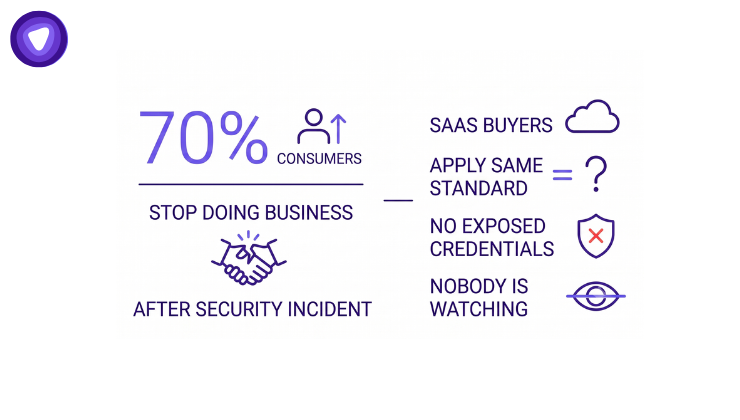
- Customer Expectation: Seventy percent of consumers say they would stop doing business with a brand after a security incident, so silence around credential exposure directly damages trust.
- Faster Rollout: White label dark web monitoring for SaaS cuts launch time from months to weeks and keeps the entire customer experience branded, unlike building in-house or buying a generic third-party tool.
- Sales Advantage: Framing this as documentation for auditors, not just a security feature, gives sales and customer success teams a concrete talking point during renewal conversations.
A SaaS platform without dark web monitoring is quietly leaving renewal revenue on the table. Not because the product lacks features. But because it has no way to warn a customer before their credentials get used against them. That silence costs subscriptions, and most product teams never trace the churn back to it.
Retention strategy in SaaS has become a competition over who protects the customer relationship best. Not just who ships the most features. Dark web monitoring is one of the few additions that turns a security function into a reason customers stay subscribed.
The Retention Gap Most SaaS Roadmaps Ignore
Product teams pour resources into onboarding flows, in-app messaging, and customer success playbooks. Security rarely gets the same budget conversation, yet it shapes renewal decisions directly.
The average annual churn rate for B2B SaaS companies sits at 3.5 percent annually, split between voluntary cancellations and failed payments. Voluntary churn is the expensive half. It comes from a loss of confidence, not a billing error, and confidence is exactly what a silent security posture damages.
Customers Already Expect This From Their Vendors
Consumer behavior backs this up. Seventy percent of consumers say they would stop doing business with a brand after a security incident. SaaS buyers apply the same standard to the software vendors holding their data. A platform with no way to flag exposed credentials is telling customers, by omission, that nobody is watching their account.
What a White Label Dark Web Monitoring Add-On Actually Gives Your Platform
This is not a generic security feature bolted onto a settings page. Done right, dark web monitoring becomes a branded capability customers see and trust as part of your product, not a third-party plug-in.
A properly built white label dark web monitoring layer gives a SaaS platform:
- Continuous scanning of breach dumps, criminal marketplaces, and leak forums for domain-specific credential exposure
- Real-time alerts routed to the affected user, sent from your platform under your brand
- API keys, session tokens, and login credentials flagged the moment they surface in a leak
- Admin-level reporting so account owners see exposure trends across their whole team
- Full white labeling of the alert experience, so customers associate the protection with you. Not a vendor name they do not recognize
Why Buying This Beats Building It
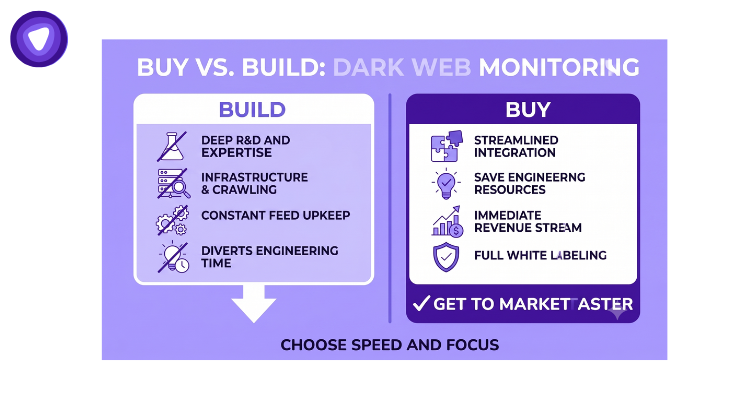
Few SaaS teams have the resources to run their own dark web crawling infrastructure. Threat feeds, breach databases, and marketplace access require constant upkeep that most product roadmaps cannot absorb. Stolen or compromised credentials remain the most common way attackers get in. Breaches tied to stolen credential theft take longer to identify and contain than any other attack type. Buying this capability closes that detection gap without diverting engineering time from the core product.
Where This Fits Inside Your Pricing Tiers
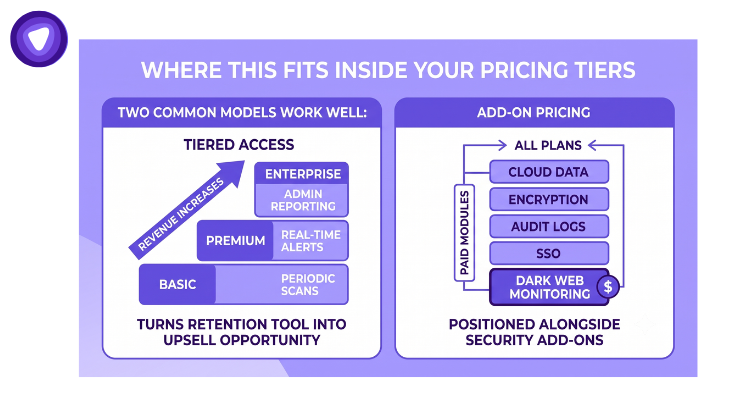
Dark web monitoring for SaaS does not need to sit as a free feature buried in every plan. Many platforms position it as a premium add-on or a differentiator reserved for higher tiers, which turns a cost center into a revenue line.
Two common models work well:
- Tiered access: Basic plans get periodic scans, while premium and enterprise tiers get real-time alerts and admin-level reporting.
- Add-on pricing: Offered as a paid module across all tiers, positioned alongside other security add-ons like SSO or advanced audit logs.
Either approach turns a retention tool into an upsell opportunity, without asking customers to trust a separate vendor for it.
Dark Web Monitoring vs Breach Notification Services
Breach notification services and dark web monitoring solve different problems, even though vendor pitches often bundle them together. A breach notification service tells a company after a confirmed, named breach occurs at a specific third party. It relies on public disclosure or a data breach clearinghouse. Dark web monitoring works before that disclosure exists.
It scans for a company’s own credentials directly. This works regardless of which breach they came from, or whether that breach ever gets publicly named. The distinction matters for a SaaS platform pitching this to customers. A breach notification service only helps once someone else admits a breach happened. Dark web monitoring catches exposure even when the original breach source stays unknown or unreported. That gap covers a large share of real-world exposure, since many breaches never get formal public disclosure at all.
The Revenue Case for Adding This to Your Platform
Framing dark web monitoring as a cost center misses the point. For a SaaS company, it is a retention lever and a pricing lever at the same time.
The global average cost of a data breach reached 4.88 million dollars in 2024, driven largely by lost business and post-breach customer support. That number represents downstream cost your customers absorb when you leave them exposed, and it is a cost they will remember at renewal time. White label security adoption reflects this shift directly.
Adoption among SaaS platforms is projected to nearly double from around 9 percent of new deployments in 2024 to roughly 18 to 20 percent in 2025, as mid-market SaaS companies move security spend toward embedded brandable tools instead of building in-house.
| Approach | Time to Launch | Ongoing Maintenance | Customer-Facing Brand |
| Build in-house monitoring | 6 to 12+ months | Full internal ownership of threat feeds and infrastructure | Fully yours, but resource-heavy to sustain |
| Buy a generic third-party tool | Weeks | Vendor-managed, but customers see an unfamiliar name | Third-party branding, weaker retention value |
| White label dark web monitoring | Weeks | Vendor-managed infrastructure, fully brandable alerts | Fully yours, with none of the build overhead |
Turning This Into a Renewal Conversation, Not a Support Ticket
An alert is only worth as much as the trust it builds. A customer who receives a branded notice that their email surfaced in a recent breach, with clear next steps, experiences your platform as a partner watching their back. That single interaction outperforms most quarterly check-ins for building loyalty.
For customers in finance, healthcare, or legal services, dark web monitoring also becomes documentation. These customers need to show auditors and regulators proof of active data protection. Offering that proof under your own brand gives sales and customer success teams a concrete answer when renewal conversations turn to security.
Making It Part of the Pitch, Not the Fine Print
SaaS companies that position dark web monitoring as a core part of their value proposition see it surface in renewal calls unprompted. It becomes something reps can point to instead of a feature buried three menus deep in account settings.
Why This Matters for Fundraising and Acquisition Conversations
SaaS companies face extra scrutiny during fundraising rounds and acquisition due diligence. Buyers and investors now run security assessments before signing. Exposed executive credentials or leaked admin accounts raise immediate red flags in these reviews. A platform that already monitors for this exposure walks into due diligence with a clean answer instead of a scramble.
Founders and executives carry outsized risk here. Their personal accounts often connect to company infrastructure, financial systems, and cap table platforms. A single leaked password tied to a founder can stall a term sheet or raise new questions from acquirers. Dark web monitoring that specifically tracks leadership credentials turns this risk into a documented, managed process instead of an unknown.
Rolling This Out Without Slowing Your Product Roadmap
Most SaaS teams cannot justify a multi-year security build just to offer this. White label dark web monitoring solves that by handing over the infrastructure while keeping the branding, the domain, and the customer relationship entirely yours.
PureVPN’s white label VPN solution extends this same model to network-level privacy, letting SaaS platforms bundle credential monitoring with secure connectivity as one branded offering, launched under their own name.
For product teams weighing build versus buy, this route cuts time to launch from quarters to weeks. It keeps the entire customer experience branded, so the added protection strengthens the platform relationship instead of introducing a vendor name customers have never heard of.
What to Look for in a White Label Partner
Not every white label provider offers the same depth of coverage, and the difference shows up the first time a real leak surfaces. Before committing, check for:
- Coverage across major breach databases, not just a narrow slice of known leak sites
- Real-time alerting rather than batch reports delivered days later
- Full branding control over alerts, dashboards, and customer-facing language
- Clear data handling practices, since the monitoring tool itself will touch sensitive credential data
A partner that falls short on any of these turns a retention tool into another support burden.
What This Means for Your Retention Numbers
Retention in 2026 is no longer just about feature velocity and support response times. Customers judge platforms by how well they protect the login behind every session, and dark web monitoring is one of the few security investments that shows up as a positive touchpoint instead of a defensive one.
Platforms that treat credential exposure as somebody else’s problem keep losing customers quietly, one unnoticed leak at a time. Platforms that build dark web monitoring into the product turn a security function into a line item customers actively pay to keep.