

Key Takeaways
- Broker profiles supply the addresses, birth dates, and relatives that pass account recovery checks.
- 23% of financial institutions reported account takeover in the 2026 Fed Risk Officer Report.
- Fintech platforms face five recovery moments per account, not the single port-out moment carriers face.
- A re-listed opt-out status works as a step-up trigger no login check can produce.
- Referring customers to an outside removal service hands away revenue, retention, and the risk signal.
Data broker removal account takeover prevention works by deleting the personal records attackers use to pose as a customer. Brokers sell home addresses, birth dates, phone numbers, and the names of relatives. Those same details answer the identity checks inside password resets, phone number changes, and support-desk recovery calls. Remove them, and an attacker holding a leaked password still fails the next verification step. For fintech platforms, broker removal becomes a control that acts before login. It sits upstream of device signals, behavioral analytics, and step-up MFA. It shrinks what a fraudster knows before the first login attempt ever happens.
Picture a takeover at a digital bank with no hacked server at all. It starts with a phone call. A caller asks to update the email address on an account. The agent asks for a date of birth, a previous address, and a phone number. The caller answers all three in seconds. Every answer sat on a public people-search listing.
The login stack never saw a threat. The customer’s balance leaves within the hour. Then the dispute lands on your desk, and your platform funds the refund.
Why Account Takeover Is Now a Fintech Balance-Sheet Problem
Account takeover has moved from a security chart to the loss column. Federal Reserve Financial Services polled more than 400 risk staff at financial firms in late 2025. Its 2026 Risk Officer Report found 23% of financial institutions hit by account takeover. That share rose seven points in one year.
Loss data shows the same shift. A 2025 study from PYMNTS Intelligence and Block found unauthorized-party fraud drove 71% of fraud incidents and dollar losses. Stolen logins and account takeover drive that group. The same study put neobank fraud loss rates at 1.1 basis points.
Who Pays When an Account Falls
The attack channel matters as much as the volume. The FBI Internet Crime Complaint Center logged more than 5,100 account takeover complaints since January 2025. Losses in those complaints passed $262 million, as American Banker reported. In many cases, criminals posed as bank support staff to steal login codes.
Liability is also shifting toward the platform. A federal court in New York ruled on a state lawsuit against a large bank. The court found the Electronic Fund Transfer Act covers consumer wires. Legal analysts say the ruling makes banks liable for unauthorized consumer wires. For a fintech platform, every successful takeover becomes a refund, a support case, and a churn risk.
What One Recovery Gap Costs: Illustrative Math
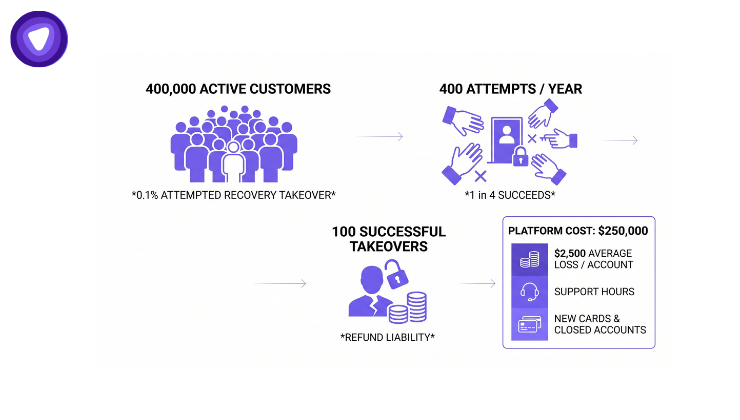
Consider an illustrative neobank with 400,000 active customers. Assume 0.1% face a recovery-channel takeover attempt each year. That produces 400 attempts. If one in four succeeds, 100 accounts fall. At an average loss of $2,500 per account, the platform refunds $250,000. Support hours, new cards, and closed accounts sit on top of that figure. These numbers are illustrative, not industry benchmarks.
How Data Brokers Feed Account Takeover Fraud
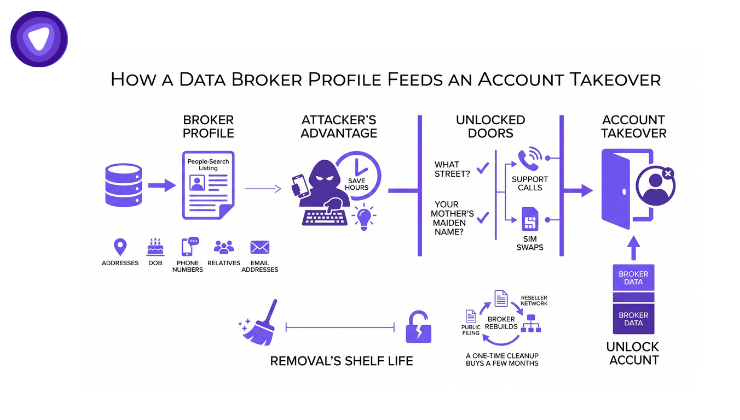
Stolen passwords open the first door. Broker data gets the attacker past the second one. The two work as a pair. Fraud stacks built around login signals watch only the first.
The Recovery Channel Is the Soft Target
Login pages now carry device checks, rate limits, and MFA. Recovery flows often carry far less. A customer who lost a phone still needs a way back in. That path usually relies on facts the customer knows.
NIST finalized SP 800-63B Revision 4 in July 2025. The standard explicitly prohibits knowledge-based authentication. Research still finds security questions in wide use today. Many support scripts ask for the same facts in spoken form. An attacker with a broker profile passes both.
What a Broker Profile Hands an Attacker
One people-search listing saves an attacker hours of work. Each field maps to a check your team runs:
- Current and past addresses answer address checks and “which street have you lived on” prompts.
- Date of birth and age satisfy the most common identity questions on support calls.
- Phone numbers set up SIM swaps and one-time code interception.
- Relatives and associates answer security questions and make phishing calls sound credible.
- Email addresses link the profile to leaked credential sets from past breaches.
Removal also has a shelf life. Brokers rebuild removed records from public filings and reseller networks. A one-time cleanup buys a few months at most.
Why Fintech Exposure Runs Wider Than Telecom
Carriers face one high-value moment: the SIM swap or port-out request. A fintech platform faces several. Each one relies on the same public facts, and each one moves money or control.
Five Recovery Moments Attackers Target
Fraud teams often guard the login page and the large transfer. The moments between them carry less friction:
- Email or phone change: redirects every future alert and one-time code to the attacker.
- Card replacement: sends a new card to an address the attacker controls.
- New payee or linked account: sets up the cash-out path before any large transfer.
- Device re-enrollment: gives the attacker a trusted device for future sessions.
- Limit increase request: raises the ceiling on what the attacker can move.
A broker profile helps at every one of these steps. That is why data broker removal account takeover prevention matters more for fintech than for carriers. The same record gets tested five times, not once.
How Data Broker Removal Account Takeover Prevention Works
Removal does not replace login controls. It changes what an attacker knows before those controls ever fire. The mechanism runs in three stages, and fintech teams gain the most from the third.
Stage One: Shrink the Answerable Question Pool
Each deleted listing takes away answers a fraudster needs. Fewer public answers mean more failed recovery tries. Failed attempts then trigger the step-up checks your fraud team already runs. Less exposed data leaves fewer openings for social engineering at every contact point.
Stage Two: Keep Records From Coming Back
Removal works as a cycle, not a single event. An exposure scan returns results in seconds. Opt-out requests then take weeks, since each broker runs its own process. A continuous service rescans monthly and resubmits requests when a record returns. Get the refresh cycle in writing before you sign.
Stage Three: Turn Opt-Out Status Into a Risk Signal
This stage turns data broker removal account takeover prevention into a live fraud signal. A removal API reports each request’s status for each customer. Typical states run from submitted to in progress, pending verification, completed, and re-listed. A re-listed record means that customer’s answers are public again. Your fraud engine can treat that status as a step-up trigger:
- Re-listed record plus a recovery request within 30 days: send the request to ID document checks.
- Re-listed record plus a new device and a phone number change: hold outbound transfers for manual review.
- Completed removal with no re-listing: keep standard recovery friction for that customer.
No login check produces this signal. It tells you which customers an impersonator can research today. A leaked password sold on a forum covers the other half of the risk. Credential alerts catch that half before an attacker uses it.
Where Data Broker Removal Account Takeover Prevention Fits in the Fraud Stack
Account takeover prevention works in layers. Each control stops a different move, at a different moment. The table below maps where broker removal sits against the controls fintech teams already run.
| Control | What It Stops | Where It Falls Short | When It Acts |
| Data broker removal | Impersonation built on public personal data | Leaked passwords, malware on the device | Before any contact |
| Credential monitoring | Logins with passwords already leaked | Recovery calls that use personal facts | After a leak, before use |
| Device and behavioral analytics | Logins from unfamiliar devices or patterns | Attackers who pass recovery and enroll a device | During the session |
| Step-up MFA | Remote attackers without the second factor | SIM swaps and support-desk resets | At high-risk actions |
| Transaction monitoring | Unusual transfers after takeover | Small transfers that stay under thresholds | After access |
No row in this table covers the recovery desk except broker removal. It is the only control here that acts before an attacker makes contact. The other four assume the attacker already knows enough to try.
Partner or Refer: Why Fintech Platforms Should Own the Removal Layer
A fintech platform has two ways to offer removal. It can point customers to a third-party consumer removal service. Or it can run removal inside its own app, under its own brand. The choice looks like a product decision, but it shapes fraud outcomes directly.
What Referral Gives Away
Referral feels cheaper on day one. It carries four costs that show up later:
- Revenue: the subscription fee goes to another company.
- Relationship: the customer’s privacy view lives in someone else’s app.
- Risk signal: opt-out status never reaches your fraud engine.
- Retention: the protection credit goes to another brand.
The third cost matters most for takeover prevention. Without the status feed, Stage Three never happens.
What Ownership Changes
A branded removal layer keeps the status data inside your stack. It also turns a fraud control into a perk customers can see. Customers see listings found, requests filed, and records removed inside your app. That visibility builds the trust digital banks compete on.
Launch also takes less time than most teams expect. An in-house build takes 12 to 24 months, while a partner launch takes weeks. The integration runs through a removal API tied to your existing user records. Your engineers map accounts once, then consume status updates like any other fraud feed.
Rolling Out Data Broker Removal Account Takeover Prevention
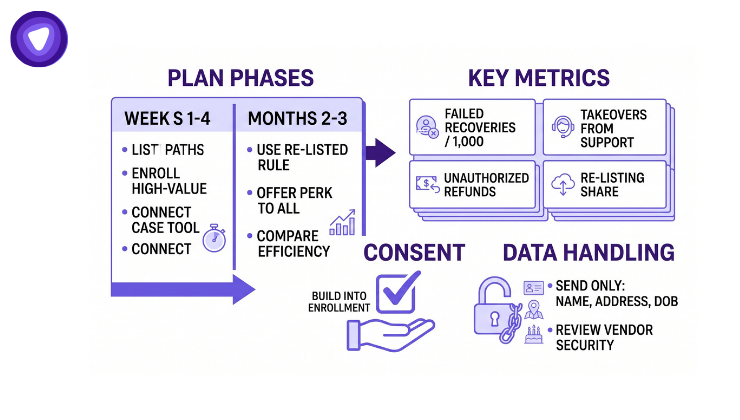
The order of steps decides how fast the layer pays back. Start where takeover losses concentrate, then widen coverage. A data broker removal account takeover prevention program needs three phases and one set of rules for customer data.
Weeks One to Four
- List every recovery path that still asks personal questions, phone scripts included.
- Enroll high-balance accounts and recently targeted customers first.
- Connect opt-out status to your case management tool.
Months Two and Three
- Add re-listed status as a step-up trigger in your fraud rules.
- Offer removal to all customers as a visible account perk.
- Compare takeover attempts at recovery before and after launch.
What to Measure
Hold the removal layer to the same loss metrics as any other fraud control:
- Failed recovery attempts per 1,000 requests.
- Takeover cases from the support desk each month.
- Refunds paid for unauthorized transfers each quarter.
- The share of enrolled customers whose records came back.
Consent and Data Handling
Removal needs the customer’s permission to act for them. Build that consent into enrollment, not the fine print. Send the vendor only the identifiers it needs for matching, such as name, address, and birth date. Review the vendor the same way you review any provider that holds customer data.
How PureVPN White Label Data Broker Removal Supports Fintech Platforms
PureVPN White Label Data Broker Removal runs this full loop under your brand. It scans 400+ people-search sites, files opt-outs wherever a site permits, and re-checks monthly. Every step leaves evidence, including listing details, screenshots, and request status. It does not promise that every trace disappears. It proves every request it files. Teams deploy it as a full branded platform, a modular API and SDK, or a hybrid of both.
The platform holds SOC 2 Type II and ISO 27001 certification. The 400+ site and 150+ partner figures are PureVPN’s own reported data, not third-party audited. Dark web monitoring runs on the same engine for teams that want credential alerts beside removal.
Final Thoughts
Fintech platforms have spent years hardening the login page. Attackers moved to the recovery desk, where public facts still open accounts. Data broker removal account takeover prevention closes that gap at the source. It deletes the answers before anyone asks the questions. It also hands your fraud engine a signal no login check produces. Teams that add it now will face the next loss review with fewer refunds to explain.
Teams earlier in evaluation can start by listing which recovery paths still ask personal-fact questions.
Request a 20-minute partnership and margin review call.
Frequently Asked Questions
What is data broker removal account takeover prevention?
It is the practice of deleting public personal records so impersonators cannot pass identity checks.
Does data broker removal prevent account takeover?
Yes. It deletes the personal facts attackers use to pass recovery checks, so a leaked password alone falls short.
How do data brokers enable account takeover fraud?
Brokers publish addresses, birth dates, phone numbers, and relatives, which answer identity questions in account recovery.
Does removed data come back on broker sites?
Yes. Brokers rebuild listings from public records and resellers, so removal needs monthly rescans and resubmissions.
Is data broker removal a replacement for MFA?
No. It works upstream of MFA by cutting the facts attackers use to reset or bypass it.
How long does data broker removal take?
Exposure scans return in seconds, opt-outs complete over weeks, and monthly re-checks catch returning records.
Should a fintech platform build or partner for data broker removal?
Partner. An in-house build takes 12 to 24 months, while a white label launch takes weeks.
How is data broker removal different from dark web monitoring?
Dark web monitoring flags leaked credentials, while broker removal deletes the public personal data used for impersonation.